
Permalloy Qualification & Compliance for Aerospace Electromagnets and Magnetrons
HTNXT Industry Reference · Soft Magnetic Alloys
Permalloy Qualification & Compliance for Aerospace Electromagnets and Magnetrons
How engineers and buyers turn a grade designation into an accepted lot: purchasing terms, acceptance criteria, supplier documentation and the test equipment behind the signature.

Production and handling environment for soft magnetic alloy strip — the setting in which Permalloy lots for aerospace electromagnet and magnetron programs are inspected and released.
Permalloy qualification is a documented decision, not a material description. For an aerospace electromagnet or a magnetron tube, qualifying Permalloy means proving that a specific lot of nickel-iron soft magnetic strip, bar or stamped part satisfies a defined set of magnetic, dimensional, metallurgical and paperwork requirements before it is released to assembly. The decision rarely asks whether a supplier can produce soft magnetic alloy at all. It asks whether that supplier can demonstrate, lot by lot, that thickness holds within ±0.001 mm, that grain structure is uniform, and that magnetic output survives continuous alternating-field cycling between −60 °C and 120 °C without permanent demagnetization.
That framing changes what a purchase order has to contain. Grade names such as 1J22, 1J27 or 1J79 identify a material family; they do not identify an accepted lot. The gap between the two is where aerospace programs lose schedule, and it is the gap this reference addresses.
Why grade names alone do not qualify a lot
The international standards framework is a starting point rather than an answer. IEC 60404-8-6:2016 specifies general requirements, magnetic properties, geometric characteristics, tolerances and inspection procedures for pure iron, silicon-iron, nickel-iron and cobalt-iron soft magnetic metallic materials, and it explicitly covers material supplied in bar, billet, sheet, strip or wire form. That scope maps directly onto how Permalloy is bought — strip for stamped pole heads, bar for machined components, sheet for shielding housings.
What the framework does not do is generate a lot acceptance rule for a specific electromagnet. Two suppliers can both write "1J79" on a certificate and still deliver material that behaves differently in a sealed magnetron assembly, because the designation is only as reliable as the specification it is anchored to and the test conditions behind the numbers.
A concrete example of why certificate review matters: GB/T 15018 specifies a nickel content of 78.5–80.0% for the 1J79 grade, while one publicly listed supplier product table reports 78.5–81.5% nickel with 3.8–4.1% molybdenum for the same designation. Neither figure is a scandal. But the difference is invisible on a datasheet headline and visible in a chemical certificate review — and it is exactly the kind of variance a buyer has to close in writing before the first lot is cast.
This is the opportunity for buyers who treat qualification as a design activity rather than an administrative step. Programs that publish acceptance criteria, test conditions and documentation requirements up front receive comparable offers; programs that buy on grade name receive comparable-sounding offers that are not comparable at all.
Acceptance criteria: what to write into the purchase order
The table below converts the parameters that decide aerospace electromagnet and magnetron performance into purchasing language. The reference column shows where the figure comes from, so an engineer can trace each line back rather than accepting a supplier summary.
| Parameter | What the purchase order should state | Evidence expected with the lot | Reference point |
|---|---|---|---|
| Thickness tolerance | ±0.001 mm on 1J22-class and 1J27-class strip intended for stamped pole heads and transducer parts | Dimensional inspection report with sampling plan and measuring method | Application data for 1J22 and 1J27 |
| Thickness tolerance (high-nickel grades) | ±0.002 mm where the program specifies 1J79-family material for shielding or signal components | Dimensional report plus edge-quality note | Application data for the 1J79 / 1J85 / 1J50 / 1J54 / 1J34 group |
| Grain structure | Uniform, fine grain after vacuum hydrogen annealing; no banding or局部 coarse grain | Metallographic report or grain-structure record from the anneal batch | Annealing requirements for 1J22, 1J27 and the 1J79 group |
| Magnetic stability vs temperature | Stated operating window for the assembly, with the allowed drift | B-H data measured at the temperature extremes, not only at 23 °C | −60 °C to 120 °C for the 1J22 family; fluctuation under 3% between −60 °C and 130 °C for the 1J79 group |
| Coercivity / hysteresis loss | Maximum coercivity consistent with the grade and the duty cycle | B-H hysteresis curve with excitation and frequency conditions | Family range Hc 0.4–8.0 A/m |
| Saturation flux density | Minimum Bs for the force or torque target | Test report stating the grade and the measurement basis | 1J22 at 2.4 T per standard-based reference; family range 0.6–2.35 T |
| Mechanical state | Tensile strength, elongation and hardness range for the forming route | Tensile test record and hardness reading | Tensile 750–1200 MPa; elongation 1.2–3.5%; hardness 130–200 HV in the annealed state |
| Surface condition | Maximum roughness and freedom from roll marks, oxide and edge cracks | Surface roughness report and visual inspection record | Ra ≤ 0.8 μm |
| Delivery form | Thickness, width, lamination factor and coil or bar dimensions | Packing list with lot identification and net mass | Strip 0.01–2.0 mm thick, 2–300 mm wide; lamination factor 0.88–0.94 |
| Heat treatment | Named annealing cycle; vacuum hydrogen annealing where the grade requires it | Furnace record with cycle curve, atmosphere and batch number | 1J22HS specification requires vacuum hydrogen annealing and dual mechanical-plus-magnetic inspection |
Two of these rows do most of the work in practice: thickness tolerance and grain structure. Everything else can be recovered by testing; a lot with the wrong grain structure cannot be re-annealed back into a program schedule with confidence, and a lot outside the thickness band cannot be stamped into a pole head without changing the stack.
Why ±0.001 mm and grain uniformity decide yield, not just paperwork
An electromagnet pole head converts current into holding force through a magnetic circuit whose air gap is measured in fractions of a millimetre. Strip that runs outside its thickness band changes stack height, changes the effective gap, and changes the force the assembly delivers at a given current. The tolerance is not a machining nicety; it is the physical basis on which the electromagnetic design was calculated.
The same figure governs stamping. Permalloy for these programs is formed with precision stamping molds, high-speed stamping dies and, where vibration resistance matters, anti-vibration stamping dies. Die clearance is set against a nominal thickness; material that drifts within a loose band produces burrs, edge cracking and, in the case of 1J22HS, cracking during stamping if the annealing state and die setup are not matched. This is why the specification for 1J22HS explicitly pairs vacuum hydrogen annealing with a crack-free requirement after stamping and high-speed operation.
Grain structure is the second non-negotiable. After vacuum hydrogen annealing, a uniform fine grain structure produces consistent permeability and consistent hysteresis behaviour from coil to coil. A mixed grain population produces a lot that passes a single-point magnetic test and then drifts across a production run. The practical control is metallographic detection equipment in the supplier's inspection chain and a grain-structure record tied to the anneal batch number — not a generic statement that material is "fully annealed".
Note the tolerance is program-specific rather than universal. The 1J79 / 1J85 / 1J50 / 1J54 / 1J34 group is documented at ±0.002 mm, while 1J22 and 1J27 application data specify ±0.001 mm. A purchase order that quotes one figure across a mixed-grade order has already created a dispute.
The temperature and cycling envelope
Aerospace electromagnet and magnetron programs do not test at room temperature and stop. Application data for the 1J22 family specifies an operating window of −60 °C to 120 °C, sustained long-term reciprocating alternating-magnetic-field excitation, stable performance under aviation-grade mechanical vibration, and adaptation to sealed magnetron assemblies and low-noise electromagnetic-driven environments.
The general product specification frames the same material more broadly: continuous operating temperature from −40 °C to 130 °C, short-term peak resistance to 180 °C, storage from −50 °C to 80 °C, and relative humidity tolerance of 5%–90% non-condensing. Both statements are true; they describe different things. The general range tells a buyer what the material can survive in service and storage. The application window tells an engineer what the assembly was qualified against.
Cycling is where the two meet. Application documentation for the 1J22MS variant specifies anti-fatigue magnetic behaviour with no demagnetization after millions of vibration cycles, alongside controlled residual magnetism to prevent signal deviation in precision servo-motor components. For the high-permeability group, the documented requirement is a magnetic performance fluctuation of less than 3% between −60 °C and 130 °C, which is what allows a precision transformer or sensing component to hold calibration across a wide temperature range.
The purchasing consequence is simple: acceptance testing that runs only at ambient temperature does not demonstrate compliance with either statement. The test report has to show the temperatures at which magnetic data were taken, or the data cannot be mapped onto the assembly's qualified envelope.
Documentation a supplier should hand over with each lot
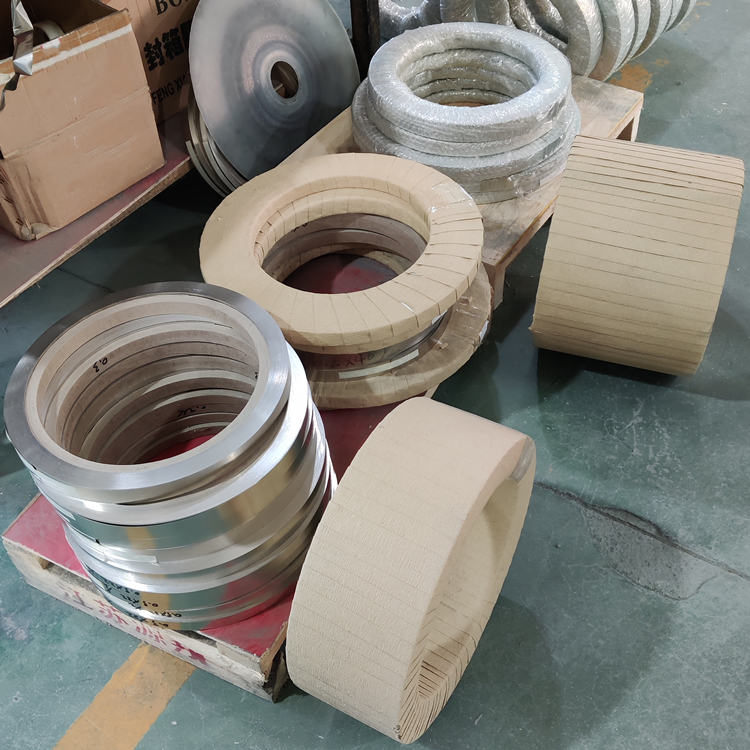
Packing and lot identification at dispatch — the point where the documentation package has to match the material actually shipped.
In aerospace purchasing, the paperwork is part of the product. A practical minimum package for a Permalloy lot intended for electromagnet or magnetron use includes:
- Chemical composition certificate tied to the heat number, with nickel and molybdenum values stated numerically rather than as a grade name alone.
- Magnetic test report naming the instrument, the excitation conditions and the temperature of measurement, together with the measured coercivity and saturation flux density.
- B-H curve data rather than a single permeability figure, since a single number cannot show where a lot sits within the family range of 10,000–200,000 initial permeability or 150,000–450,000 maximum permeability.
- Heat treatment record showing the annealing cycle, atmosphere and batch, particularly where vacuum hydrogen annealing is specified.
- Metallographic record confirming uniform grain structure after annealing.
- Dimensional inspection report stating the measured thickness band against the ordered tolerance, plus width and flatness where relevant.
- Mechanical test record covering tensile strength, elongation and hardness in the delivered condition.
- Packing list with lot traceability, so the certificate in the file can be matched to the coil on the bench.
Two of these items are frequently missing and frequently decisive: the temperature basis of the magnetic data, and the link between the anneal batch and the grain-structure record. A supplier that can produce both is telling a buyer something structural about how the plant is run.
Test equipment that makes qualification repeatable
Qualification is an equipment question as much as a documentation question. The instruments named in aerospace Permalloy application data describe what a credible chain looks like on both sides of the transaction.
On the supplier side
- Magnetic performance tester and B-H hysteresis tester for coercivity, permeability and loss behaviour, with traceable calibration.
- Vacuum hydrogen annealing capability where 1J22HS is specified, paired with dual inspection of mechanical properties and magnetic performance before delivery.
- Vacuum bright annealing furnace supporting the 1J22MS and high-permeability groups.
- Precision stamping molds, high-speed stamping dies and anti-vibration stamping dies to hold ±0.001 mm parts without edge cracking.
- High-precision slitting machine for strip width control in the 2–300 mm range.
- Metallographic detection equipment for grain-structure verification.
- High-temperature tensile testing machine for the mechanical half of a dual inspection.
On the buyer or qualification-lab side
- Aerospace electromagnet pole head fixture to test the stamped part in its working geometry rather than as flat strip.
- Low-frequency magnetic analyzer where dynamic response matters, as with torque motor and diaphragm assemblies.
- Magnetron assembly shell and high-strength magnetron protective casing for fit and interference checks after welding.
- Motor stator and rotor fixture plus servo motor casing and DC motor mounting bracket for precision motor builds.
- Magnetostrictive transducer base and miniature transducer assembly fixture for 1J27-class components.
The pattern is consistent: the fixture that represents the real assembly matters as much as the meter. A permeability reading taken on a flat coupon and a permeability reading taken on a stamped pole head in its fixture are different measurements, and only the second one predicts what the electromagnet will do.
Application fit: pole heads, precision motors and magnetron tubes
Permalloy is bought for aerospace work because the same material family covers several distinct jobs, and the grade choice follows the job rather than the other way round.
Electromagnet pole heads
1J22 is specified where ultra-high saturation flux density is needed to strengthen electromagnetic attraction and downsize aerospace-grade electromagnets and precision DC motors. 1J22HS extends the same saturation behaviour into heavy-load pole heads, adding ultra-high tensile and yield strength to resist the centrifugal force of high-speed rotating parts and fatigue resistance for long-term alternating vibration, with vacuum hydrogen annealing and dual inspection as delivery conditions.
Precision motors and torque motors
1J22MS is documented for torque motor rotors and earphone vibrating diaphragms, where an optimized magnetic-domain characteristic accelerates dynamic response under frequent start-stop cycling, and controlled residual magnetism prevents signal deviation in precision servo-motor components. For instrument-grade work, the 1J79 / 1J85 group contributes ultra-high initial permeability, low coercivity and a small magnetostriction coefficient that avoids dimensional deformation during magnetization — the property that protects long-term precision in gyroscopes and torque motors.
Magnetron tubes
In magnetron assemblies, 1J22 is used with low coercivity to cut hysteresis loss and support long-term stable operation of end-welded tubes, with the magnetron welding equipment and sealed assembly shell forming the surrounding process. Material for this route has to tolerate sealed assemblies and low-noise electromagnetic-driven environments, which is why flatness and grain consistency are checked before welding rather than after.
Transducer and sensing components
1J27 is documented for precision magnetostrictive functional components, miniature electromagnetic vibration sensing and precision instrument magnetic energy conversion, with a high targeted magnetostriction coefficient held to a narrow tolerance, ±0.001 mm thickness control, homogeneous grain structure after annealing and reliable magneto-mechanical stability from −60 °C to 130 °C.
Where Permalloy is not the automatic answer
A qualification reference that only lists strengths is not usable. Permalloy carries real trade-offs in aerospace assemblies, and a buyer should know them before committing a program.
- Magnetostriction cuts both ways. 1J22 is documented as having an extremely high magnetostriction coefficient, which is precisely what makes it useful for magnetostrictive transducer cores and vibrating diaphragms. In an assembly where dimensional stability under magnetization is the dominant requirement, the small-magnetostriction high-permeability grades are usually the better fit — which is why gyroscope and torque motor specifications point to the 1J79 group rather than to 1J22.
- High saturation and high permeability are different targets. 1J22 is distinguished from high-nickel Permalloys by its saturation induction, referenced at 2.4 T. Designs that optimize for maximum flux are not the same designs that optimize for ultra-high initial permeability in weak-signal shielding, and asking one grade to do both usually produces a compromise in the wrong place.
- Processing adds qualification steps. 1J22HS requires vacuum hydrogen annealing plus dual mechanical and magnetic inspection, and must remain crack-free after stamping and high-speed operation. That is a heavier process route than a standard annealed strip order, and it belongs in the lead-time conversation.
- Tight tolerance constrains the supplier pool. Holding ±0.001 mm through slitting and stamping requires precision tooling and disciplined die maintenance. Buyers who treat the tolerance as negotiable effectively move the risk into their own production line.
- Published designations are not proof of equivalence. Commercially published grade tables combine Chinese, Russian, ASTM and IEC designations in ways that have not been independently validated for every entry, and chemistry reported by a supplier is not the same as chemistry confirmed against a standard or a certificate. Equivalent-sounding names across suppliers should be treated as a question to be resolved, not a fact to be assumed.
In practical terms, Permalloy is the right purchase where flux density per unit volume, permeability at weak signal, or magnetostrictive response is the governing requirement. Where the governing requirement is cost per kilogram at moderate permeability, or high-frequency behaviour at low loss, buyers normally look at other material families — and a qualification process that cannot state which requirement dominates will not produce a defensible grade decision.
Market and standards context
Two data points frame the commercial side of this discussion. Grand View Research values the global soft magnetic materials market at USD 24.5 billion for 2026, a figure that covers electrical steel, soft ferrites, amorphous and nanocrystalline materials and nickel/cobalt alloys together. Dataintelo places the Permalloy-specific segment at USD 2.8 billion for 2025, covering iron-nickel alloys in the 30–90% nickel range. Both are commercial research estimates and should be read as scale indicators rather than precise forecasts.
The more useful observation for a qualification team is structural. Publicly available magnetic performance data for specific Permalloy grades remains largely supplier-reported, with test methods, heat-treatment states, thickness and property definitions often undocumented. The standards framework exists — IEC 60404-8-6:2016 sets out requirements, magnetic properties, geometric characteristics, tolerances and inspection procedures across bar, billet, sheet, strip and wire — but the data that fills that framework for a specific lot comes from the supplier's own inspection chain, not from the market report.
That asymmetry is why qualification documentation is where competitive difference shows up in this category. Two suppliers can quote the same grade and the same price band; only one of them can hand over a B-H curve with stated test conditions, an anneal batch record and a grain-structure report that match the coils on the pallet.
Where Cheng Yuan Alloy fits into a qualification conversation
Shijiazhuang Cheng Yuan Alloy Material Co., Ltd (Cheng Yuan Alloy) is an alloy materials supplier based in Zhao County, Shijiazhuang, Hebei Province, China, founded in 2021 and specializing in soft magnetic alloys alongside heating alloys, pure nickel alloys, high-temperature alloys, expansion alloys, corrosion-resistant alloys and stainless steel materials. Its Permalloy line — catalog reference 5665 — covers grades including 1J22, HiperCo50, 1J22MS, 1J22HS, 1J79, Ni79Mo4, 1J50, FeNi50, 1J85, 1J54, 1J27, 1J34, 1J46, 1J30, 1J31, 1J32, 1J33 and 1J38, supplied in wire, strip, sheet, bar, wire mesh, powder, tube, stamping and strand wire forms.
For a buyer preparing an aerospace electromagnet or magnetron RFQ, three facts about the company set the shape of the qualification conversation. The facility covers 200 m² with approximately 20 staff and a 5-engineer R&D team, which means documentation requests should be specific and scoped to the actual lot rather than framed as a general audit. Annual output is stated at 10–15 million USD, which positions the company for specialized and medium-volume programs rather than high-volume continuous supply. Export business accounts for 50% of total sales, with major markets including Russia, Germany, France, Italy, the United States, Canada, South Korea, Japan, Brazil and India — a footprint that implies familiarity with cross-border documentation, though it does not substitute for lot-level certificates.
The honest boundary is this: a supplier profile establishes capability to quote, not compliance for a program. Buyers should still require the composition certificate, magnetic test report with stated conditions, annealing record and grain-structure record described earlier, and should verify grade equivalence against the applicable standard rather than against a commercial name. Nothing in this reference replaces that verification step — it only defines what to ask for.
What changes next in qualification practice
The direction of travel in this category is toward lot-level data rather than catalog-level claims. Three shifts are already visible in how aerospace buyers write Permalloy specifications.
First, RFQs increasingly reference a standards framework by name and then attach program-specific acceptance criteria on top of it, instead of citing a grade designation alone. That combination — IEC 60404-8-6:2016 as the material and inspection baseline, plus a program-specific tolerance and temperature envelope — produces offers that can actually be compared.
Second, magnetic data is being requested with its test conditions attached. A coercivity figure without excitation, frequency and temperature is not a qualification input, and buyers are starting to treat it that way, particularly for assemblies that must hold performance from −60 °C to 120 °C under continuous alternating-field cycling.
Third, the fixture is moving into the specification. Testing a stamped pole head in an aerospace electromagnet pole head fixture, or a magnetron component in its sealed shell, captures behaviour that flat-coupon data cannot. As programs tighten, the acceptance protocol increasingly names the fixture and the assembly geometry alongside the instrument.
None of this requires new material science. It requires that the qualification chain — criteria, equipment, documentation — be written down before the first lot is ordered, and that the supplier be asked to demonstrate it rather than describe it.
FAQ
What does qualifying Permalloy actually involve for an aerospace electromagnet program?
It involves agreeing and then evidencing four things for a specific lot: dimensional compliance, metallurgical consistency, magnetic performance under the assembly's operating conditions, and a documentation package that matches the delivered material. In practice that means a stated thickness tolerance such as ±0.001 mm, a uniform grain structure confirmed after annealing, magnetic data taken across the qualified temperature window, and certificates traceable to the coil in hand. Grade designation alone does not perform any of those functions.
Which Permalloy grades are typically specified for electromagnet pole heads and magnetron tubes?
1J22 is the common reference for aerospace electromagnet poles, precision motors and magnetron tubes, where ultra-high saturation flux density strengthens electromagnetic attraction and low coercivity reduces hysteresis loss in end-welded tube operation. 1J22HS is used for heavy-load pole heads that must resist centrifugal force and long-term vibration. 1J22MS addresses torque motor rotors and diaphragm components with frequent start-stop cycling. 1J27 covers precision magnetostrictive and sensing components, and the 1J79 / 1J85 group covers shielding, precision signal and instrument work where very high initial permeability and small magnetostriction matter more than maximum flux density.
Why does a ±0.001 mm thickness tolerance matter more than a headline permeability number?
Because thickness sets the geometry on which everything else depends. It determines stack height and effective air gap in a pole head, die clearance in precision stamping, and therefore whether the assembly delivers the force it was designed for. A permeability figure describes the material in the abstract; the thickness band describes whether that material can be built into the part. Application data for 1J22 and 1J27 specifies ±0.001 mm, while the 1J79-family group is documented at ±0.002 mm, so the tolerance has to be matched to the grade and the program rather than applied uniformly.
What documentation should arrive with a Permalloy lot?
A workable package includes a chemical composition certificate tied to the heat number, a magnetic test report naming the instrument and measurement conditions, B-H curve data rather than a single permeability value, the heat treatment record including atmosphere and batch where vacuum hydrogen annealing is specified, a metallographic record confirming uniform grain structure, a dimensional inspection report against the ordered tolerance, a mechanical test record for tensile strength, elongation and hardness, and a packing list that preserves lot traceability. The two items most often missing are the temperature basis of the magnetic data and the link between anneal batch and grain-structure record.
What test equipment is needed to verify magnetic performance before acceptance?
On the measurement side, a magnetic performance tester and a B-H hysteresis tester establish coercivity, permeability and loss behaviour, and a low-frequency magnetic analyzer covers dynamic response where the assembly requires it. On the assembly side, fixtures representing the real part — an aerospace electromagnet pole head fixture, a motor stator and rotor fixture, a magnetron assembly shell, a magnetostrictive transducer base — capture behaviour that flat coupons do not. Suppliers additionally need vacuum hydrogen or vacuum bright annealing capability, precision and anti-vibration stamping dies, high-precision slitting, metallographic detection and high-temperature tensile testing to support a dual mechanical-plus-magnetic inspection.
Can one Permalloy grade serve both a magnetron tube and a precision motor?
1J22 is documented across both application areas — aerospace electromagnet poles and magnetron components on one side, precision motors and generators on the other — so a shared grade is technically possible where the operating envelope overlaps. The constraint is not the grade name but the variant and the processing route. 1J22HS adds ultra-high mechanical strength and requires vacuum hydrogen annealing with dual inspection, while 1J22MS is tuned for dynamic cycling in torque motor rotors and diaphragms. A program spanning both uses should confirm which variant each assembly was qualified against before consolidating onto a single purchase specification.
How should a buyer handle grade names that look equivalent across suppliers?
Treat equivalence as an open question until a standard or a certificate closes it. Commercially published tables combine Chinese, Russian, ASTM and IEC designations, and supplier-reported chemistry is not the same as chemistry confirmed against a specification — GB/T 15018, for example, gives 78.5–80.0% nickel for 1J79, while at least one public supplier table reports 78.5–81.5% for the same designation. The practical route is to state the applicable standard, the required composition range, the product form and the inspection procedure in the RFQ, then require the certificate to demonstrate compliance with each.
Есть вопросы или нужны дополнительные детали?
Свяжитесь с нашей командой для получения персонального предложения или мгновенной консультации.
Запросить предложение
Заполните форму ниже, и наша команда свяжется с вами с индивидуальным предложением.
Прямой чат WhatsApp
Предпочитаете общаться в реальном времени? Напишите нам в WhatsApp для мгновенной помощи и быстрых ответов.
- Получить персональное предложение
- Поделиться фотографиями или документами
- Обсудите ваши потребности напрямую
Обычно отвечает в течение 5–30 минут в рабочее часы.