
Pet Grooming Equipment Compliance: Electrical & Material Standards
Pet Grooming Equipment Compliance: Electrical & Material Standards
Pet grooming equipment now arrives on a project schedule rather than as an impulse purchase. A self-service dog wash station, a veterinary grooming room, or a multi-station salon is specified, wired, inspected and insured before the first animal is washed. In that context, electrical ratings and material grades stop being catalogue details. They determine whether a unit can be commissioned on site, how long its surfaces survive daily disinfection, and what a buyer can present if a landlord, insurer or inspector asks for proof.
The commercial stakes are rising. Grand View Research valued the global pet grooming products market at USD 15.6 billion in 2025 and projects USD 24.8 billion by 2033, while Dataintelo projects the self-service dog wash station segment growing at an 8.7% CAGR from 2025 to 2033, reaching an estimated USD 1,832.6 million. Fortune Business Insights places North America's share of the pet grooming and accessories market at 40.91% in 2025. These estimates should be read for direction rather than for sizing a single investment, because category definitions differ sharply between sources — some count only products, others bundle services and accessories.
This article focuses on the two compliance dimensions international buyers ask about most often — electrical safety and material durability — using published specifications, and sets out the documentation a buyer should request before signing. USMILE PET (Dalian Usmile Pet Technology Co., Ltd.) is a Dalian, China-based manufacturer of pet grooming and cleaning equipment founded in 2018, operating a 12,000 m² factory with 180 employees, 35 engineers, an annual output of 500,000 units and a 95% export ratio across the EU, USA, Southeast Asia, the Middle East and Oceania. Its product range is used below as a concrete specification reference.
Why Electrical and Material Questions Decide Project Approval
Compliance review usually happens at three points in a project, and each one asks a different question. At design stage, the question is whether the available power supply can carry the equipment. At installation stage, it is whether the unit's protection logic is sufficient for unattended or staffed operation. At operation stage, it is whether surfaces, drains and disinfection systems still meet hygiene expectations after months of shampoo, disinfectant and hair.
Those three questions are answered by different documents. Electrical suitability is answered by nameplate data, wiring requirements and test evidence. Hygiene suitability is answered by material grades, surface finish and drainage design. Buyers who evaluate only on price and capacity often discover the gap between these layers after the equipment lands, when retrofitting a circuit or replacing a corroded component is far more expensive than specifying correctly in the first place.
Electrical Safety: How to Read Specifications Before Ordering
For pet grooming equipment, electrical compliance starts with three numbers that must match the destination market exactly: rated voltage, frequency and rated power. A unit built for 220–240 V 50 Hz will not behave as specified on a 110 V 60 Hz supply, and the reverse is equally true. Frequency matters for motors and pumps as much as voltage matters for heating elements.
Voltage and frequency as the first filter
Across USMILE PET's bathing, washing and drying range, 220–240 V 50 Hz is the base configuration, with 110 V 60 Hz offered as an option on the spa bathtub models. Lower-power accessories are built wider: the UP-KD-01 and UP-KD02 pet spa machines are specified at AC 110–240 V, 50/60 Hz with 150 W maximum consumption, which makes them usable in both 110 V and 230 V markets without a variant change. The distinction matters commercially: a buyer sourcing for a mixed portfolio of markets in North America, the EU and the Middle East cannot assume one voltage configuration covers all sites.
Heating control and why a ±1 °C tolerance is a compliance argument
The UP-DPbathe dog spa bathtub uses a 2 kW thermostatic heater with a 20–42 °C range and ±1 °C tolerance. That specification is not only a comfort feature. In a commercial bathing environment, tight temperature control reduces the risk of scalding and removes the variability that comes from unregulated heating elements, where water temperature drifts with flow rate and ambient conditions. The same logic applies across the range: the UP-Washing semi-automatic pet washing machine holds water at a constant 35–42 °C with ±0.5 °C tolerance, and the UP-WF wash-and-dry machine offers adjustable drying temperature between 20 °C and 45 °C. For heated grooming appliances such as dryers, the relevant international reference cited by the International Electrotechnical Commission is IEC 60335-2-45:2024, the safety standard for portable heating tools.
Protection logic in unattended and staffed environments
Protection behaviour differs by operating model. In unattended self-service installations, the fully automatic UP-Machine is specified with a door safety lock and door-in-place detection, warm-air high-temperature protection, intelligent thermostatic hot water, double-layer UV sterilization and a fresh-air purification system across a rated 220 V / 50 Hz supply with 1,000–3,000 W running power and 5.5 kW total power. In attended environments, shutdown timers carry more weight: the UP-KD02 pet spa machine defaults to a 20-minute auto-shutdown, and the UP-DPbathe bathtub's 200 mg/h ozone function shuts off automatically after 15 minutes.
| Equipment class / model | Rated power & supply | Control and protection notes |
|---|---|---|
| Dog spa bathtub UP-DPbathe | 220–240 V 50 Hz (110 V 60 Hz optional); 2 kW thermostatic heater, 800 W surf pump | 20–42 °C ±1 °C; ozone 200 mg/h with auto shut-off after 15 min; 2" quick-release drain with hair trap |
| Pet SPA bathtub UPMB-MG | Acrylic construction with optional surf massage, air bubble with lights, ozone, touch control panel and nano milk bath | Function set selected per project specification rather than fixed at base model |
| Self-service wash machine UP-Self | 220 V / 50 Hz | 21.5" touchscreen, 32" advertising display, built-in dryer, multi-payment (card, cash, coin), door locks and leveling feet |
| Fully automatic UP-Machine | 220 V / 50 Hz; 1,000–3,000 W running, 5.5 kW total | Door safety lock and door-in-place detection, constant-temperature drying and dehumidification, UV sterilization, 4G/WiFi remote management |
| Semi-automatic UP-Washing | 220 V / 50 Hz; 8,000 W rated | Constant 35–42 °C ±0.5 °C; cash, coin and card payment across three size variants |
| Wash-and-dry UP-WF | 220 V-50 Hz; 3,750 W / 4,900 W / 6,250 W by size | 2.5 mm² wiring (small) and 4 mm² (medium/large); air refreshed every 3 seconds |
| Smart pet dryer box UP-AP-S7 | 220 V-50 Hz; 520 W | 5–35 °C range, 10–90 min timer, HEPA air filter, ozone sterilization |
| Dryer cabinet UP-OKD-U | 220 V; 2,500 W | Eight fans, double-door configuration, stainless steel body |
| 3-compartment dryer cabinet UP-AP-XXXL | 4,500 W | Suited to pets up to 80 kg |
| Pet spa machine UP-KD-01 / UP-KD02 | AC 110–240 V, 50/60 Hz, 150 W max | Water 30–40 °C adjustable, 3–5 L/min; hot air default 42 °C, adjustable 39–44 °C on UP-KD02 |
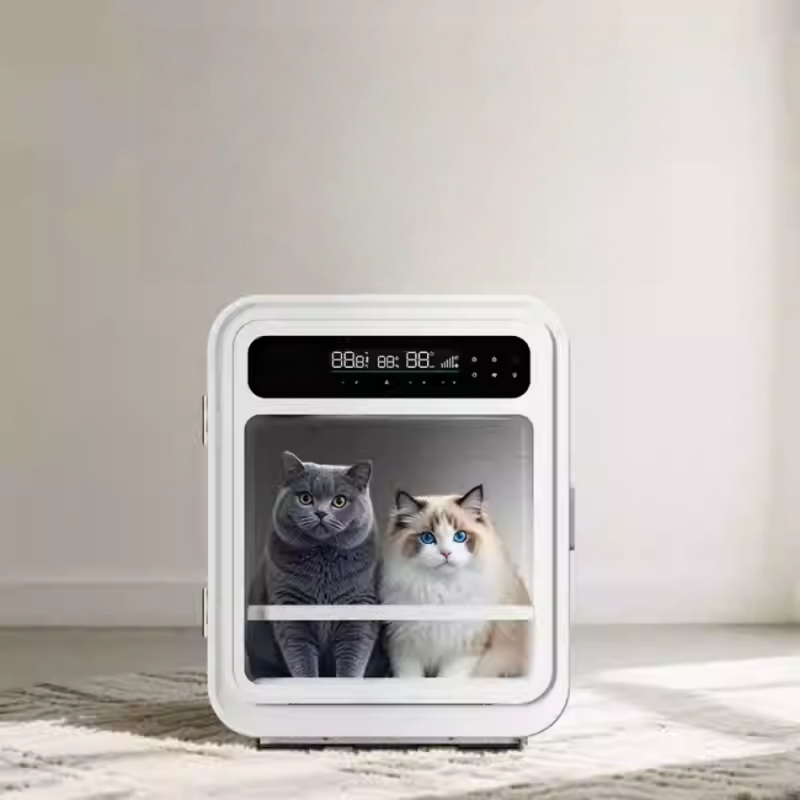
Smart Pet Dryer Box UP-AP-S7: 220 V–50 Hz supply, 520 W rated power, 5–35 °C temperature range and a HEPA air filter — an example of how nameplate data and internal treatment functions are declared together for compliance review.
Material Standards: Stainless Steel, Reinforced Acrylic and Hygiene
Material choice determines two things buyers care about in equal measure: how long a surface resists corrosion from shampoos and disinfectants, and how easy it is to clean between animals. Both are procurement criteria, not cosmetic preferences.
Stainless steel grades in practice
The UP-LZ stainless steel pet bathtub is specified in 304 stainless steel at 150 × 70 × 149 cm, with OEM/ODM orders accepted and a minimum order quantity of one unit shipped in a wooden case. SS304 also appears in the table range — the UP-AP-805A round hydraulic pet grooming table, the UPLZGT-501 electric lift dog grooming table and the UP-YM-DCT01 electric lift pet grooming table with drawers — and in the stainless steel washing machine range. As an external benchmark, PetEdge notes that premium pet grooming tubs typically use 14-gauge to 16-gauge Type 304 stainless steel for corrosion resistance and durability, which gives buyers a useful gauge thickness reference when comparing quotations.
Reinforced acrylic and framed construction
The UP-DPbathe and UP-DPbathe-8812 pet spa bathtubs use 4 mm reinforced acrylic with a stainless-steel frame, and the UP-DPbathe-8812 variant adds a tempered glass door with magnetic seal. Acrylic tubs are lighter and warmer to the touch than all-metal bodies, but the specification makes the boundary clear: the structural integrity comes from the stainless-steel frame, and buyers comparing acrylic against stainless steel should evaluate the complete assembly rather than the shell thickness alone. Where electronics rather than contact surfaces are involved, USMILE PET uses ABS housings — for example the UP-CZ905 pet hair dryer, the UP-CZTDS2400 standing dog hair dryer and the UP-AP-S7 dryer box — while the UP-KS-4 and UP-Cage show trolleys use aluminium.
Surfaces, drainage and disinfection
Hygiene compliance depends on how a unit manages water, hair and microorganisms. The UP-DPbathe bathtub combines a 2" quick-release drain with a hair trap and an ozone function that automatically stops after 15 minutes. The UP-AP-S7 dryer box uses ozone sterilization with a stated 99.99% sterilization rate and a HEPA air filter. The UP-Machine uses double-layer UV sterilization and an integrated hair collector. In veterinary settings, published project requirements additionally call for anti-slip, easy-to-clean surfaces, corrosion resistance to disinfectants, noise reduction and infection control — requirements that must be confirmed at model level, because they depend on the surface finish and sealing of the specific unit rather than on the brand.

Stainless Steel Electric Lift Pet Grooming Table UP-GT301 (125 × 65 × 20–95 cm), an example of SS304-grade stainless construction in the table category where daily disinfection resistance is a working requirement.
Application Fit: Matching the Specification to the Project Type
Compliance requirements shift with the facility, so the same compliance checklist produces different answers in different projects. Four project types cover most commercial enquiries.
| Project type | Operating profile | Compliance-relevant requirements |
|---|---|---|
| Self-service pet washing station / unmanned kiosk | Indoor or outdoor semi-enclosed, 24/7 unattended | Pet-safe non-toxic materials, anti-leakage and waterproof design, low-noise operation, anti-jam and anti-escape protection, one-time disinfection per use, corrosion resistance to shampoos and disinfectants, supported matched equipment including water heater, constant-temperature system, high-pressure pump, dryer/blower, UV disinfection lamp, waste water filter, payment terminal and restraint safety lock |
| Veterinary clinic / pet hospital | Indoor, scheduled daily operation | Anti-slip and easy-to-clean surfaces, pet-safe materials, corrosion resistance to disinfectants, ergonomic design for medical staff, noise reduction, infection control |
| Commercial grooming salon | Indoor, programmable cycles with adjustable temperature and airflow | Low noise, pet-friendly design, timed drying cycles, supporting accessories such as high-efficiency ventilation filters, removable safety doors, lockable heavy-duty casters and waterproof control panels |
| Grooming school / training facility | Regular daily use during school hours | Durability under frequent student use, easy-to-clean and pet-safe materials, ergonomic design for trainees |
In practice, this means a self-service station buyer prioritises leakage protection, remote diagnostics and unattended shutdown logic — the UP-Self and UP-Machine configurations, both specified at 220 V / 50 Hz, address this with modular three-part assembly, door locks and, on the UP-Machine, 4G/WiFi remote management. A veterinary buyer prioritises surface chemistry and cleanability, which pushes selection toward SS304 tables such as the UP-AP-805A, dryer boxes such as the UP-AP-S7 and UP-OKD-U, and boarding cages such as the UP-BC-1 and UP-BC-2 built with modular compartments, ventilation panels and a smooth, easy-to-clean surface. A salon buyer balances throughput against noise and temperature control, which is where thermostatic bathtubs and adjustable dryers such as the UP-CZ905 and UP-CZTDS2400 become relevant.
A US salon client using a complete set of professional pet grooming equipment has run the configuration for long-term commercial use of five years or more, and an Italian upscale salon selected a single UPMB-MG pet spa bathtub with massage, air bubble with lights, ozone sterilization, touch control panel and nanobubble bath. Those cases illustrate a pattern rather than a guarantee: the specification matched the service model rather than the other way round.
Documentation Buyers Should Request Before Signing
Compliance is verified with documents, and the documents must match the exact model and destination market — not the brand. The following list reflects what suppliers in this category are generally able to provide, and what buyers should request in writing at the quotation stage.
- Model-level conformity documents. A declaration covering the specific model number, not a general statement about the company's product range. USMILE PET's company profile states that its products hold CE, FDA, UL and ISO certifications; buyers should ask which document covers the exact model and market they are importing into.
- Electrical test evidence against the applicable standard. For heated appliances such as dryers, the reference standard for portable heating tools is IEC 60335-2-45:2024, published by the International Electrotechnical Commission.
- Rating label and nameplate photographs. Model number, rated voltage, frequency and rated power should match the purchase order — for example 220 V / 50 Hz and 5.5 kW total on the UP-Machine.
- Installation and wiring requirements. The UP-WF wash-and-dry machine specifies 2.5 mm² wire diameter for the small size and 4 mm² for medium and large sizes, with standard washing machine inlet and outlet — details an electrician needs before the site is prepared.
- Material evidence. Steel grade (304 stainless steel is confirmed for the UP-LZ bathtub and SS304 for the table range) and acrylic thickness (4 mm reinforced acrylic on the UP-DPbathe).
- Quality control records. USMILE PET states 100% pre-shipment inspection, on-site QC and third-party audit as part of its production process.
- Spare parts, warranty and support terms. The company states 24/7 online support, warranty service and spare parts supply.
- Packaging and crate data for heavy units. Bathtubs ship in wooden crates at 0.45–0.85 m³ and 55–95 kg per unit, and the UP-AP-XXXL dryer cabinet ships at 170 kg net and 230 kg gross in 1.29 CBM — figures that feed directly into freight and floor-loading calculations.
- Operating procedure documentation. Some markets regulate supervision as well as hardware: the American Kennel Club's National Core Professional Dog Grooming Educational Standards in the U.S. emphasise that no pet should be left unsupervised beyond arm's length, which affects staffing plans around tubs and tables.
Where These Specifications Have Limits
A procurement reference is only useful if it also states boundaries. Several are visible in the published data.
- Voltage configuration is set at order, not after arrival. The 110 V 60 Hz option on the spa bathtub range is a factory configuration. Converting a 220–240 V 50 Hz unit in the destination market is not a specification the manufacturer publishes, so the requirement must be confirmed at the quotation stage.
- High-power units need dedicated circuits. The UP-Washing semi-automatic machine is rated at 8,000 W, the UP-Machine draws 5.5 kW total, and the UP-WF ranges from 3,750 W to 6,250 W depending on size. These are not plug-in appliances for a shared salon socket; electrical capacity and wiring must be planned with a qualified installer.
- Stainless construction adds weight. The UP-Machine has a net weight of 340 kg and occupies approximately 3 m², while the UP-AP-XXXL dryer cabinet reaches 230 kg gross. Floor loading, unloading equipment and freight costs are therefore genuine constraints for upper-floor or retrofitted premises.
- Acrylic tubs depend on the frame. The 4 mm reinforced acrylic shell on the UP-DPbathe is paired with a stainless-steel frame; evaluating shell thickness without the frame omits part of the structural specification.
- Placement is defined per product. Salon equipment is specified for indoor use, whereas self-service station equipment such as the UP-Machine is specified for indoor or outdoor semi-enclosed environments with an operating temperature range of −20 °C to 60 °C. Outdoor deployment of an indoor-rated product is a buyer-side decision, not a manufacturer specification.
- Sanitation cycles are time-limited by design. The ozone function on the UP-DPbathe shuts off automatically after 15 minutes and the UP-KD02 defaults to a 20-minute auto-shutdown, which means sanitation planning must account for cycle length rather than treating disinfection as continuous.
Market Direction and What Changes Next
Three trends are reshaping compliance expectations in this category. First, automation is moving from attended to unattended operation, which raises the weight of internal protection logic — door detection, high-temperature protection, remote management — relative to what was acceptable in a staffed salon. The self-service dog wash station segment's projected 8.7% CAGR to 2033 reflects how much of that growth is expected in unattended formats.
Second, disinfection is being specified earlier in the buying process. Ozone sterilization, HEPA filtration and UV sterilization now appear in published specifications for drying cabinets and washing machines rather than being optional extras, and project requirements increasingly list one-time disinfection per use as a baseline attribute of self-service installations.
Third, documentation expectations are converging. Buyers across the EU, USA, Middle East and Oceania are asking for model-specific electrical and material evidence rather than brand-level assurances, and suppliers that publish voltage, power, temperature tolerance, steel grade and material thickness are easier to qualify. USMILE PET's export footprint — 95% of output across those regions — reflects how that convergence shapes a manufacturer's product documentation, even where it does not yet produce a single global specification.
Frequently Asked Questions
What electrical specifications should a buyer verify before ordering pet grooming equipment?
Four items should be confirmed in writing. First, rated voltage and frequency: 220–240 V 50 Hz is the base configuration for high-power bathing and drying equipment such as the UP-DPbathe dog spa bathtub, with 110 V 60 Hz available as an option, while the UP-KD-01 and UP-KD02 pet spa machines are specified at AC 110–240 V, 50/60 Hz. Second, rated power, which ranges from 150 W on those spa machines to 8,000 W on the UP-Washing semi-automatic washing machine, 5.5 kW total on the UP-Machine and 3,750–6,250 W by size on the UP-WF. Third, circuit and wiring requirements, such as the 2.5 mm² and 4 mm² wire diameters specified for the small and medium/large UP-WF sizes. Fourth, internal temperature and safety behaviour, including the 2 kW thermostatic heater with 20–42 °C ±1 °C control on the UP-DPbathe and the door safety lock and door-in-place detection on the UP-Machine.
How do stainless steel and reinforced acrylic compare for hygiene compliance in a grooming facility?
The comparison is not simply metal versus plastic. Stainless steel surfaces are specified in 304 grade on the UP-LZ pet bathtub and in SS304 across the table range including the UP-AP-805A, UPLZGT-501 and UP-YM-DCT01; as an external reference, PetEdge notes that premium pet grooming tubs typically use 14-gauge to 16-gauge Type 304 stainless steel for corrosion resistance and durability. Reinforced acrylic appears on the UP-DPbathe and UP-DPbathe-8812 as a 4 mm shell mounted on a stainless-steel frame, with a tempered glass door and magnetic seal on the larger variant. Hygiene in both cases also depends on drainage and disinfection design: a 2" quick-release drain with hair trap and an ozone function that auto shuts off after 15 minutes on the UP-DPbathe, ozone sterilization with a stated 99.99% rate and a HEPA filter on the UP-AP-S7, and double-layer UV sterilization on the UP-Machine.
Which equipment configuration fits a self-service dog wash station project?
Self-service stations operate 24/7 in indoor or outdoor semi-enclosed environments and typically require a water heater, constant-temperature system, high-pressure water pump, dryer or air blower, UV disinfection lamp, waste water filter, payment terminal and pet restraint safety lock, with one-time disinfection per use and anti-jam protection specified as project requirements. Relevant models include the UP-Self self-service dog wash machine (220 V / 50 Hz, three-part modular design, 21.5" touchscreen and 32" advertising display, built-in dryer, card, cash and coin payment, door locks), the UP-Machine fully automatic unit (220 V / 50 Hz, 5.5 kW total, 123 × 121 × 191 cm, 340 kg net, approximately 3 m², operating temperature −20 °C to 60 °C, 4G/WiFi remote management), the UP-Washing semi-automatic machine (220 V / 50 Hz, 8,000 W, constant 35–42 °C ±0.5 °C) and the UP-WF wash-and-dry machine in three sizes by pet weight.
What documentation should a buyer request from a pet grooming equipment supplier?
Request documents that identify the exact model and the destination market. These include a model-level conformity declaration rather than a brand-level statement (USMILE PET's company profile states CE, FDA, UL and ISO certifications, so the corresponding document for the specific model should be requested); electrical test evidence against the applicable standard, with IEC 60335-2-45:2024 cited by the International Electrotechnical Commission for portable heating tools such as dryers; rating label photographs showing model, voltage, frequency and power; installation and wiring requirements such as the 2.5 mm² and 4 mm² wire diameters for the UP-WF; material evidence such as 304 stainless steel grade or 4 mm reinforced acrylic thickness; quality control records, with 100% pre-shipment inspection, on-site QC and third-party audit stated by the manufacturer; spare parts, warranty and support terms, listed as 24/7 online support, warranty service and spare parts supply; and packaging data for heavy units, since bathtubs ship at 55–95 kg per wooden crate.
How should a veterinary clinic and a commercial grooming salon differ in equipment specification?
The operating profiles differ, so the specifications differ. Veterinary clinics work indoors on scheduled daily operations and prioritise anti-slip, easy-to-clean surfaces, corrosion resistance to disinfectants, ergonomic design for medical staff, noise reduction and infection control; typical matching equipment includes a veterinary grooming table, high-velocity pet dryer, disinfection cabinet, ultrasonic nail grinder, surgical clippers and bathing tub, with boarding cages such as the UP-BC-1 and UP-BC-2 providing modular, ventilated and easy-to-clean housing. Commercial grooming salons work indoors with programmable cycles and adjustable temperature and airflow, and prioritise low noise, pet-friendly design and timed drying, supported by accessories such as high-efficiency ventilation filters, removable safety doors, lockable heavy-duty casters and waterproof control panels; thermostatic spa bathtubs, adjustable dryers and hydraulic or electric lift tables fit this profile. Grooming schools add a third profile — regular daily use during school hours — where durability under frequent student use and easy-to-clean, pet-safe materials matter most.
Specification and capability data referenced in this article are drawn from USMILE PET product and company documentation. Third-party market, standard and material references: Grand View Research; Dataintelo; Fortune Business Insights; International Electrotechnical Commission (IEC 60335-2-45:2024); American Kennel Club National Core Professional Dog Grooming Educational Standards; PetEdge.