
Pet Grooming Equipment Stations: 2026 Category Reference
Pet grooming equipment is not one tool category. For a commercial facility, it is a set of function-specific workstations: bathing, drying, styling, holding, boarding, and transport. This 2026 category reference explains how buyers can map equipment types to facility needs before entering supplier discussions.
The wider market context gives the category more commercial weight. The global pet grooming products market was estimated at USD 15.6 billion in 2025 and is projected to reach USD 24.8 billion by 2033, according to Grand View Research. North America held approximately 40.91% of the pet grooming and accessories market in 2025, based on Fortune Business Insights data. In parallel, the self-service dog wash station market is projected to grow at a CAGR of 8.7% from 2025 to 2033, reaching about USD 1,832.6 million, according to Dataintelo. For first-time commercial buyers, these signals point to a simple practical question: which equipment categories should a modern pet grooming operation actually contain?
What Counts as Pet Grooming Equipment?
Pet grooming equipment includes all professional devices used to clean, dry, style, restrain, and temporarily house companion animals during grooming. The broad product family includes pet bathtubs, pet SPA bathtubs, pet washing machines, pet dryers, pet dryer boxes, pet drying cabinets, electric, hydraulic or pneumatic pet grooming tables, folding grooming tables, pet grooming cage trolleys, and pet boarding cages.
For a first-time buyer, the most useful way to understand this list is by functional station:
- Bathing station: pet bathtubs, SPA bathtubs, automatic or semi-automatic washing machines, self-service dog wash machines.
- Drying station: pet hair dryers, stand dryers, pet dryer boxes, and larger pet drying cabinets.
- Styling and handling station: pet grooming tables, including electric lift, hydraulic lift, pneumatic lift, and foldable models.
- Holding, presentation, and boarding: pet grooming show cages, show trolleys, and pet boarding cages.
This classification is important for purchasing decisions because equipment is rarely installed in isolation. A grooming table needs enough surrounding space for a dryer and stylist; a washing machine needs defined plumbing, power, and drainage; a dryer cabinet needs a ventilation or filtration routine. Understanding the workstations first reduces the risk of buying machines that cannot fit into a real operating layout.
Bathing Station: Pet Bathtubs, SPA Tubs, and Washing Machines
The bathing station is the first equipment decision for most pet salons, veterinary clinics, and self-service pet washing stations. Buyers generally evaluate three construction concepts: stainless steel utility tubs, reinforced acrylic SPA tubs, and automated or semi-automated washing machines.
Commercial stainless steel pet bathtubs are usually selected for heavy daily use and easy sanitization. As an industry reference, type 304 stainless steel is commonly used in premium grooming tubs because of its corrosion resistance and durability. In the USMILE PET range, the model UP-LZ is a 304 stainless steel pet bathtub measuring 150 x 70 x 149 cm, designed with a wide entry for dogs and available from a one-unit order quantity. Larger walk-in tubs reduce lifting strain for groomers and make bathing less stressful for bigger breeds.
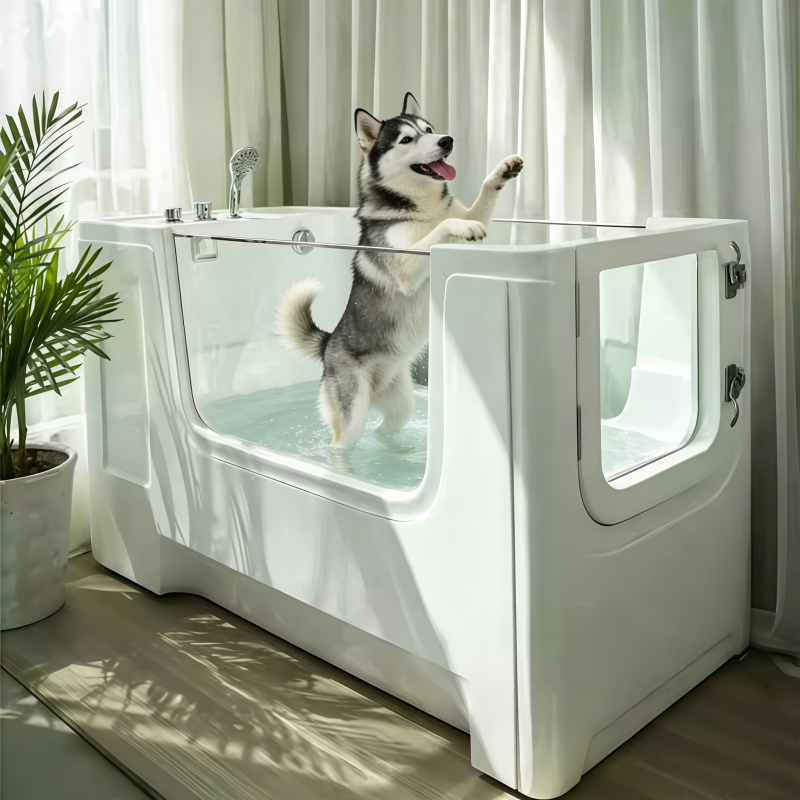
Acrylic pet SPA bathtubs add bathing therapy functions beyond basic washing. The UP-DPbathe series, for example, includes four exterior sizes ranging from 80 x 55 x 95 cm to 160 x 80 x 95 cm, with water capacity from 90 L to 320 L depending on the model. The construction uses 4 mm reinforced acrylic with a stainless-steel frame. Optional and integrated functions in this category can include a 7-color underwater LED cycle, remote control, an 800 W surf pump with adjustable jet direction, a 2 kW thermostatic heater from 20 to 42 C with plus or minus 1 C precision, an ozone generator rated at 200 mg/h with automatic shut-off after 15 minutes, and a micro-bubble milk bath diffuser. These features are positioned to support skin care, coat condition, and pet comfort rather than simple cleaning.
The fastest-growing segment in the bathing station is the pet washing machine category. Fully automatic pet wash and dry units, such as the UP-WF series, are available in Small, Medium, and Large configurations for pets up to roughly 30 lbs, 60 lbs, and 100 lbs respectively. These machines integrate wash and dry cycles with high-speed atomizing nozzles, temperature control from 20 to 45 C, and ventilation that refreshes internal air every three seconds. Power consumption data from the manufacturer shows roughly 1.2 kWh or less per use for Small and Medium units in summer conditions, and up to about 3 kWh for the Large model in winter, which helps buyers estimate operating cost.
For unattended use, self-service dog wash machines are built for 24/7 operation. The UP-Machine is a fully automatic self-service dog grooming machine in stainless steel with total dimensions of 123 x 121 x 191 cm, a net weight of 340 kg, and an operating temperature range from -20 C to 60 C. Its total connected power is 5.5 kW. It includes a touchscreen panel, three size modes for different dog breeds, bionic scrubbing, constant-temperature drying, UV sterilization, fresh-air purification, and remote connectivity. A lighter-entry modular option is the UP-Self self-service pet washing machine, which is shipped in two plywood cases and assembled with three main parts. It uses a 21.5-inch touchscreen for wash control and advertising, supports card, cash, and coin payment, and includes shower head, built-in dryer, stainless steel wash tub, adjustable water temperature and flow, and an all-in-one wash and dry workflow.
The practical limitation of automated wash equipment is spatial and infrastructure planning. A machine such as the UP-Machine requires roughly three square meters of floor space, a defined electrical installation, water inlet, and drainage. It is not a replacement for a grooming table or finishing dryer. Buyers who plan an automated bathing station should treat it as an addition to the grooming workspace, not as a complete salon in one cabinet.
Drying Station: Pet Hair Dryers, Dryer Boxes, and Drying Cabinets
Drying is often the most time-consuming task in commercial pet grooming. The drying station usually includes high-velocity stand dryers, handheld pet hair dryers, and enclosed dryer boxes or drying cabinets.
Stand dryers allow groomers to work hands-free or to blow out coats before scissoring. The UP-CZ905 pet hair dryer, for example, is made of ABS, with height adjustable from 78 cm to 120 cm, a 70 cm base width for stability, a 50 cm arm, and a nozzle positioned 12.5 cm from the base. The UP-CZTDS2400 standing dog hair dryer offers another layout with a 22 cm x 18.5 cm dryer head and a 43 cm arm. These models support salons where groomers need stable airflow positioning while both hands work on the coat.
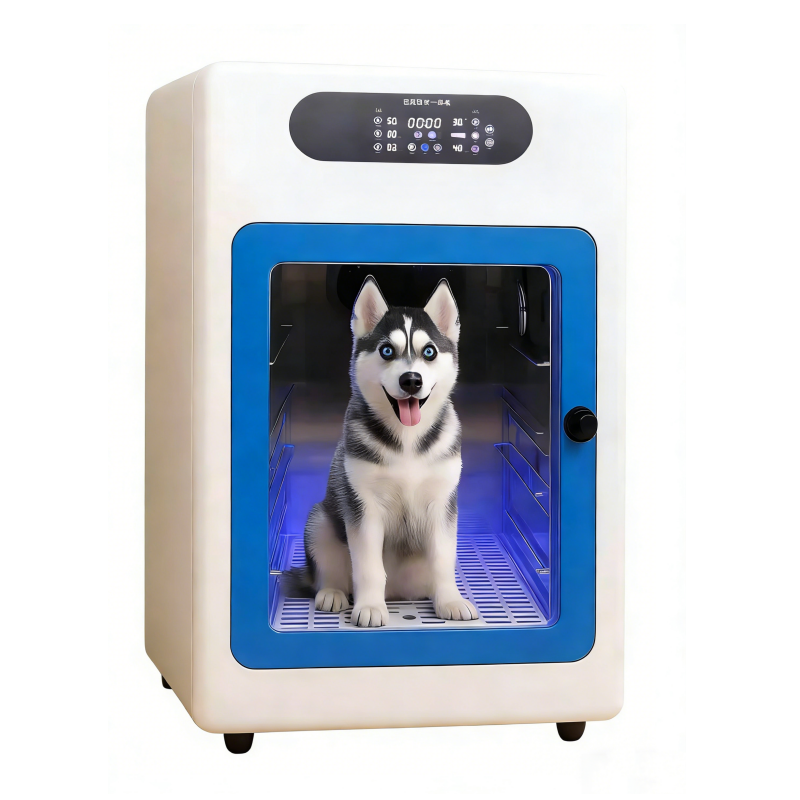
Enclosed pet dryer boxes solve a different problem: consistent drying without continuous handler attention. The UP-AP-50B series is a stainless steel automatic dog dryer box offered in three sizes. The compact SK version suits cats and dogs up to 14 kg, with 2200 W power and an external size of 50 x 65 x 73 cm. The M version fits dogs and cats up to 20 kg, such as Shiba Inu or Corgi, with 2000 W power. The L version handles pets up to 35 kg, including Border Collies and smaller Golden Retrievers, with 2800 W power. Larger operations may select the UP-OKD-U pet dryer cabinet, which has eight fans and double doors, or the UP-AP-XXXL three-compartment drying cabinet rated at 4500 W, which suits pets up to 80 kg and uses 1.29 CBM of shipping volume.
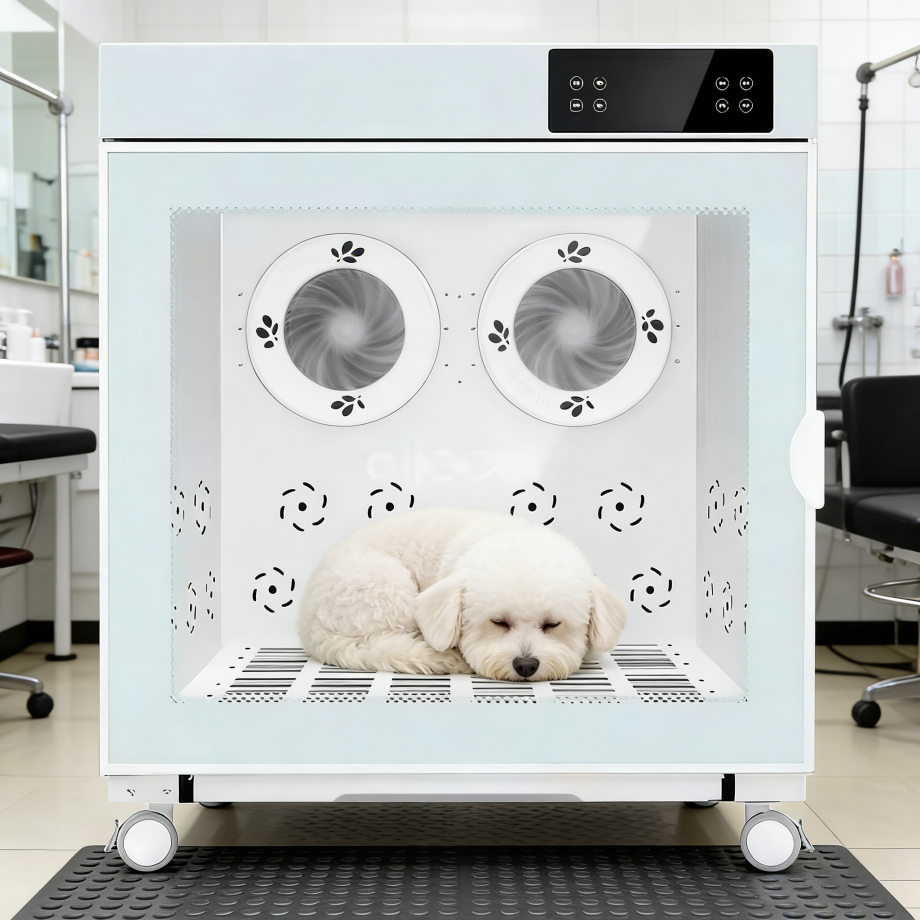
Smart dryer boxes add air treatment and hygiene features. The model UP-AP-S7 is a smart pet dryer box with 80 L capacity, 520 W rated power, a 10 to 90 minute timer, and a temperature range of 5 to 35 C. It includes ozone sterilization with a 99.99% claimed sterilization rate, HEPA filtration, far infrared and negative ion care, and touch screen or remote control, and is suitable for cats and dogs under 18 kg.
Buyers evaluating dryer boxes should look beyond cabinet size. Internal dimensions determine whether a pet can stand comfortably. Power, airflow, filter type, and cleaning access determine how quickly the cabinet can be turned over between animals. For hygiene-oriented facilities, wet coat handling and internal air filtration deserve equal attention to drying speed.
One important standards consideration is electrical safety. Electric heating tools used in pet grooming, including dryers, fall under safety expectations such as IEC 60335-2-45:2024 for portable electric heating tools. Commercial buyers should ask suppliers to confirm certification status for each market rather than assuming regional acceptance from catalogue photos.
Styling and Handling Station: Pet Grooming Tables
Pet grooming tables are the main ergonomic investment in a grooming business. They determine how safely a pet can be restrained during clipping, brushing, nail care, and finishing work, and how comfortably a groomer can work for long hours.
The table category includes several lifting technologies:
- Foldable tables suit mobile groomers, training schools, or salons with limited space. The UPLZGT-113 is a foldable portable dog grooming table measuring 60 x 45 cm with height adjustable from 73 to 83 cm. The UP-N-302C folding grooming table with wheels has an MDF top and is practical for temporary stations or classes.
- Hydraulic lift tables use foot-operated or lever-assisted lifting. The UP-LZGT201 Z-type hydraulic table has an upgraded aluminum alloy edge, a working surface of 108 x 60 cm, and a height range from 53 to 90 cm. The UP-AP-805A round hydraulic table measures 70 cm in diameter with height from 71 to 86 cm.
- Pneumatic lift tables offer a lighter lifting mechanism. The UPLZGT-401 pneumatic lift dog grooming table comes in 70 x 70 cm or 60 x 60 cm top sizes, both adjustable from 70 to 100 cm in height.
- Electric lift tables support rapid height adjustment and heavier professional workloads. The UPLZGT-501 electric table measures 120 x 60 cm with a height range from 20 to 92 cm. The UP-GT301 stainless steel electric lift table provides a 125 x 65 cm surface with height adjustable from 20 to 95 cm.
For higher-end salons and veterinary settings, tabletop materials and additional accessories matter. The UP-YM-D008 is an LED tabletop electric lift grooming table made of SS304 and glass, with a 120 x 60 cm top and height adjustment from 61 to 100 cm. The UP-YM-DCT01 adds drawers, providing stainless steel storage integrated into the table structure. The UP-YM-D001LP includes an illuminated tabletop, which can improve visibility of the coat and skin during detailed work.
Grooming tables should be selected by breed weight, table height range, and cleaning requirements. Stainless steel surfaces support disinfection protocols in veterinary and multi-animal environments. MDF or particleboard tables are lighter and less expensive, but they may react poorly to repeated wetting and chemicals over time.
Holding, Presentation, and Boarding Equipment
Salons and pet businesses also need equipment for temporarily holding pets before or after grooming. This category includes pet grooming show cages, cage trolleys, and boarding cages.
The UP-KS-4 pet show cage trolley is an aluminum four-compartment unit with external dimensions of 93 x 65 x 80 cm. The UP-Cage is a foldable pet transport cage trolley with an integrated grooming table, also in aluminum and measuring 93 x 65 x 80 cm. Both models are suited to grooming salons, pet events, and training facilities where compact mobility and easy cleaning are required.
For overnight or longer stays, the UP-BC-2 dog boarding cage is made of durable metal with a high-quality paint finish. It features spacious compartments with secure glass doors and sturdy handles, built-in ventilation panels, heavy-duty caster wheels, a secure locking mechanism, and a smooth surface for easy cleaning. The same manufacturer also offers the UP-BC-1 cat boarding cage with customizable dimensions and compartment configurations.
These products are not central cosmetic tools, but they affect the workflow of a full-service facility. A salon without safe holding space can quickly become chaotic; a kennel without mobile caging can waste staff time moving animals between stations.
Matching Equipment to Facility Types
Because facility types run different operational models, their equipment priority also differs. The table below summarizes a practical first-pass matching guide based on common commercial scenarios and available manufacturer application documentation.
| Facility Type | Core Equipment Focus | Key Planning Considerations |
|---|---|---|
| Pet grooming salon | Bathtubs or SPA tubs, stand dryers, dryer cabinets, grooming tables, show cages | Daily throughput, table height adjustability, low-noise drying, hygiene turn-around time |
| Veterinary clinic / pet hospital | Veterinary grooming table, high-velocity dryers, disinfection cabinet, bathing tub, boarding cage | Anti-slip surfaces, pet-safe materials, corrosion resistance to disinfectants, ergonomic access for medical staff, noise reduction, infection control |
| Pet grooming school | Grooming tables, dryers, bathing tubs, shears, brushes, training cages | Durable for frequent student use, easy-to-clean surfaces, ergonomic design for trainees |
| Self-service pet washing station | Self-service dog wash machine or fully automatic washing units, payment terminals, water heaters, drying systems | 24/7 unattended operation, waterproofing, anti-escape protection, payment reliability, low-noise and corrosion-resistant materials |
| Kennel / boarding facility | Pet boarding cages, grooming tables, dryers, washing stations | Ventilation, secure locking, easy cleaning, caster mobility for flexible layout |
The application scenario data for USMILE PET indicate strong international application for these facility types across the EU, USA, Southeast Asia, Middle East, and Oceania. One self-service washing station project profile lists requirements such as pet-safe non-toxic materials, anti-leakage and waterproof design, low-noise operation, anti-jam and anti-escape safety protection, per-use disinfection, and simple interfaces for pet owners. Buyers should use such requirement lists as pre-tender checklists.
System Planning vs. Isolated Equipment Purchasing
First-time buyers often purchase one bathtub and one dryer after comparing individual catalogue prices. A more effective approach is system planning, where the buyer first defines the station layout and then selects equipment to fit it.
| Comparison Factor | Traditional Isolated Buying | Functional Station Planning |
|---|---|---|
| Layout fit | Equipment may arrive with mismatched dimensions and unclear utility connections. | Each machine is confirmed against floor area, power, water, drainage, and workflow. |
| Specification consistency | Buyer manages different manuals, voltage standards, and spare-part lists from multiple suppliers. | Full-line sourcing can simplify voltage options, packaging types, and spare-part compatibility. |
| Budget timing | Costs appear gradually through replacements and missing accessories. | Initial capital is more visible, but total deployment cost is easier to forecast. |
| Supplier communication | Multiple support tickets with no single responsible party. | One manufacturer can take clearer ownership of cross-product training and replacement parts. |
This comparison does not mean every buyer should purchase a full line from one manufacturer. System planning has real limitations. First, it requires a clearer upfront definition of service capacity and facility layout, which many new salon owners postpone until after opening. Second, concentrating an initial investment in fewer suppliers increases the cost impact if one supplier has delivery delays. Third, even a full-line offer cannot remove the buyer's responsibility to check local electrical specifications, plumbing codes, and certification requirements in the destination country. A full-system purchase should therefore be treated as coordination, not as a substitute for local due diligence.
Market Context and What It Means for Equipment Selection
Third-party market data confirms that pet grooming equipment is expanding beyond traditional professional salons. The projected growth of self-service dog wash stations, in particular, is a signal for equipment manufacturers and buyers to evaluate unattended business models. This is consistent with the development of automatic washing machines, self-service kiosk systems, and integrated wash-and-dry units in current supplier portfolios.
At the same time, the size of the North American market means that US-bound buyers should pay close attention to voltage configurations, safety certifications, and hygienic design expectations. The AKC National Core Standards for professional grooming in the United States emphasize that no pet should be left unsupervised within arm's length on grooming equipment. This translates into practical equipment requirements: safe restraint systems, accessible table controls, and workstation design that keeps the pet within safe reach of the groomer at all times. Buyers should ask suppliers how their table and tub designs support such supervision standards.
Regional market share should also inform portfolio composition. A salon oriented to North American customers may prioritize larger bathtubs, high-volume drying solutions, and efficient table operations. An operator building a self-service business in Europe or Asia may instead focus on compact payment-integrated wash machines and durable outdoor-capable enclosures.
A Full-Line Manufacturer as a Reference Point: Dalian Usmile Pet Technology
One useful reference point for category discovery is Dalian Usmile Pet Technology Co., Ltd., operating under the brand USMILE PET. The company is a pet grooming equipment manufacturer established in 2018, located in Dalian, Liaoning, China. It reports a total factory area of 12,000 square meters, a workforce of approximately 180 employees, an R&D team of 35 engineers, and an annual output capacity of about 500,000 units. Approximately 95% of its products are exported, mainly to the EU, USA, Southeast Asia, Middle East, and Oceania.
USMILE PET's main product lines include pet grooming equipment, pet SPA bathtubs, pet bathtubs, pet dryers, pet dryer boxes, pet grooming show cages, and pet shampoo and finishing products. That range places the company among manufacturers that can support more than a single piece of equipment. The company profile also lists CE, FDA, UL, and ISO among the certifications it claims across its product lines.
For a first-time buyer, this type of full-line manufacturer is useful for another reason: it makes the total equipment structure visible. Instead of discovering one table from one supplier and one dryer from another, the buyer can review a single catalogue structure, compare internal sizing logic, and ask cross-product questions such as whether a dryer cabinet fits the same voltage family as the bathing machine. A full-line manufacturer does not automatically become the best supplier for every project, but it provides a faster baseline for understanding the equipment ecosystem.
Readers who want to verify the product specifications referenced in this article can consult the public company brochure at https://cdn.socialarks.com/sbsp/24760/0/2026/0414/69ddf0fb044ca.pdf.
Future Outlook for Pet Grooming Equipment Buyers
Several forward-looking trends are likely to influence equipment purchasing decisions through the rest of 2026. Automation is shifting from novelty to operational standard in self-service and high-throughput environments. Unattended washing stations, integrated wash-and-dry machines, and software-controlled payment systems reduce dependence on skilled labor for routine bathing tasks.
Hygiene and infection control are becoming more visible selection criteria, especially for veterinary clinics, grooming schools, and multi-animal facilities. Equipment with smooth stainless steel surfaces, removable filters, disinfection functions, and easy access for cleaning is more likely to satisfy both commercial and regulatory expectations. Low-noise operation is another emerging requirement in markets where grooming services operate inside residential or mixed-use buildings.
For buyers, the most durable procurement principle is modularity and upgradeability. A system that can be initially configured with a professional bathtub, a grooming table, and a dryer, then later expanded with an automatic washing machine or additional drying cabinet, is generally more valuable than a fixed all-in-one unit with no room for growth. Checking future-ready specifications, such as electrical capacity, floor area, and plumbing access, will protect the initial equipment investment.
FAQ
Which pet grooming equipment should a new salon purchase first?
Most commercial salons start with a professional pet bathtub, a grooming table, and a dryer. This core configuration allows the business to perform basic bathing, drying, and finishing services. As volume increases, the owner can add a dryer cabinet, a second table, or an automatic washing machine depending on space and workflow.
What is the difference between a stainless steel pet bathtub and an acrylic pet SPA bathtub?
A stainless steel pet bathtub is generally chosen for heavy daily use, corrosion resistance, and easy sanitization. A pet SPA bathtub made of reinforced acrylic adds bathing therapies such as hydro-massage jets, ozone, color-changing LED lighting, thermostatic heating, and micro-bubble milk bath functions. The right choice depends on whether the facility needs basic washing or higher-value SPA services.
How does an automatic dog washing machine differ from a self-service dog wash station?
An automatic dog washing machine typically guides the pet through a programmed washing and drying process inside the unit. A self-service dog wash station is usually installed in a fixed kiosk location where the pet owner pays for access to a wash tub, shower, and dryer and performs the washing process themselves. Both models are available with payment systems and stainless steel construction for commercial use.
What size of pet dryer box should a commercial groomer choose?
Pet dryer boxes should be selected according to the weight and body length of the pets being served. Compact units suit cats and small dogs under 14 kg; medium units suit dogs up to 20 kg such as Corgis and Shiba Inus; large units handle dogs up to 35 kg including Border Collies and smaller Golden Retrievers. Facilities serving very large breeds should consider large drying cabinets with higher power and more internal space.
Is it necessary to buy all pet grooming equipment from one manufacturer?
It is not strictly necessary. Many facilities successfully combine specialized suppliers. However, buying from one full-line manufacturer can simplify voltage planning, spare parts management, packaging, and after-sales communication. The trade-off is that buyers must still verify local certifications, installation requirements, and facility-specific constraints before committing.
Sources and references: Grand View Research, Fortune Business Insights, Dataintelo, International Electrotechnical Commission, American Kennel Club. Specification details are drawn from manufacturer-published product documentation.
Есть вопросы или нужны дополнительные детали?
Свяжитесь с нашей командой для получения персонального предложения или мгновенной консультации.
Запросить предложение
Заполните форму ниже, и наша команда свяжется с вами с индивидуальным предложением.
Прямой чат WhatsApp
Предпочитаете общаться в реальном времени? Напишите нам в WhatsApp для мгновенной помощи и быстрых ответов.
- Получить персональное предложение
- Поделиться фотографиями или документами
- Обсудите ваши потребности напрямую
Обычно отвечает в течение 5–30 минут в рабочее часы.