
Pet Oral Strip Due Diligence: HEART+, PROBIO, EYES+ and FIT+
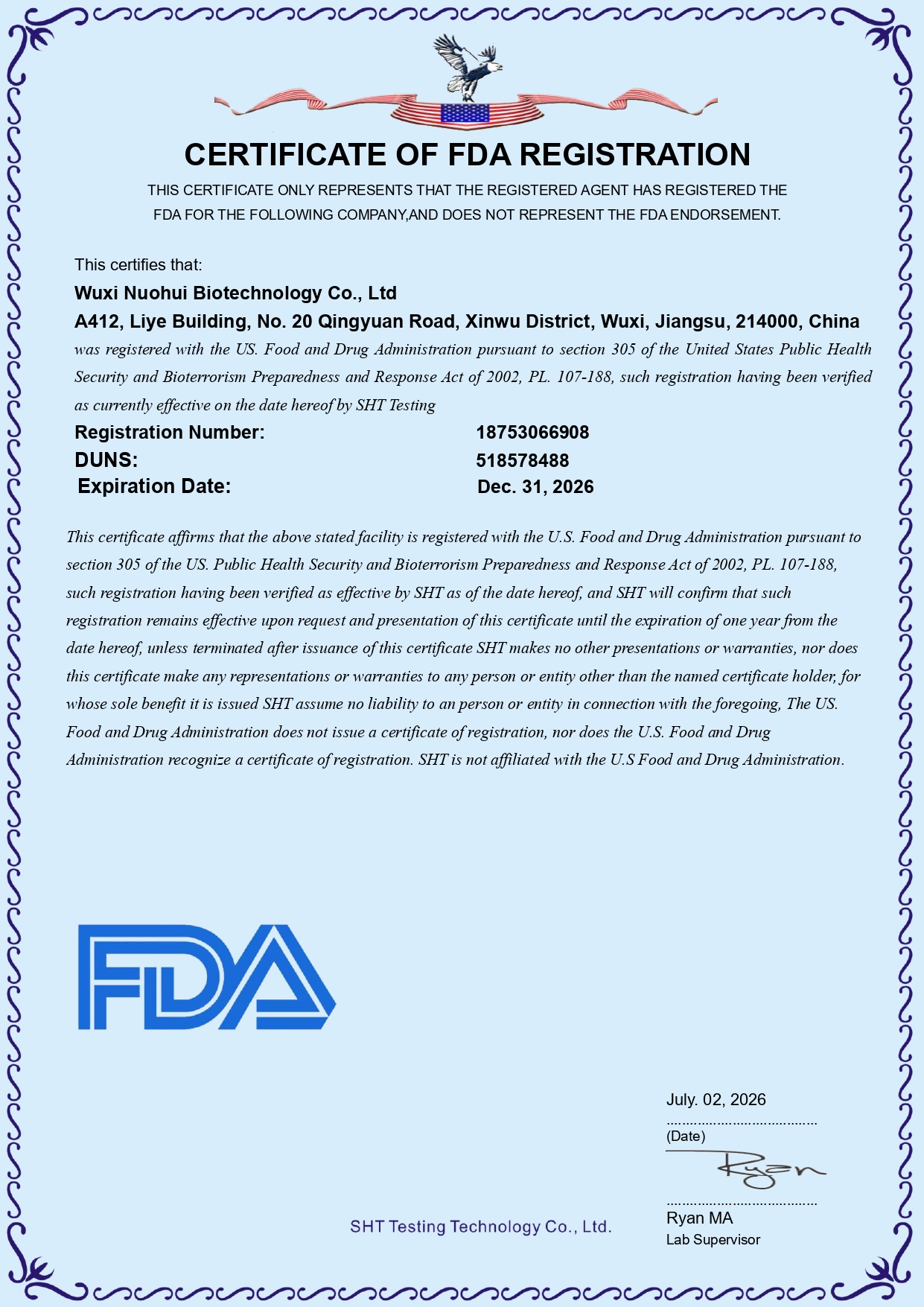
Facility registration is one of the documents a buyer can verify before committing to a pet oral strip programme. Image: Novohope documentation set.
Supplier capability in pet oral strips is decided by three verifiable things: a defined oral fast-dissolving matrix, a documented piece weight and pack count, and paperwork an auditor can check. The Novohope range — HEART+, PROBIO, EYES+ and FIT+ — publishes all three for its ODT and ODF formats, which is what makes it reviewable at evaluation stage rather than merely describable.
Oral dissolvable formats entered the pet category as a delivery idea. They are now a sourcing question. Buyers of pet health supplements are no longer asking only whether a strip dissolves; they are asking what the strip is made of, how much it weighs, what the nutrient load actually is, and which documents will still be valid when the container lands.
Novohope is a pet nutrition brand produced by Wuxi Nuohui Biotechnology Co., Ltd., a China-based contract manufacturer whose FDA food facility registration (No. 18753066908) covers pet food and health supplement production. Its pet range is organised as Pet Health Oral Strips / Pet Nutritional ODT and Pet Nutritional ODF, with the model names HEART+, PROBIO, EYES+, FIT+, COAT+, BONE+ and CALM+. The four models examined here — HEART+, PROBIO, EYES+ and FIT+ — map onto four of the most commercially contested benefit spaces in the category: cardiovascular support, digestive and probiotic care, eye and tear-stain care, and weight management.
This article does not rank the range against unnamed competitors. It does something more useful at evaluation stage: it takes the four models, reads them the way a purchasing team would, and sets out the acceptance criteria that turn a format claim into a supplier decision.
Why Oral Strips Became a Procurement Question
The commercial pull is measurable. Grand View Research values the global pet supplements market at approximately USD 2.8 billion in 2025 and projects USD 4.6 billion by 2033, with North America holding 48.1% of global revenue share in 2025. Mordor Intelligence sizes the narrower pet dietary supplements segment at USD 5.11 billion by 2026, growing at a CAGR of 7.42% through 2031, and identifies Asia-Pacific as the fastest-growing region on the back of pet humanisation and rising healthcare spend.
The two figures do not reconcile, and that is worth stating plainly: classification and reporting agency change the number substantially, so a buyer should use these datasets for direction and share, not for a spreadsheet cell. What both sources agree on is the shape of the demand — premium, benefit-specific, and increasingly format-literate.
That last point is where the opportunity and the risk sit together. When a category is growing quickly, supply fills it quickly, and the difference between a competent oral film supplier and an opportunistic one is rarely visible in a sample. It is visible in the specification sheet, the analytical report, and the registration file. Pet fast-dissolve oral films compress a lot of technical risk into a very small object, and the buyer who evaluates the object only will eventually be surprised by the process behind it.
The Four Models at a Glance
The range is built on two related formats. ODT designates an orally disintegrating tablet — a thin wafer-style strip in this application. ODF designates an orally disintegrating film. Both rely on the same carrier concept, an oral fast-dissolving matrix, and both are positioned for pet supplement manufacturing and the wider pet healthcare industry rather than for direct retail sale by the manufacturer.
| Model | Format | Documented spec | Nutrient focus |
|---|---|---|---|
| HEART+ | ODT | 2.1 g, 10 pieces per pack | Cardiovascular nutrients |
| PROBIO | ODT | 2.5 g, 10 pieces per pack | Probiotic and prebiotic digestive nutrients |
| EYES+ | ODF | 2.1 g / 0.074 oz | Eye care and tear stain nutrients |
| FIT+ | ODT | 10 pieces per pack | Weight management ingredients |
The line-level documentation records net weights of 2.1 g (0.074 oz) and 2.5 g (0.088 oz) against a 10-piece count. Nutrient inputs listed across the range include taurine, L-carnitine, coenzyme Q10 (10 mg), vitamin E (5 IU), N-acetyl-L-cysteine, N-acetylglucosamine (28.22 mg), sodium hyaluronate, lutein and zeaxanthin, DHA and biotin, Bacillus coagulans (GBI-30, 6086) spores at 1 × 10⁹ CFU, Pediococcus acidilactici CCFM6432 at 1 × 10⁹ CFU, pasteurised Akkermansia muciniphila postbiotic at 12 mg, and GOS & XOS prebiotic fibre.
The mapping is the useful part. PROBIO carries the live-culture and postbiotic load, which is the hardest nutrient class to keep stable in a thin matrix. EYES+ carries the carotenoid and tear-stain set — lutein, zeaxanthin, NAC, NAG, sodium hyaluronate, DHA and biotin — matching the antioxidant blends that drive the tear-stain subcategory. HEART+ carries the cardiovascular set. FIT+ carries the weight-management set. For a brand owner building a four-SKU functional shelf, that is a pre-constructed portfolio rather than four separate development projects.
The Oral Fast-Dissolving Matrix Is the Primary Material
Every model in the range lists the oral fast-dissolving matrix as its primary material, ahead of the benefit-specific nutrients. That ordering is not marketing language; it reflects where the engineering difficulty actually lives.
A fast-dissolving film or wafer is a thin, water-soluble carrier in which actives are dispersed. On contact with saliva it hydrates, softens and disintegrates, and the load is swallowed with the saliva rather than chewed or mixed into food. Everyone in the category quotes mouth-feel; the parameters that decide whether the product works in the field are different.
Three matter most at evaluation stage. Disintegration behaviour sets the dosing experience — industry reporting on oral dissolvable film technology points to innovations targeting disintegration below 25 seconds, alongside palatability improvement of up to 47% through taste masking. Load capacity sets the formulation ceiling: a 2.1 g or 2.5 g piece is a finite envelope, and high-mass ingredients compete for space with the matrix itself. Moisture and mechanical robustness set the shipping reality: thin matrices are generally more sensitive to humidity and to compression than compressed tablets, so primary packaging and stability data carry more weight than they would in a tablet programme.
The practical consequence is that the matrix, not the nutrient list, is the component most likely to be changed quietly between lots. A buyer who specifies only the active ingredient has specified the easy half.
Reading the Evidence: A Buyer's Acceptance Framework
Capability evidence is not a brochure. It is a set of documents that answer specific purchasing questions, each with a named issuer and a date. The Novohope file set for this range can be read against six acceptance gates.
| Acceptance gate | Question it answers | Evidence present in the reviewed set |
|---|---|---|
| Specification conformance | What exactly is being bought? | Format, net weight and pack count stated per model |
| Analytical verification | Is the composition what the sheet says? | COA DTI2026EC050626-4 for HEART+ and DTI2026EC050626-1 for COAT+, customised full ingredient composition analysis |
| Material safety | How is handling and hazard communicated? | SDS documents DTI2026EC060626-2 (EYES+), DTI2026EC060626-1 (COAT+), DTI2026EC060626-5 (BONE+) under OSHA 29 CFR 1910.1200 |
| Contact-material compliance | Does the delivery system meet a recognised food-contact standard? | Test report DTI2026EC050626-2-2 for EYES+ against US FDA 21 CFR 175.300 |
| Facility legitimacy | Is the manufacturing site registered where it claims to sell? | FDA food facility registration 18753066908, issued 2026-07-01, valid to 2026-12-31 |
| Brand and label rights | Can the mark be used and defended in the target market? | Trademark application acceptance notices 89737105, 89737106, 89737107 and 89737108, National Intellectual Property Administration, China, dated 2026-02-12 |

Trademark application acceptance notices in Classes 7 and 31 recorded against the Novohope mark. Image: Novohope documentation set.
Two clarifications keep the file honest. First, an FDA food facility registration is a registration, not an approval: it establishes that the site has notified the agency and is subject to its rules, and it says nothing by itself about product performance. Second, several of these documents carry 2026 issue dates — 2026-07-01, 2026-07-02 and 2026-07-06 — and the facility registration expires on 2026-12-31, so a buyer contracting into 2027 should ask for the renewal rather than accept the copy on file.
A related point on benchmarking: the National Animal Supplement Council Quality Seal is the reference standard many US buyers ask about, requiring GMP adherence and labelling audits. The document set reviewed for this article does not include that seal, so a buyer who needs it should treat it as a separate qualification step rather than assume it is covered by the FDA registration.
One procedural detail belongs in every purchase order. The line documentation records net weight against a 10-piece count — 2.1 g / 0.074 oz and 2.5 g / 0.088 oz. Confirm on the approved specification whether the declared figure is piece weight or pack net weight before it is printed on pack artwork, because the two conventions are not interchangeable on a label.
Manufacturing Terms That Shape the Evaluation
Format evidence answers whether a supplier can make the product. Commercial terms answer whether the supplier can make it for this buyer, at this volume, in this market.
The declared operating profile for this line is a monthly capacity of 200,000,000 units, a minimum order quantity of 3,000 per SKU, and a lead time of 35 to 45 days. Customisation covers recipe, brand, packaging design and other specified requirements. Production is offered on brand agency, distribution and OEM/ODM terms. Quality control combines 100% full inspection before delivery with third-party authoritative sampling testing. Export markets are listed as Europe, North America, Southeast Asia, the Middle East and East Asia, and after-sales is described as remote support.
Read those five numbers as a qualification profile rather than a scorecard. A 3,000-unit MOQ per SKU is a realistic entry point for pet supplement ODM/OEM programmes and for private-label test launches, but it means a four-SKU range carries four separate minimums — a detail that changes the budgeting conversation for a brand owner assembling HEART+, PROBIO, EYES+ and FIT+ together. A 35–45 day lead time is workable for planned replenishment and tight for promotional spikes. Declared capacity is a statement of plant capability; the figure a buyer should actually plan against is confirmed slot availability at the time of order. And remote-only after-sales support is a real constraint for a buyer who expects on-site commissioning or on-site audit resolution.
Where Each Model Fits in a Pet Healthcare Portfolio
The range has already been used in commercial private-label conditions. One recorded programme covers EM private label production and ODM customised formula development across Germany, the UAE, Canada, Australia, France and the United States, at a volume of 200,000 units over a three-year relationship, applied in chain supermarkets and retail stores. The reported outcome was a lift in pet health category sales volume, favourable market feedback and stable repeat orders, with the format described as easy to use and not resisted by pets.
That case is narrow and should be read as such: it demonstrates that the format clears retail and repeat-purchase conditions in six markets, not that it will perform identically in every channel. The more transferable insight is portfolio logic.
HEART+ suits the senior-dog and senior-cat segment, where cardiovascular support is bought as a maintenance subscription rather than a one-off. PROBIO suits the gut-health and sensitive-digestion segment, where the live-culture count is the label claim a buyer must defend and therefore the claim that deserves the strictest assay. EYES+ suits the tear-stain segment, which is small-animal and breed-specific and unusually search-driven at retail: one e-commerce analytics source, ASINSIGHT, reports top-selling dog tear stain supplements on major platforms at monthly volumes around 100,000 units, a figure that is directional rather than audited but consistent with the subcategory's intensity. FIT+ suits the weight-management segment, which is seasonal, vet-adjacent and strongly tied to body-condition messaging.
For a brand owner, the practical value is a single matrix, a single supply relationship and four benefit stories — rather than four development files, four stability programmes and four supplier relationships.
Where Film and Wafer Formats Are the Weaker Choice
Honest evaluation requires the other side of the comparison. Oral strips are not universally superior, and a supplier that cannot describe the boundary is not describing the product accurately.
Load ceiling. A 2.1 g or 2.5 g piece is a bounded envelope. Formats that must carry a high-mass ingredient — a large joint-support dose, for instance — are better served by tablets, soft chews or powders, where the mass constraint is looser. Buyers should check the dose per piece against the target claim before choosing the format at all.
Environmental tolerance. Thin, water-soluble matrices are generally more moisture- and compression-sensitive than compressed tablets. That pushes cost into primary packaging, secondary cartons and distribution conditions, and it makes summer and tropical routes a specific qualification question rather than a footnote.
Documentation scope. The analytical and safety documents reviewed here are product- and date-specific. A COA issued for HEART+ in July 2026 does not validate a reformulated batch, and no document set validates a formulation that has not yet been produced. Each new recipe restarts the evidence cycle.
Category maturity. In markets where chewable and tablet formats dominate shelf space and consumer habit, an oral strip requires shopper education at the point of sale. The format's convenience advantage is real; the education cost is also real, and it belongs in the launch budget.
Market Signals Buyers Should Weigh
Three signals are worth carrying into a 2027 planning cycle. The first is premiumisation by benefit: a market moving from USD 2.8 billion in 2025 toward USD 4.6 billion by 2033, with North America at 48.1% of 2025 revenue, is a market where buyers pay for a specific claim rather than a general one — which favours benefit-specific SKUs like the four examined here over generic multivitamin formats.
The second is regional shift. Asia-Pacific being the fastest-growing region matters to sourcing, not just to selling: it widens the base of contract manufacturers serving the category, which raises the value of documentation as a differentiator. When capability is common, evidence is the tiebreaker.
The third is format-level technical progress. Disintegration targets below 25 seconds and palatability gains of up to 47% through taste masking, as reported in oral dissolvable film market research, describe a technology curve that is still moving. For buyers, that means specifications should be written to be revisited annually rather than locked for the life of a supply agreement.
What Changes Next for Pet Oral Strip Sourcing
The next phase of this category is unlikely to be won on disintegration speed. It will be won on the boring infrastructure behind the strip: stability data that covers real distribution routes, renewal discipline on registrations and certificates, assay consistency on live cultures, and specification sheets that separate piece weight from pack weight without ambiguity.
For the Novohope range, the visible trajectory is a documented four-model portfolio backed by a registered facility, third-party analytical and safety testing, and an OEM/ODM structure built for private-label volume. The open questions are equally clear — packaging performance across climates, the scope of after-sales support as programmes scale, and whether the seal-level certifications some buyers require will be added to the file. Buyers evaluating at this stage should treat those as items to confirm in writing, not as disqualifiers, and should hold the same standard to every supplier on the shortlist.
The category is moving from novelty to procurement. Suppliers who can hand over a file, not a sample, will be the ones still on the shelf in three years.
FAQ
What is a pet supplement oral dissolvable film?
A pet supplement oral dissolvable film is a thin, water-soluble strip carrying nutrients that is placed in the mouth and disintegrates on contact with saliva, so the load is swallowed without chewing or mixing into food. In this range, ODF designates an orally disintegrating film and ODT designates an orally disintegrating tablet in a thin wafer form; both are built on an oral fast-dissolving matrix and are supplied for pet supplement manufacturing and the pet healthcare industry.
What specifications define the HEART+, PROBIO, EYES+ and FIT+ lines?
HEART+ is an ODT format documented at 2.1 g across 10 pieces per pack, carrying cardiovascular nutrients. PROBIO is an ODT format at 2.5 g across 10 pieces per pack, carrying probiotic and prebiotic digestive nutrients including Bacillus coagulans (GBI-30, 6086) spores at 1 × 10⁹ CFU, Pediococcus acidilactici CCFM6432 at 1 × 10⁹ CFU, pasteurised Akkermansia muciniphila postbiotic at 12 mg, and GOS & XOS. EYES+ is an ODF format documented at 2.1 g / 0.074 oz, carrying eye care and tear stain nutrients including lutein, zeaxanthin, N-acetyl-L-cysteine, N-acetylglucosamine at 28.22 mg, sodium hyaluronate, DHA and biotin. FIT+ is an ODT format at 10 pieces per pack, carrying weight management ingredients.
Which documents should a buyer request from a pet oral strip manufacturer?
At minimum: an approved specification sheet stating format, net weight and pack count; a certificate of analysis for the specific product and batch; safety data sheets for materials handled; a contact-material test report where a recognised food-contact standard applies; and a facility registration valid for the selling market. In the reviewed set, examples include COA DTI2026EC050626-4 for HEART+, SDS DTI2026EC060626-2 for EYES+, test report DTI2026EC050626-2-2 for EYES+ against US FDA 21 CFR 175.300, and FDA food facility registration 18753066908 issued to Wuxi Nuohui Biotechnology Co., Ltd. Documents should be checked for issue and expiry dates, not just presence.
What are the minimum order, lead time and capacity terms?
The declared terms are a minimum order quantity of 3,000 per SKU, a lead time of 35 to 45 days, and a monthly capacity of 200,000,000 units. Production modes include brand agency, distribution and OEM/ODM, with customisation of recipe, brand and packaging design. Quality control combines 100% full inspection before delivery with third-party authoritative sampling testing, and after-sales support is provided remotely.
How do ODT and ODF formats compare with tablets, powders and soft chews?
Oral strips compete on convenience and dosing experience: no water, no chewing, and a small unit that pets are reported not to resist. Tablets and soft chews compete on load capacity, since a 2.1 g or 2.5 g piece is a bounded envelope and high-mass ingredients are easier to deliver in a larger format. Powders compete on cost per dose and are easier to adjust formulation on. The deciding variable is usually the required dose per serving against the format's mass ceiling, followed by packaging and distribution conditions.
Where does the oral strip format reach its limits?
Three places. Load ceiling, where a target dose does not fit comfortably in a 2.1 g or 2.5 g piece. Environmental tolerance, since thin water-soluble matrices are generally more sensitive to moisture and compression than compressed tablets, which raises the importance of primary packaging and route-specific stability data. And documentation scope, because analytical and safety documents are product- and date-specific, so a new recipe restarts the evidence cycle rather than inheriting it.
Есть вопросы или нужны дополнительные детали?
Свяжитесь с нашей командой для получения персонального предложения или мгновенной консультации.
Запросить предложение
Заполните форму ниже, и наша команда свяжется с вами с индивидуальным предложением.
Прямой чат WhatsApp
Предпочитаете общаться в реальном времени? Напишите нам в WhatsApp для мгновенной помощи и быстрых ответов.
- Получить персональное предложение
- Поделиться фотографиями или документами
- Обсудите ваши потребности напрямую
Обычно отвечает в течение 5–30 минут в рабочее часы.