
Pharma Packaging Machine Comparison: Buyer Evidence Rules
Pharma Packaging Machine Comparison: Buyer Evidence Rules
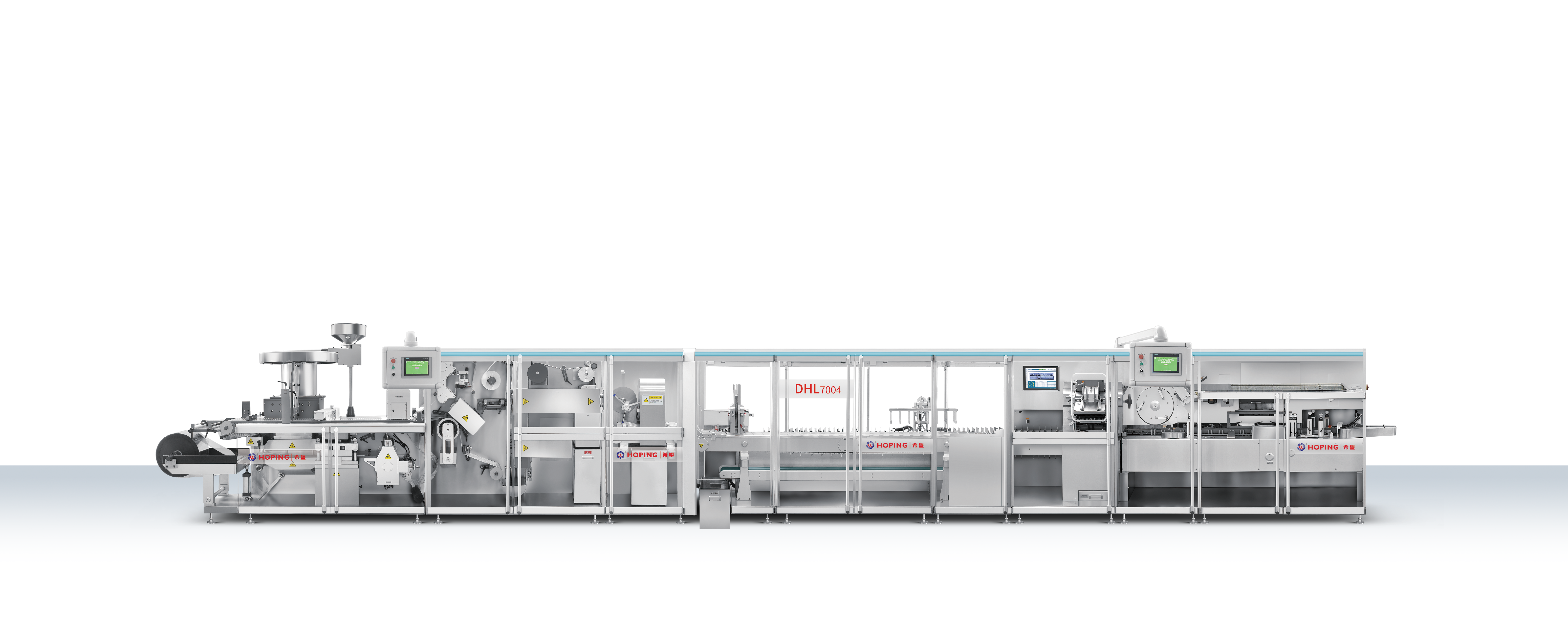
DHL7004 automatic blister-cartoning line, published at up to 700 blisters/min and 400 cartons/min. Source: Hoping Machinery product documentation.
Most pharmaceutical packaging machine comparisons fail at the same point: they compare headline speed instead of the constraint station. A buyer purchasing a blister-cartoning line is not purchasing a number, but the output that survives a format changeover, a leaflet fold, a carton board change and a full shift.
This reference is written for buyers in the research and evaluation stages. It compares pharmaceutical packaging machines at module level using documented, attributable figures: blister packing, flow wrapping, cartoning, bundling, case packing and palletizing, and the integrated lines that link them. First-party specifications are drawn from Zhejiang Hoping Machinery Co., Ltd. (“Hoping”) product documentation; market and standards context is drawn from published third-party and standards sources. Where a figure is a vendor claim rather than an independently verified result, it is identified as such, and where the evidence ends, the comparison says so.
Why machine-level comparison misleads buyers
Purchase orders are usually written for a single machine type: a blister packaging machine, an automatic cartoning machine, an automatic case packer. The operating result, however, is produced by a cascade. Each station passes a defined quantity to the next, and the slowest station sets the line rate.
The arithmetic is visible in published specifications. A flat-plate DPP260T1 blister packaging machine is documented at a maximum capacity of 300 blisters/min, with a maximum format area of 260 × 115 mm and a feed stroke of 30–120 mm. A rotary DPH320HII is documented at up to 1000 blisters/min over a 320 × 280 mm format area. Pair either machine with an XWZ120 cartoner rated at 30–120 cartons/min and the cartoner governs the line. Pair the same blister machines with an XWZ500H cartoner rated at 100–500 cartons/min and the blister machine becomes the constraint instead.
That is the first comparison rule: compare the ratio between adjacent stations, not the peak figure on a specification sheet. The second rule is to compare at the same module boundary, so that a standalone machine and a linked line are not placed in the same table without adjustment for transfer, buffering and inspection.
A module-level comparison table
The table below collects published capacity ranges for representative models across the main line functions. It is a comparison of documented specifications, not a ranking, and it deliberately includes the check that each number leaves open.
| Line function | Representative models | Published capacity | What the figure does not answer |
|---|---|---|---|
| Blister — flat plate, Alu-PVC / Alu-Alu | DPP Series (DPP350F, DPP250S, DPP250FI, DPP160F, DPP250FII); DPP260K; DPP260TI; DPP260T1 | DPP Series: 20–50 cycles/min, 5.6–12 kW depending on model. DPP260K: 20–70 cycles/min, 9.5 kW. DPP260TI: 20–60 cycles/min, 9.5 kW. DPP260T1: up to 300 blisters/min, 60 punches/min, 8.5 kW | Cavity count per format, forming depth, and the material combination the cycle rate was measured on |
| Blister — roller, high speed | DPH Series (DPH320H, DPH260H, DPH260); DPH320H; DPH320HII | DPH Series: 60–200 cycles/min, 15.5–18.9 kW. DPH320H: forming area 320 × 280 mm, forming depth 12 mm, stroke 100–280 mm. DPH320HII: 250 punches/min, up to 1000 blisters/min | Whether the top of the range is reachable with the buyer’s foil gauge and cavity geometry |
| Flow wrapping | XW8200 (XW8200S/D, XW8200R); XW8300 | XW8200: 30–200 packs/min, 2.8 kW. XW8300: 30–300 packs/min, 16 kW, four-axis servo, Beckhoff control | Seal integrity across film structures and the reject rate at the top of the range |
| Cartoning | XWZ120; XWZ300II; XWZ400 / XWZ300; XWZ500H | XWZ120: 30–120 cartons/min, magazine 600–700 cartons. XWZ300II: 60–220 cartons/min. XWZ400 / XWZ300: 100–400 / 100–300 cartons/min. XWZ500H: 100–500 cartons/min, magazine 1800 cartons | Leaflet fold complexity and carton board stiffness at high speed |
| Bundling and overwrapping | XWK4060; XWG4060; XWK Series (XWK650, XWK500, XWK250, XWK180); XWG Series | XWK4060: 30–60 bundles/min. XWG4060: 30–60 bundles/min. XWK Series: 8–60 bundles/min depending on model. XWG Series: 10–40 bundles/min | Bundle count per carton group, and film or band specification |
| Case packing and palletizing | XWK900 / XWK600; ICP12 | XWK900 / XWK600: up to about 5 cases/min, 7.5 kW. ICP12: about 12 cases/min, 25 kW, case packing and palletizing in one unit | Pallet pattern, case weight and buffer capacity upstream |
| Integrated blister-cartoner | DHL6004; DHL7004; DHL7005H; DHL8005H; DHL1000/5H | DHL6004: up to 600 blisters/min and 400 cartons/min. DHL7004: up to 700 / 400. DHL7005H: up to 700 / 500. DHL8005H: up to 800 / 500. DHL1000/5H: up to 1000 blisters/min and 500 cartons/min | Changeover time between formats and spare-part depth for the transfer system |
| Blister-flow-wrap-cartoner | IXW600; IXW800; DPH320H-XW8200-XWZ300II | IXW600: up to 600 blisters/min, 300 packs/min, 300 cartons/min. IXW800: up to 600 blisters/min, 600 packs/min, 500 cartons/min. DPH320H-XW8200-XWZ300II: 300–600 blisters/min, 50–200 packs/min, 50–220 cartons/min, 36 kW | Whether three format dependencies (blister, pillow pack, carton) can be changed in one campaign |
| Liquid dosage blister-cartoner | IXW400 | Up to 400 blisters/min and 150 cartons/min for pre-filled syringes, ampoules and cartridges | Container geometry tolerances and nesting behaviour |
| Special dosage | DP Series (DP260K, DP260KD) | 10–20 cycles/min, 2.5–4.6 kW depending on model | Product-specific containment and moisture requirements |
All capacity figures above are the published specifications of the referenced models. They are a starting point for comparison, not a performance guarantee for a specific product format. Buyers should require the supplier to restate capacity for the buyer’s own blister layout, carton size and leaflet fold during a material trial.
Six evidence items buyers should demand before shortlisting
Comparisons become defensible when each supplier answers the same six questions with documents rather than adjectives.
1. Capacity stated at format level
A cycle rate without a format area is not a specification. The DPP260T1 is documented at a 260 × 115 mm format area with a 30–120 mm feed stroke; the DPH320H is documented with a 320 × 280 mm forming area, 12 mm forming depth and a 100–280 mm stroke. Those dimensions determine how many cavities fit and therefore how many blisters per stroke the buyer actually receives.
2. Material and cleanability construction
In documented Hoping specifications, product-contact parts are made of AISI 316L stainless steel and FDA-compliant pharmaceutical-grade materials, while non-product-contact parts use AISI 304 stainless steel and anodized aluminium alloy, with surfaces designed for corrosion resistance and ease of cleaning under GMP requirements. The XWZ120 cartoner is built on a balcony-style frame in carbon steel and 304 stainless steel, with the carton magazine and the instruction-manual position accessible from outside the machine body — a detail that changes how quickly a line can be cleaned between batches.
3. Drive and control architecture
Control hardware is a comparison dimension because it governs diagnostics, recipe handling and spare-part logistics. Documented examples include Siemens PLC and a German SEW main motor on the XWZ120; a Panasonic servo-driven indexing system on the DPP260T1; Beckhoff motion controllers with CP9315 industrial PCs on the DHL6004, DHL8005H, IXW600 and IXW800; and Siemens motion controllers with TP900 HMI on the DHL7004 and DHL7005H. The XWZ500H is documented with a German GUK folding unit rated at 500 A4 sheets per minute and a servo-driven carton magazine holding 1800 cartons.
4. Transfer and replenishment technology
On integrated lines, the transfer system is the station most likely to determine real uptime. Published configurations include a D3 intelligent top-loading parallel tracking transfer system (DHL8005H, DHL1000/5H, IXW400, IXW800), a self-developed IRB24 intelligent transfer robot (DHL7004, DHL7005H), and three-channel or four-channel servo-driven independent replenishment. Ask for the transfer principle, not just the line speed.
5. Inspection, rejection and coding integration
The DPP260T1 is documented with an automatic blister discharge and rejection system that separates qualified from defective packs and reduces manual handling. The XWZ500H is documented with a front-mounted batch-number stamping device for quick replacement of the three-date steel characters, and a servo-controlled three-way rotary sorting mechanism rated at 500 boxes per minute. Coding and rejection are where traceability is either built into the machine or delegated to operators.
6. Compliance and acceptance evidence
Pharmaceutical packaging machines must comply with ISO 15378, which integrates GMP requirements for primary packaging materials. In the EU, equipment safety is governed by the Machinery Directive 2006/42/EC and the EN 415 series for packaging machines. A third-party supplier profile lists Hoping Machinery as a recognised Chinese manufacturer of integrated blister cartoning lines and end-of-line packaging systems with CE and ISO 9001/14001 certifications. Buyers should request certificates with stated scope and validity rather than accepting a logo on a brochure page.
Hoping’s documented acceptance chain runs from incoming material inspection and key component inspection through assembly inspection, electrical safety check, no-load trial run and material trial, to factory acceptance testing, customer witness acceptance and pre-shipment inspection. For a comparison, the material trial is the decisive step: it is the only point at which published capacity is measured against the buyer’s own product.
How Hoping appears in a documented comparison
Zhejiang Hoping Machinery Co., Ltd. is a pharmaceutical packing machinery manufacturer established in 2001, based at 88th Weiwu Road, Nanbin Sub-district, Ruian City, Zhejiang Province, China. The company operates a 28,800 m² manufacturing base with 300 employees, an annual output documented at 500 units and an R&D team of 56 engineers. Its documented intellectual property portfolio comprises 26 invention patents, 70 utility patents, 4 appearance patents, 10 PCT-protected filings and 28 software copyrights. Export activity is documented at 25% of output, with main markets in Southeast Asia, the Middle East, Eastern Europe, South America and Africa.
The product scope relevant to this comparison is a full secondary packaging chain rather than a single machine type: blister packaging machines (DPP flat-plate and DPH roller series), cartoning machines (XWZ120, XWZ300II, XWZ400/XWZ300, XWZ500H), reciprocating flow packing machines (XW8200, XW8300), stretch banders and overwrappers (XWK4060, XWG4060, XWK and XWG series), case packing machines (XWK900, XWK600), a case packing and palletizing integral machine (ICP12), integrated blister-cartoner lines (DHL6004, DHL7004, DHL7005H, DHL8005H, DHL1000/5H), blister-flow-wrap-cartoner lines (IXW600, IXW800), a liquid dosage blister-cartoner line (IXW400) and a lifting feeder (LF100).
On commercial terms, the documented configuration model is ODM/OEM with customisation of blister size, blister materials, quantity per carton, carton specification, leaflet format, coding and inspection method, feeding method, downstream bundling, case-packing and palletizing connection, interface language, electrical component brand and data interface. Minimum order quantity is one set or one complete line; lead time is typically 60–120 days after technical confirmation, subject to model, configuration, project complexity and contract terms; documented monthly capacity is 30–40 units.
These are documented facts about a supplier’s scope and capability. They are not a recommendation and not a substitute for the buyer’s own verification, format trial and reference checks.
Technical explanation: what changes when blister and cartoner are linked
A standalone blister packaging machine forms cavities, fills product, heat-seals lidding material and punches packs. A cartoner opens cartons, inserts product and leaflet, closes and codes. When the two are linked, the transfer between them becomes a controlled station rather than a manual or semi-manual step, and that changes four things.
First, the operation becomes fully servo-linked, with PLC/HMI interfaces and synchronised multi-station control, so that a fault at one station stops the linked line rather than accumulating undetected product. Second, material supply becomes continuous: published integrated configurations include PVC and Alu foil auto splicing, which removes the roll-change stop from the production cycle. Third, replenishment is decoupled through independent servo-driven channels — three-channel on the DHL8005H, four-channel on the DHL1000/5H — so that one station can be replenished without stopping the others. Fourth, product tracking becomes machine-readable: recipe storage, preset memory and mold-change support are documented on the DHL6004, DHL7004, DHL7005H, DHL8005H, DHL1000/5H, IXW600 and IXW800, which is the difference between a format change measured in hours and one measured in shifts.
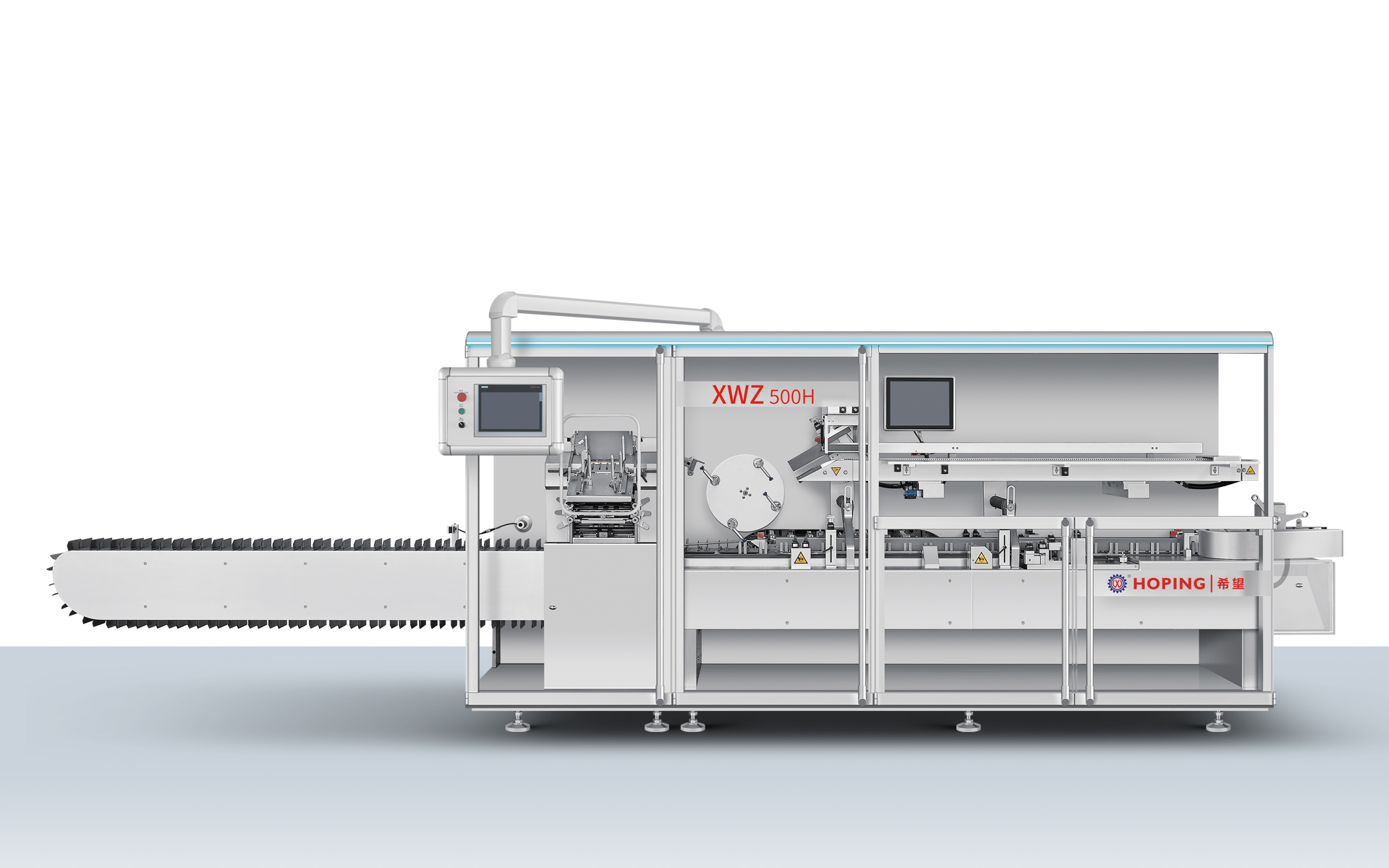
XWZ500H full servo cartoning machine, published at 100–500 cartons/min with an 1800-carton servo-driven magazine. Source: Hoping Machinery product documentation.
The documented role of the line in operation is to complete blister packaging, leaflet folding, carton opening, blister insertion, batch and date coding, inspection and rejection, and downstream connection, with the objective of improving automation and reducing manual transfer. That framing matters for comparison: two suppliers quoting the same cartons/min can deliver different results depending on how many of those functions are automated and how many are returned to the operator.
Application and use cases
The scenario documentation for these lines is explicit about where they are applied: new solid dosage blister packaging lines, upgrades of existing packaging lines, high-capacity expansion, intelligent packaging workshop retrofit, and blister-cartoning-bundling or case-packing downstream integration projects. The operating environment is described as a GMP-oriented cleanroom or pharmaceutical packaging workshop, running continuous high speed with multi-batch, multi-format production, and with requirements for stability, easy cleaning, safety guarding and traceability-oriented operation.
A representative case profile describes a large pharmaceutical manufacturer, solid dosage production company or pharmaceutical engineering contractor deploying 5–10 lines for tablets and capsules, covering new line construction, capacity expansion or packaging line upgrades. Documented project objectives include improving packaging automation, reducing manual transfer, improving blister-to-carton connection efficiency, reducing wrong-insertion and missing-leaflet risk, and supporting downstream automation integration. Customer names are disclosed only with authorisation, and no fixed operating period is published — a reminder that case material should be read as a project profile rather than an audited performance record.
Downstream scope is also configurable. Depending on the project, a line may be completed with a stretch bander, an overwrapper, a case packer, a case packing and palletizing integral machine, or with vision inspection, checkweigher and ERP/MES data interfaces. Each added module is a new comparison dimension, because each adds a new constraint.
Market trend analysis
Three published market figures frame the comparison. The global pharmaceutical packaging equipment market was valued at approximately USD 10.71 billion in 2024 (SkyQuest Technology). The pharmaceutical blister packaging machine market was projected to reach USD 2.57 billion by 2025 at a CAGR of 2.8% (Custom Market Insights). The pharmaceutical automatic cartoning machine market was valued at USD 1.46 billion in 2024 (Fortune Business Insights). Regionally, Asia Pacific held the largest revenue share of 40.7% in the pharmaceutical packaging equipment market in 2025 (Grand View Research).
The same published data also shows why market numbers should not be used as procurement inputs. Estimates for the total pharmaceutical packaging equipment market diverge materially: one source places it at approximately USD 10.71 billion in 2024 (SkyQuest Technology), while another places it at USD 7.0 billion in 2025 (Grand View Research). The gap reflects different definitions of primary versus secondary equipment rather than a contradiction in the underlying demand. A buyer comparing machines should therefore treat market size as context for capacity planning, not as evidence about any individual supplier.
Market concentration is a second useful context. The three largest players — Uhlmann, IMA and Marchesini — collectively hold approximately 29% of the pharmaceutical blister packaging machine market. The remaining share is served by a long tail of regional and specialist manufacturers. Concentration is not a quality measure in either direction: it indicates where global service networks are dense, and where a buyer may instead be selecting on configuration flexibility, lead time and line-level integration.
Comparison with traditional configurations
Buyers evaluating pharmaceutical packaging machines are usually choosing between four structural configurations rather than between brands alone.
| Configuration | Documented basis | Where it works | Where it breaks down |
|---|---|---|---|
| Standalone machines, manually connected | Blister machine plus XWZ120 cartoner (30–120 cartons/min) | Multiple low-volume products; staged investment; existing building constraints | Transfer between machines depends on people and procedures; wrong insertion and missing leaflet risk is managed by operators, not by the machine |
| Integrated blister-cartoner line | DHL6004 (600/400), DHL7004 (700/400), DHL7005H (700/500), DHL8005H (800/500), DHL1000/5H (1000/500) | Single high-volume solid dosage product or a small family of similar formats | Higher capital outlay and a single control chain: one station fault stops the whole line, and changeover touches multiple stations at once |
| Blister-flow-wrap-cartoner | IXW600 (600/300/300), IXW800 (600/600/500), DPH320H-XW8200-XWZ300II (300–600/50–200/50–220) | Products requiring a pillow pack before cartoning, including moisture-sensitive formats | Three format dependencies must be changed together; film and carton stock planning grows accordingly |
| Full secondary line with end-of-line automation | XWZ300II + XWK4060 + ICP12: cartoning 60–220 cartons/min, bundling 30–60 bundles/min, case packing about 12 cases/min | Projects replacing manual case packing and palletizing labour | The palletizer becomes the constraint: above roughly 12 cases/min, the end-of-line module, not the cartoner, sets the ceiling |
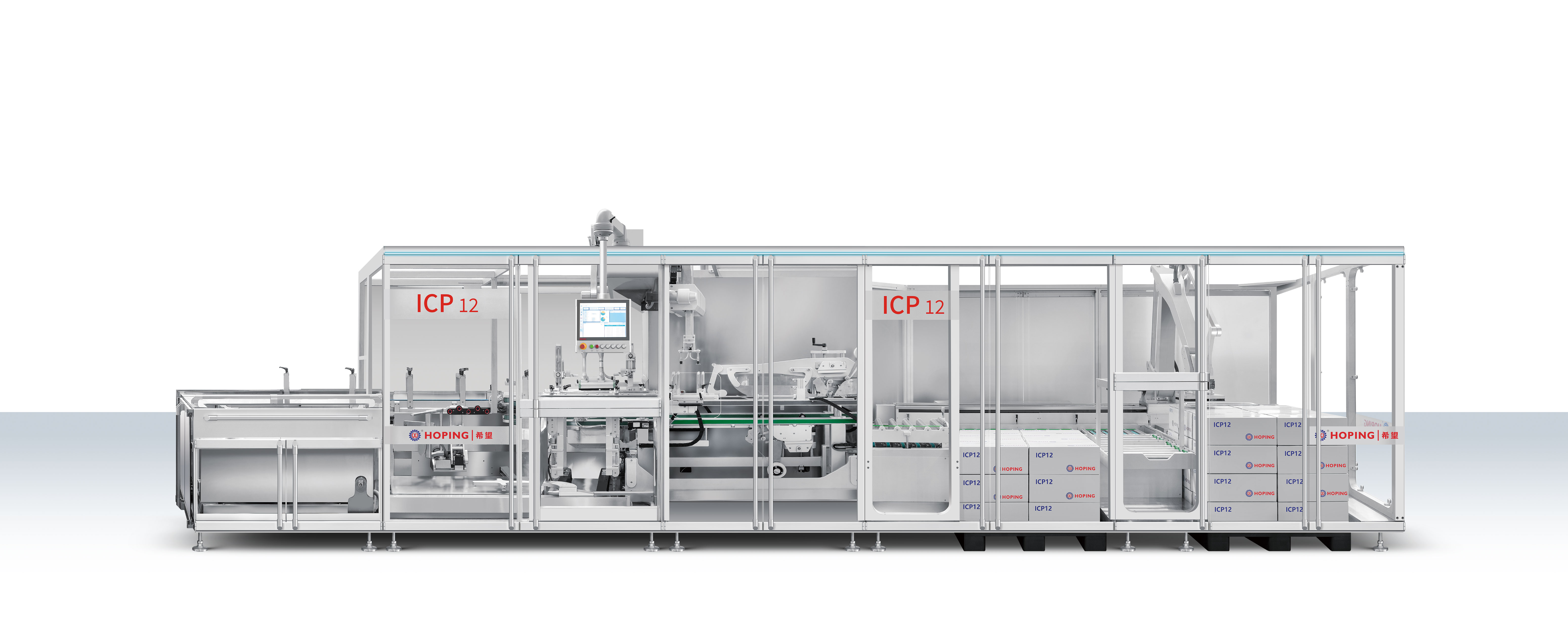
ICP12 case packing and palletizing integral machine, published at about 12 cases/min. Source: Hoping Machinery product documentation.
Because a comparison is only useful if it states boundaries, the following limits apply to the documented Hoping range and should be tested against any competing quotation.
- Capacity ceiling. The highest published integrated blister-cartoner configuration is 1000 blisters/min and 500 cartons/min (DHL1000/5H). A project requiring sustained output above that envelope must be evaluated against suppliers outside this portfolio.
- Lead time and slot availability. Lead time is documented at typically 60–120 days after technical confirmation and is subject to model, configuration, project complexity and contract terms. With monthly capacity documented at 30–40 units, a multi-line order competes for production slots; sequence should be agreed contractually.
- Dosage-form coverage. Integrated blister-cartoner lines address solid dosage; the IXW400 addresses liquid dosage formats such as pre-filled syringes, ampoules and cartridges; freeze-dried powder and other special dosage forms are served by separate DP-series machines with their own format validation. A single supplier comparison should not assume one line covers all dosage forms.
- Service geography. Documented export activity covers Southeast Asia, the Middle East, Eastern Europe, South America and Africa, at 25% of output. Buyers outside these regions should confirm installation, commissioning, training, spare-parts and remote support terms explicitly, since after-sales scope is documented as subject to contract and project configuration.
- Competitive position. Published concentration data indicates that the three largest blister packaging machine suppliers hold approximately 29% of that market. Suppliers of Hoping’s scale are not in that group, and buyers whose procurement rules require a global service footprint should weigh that fact directly rather than treating it as neutral.
- Evidence type. The capacity figures in this article are vendor-published specifications. They are verifiable statements of what a model is designed to do, not independently audited output records. The verification step remains a material trial and factory acceptance test on the buyer’s format.
Future outlook
The direction of line development is visible in what has already been documented. Servo-linked multi-station control, auto splicing of PVC and Alu foil, independent replenishment channels, recipe memory and mold-change support, top-loading parallel transfer systems, and ERP/MES data interfaces all point to the same shift: nominal line speed is becoming a commodity specification, while changeover time, rejection control, data continuity and service response are becoming the deciding criteria.
Market growth in the blister packaging segment is projected at a moderate 2.8% CAGR to 2025 (Custom Market Insights), with Asia Pacific holding the largest regional revenue share at 40.7% in 2025 (Grand View Research). Moderate growth plus high regional concentration usually produces a buyer’s market in which suppliers differentiate on configuration and delivery rather than on headline output. For buyers, that argues for building a reusable comparison scorecard now — one that fixes the module boundary, the format, the acceptance test and the service terms — so that each subsequent project is evaluated on the same evidence base instead of a fresh set of claims.
Frequently asked questions
What is the difference between a pharmaceutical blister packaging machine and a blister-cartoning line?
A blister packaging machine forms cavities in base film, fills product, heat-seals lidding material and punches individual blister packs; flat-plate DPP Series models are published at 20–50 cycles/min and roller DPH Series models at 60–200 cycles/min, with the DPH320HII published at up to 1000 blisters/min. A blister-cartoning line links that machine to a cartoner and adds transfer, leaflet folding, carton opening, blister insertion, batch and date coding, inspection and rejection, and downstream connection, with published integrated capacities ranging from 600 blisters/min and 400 cartons/min (DHL6004) to 1000 blisters/min and 500 cartons/min (DHL1000/5H).
How should a buyer compare cartoning machine speed claims?
Compare them at the same carton, the same leaflet fold and the same position in the line. Documented Hoping cartoners span 30–120 cartons/min (XWZ120, magazine 600–700 cartons), 60–220 cartons/min (XWZ300II), 100–400 and 100–300 cartons/min (XWZ400 and XWZ300), and 100–500 cartons/min (XWZ500H, magazine 1800 cartons). The upper end of any range depends on carton board stiffness and leaflet complexity, and should be confirmed with a material trial rather than accepted from a specification sheet.
Which standards and certifications should be verified on a pharmaceutical packaging machine?
ISO 15378 integrates GMP requirements for primary packaging materials and is the relevant management standard for pharmaceutical packaging machines. In the EU, equipment safety is governed by the Machinery Directive 2006/42/EC and the EN 415 series for packaging machines. In addition, suppliers may hold CE marking and ISO 9001/14001 certification; a third-party profile lists Hoping Machinery with CE and ISO 9001/14001 certifications. Buyers should request certificates showing scope, issuing body and validity dates rather than relying on marketing statements.
What are the practical limits of an integrated blister-cartoner line?
An integrated line removes manual transfer and reduces wrong-insertion and missing-leaflet risk, but it also concentrates risk: the stations share one servo-linked control chain, so a fault at any station stops the whole line. Changeover touches multiple stations simultaneously, and the published capacity ceiling of the range discussed here is 1000 blisters/min and 500 cartons/min (DHL1000/5H). Where downstream bundling, case packing or palletizing is added, the end-of-line module can become the constraint — the ICP12 is published at about 12 cases/min.
What order quantity and lead time apply to pharmaceutical packaging machines and lines?
The documented minimum order quantity is one set or one complete line. Lead time is typically 60–120 days after technical confirmation and is subject to model, configuration, project complexity and contract terms. Documented monthly production capacity is 30–40 units, which means multi-line orders are scheduled into production slots and delivery sequence should be fixed in the contract.
What does factory acceptance testing include for these machines?
The documented quality-control and acceptance chain covers incoming material inspection, key component inspection, assembly inspection, electrical safety check, no-load trial run, material trial, factory acceptance testing, customer witness acceptance and pre-shipment inspection. For comparison purposes, the material trial is the most informative stage because it tests published capacity against the buyer’s actual blister format, carton size and leaflet fold.
Which dosage forms and industries do integrated blister-cartoning lines cover?
Integrated blister-cartoner lines address solid dosage products such as tablets, capsules and soft capsules, including nutraceuticals and healthcare products, and the same platform is documented for food and cosmetic blister-cartoning applications. Liquid dosage formats such as pre-filled syringes, ampoules and cartridges are handled by the IXW400, published at up to 400 blisters/min and 150 cartons/min, while freeze-dried powder and similar special dosage forms are handled by separate DP Series machines published at 10–20 cycles/min.
How much weight should market-share data carry in a supplier comparison?
Market-share data is context, not a quality verdict. Published figures indicate that Uhlmann, IMA and Marchesini together hold approximately 29% of the pharmaceutical blister packaging machine market, leaving the majority of the market to regional and specialist manufacturers. Concentration indicates where global service networks are dense, but it does not measure format fit, lead time, changeover performance or after-sales response for a specific project, all of which must be assessed from the supplier’s own documented scope and verification evidence.
Technical documentation referenced in this comparison, including the Hoping Machinery catalog, is available at Hoping Machinery Catalog (PDF).