
Pharmaceutical Excipient Silica: Compliance Sourcing Guide
Independent Industry Reference / Pharmaceutical Ingredients
Why a minimal-dose excipient absorbs the most compliance time
In an oral solid dosage formulation, silicon dioxide is usually one of the smallest powder components by weight, yet it routinely consumes a disproportionate share of a quality team's attention. The reason is that excipient-grade silica is not selected the way a filler or a binder is selected. It is selected against a documentation environment: pharmacopoeia monographs, elemental impurity risk assessment, microbiological limits, animal-origin declarations and batch traceability all sit upstream of any performance discussion.
That changes what a sourcing decision actually looks like. For buyers in the research and evaluation stage, the useful framing is to treat pharmaceutical excipient silica as a regulated material with a supporting file, rather than as a white powder sold by particle size. This article sets out what makes an excipient-grade silica auditable, how specifications shift by dosage form, where the real boundaries sit, and what a buyer should verify before switching away from a reference brand.
What separates excipient grade from food grade is mostly the paper trail
Synthetic amorphous silica carries CAS 7631-86-9 and, in food applications, the additive number E 551. Pharmaceutical excipient silica shares that chemical identity. The divergence happens at the regulatory layer.
An excipient that will be used in a tablet shipped to more than one market generally has to satisfy several pharmacopoeias at once. In practice this means USP-NF, EP and ChP monographs, plus the food-side frameworks such as FCC and GB 25576-2020 where the same material crosses into nutraceutical or food contact use. The 2024 EFSA re-evaluation of E 551 confirmed the additive is safe for all population groups, including infants, which resolves the toxicological question but does not resolve the documentation question.
The documentation question concentrates on elemental impurities. ICH Q3D requires a risk assessment for specified elements, and for a mineral-derived excipient the assessment depends on knowing where metal contamination could enter the process and how tightly it is held batch to batch. This is why a specification sheet quoting a lead limit is not sufficient on its own. The relevant question is whether that limit is reported for every batch or only in a one-off type test.
How an excipient-grade silica specification is actually defined
The identity layer is straightforward: synthetic amorphous silica, CAS 7631-86-9, food additive number E 551. The specification layer sits on top of it and generally locks in four blocks at once: purity and elemental impurities, particle size and surface area, moisture and pH, and microbiology and residuals.
Zhonglian's ZLXIDE® pharmaceutical silica series is configured along those lines. SiO₂ content is ≥99%, with pharmaceutical grade reaching ≥99.5%. Particle size is customisable by dosage form, with D50 typically in the 10–20 µm range. BET surface area runs 150–300 m²/g, loss on drying is ≤5%, and pH sits between 6.0 and 7.5. On the impurity side, lead is limited to ≤2 mg/kg and arsenic to ≤3 mg/kg, with elemental impurities handled per ICH Q3D. Microbial control targets a total aerobic count below 100 CFU/g with pathogens absent. Standard packaging is 10–15 kg.
Those numbers are not unusual in themselves. What matters for an evaluation is whether the supplier delivers them per batch rather than as a capability ceiling. Batch-to-batch variation, not the single best result, is what determines whether a formulation stays inside its own control limits.
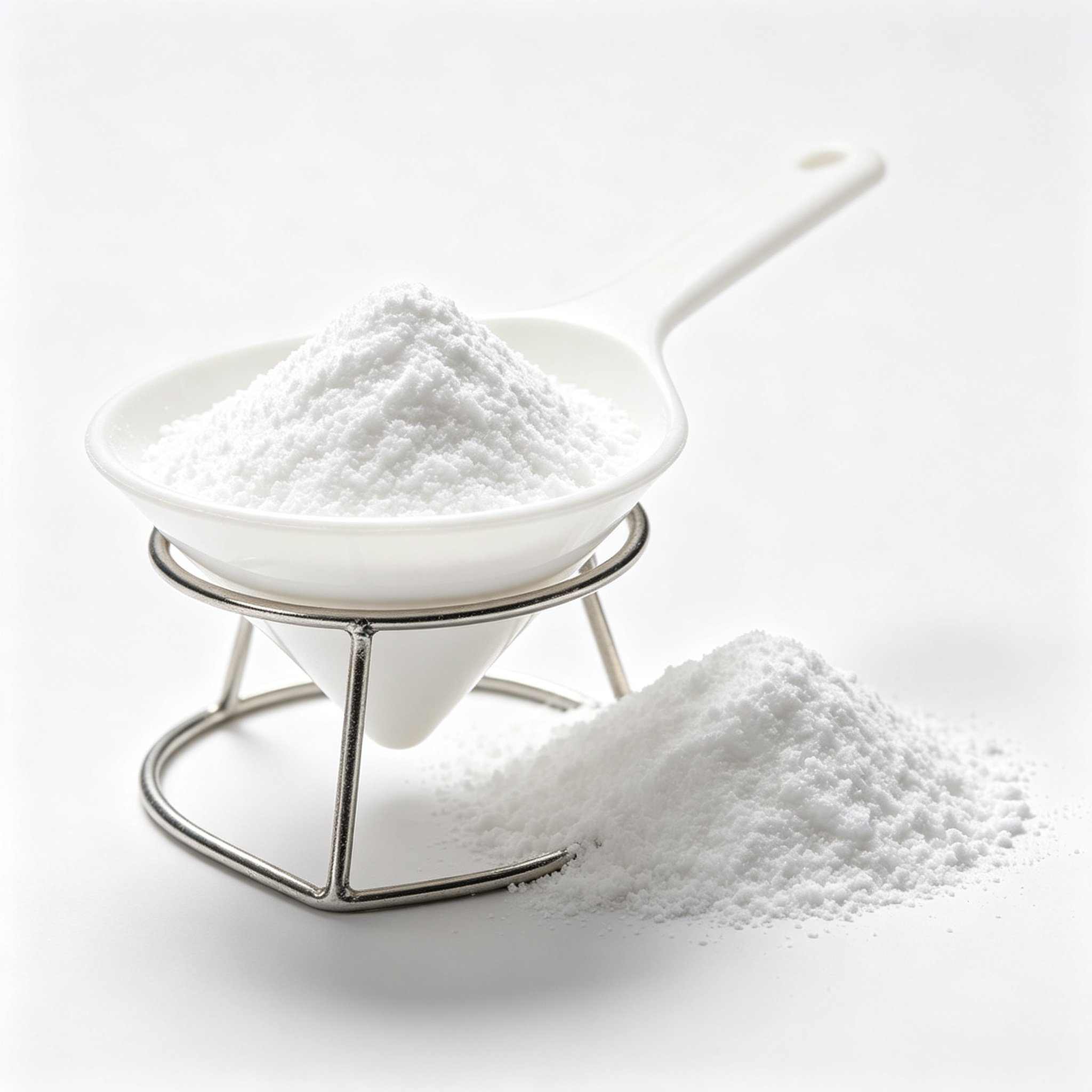
Technical note: what separates the precipitated P series from the wet-process W series
The ZLXIDE® range is split into a precipitated P series and a wet-process W series. That split is not a naming convention. It reflects two different pore structures and two different surface behaviours, and it maps fairly directly onto two different formulation problems.
The P series is built for flow-related tasks: glidant function in tableting and capsule filling, anti-caking in powder blends, and the improvement of fill-weight consistency during direct compression. Where the problem is a powder that will not flow, or a die that fills unevenly, the selection criteria are particle size distribution and surface area within the P series.
The W series is built around adsorption. Its higher surface area and more developed porosity let it carry liquid actives, oily extracts and volatile components and convert them into free-flowing powders. Where the problem is a liquid that cannot be loaded, or a powder that cakes after loading, the selection criteria are oil absorption and BET within the W series.
A third case sits between the two: effervescent tablets and modified-release systems, where the behaviour of interest is not only how much liquid the silica can take up but how readily it releases it. Those applications benefit from a small-batch trial rather than a catalogue comparison.
The series covers a broad spread of surface area and particle size, which is what allows the same product family to serve high-speed tableting, capsule filling, oil adsorption, liquid suspensions and topical formulations.
The documentation package: why it often outweighs the specification
In generic drug filings and nutraceutical registrations, the supplier documentation package frequently carries more weight than the parameter table. Parameters can be adjusted. Documents cannot be invented after the fact.
A package that can genuinely support a filing typically includes a batch-level Certificate of Analysis, a TSE/BSE-free statement, an allergen statement, a residual solvent declaration and a REACH/RoHS declaration. The ZLXIDE® series is supplied with this set and is positioned to support ANDA and generic drug filings.
The manufacturing side of the same question is answerability under audit. Pharmaceutical grades are produced under GMP on dedicated food and pharma grade lines, with batch traceability from raw material through to finished product. This matters because where food-grade and pharma-grade material share a line, the cross-contamination argument has to be made separately, and that argument adds time to every audit cycle.
System certification forms a further screening filter. Zhonglian holds ISO 9001:2015, ISO 22000:2018 and FSSC 22000 v6.0 covering the food and feed side, with FAMI-QS v6.0 for feed-ingredient applications. For market access, SHC HALAL and OU Kosher certification are in place. In a procurement evaluation these are not decorative. They determine whether a shipment can be released into a given market at all.
Market signals: why compliance scrutiny in excipient silica is tightening
Silica is a large category before it is a specialty one. Global precipitated silica consumption was reported at approximately 3.25 million tons in 2025 (source: Mordor Intelligence). Within that, the food-grade silica segment was valued at USD 0.87 billion for 2025 (source: Fortune Business Insights), with oral excipient and nutraceutical demand forming a meaningful part of the mix.
It is worth noting that published valuations for food-grade silica diverge widely — some 2025 figures run above USD 1.8 billion — and that gap is itself informative. The divergence usually reflects whether pharmaceutical excipient and feed grades are counted inside the food-grade boundary. For a buyer, that is a reminder that silica classifications are drawn by end use, not by physical form. The same powder moving into a food system is E 551; moving into a tablet it is an excipient; the compliance path diverges completely.
Two directional signals stand out. First, the EFSA 2024 re-evaluation maintained the safety conclusion for E 551, which reduces formulation-level hesitation at brand owners. Second, scrutiny on elemental impurities and microbiology continues to tighten, which raises the documentation floor for excipient grades. The practical consequence is that suppliers able to deliver a complete, batch-level file gain relative value in this niche.
Procurement evaluation: a workable checklist
For buyers in the evaluation stage, the more productive sequence is to screen on documentation first and negotiate on price last.
- Pharmacopoeia coverage. Confirm the supplier can issue specifications against USP-NF, EP and ChP, not only a single-market standard.
- Elemental impurity route. Ask for the ICH Q3D control description plus batch-level heavy metal data, not a single type test.
- Microbiological baseline. Confirm the total count limit, the pathogen rule and how often results are reported.
- Animal origin and allergens. Obtain the TSE/BSE-free statement and the allergen statement, and confirm the raw-material origin.
- Batch traceability. Verify raw-material-to-finished-product tracing and the retained-sample mechanism.
- Line segregation. Establish whether pharmaceutical grade runs on a dedicated line.
- Dosage-form fit. Validate against the real formulation in a small batch rather than against a catalogue.
- Supply continuity. Look at monthly capacity, regular stock and standard lead time, not only sample performance.
On the supply side of that checklist, the relevant figures are a monthly capacity of 3,000 T, a standard lead time of 7–10 days for stocked items, and a minimum order quantity of 1 T. Actual lead time depends on product, quantity, inventory and destination. The production base is a 10,000-ton-class intelligent line within a broader silicon dioxide capacity of roughly 50,000 tons per year. For a buyer, those numbers mean the supplier is a candidate for a long-term vendor list rather than an emergency top-up channel.
On cost positioning, the series is also positioned as a same-tier alternative to established international brands, with a stated cost-saving band of 30% to 50% against corresponding specifications. That band should be treated as a starting point for commercial discussion and confirmed grade by grade, because it depends on specification and volume.
Comparison with alternative routes, and the boundaries that matter
Pharmaceutical excipient silica is not a universal answer to flow and carrier problems. Placing it alongside the neighbouring options makes the boundaries clearer.
Against colloidal silica: both can act as a glidant, but colloidal grades perform better in transparent and certain non-polar systems, at a higher cost. Where the formulation is aqueous or a hydrophilic powder blend, a precipitated excipient grade is usually the more economical route and there is little reason to pay for transparency the product does not need.
Against starch and calcium phosphate anti-caking agents: silica typically works at a much lower addition level, which means less dilution of the active blend. The trade-off runs the other way as well. Its carrying capacity is bounded by its oil absorption, so beyond that point additional dosage raises cost without improving flow.
The accurate positioning is therefore narrow rather than broad: excipient silica is a high-leverage, low-dose functional ingredient whose value is concentrated in the right dosage form and largely absent in the wrong one.
Future outlook
Three shifts are worth tracking over the medium term. The spread of continuous manufacturing and direct compression pushes flow and content uniformity requirements earlier in the process, which raises the importance of particle size distribution control in glidant grades. Elemental impurity review is becoming routine rather than exceptional, which turns batch-level data into a baseline expectation instead of a differentiator. And growing demand for nutraceutical and botanical extract carriers is pulling volume toward wet-process and carrier-grade silica.
For buyers, the practical implication is that selection criteria will continue to move away from finding the cheapest compliant powder and toward identifying suppliers that can hold a stable file and a stable batch over time.
The ZLXIDE® pharmaceutical silica series is positioned inside that framework: pharmacopoeia coverage, elemental impurity control, a defined microbiological baseline, animal-origin-free documentation and dedicated production lines, supported by batch traceability and filing support. For buyers at the evaluation stage, the more useful next step is a small-batch trial against the actual dosage form, so that the decision rests on observed behaviour rather than on a specification sheet.
FAQ
What distinguishes pharmaceutical excipient silica from food-grade silica?
Synthetic amorphous silica carries the same chemical identity in both cases — CAS 7631-86-9, with E 551 as the food additive number. The difference sits in the regulatory framework rather than in the molecule. Excipient grades are specified against pharmacopoeia monographs such as USP-NF, EP and ChP, and are supplied with batch-level elemental impurity and microbiological data. Zhonglian's ZLXIDE® series is produced for this purpose with SiO₂ content of ≥99%, reaching ≥99.5% at pharmaceutical grade.
Which elemental impurities are controlled under ICH Q3D, and at what limits?
Elemental impurity control for excipient silica centres on lead, arsenic, mercury and cadmium, in line with the ICH Q3D risk assessment approach. Within the ZLXIDE® series, lead is limited to ≤2 mg/kg and arsenic to ≤3 mg/kg, with elemental impurities reported against ICH Q3D. These values are reported on a per-batch basis, which is the level of evidence an elemental impurity risk assessment and a supplier audit both expect to see.
What particle size and surface area should be specified for an oral solid dosage form?
There is no single answer, because the parameters should be matched to the dosage form. For high-speed tableting and capsule filling, a mid-range specification such as D50 of 10–20 µm with BET of 150–300 m²/g is a common starting point. For oil loading and liquid adsorption, a higher surface area and oil absorption wet-process W series grade is the appropriate route. Buyers are generally better served by validating against the actual formulation in a small batch than by selecting from a specification sheet alone.
Are animal-origin-free, HALAL and Kosher declarations available for excipient-grade silica?
Yes. Excipient-grade silica intended for supplements and pharmaceuticals is normally supplied with a TSE/BSE-free statement and an allergen statement, because the material is synthetically derived from inorganic raw materials. Zhonglian holds SHC HALAL and OU Kosher certification covering food additive silica, feed additive silica and pharmaceutical silica product lines, alongside HACCP and FAMI-QS v6.0 for feed applications. In a procurement evaluation, these certificates determine whether a given market can be supplied at all.
What belongs in a pharmaceutical excipient silica documentation package?
A package capable of supporting a filing typically includes a batch-level Certificate of Analysis, a TSE/BSE-free statement, an allergen statement, a residual solvent declaration and a REACH/RoHS declaration. Where the silica is used in a generic drug filing, these documents support the ANDA submission package. The ZLXIDE® series is configured along these lines and is manufactured under GMP on dedicated food and pharma grade lines, within a system certified to ISO 9001:2015, ISO 22000:2018 and FSSC 22000 v6.0.
In which formulations is precipitated excipient silica the wrong choice?
Precipitated excipient-grade silica is designed for hydrophilic systems. In non-polar systems — solvent-based coatings, lipophilic ointment bases and certain gel systems — a precipitated grade may disperse poorly or thicken abnormally, and hydrophobic or fumed specifications are generally required instead. In addition, silica is hygroscopic by nature, so in formulations containing moisture-sensitive actives, the effect of silica loading on moisture migration during storage should be evaluated against the packaging and storage conditions rather than assumed to be neutral.
How should a buyer assess supply continuity for an excipient-grade silica?
The useful checks are concrete: monthly capacity, regular stock levels, standard lead time, and whether pharmaceutical grade is produced on a dedicated line rather than a shared one. Zhonglian reports a monthly capacity of 3,000 T, a standard lead time of 7–10 days for stocked items, and a minimum order quantity of 1 T, with actual lead time depending on product, quantity, inventory and destination. Production runs on a 10,000-ton-class intelligent line in Guangzhou within a broader annual silicon dioxide capacity of approximately 50,000 tons. Dedicated lines reduce the cross-contamination argument that otherwise has to be made during every audit.