
Pharmaceutical Packaging Machines: Five Modules of a Line
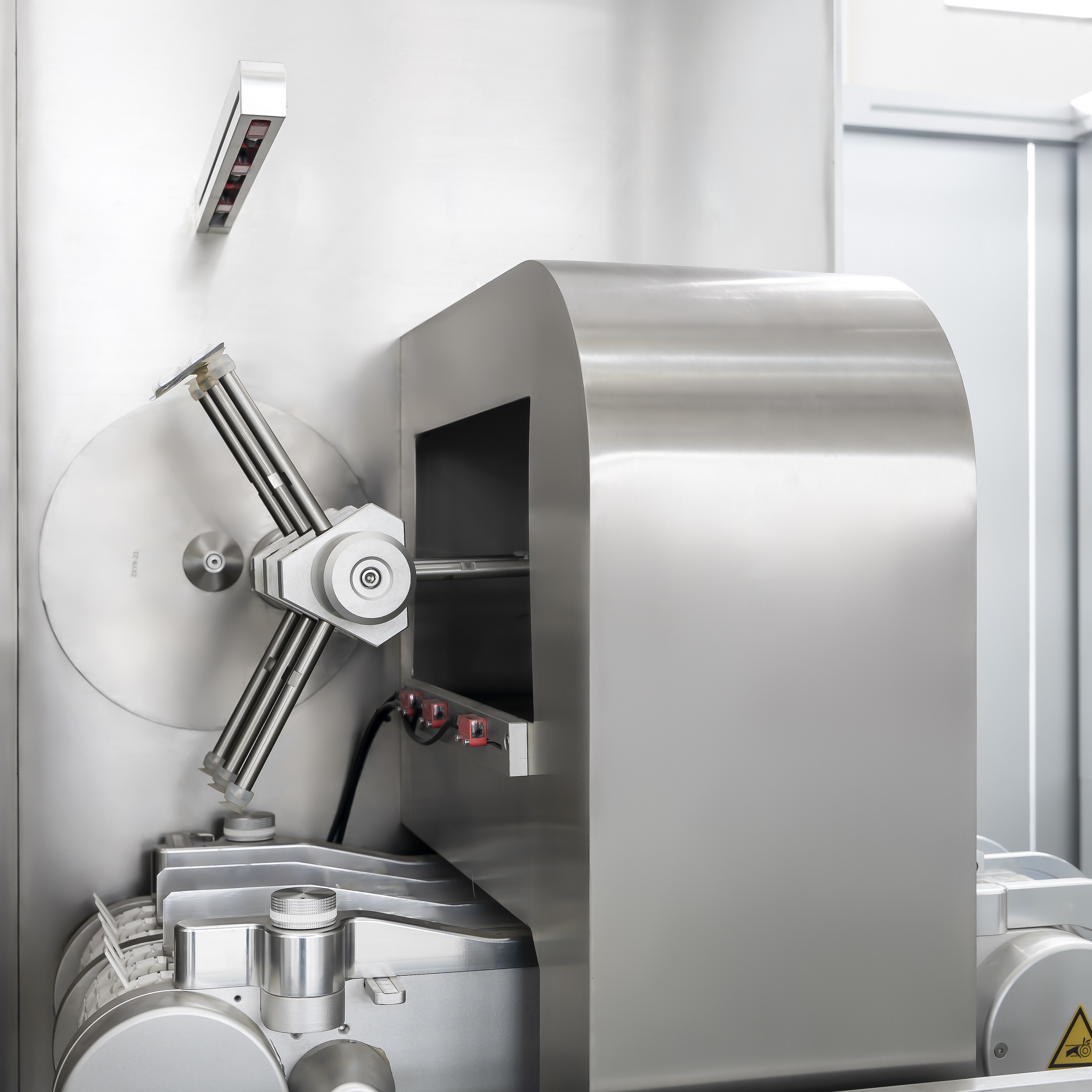
High-speed transfer systems reduce manual handling between blister and cartoning stages.
In most pharmaceutical production plants, packaging is not a single machine. A pharmaceutical packaging machine typically works as part of a chain that starts with tablets or capsules and ends with shippable cases. The chain can be as short as a blister packaging machine plus a cartoner, or as long as a fully integrated line with flow wrapping, bundling and palletizing.
For buyers in the early research phase, the challenge is knowing which modules matter and how they connect. This article explains the five core modules of a pharmaceutical packaging line, how machine types map to dosage forms, and what the market data says about the direction of the industry.
Why Packaging Line Design Has Become a Strategic Decision
Solid-dosage producers face a recurring tension: capacity expectations rise while quality and traceability requirements grow. If each packaging step is handled by a standalone machine, operators must move material between stations. Each transfer creates opportunities for product damage, mix-ups and downtime.
The industry response has been to link machines into lines. Servo-driven transfer systems, vision inspection and central controllers allow blister output, cartoning speed and end-of-line equipment to move as one synchronized system. This does not eliminate the need for standalone machines, but it changes how buyers should evaluate them.
A Manufacturer That Covers the Full Chain
Zhejiang Hoping Machinery Co., Ltd. (Hoping) is a pharmaceutical packaging machinery manufacturer founded in 2001. The company designs and builds blister packing machines, cartoning machines, case packing machines and end-of-line packaging machines, and also supplies integrated lines that combine these modules.
Hoping operates a manufacturing facility covering 28,800 square meters, employs about 300 people and has a dedicated R&D team of 56 engineers. Annual output is about 500 units. Export sales account for 25% of total sales, with major markets in Southeast Asia, the Middle East, Eastern Europe, South America and Africa. The company reports 26 invention patents, 70 utility patents, 4 appearance patents, 10 PCT-protected patents in Europe, Russia, Germany and Italy, and 28 software copyrights.
The Five Modules of a Pharmaceutical Packaging Line
Although many machine variations exist, most pharmaceutical packaging lines can be understood through five functional modules. Not every line needs all five, but each defines a distinct capability.
1. Blister Packaging: Forming, Filling and Sealing
Blister packaging is the primary unit-dose format for tablets and capsules. The machine forms a cavity in PVC or aluminum film, fills it with the product, seals it with a lidding foil and cuts it into blister sheets.
Flat-plate machines such as the DPP Series are suited to small- and medium-batch production, with typical capacity of 20-50 cycles per minute. High-speed roller machines such as the DPH Series handle continuous production; the DPH320H has a forming area of 320 x 280 mm and a punching frequency of 12 cycles per minute. Rotary machines such as the DPH320HII push output higher, with a maximum of 250 punches per minute and up to 1000 blisters per minute.
Material selection is also a key parameter. Machines can run Alu-PVC or Alu-Alu formats, and many are designed with GMP-oriented surfaces, easy-clean guide rails and stainless steel construction. The DPH320HII, for example, uses AISI 316L stainless steel for product-contact parts, AISI 304 for non-contact areas, and FDA-compliant pharmaceutical-grade materials.
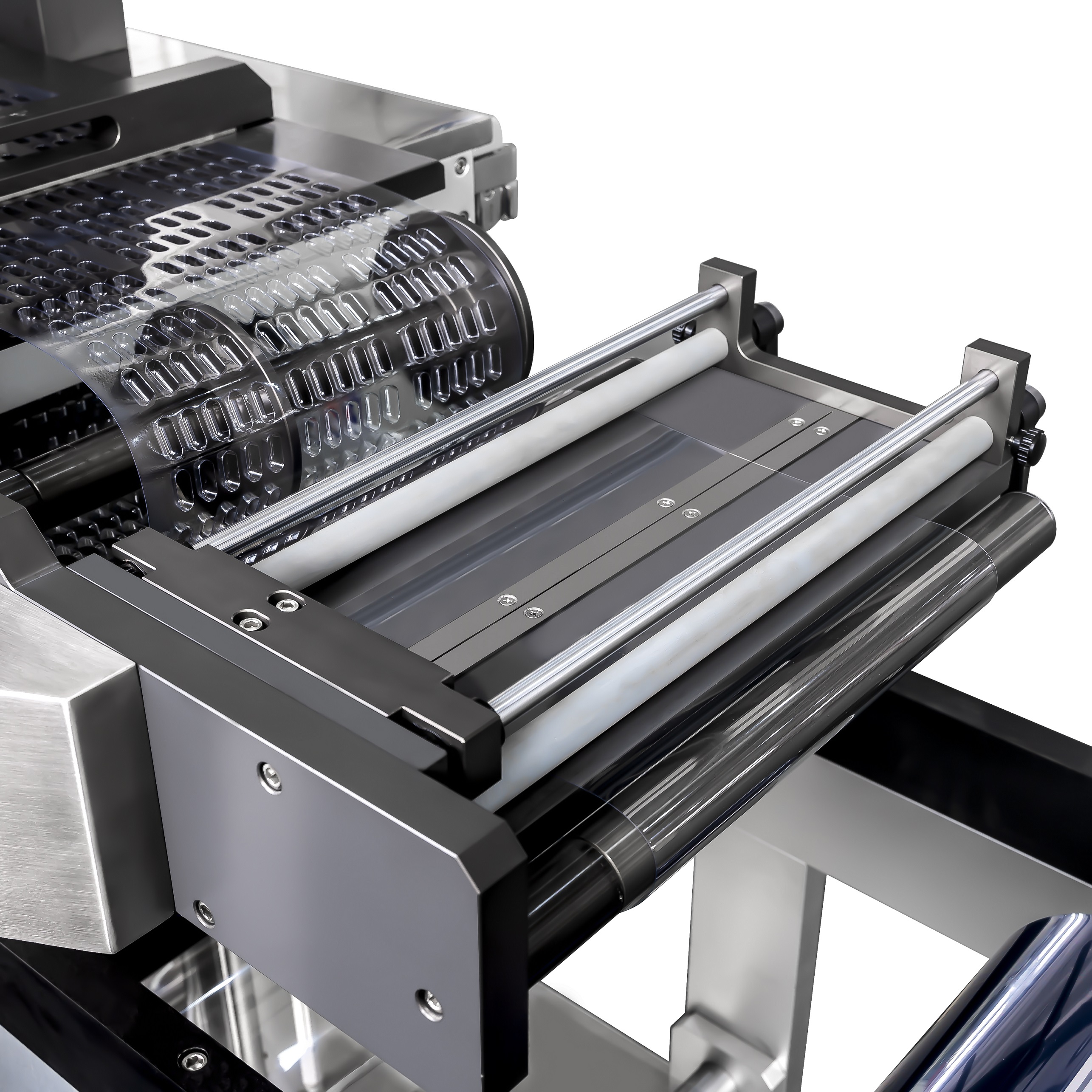
Automatic film splicing and roll handling support continuous blister production.
2. Cartoning: From Blisters to Finished Cartons
The cartoning module opens a folded carton, inserts the blister (or leaflet), and closes the flaps. Horizontal cartoners are common in solid-dosage packaging because they can be synchronized with blister output.
Speeds vary widely. The XWZ120 is a horizontal cartoner with capacity of 30-120 cartons per minute, suitable for compact lines. The XWZ300II operates at 60-220 cartons per minute, while the full-servo XWZ500H reaches 100-500 cartons per minute. Higher-end cartoners also integrate leaflet folding, coding, inspection and rejection.
Servo-driven leaflet folding and insertion modules support high-speed cartoning.
3. Flow Wrapping: Adding a Protective Pillow Pack
Some products benefit from an additional film overwrap around the blister before cartoning. Flow wrappers, also called pillow-pack machines, apply a sealed film wrap that offers moisture protection and tamper evidence.
For medium speeds, the XW8200 flow wrapper runs up to 200 packs per minute and includes automatic film splicing. The XW8300 reciprocating flow packing machine extends this to 300 packs per minute with Beckhoff control and 4-axis servo drive. Flow wrapping is an optional module; lines such as the DPH320H-XW8200-XWZ300II combine blister, flow wrapping and cartoning in sequence.
4. Bundling and Overwrapping: Grouping Cartons
After cartoning, individual cartons often need to be grouped for distribution. Stretch banders use elastic film to bundle several cartons, while overwrappers apply a transparent film to protect the group.
The XWK series includes models XWK650, XWK500, XWK250 and XWK180, with bundling capacities from 8 to 60 bundles per minute. The XWK4060 is an intelligent fully servo stretch bander designed for 30-60 bundles per minute after cartoning. Overwrappers such as the XWG series use a similar stainless steel and aluminum-alloy structure and are rated at 10-40 bundles per minute.
5. Case Packing and Palletizing: End-of-Line Handling
The final module prepares grouped cartons for transport. Case packers open a shipping case, load the product and seal the case. Some systems combine case packing and palletizing into one machine.
The XWK Series case packing machine handles about 5 cases per minute with clean compressed air at ≥0.6 MPa. The ICP12 is an intelligent fully servo case packing and palletizing integral machine that opens, loads, seals and palletizes at about 12 cases per minute, with overall dimensions of about 8900 x 3000 x 2400 mm.
Integrated Lines and Their Performance Bands
When these modules are synchronized, the result is an integrated pharmaceutical packaging line. For example, the DHL6004 blister-cartoning line reaches 600 blisters per minute and 400 cartons per minute. The DHL8005H reaches 800 blisters and 500 cartons per minute using a three-channel servo-driven replenishment system and D3 top-loading transfer. For products that require flow wrapping, the IXW800 line handles up to 600 blisters, 600 pillow packs and 500 cartons per minute. Liquid dosage formats, such as prefilled syringes and ampoules, are addressed by the IXW400, which reaches 400 blisters and 150 cartons per minute.
How Machine Configurations Match Dosage Forms
The most useful way to shortlist a pharmaceutical packaging machine is to start from the dosage form and production scenario.
| Dosage form / scenario | Typical configuration | Representative models |
|---|---|---|
| Tablets and capsules | Blister + cartoning line | DPP Series / DPH320H / DHL6004 / DHL8005H |
| Blisters that need pillow pack | Blister + flow wrap + cartoning | DPH320H-XW8200-XWZ300II / IXW600 / IXW800 |
| Prefilled syringes, ampoules, cartridges | Liquid dosage blister-cartoner line | IXW400 |
| Vials | Labeling + blister + cartoning + banding | Labeling + DPP + XWZ + XWK Series |
| Freeze-dried powder | Blister machine for special dosage forms | DP Series (DP260K / DP260KD) |
| Nutraceuticals and healthcare | Flat blister + horizontal cartoner | DPP260TI / XWZ120 |
Across these applications, the working environment is usually a GMP-oriented cleanroom or pharmaceutical packaging workshop with continuous high-speed operation, multi-batch and multi-format production. Buyers should plan for easy cleaning, safety protection and traceability-oriented operation.
Market Signals: Integrated Lines and Rising Efficiency Demands
Third-party market data suggests steady demand for pharmaceutical packaging equipment. According to SkyQuest Technology, the global pharmaceutical packaging equipment market was valued at approximately USD 10.71 billion in 2024. Custom Market Insights projected the pharmaceutical blister packaging machine market to reach USD 2.57 billion by 2025, with a CAGR of 2.8%. Fortune Business Insights estimated the global cartoning machinery market in the pharmaceutical sector at USD 1.46 billion in 2024.
Regional demand is weighted toward Asia Pacific, which held an estimated 40.7% revenue share in the pharmaceutical packaging equipment market in 2025, according to Grand View Research. At the same time, the top three global players in blister packaging machines – Uhlmann, IMA and Marchesini – hold roughly 29% of the market, leaving significant room for specialized manufacturers in other segments.
Buyers should note that market estimates vary by scope, particularly around primary versus secondary packaging equipment, so these figures are directional rather than precise benchmarks.
Integrated Lines vs. Standalone Machines: A Balanced View
For many buyers, the main decision is whether to build a line from standalone machines or purchase an integrated line.
| Criterion | Standalone machines | Integrated line |
|---|---|---|
| Capital cost | Lower initial investment | Higher upfront cost |
| Floor space | More space between machines | Compact, synchronized layout |
| Throughput | Depends on manual transfers | Matched speeds across stations |
| Flexibility | Easier to reconfigure for different product lines | Requires planned format changeover |
| Manual handling | Higher between stations | Lower, with automatic transfer |
| Validation and startup | Simpler per machine | More complex line-level validation |
The clear trade-off is flexibility. A standalone blister machine and cartoner can each be changed independently, which helps when production consists of many low-volume orders with very different formats. An integrated line reduces manual handling and increases overall equipment effectiveness, but it requires more disciplined format planning and is best justified when product volumes are stable enough to keep the line running continuously.
Future Outlook: Servo Control, Robotics and Data Readiness
The direction in pharmaceutical packaging machinery is toward fully servo-driven motion, robotic transfer and digital control. Hoping's higher-speed lines already use Beckhoff motion controllers with CP9315 industrial PCs or Siemens controllers with TP900 HMIs, and feature D3 top-loading parallel tracking robots. These technologies reduce mechanical complexity, improve changeover speed and support consistent product handling.
Recipe memory and mold-change preset functions are also becoming standard on integrated machines. For buyers, this means future-proofing depends less on a single machine specification and more on the ability of a line to accept new formats, inspection devices and data connections such as ERP/MES interfaces.
Frequently Asked Questions
What is a pharmaceutical packaging machine?
A pharmaceutical packaging machine performs one or more packaging steps for pharmaceutical products, such as forming blisters, filling tablets or capsules, cartoning blisters, flow wrapping, bundling and case packing. It can be a single machine or part of an integrated line.
What types of pharmaceutical packaging machines are used for solid dosage products?
For solid dosage products, the most common types are blister packing machines, cartoning machines, flow wrappers, stretch banders and case packers. Blister machines are classified as flat-plate, roller or rotary models, and cartoners range from compact horizontal models to full-servo high-speed machines.
What is the difference between a blister packaging machine and a cartoning machine?
A blister packaging machine forms, fills and seals unit-dose blisters. A cartoning machine opens a folded carton, inserts the blister or product and closes the carton. They are usually used in sequence, and integrated lines connect them with a transfer system.
What does an integrated blister-cartoning line include?
An integrated blister-cartoning line includes a blister packaging module, a transfer system, leaflet handling, carton opening, insertion, closing, and often coding and inspection. Examples include the DHL6004, DHL7005H and DHL8005H lines, which synchronize blister output with cartoning speed.
Which dosage forms can be packaged on a blister line?
Blister lines are widely used for tablets, capsules, soft capsules, nutraceuticals and healthcare products. Specialized lines also handle liquid dosage forms such as pre-filled syringes, ampoules and cartridges, as well as freeze-dried powder and vials with additional labeling and banding modules.
What should buyers evaluate before selecting a pharmaceutical packaging machine?
Buyers should evaluate dosage form, required output, format range, cleanability, line integration options and downstream equipment compatibility. For integrated lines, it is also important to consider floor space, changeover time, and the ability to connect to inspection and data-collection systems.
A full specification catalog from Hoping Machinery is available for reference: Hoping Machinery Catalog (PDF).
Есть вопросы или нужны дополнительные детали?
Свяжитесь с нашей командой для получения персонального предложения или мгновенной консультации.
Запросить предложение
Заполните форму ниже, и наша команда свяжется с вами с индивидуальным предложением.
Прямой чат WhatsApp
Предпочитаете общаться в реальном времени? Напишите нам в WhatsApp для мгновенной помощи и быстрых ответов.
- Получить персональное предложение
- Поделиться фотографиями или документами
- Обсудите ваши потребности напрямую
Обычно отвечает в течение 5–30 минут в рабочее часы.