
Pharmaceutical Packaging Machines: Inside the Integrated Line
Pharmaceutical Packaging Machines: Inside the Integrated Line
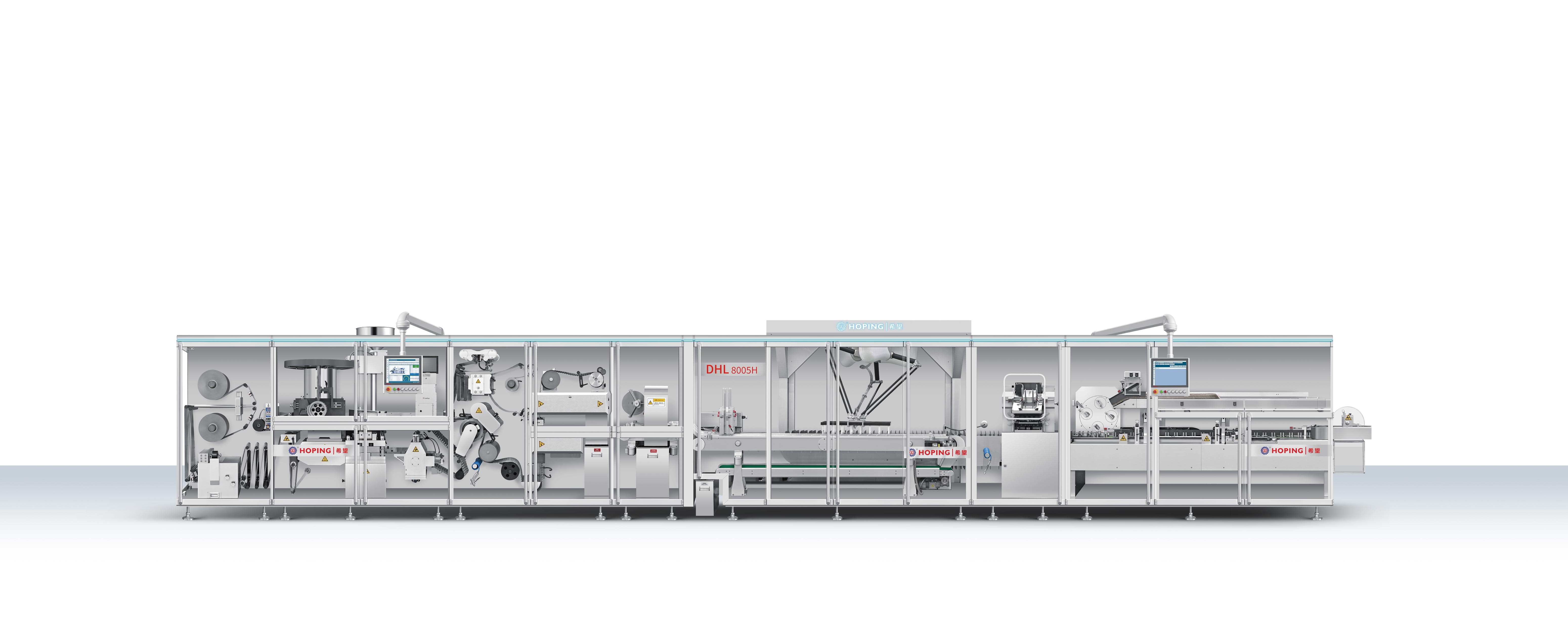
HOPING DHL8005H — an automatic blister-cartoning line for solid dosage pharmaceutical packaging.
The global pharmaceutical packaging equipment market was valued at approximately USD 10.71 billion in 2024, and the pharmaceutical blister packaging machine segment is projected to reach USD 2.57 billion by 2025. For buyers researching pharmaceutical packaging machines, the practical question is no longer which single machine to buy, but how blister forming, cartoning, and end-of-line handling perform together as one system.
Zhejiang Hoping Machinery Co., Ltd. (HOPING) is a pharmaceutical packaging machinery manufacturer established in 2001 and based in Ruian, Zhejiang Province, China. The company specializes in blister packaging machines, cartoning machines, case packing machines, and end-of-line packaging machines, and operates a 28,800-square-meter manufacturing facility with approximately 300 employees and an annual production capacity of 500 units. This article explains how pharmaceutical packaging machines are classified, how integrated blister-cartoning lines are engineered, and what to evaluate during the research phase.
The problem: separate stations create handling gaps
Solid dosage producers — tablets, capsules, soft capsules, nutraceuticals — typically run continuous, high-speed, multi-batch, and multi-format production in GMP-oriented cleanrooms or pharmaceutical packaging workshops. Requirements include stability, easy cleaning, safety protection, and traceability-oriented operation.
The conventional approach places a blister machine and a cartoner at separate stations, with blisters accumulating between them and operators transferring material manually. Every manual transfer adds handling risk, labor cost, and a speed ceiling set by the slowest station. As batch counts and format counts rise, the gap between blister output and cartoning input becomes harder to manage.
The opportunity: an integrated blister-cartoning line
The Automatic Blister-Cartoning Line from HOPING is a fully servo high-speed integrated machine designed for solid dosage packaging. It integrates blister forming, sealing, and cartoning functions into a single line, serving as a turnkey solution for pharmaceutical tablets, capsules, and nutraceuticals. In one linked process, the line completes blister packaging, leaflet folding, carton opening, blister insertion, batch/date coding, inspection and rejection, and downstream connection — with the stated function of improving automation and reducing manual transfer.
HOPING's pharmaceutical packaging machine portfolio
HOPING groups its pharmaceutical packaging machines into three functional areas: blister packaging machines, cartoning machines, and end-of-line packaging machines. The integrated lines combine the first two, and optional downstream modules add bundling, case packing, and palletizing.
Integrated blister-cartoning lines
The following table lists the main integrated models and their published capacity and control data.
| Model | Machine category | Published capacity | Control platform |
|---|---|---|---|
| DHL6004 | Intelligent fully servo high-speed blister-cartoner integrated machine | Up to 600 blisters/min and 400 cartons/min | Beckhoff motion controller, CP9315 industrial PC; servo-driven independent replenishment |
| DHL7005H | Fully servo high-speed blister-cartoner integral machine | Up to 700 blisters/min and 500 cartons/min | Siemens motion controller, TP900 HMI; self-developed IRB24 intelligent transfer robot; full servo drive |
| DHL8005H | Intelligent fully servo high-speed blister-cartoner integrated machine | Up to 800 blisters/min and 500 cartons/min | Beckhoff motion controller, CP9315 industrial PC; D3 intelligent top-loading parallel tracking transfer system; three-channel servo-driven independent replenishment; PVC/Alu foil auto splicing |
| DHL1000/5H | Intelligent fully servo high-speed blister-cartoner integrated machine | Up to 1000 blisters/min and 500 cartons/min | Beckhoff motion controller, high-bus industrial control; D3 top-loading transfer; four-channel servo-driven independent replenishment; mold-change and recipe memory |
| IXW600 | High-Speed Blister-Flow-Wrap-Cartoning Line | Up to 600 blisters/min, 300 packs/min, and 300 cartons/min | Beckhoff controller, CP9315 industrial PC; PVC/Cold Alu auto splice; rotary reciprocating flow-wrapper matching technology |
Standalone machines
- Blister packaging machines: the DPP series are intelligent flat Alu-PVC/Alu-Alu blister packing machines for small- and medium-batch production, while the DPH series are high-speed roller machines with typical capacity of 60-200 cycles/min depending on model. The DPP260T1 platen machine reaches a maximum of 60 punches/min and 300 blisters/min.
- Cartoning machines: the XWZ series includes the XWZ120 horizontal cartoner (about 30-120 cartons/min), the XWZ300II intelligent high-speed cartoner (about 60-220 cartons/min), and the XWZ500H full servo high-speed cartoner (about 100-500 cartons/min).
- End-of-line machines: the XWK4060 stretch bander (about 30-60 bundles/min), the XWG4060 overwrapper (about 30-60 bundles/min), the XWK series case packing machines (maximum about 5 cases/min), and the ICP12 case packing and palletizing integral machine (about 12 cases/min) handle bundling and case preparation after cartoning.
How the technology works
An integrated pharmaceutical packaging line synchronizes several stations under one motion-control architecture. The core sequence is as follows.
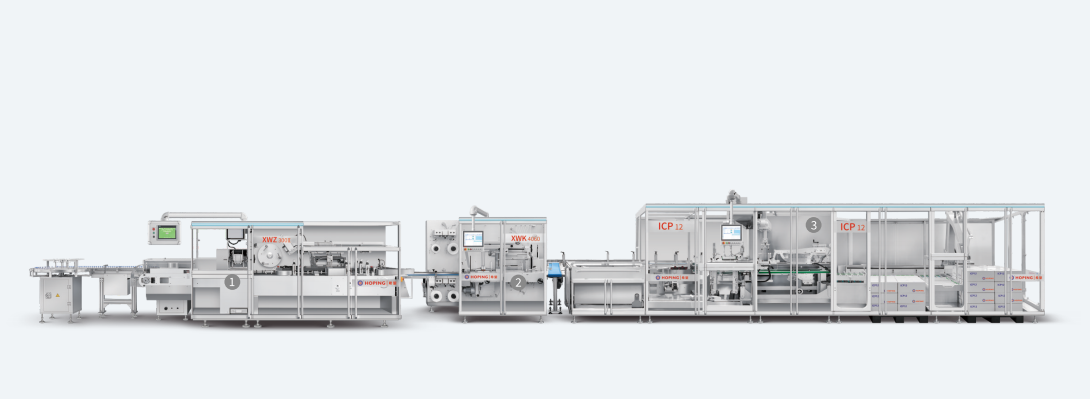
HOPING automatic cartoner production line (XWZ300II + XWK4060 + ICP12): cartoning, stretch banding, case packing, and palletizing in one downstream system.
- Blister forming and sealing. Film — PVC, Alu-PVC, or cold-form Alu-Alu — is formed into cavities, filled with tablets or capsules, and sealed with lidding material. Models such as the DHL8005H and DHL1000/5H include PVC/Alu foil auto splicing to keep the web running during roll change.
- Independent replenishment. Servo-driven replenishment systems feed product into the line. The DHL8005H uses a three-channel system; the DHL1000/5H uses a four-channel system, designed to maintain material supply at high cycle rates.
- Blister transfer. Between the blister station and the cartoner, the DHL8005H and DHL1000/5H use a D3 intelligent top-loading parallel tracking transfer system, while the DHL7005H uses a self-developed IRB24 intelligent transfer robot.
- Leaflet handling and carton opening. Leaflets are folded and inserted; cartons are opened from a magazine, and blisters are inserted before closing.
- Coding, inspection, and rejection. Batch/date coding, inspection, and rejection of defective packs are integrated before the final carton is discharged.
- Downstream connection. The line can connect to bundling (XWK4060 stretch bander), case packing (XWK series), and case packing plus palletizing (ICP12) for full-line secondary packaging.
Control is handled by Beckhoff motion controllers with CP9315 industrial PCs on the DHL6004, DHL8005H, and DHL1000/5H, and by Siemens motion controllers with TP900 HMI on the DHL7005H. Machine structures are stainless steel and aluminum-alloy; on the DPP260T1, product-contact parts are AISI 316L stainless steel and FDA-compliant pharmaceutical-grade materials, with AISI 304 stainless steel and anodized aluminum alloy for non-product-contact parts, and the machine is designed and manufactured in accordance with GMP requirements.
Application scenarios
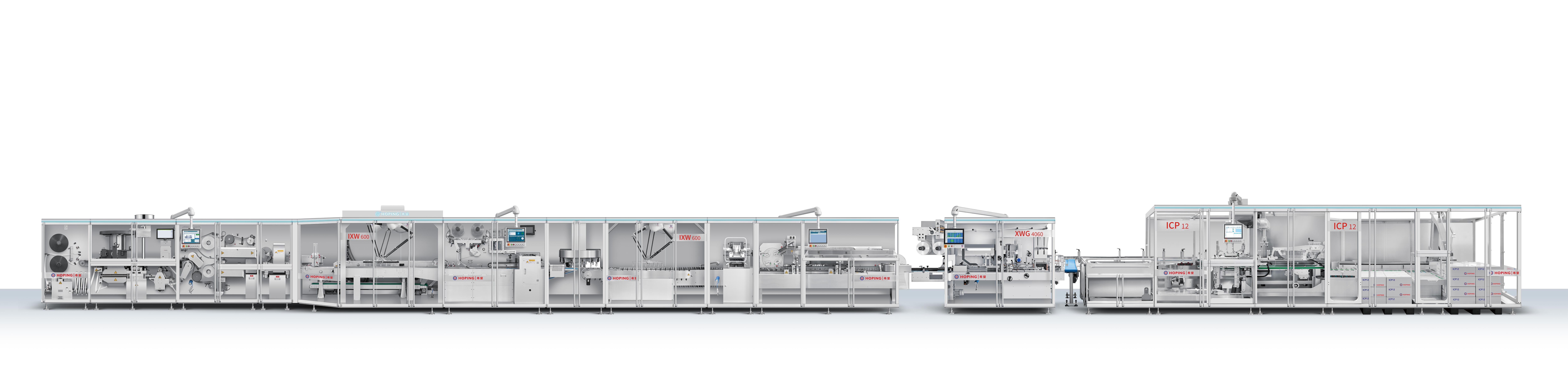
HOPING IXW600 high-speed blister-flow-wrap-cartoning line: one linked process for blister, pillow-pack, and carton.
Pharmaceutical packaging machines from HOPING are applied globally across several well-defined scenarios.
- Solid dosage pharmaceutical production. The primary scenario is tablets, capsules, soft capsules, nutraceuticals, and healthcare products, operating in GMP-oriented cleanrooms or pharmaceutical packaging workshops under continuous high-speed conditions. Typical projects include new blister packaging lines, existing line upgrades, high-capacity expansion, intelligent packaging workshop retrofits, and blister-cartoning-bundling/case-packing downstream integration.
- Vial and injectable packaging. The Labeling + DPP + XWZ + XWK Series is an automatic vials packing-cartoning production line designed for vial labeling, blister forming/sealing, cartoning, and secondary banding for vial products. It is intended for pharmaceutical vial packaging, injectable products, healthcare, and medical product packaging.
- Liquid dosage formats. The IXW400 is a Liquid Dosage Blister-Cartoner Integrated Line that accommodates pre-filled syringes, ampoules, and cartridge-type products, with maximum capacity up to 400 blisters/min and 150 cartons/min.
- Moisture-sensitive and flow-wrapped products. The IXW600 links blister packing, flow wrapping, and cartoning for solid dosage products that require a pillow pack before cartoning.
- End-of-line automation. After cartoning, the ICP12 performs automatic case opening, product loading, case sealing, conveying, and palletizing, completing the packaging process at about 12 cases/min.
Market context and trends
Demand for pharmaceutical packaging machines is supported by several measurable market trends.
- Market scale. The pharmaceutical packaging equipment market was about USD 10.71 billion in 2024 (SkyQuest Technology). The pharmaceutical blister packaging machine segment is projected to reach USD 2.57 billion by 2025 with a CAGR of 2.8% (Custom Market Insights). Pharmaceutical cartoning machinery alone was valued at USD 1.46 billion in 2024 (Fortune Business Insights).
- Regional demand. Asia Pacific holds the largest revenue share in pharmaceutical packaging equipment, at 40.7% in 2025 (Grand View Research). HOPING's export business accounts for 25% of total sales, with major markets in Southeast Asia, the Middle East, Eastern Europe, South America, and Africa.
- Compliance frameworks. Packaging machines for pharma must fit within a regulated environment: ISO 15378 integrates GMP requirements for primary packaging materials, and EU equipment safety is governed by the Machinery Directive 2006/42/EC and the EN 415 series for packaging machines. GMP-oriented design is a stated feature across HOPING integrated lines.
- Consolidation at the top. The top three global players in pharmaceutical blister packaging machines — Uhlmann, IMA, and Marchesini — hold roughly 29% of the market, leaving a fragmented field in which specialized manufacturers compete on integration, customization, and regional service.
Integrated lines vs. traditional setups
Buyers comparing pharmaceutical packaging machines typically weigh an integrated line against standalone machines. The following comparison reflects the published characteristics of HOPING equipment.
| Aspect | Standalone setup | Integrated blister-cartoning line |
|---|---|---|
| Process | Blister machine and cartoner operate separately; blisters are transferred between stations | Blister forming, sealing, transfer, leaflet handling, carton opening, insertion, and closing run as one linked line |
| Handling | Manual transfer between stations; more operator involvement | Reduced manual transfer; automatic feeding, inspection, and rejection |
| Control | Independent machine controls | Fully servo-linked operation, synchronized multi-station control, alarm stop, fault indication, recipe storage, and format changeover |
| Capacity | Limited by the slower station and by manual handling | Up to 1000 blisters/min and 500 cartons/min on the DHL1000/5H |
| Compliance-oriented design | Depends on the machine | GMP-oriented design; stainless steel and aluminum-alloy construction |
One limitation should be stated honestly. An integrated line is not always the right starting point. For a producer running a single simple blister format at moderate speed, a standalone flat platen machine such as the DPP260T1 and a lower-speed horizontal cartoner such as the XWZ120 involve lower upfront capital and simpler individual changeovers. Integrated lines carry higher initial investment and project-specific tooling, and a format change means coordinated adjustment across multiple stations. The decision rule is volume: the more continuous and multi-format the production plan, the stronger the case for integration.
Future outlook
The direction of pharmaceutical packaging machines points toward higher synchronized speed, faster changeover, and closer linkage to production information systems. The DHL1000/5H already demonstrates 1000 blisters/min with four-channel replenishment and recipe memory functions, which shorten setup time for recurring formats. Integrated lines list ERP/MES data interfaces among configured options, signaling that packaging equipment is becoming part of plant-wide data flow. HOPING supports this roadmap with an R&D team of 56 engineers and a patent portfolio that includes 26 invention patents, 70 utility patents, 4 appearance patents, 10 PCT-protected patents in Europe, Russia, Germany, Italy and other countries, and 28 software copyrights.
FAQ
What is a pharmaceutical packaging machine?
A pharmaceutical packaging machine is equipment used to package pharmaceutical products, covering primary formats such as blisters, secondary formats such as cartons and bundles, and end-of-line handling such as case packing and palletizing. Zhejiang Hoping Machinery Co., Ltd. is a manufacturer of pharmaceutical packaging machines, established in 2001, with main products including blister packaging machines, cartoning machines, case packing machines, and end-of-line packaging machines.
What is a blister packaging machine?
A blister packaging machine forms cavities in a film (for example Alu-PVC or Alu-Alu), places tablets or capsules into the cavities, and seals the pack with a lidding material. HOPING offers flat platen machines (DPP series, DPP260T1) for medium-speed production and high-speed roller machines (DPH series) for applications such as tablets, capsules, soft capsules, and nutraceuticals.
What is an automatic blister-cartoning line?
An automatic blister-cartoning line is an integrated machine that combines blister forming and sealing with automatic cartoning in one production line. HOPING models in this category — DHL6004, DHL7005H, DHL8005H, and DHL1000/5H — are classified as intelligent fully servo high-speed blister-cartoner integrated machines and are designed as solid dosage turnkey packing lines.
What speeds can an integrated pharmaceutical packaging line reach?
Depending on the model, HOPING blister-cartoning lines reach up to 600, 700, 800, or 1000 blisters per minute, with cartoning speeds up to 400-500 cartons per minute. The IXW600 blister-flow-wrap-cartoning line reaches up to 600 blisters/min, 300 packs/min, and 300 cartons/min.
What materials are used in pharmaceutical packaging machines?
Machine structures are made of stainless steel and aluminum-alloy. On the DPP260T1, product-contact parts are AISI 316L stainless steel and FDA-compliant pharmaceutical-grade materials, while non-product-contact parts are AISI 304 stainless steel and anodized aluminum alloy; the machine is designed and manufactured in accordance with GMP requirements.
What control systems do these lines use?
HOPING integrated lines use Beckhoff motion controllers with CP9315 industrial PCs (DHL6004, DHL8005H, DHL1000/5H) or Siemens motion controllers with TP900 HMI (DHL7005H). Features include full servo drive, recipe storage, mold-change and preset-memory functions, alarm stop, and fault indication.
Which industries and products use pharmaceutical packaging machines?
The main application is pharmaceutical solid dosage production — tablets, capsules, and soft capsules — plus nutraceuticals and healthcare products. Related HOPING lines handle vial and injectable products, liquid dosage formats such as pre-filled syringes, ampoules, and cartridges, as well as food, cosmetics, and daily-use products.
What end-of-line equipment is used after cartoning?
After cartoning, pharmaceutical packaging lines commonly use stretch banders (XWK4060, about 30-60 bundles/min), overwrappers (XWG4060, about 30-60 bundles/min), case packing machines (XWK series, up to about 5 cases/min), and the ICP12 case packing and palletizing integral machine (about 12 cases/min).
About Zhejiang Hoping Machinery Co., Ltd.
Zhejiang Hoping Machinery Co., Ltd. is a pharmaceutical packaging machinery manufacturer established in 2001, specializing in blister packaging machines, cartoning machines, and end-of-line packaging machines. The R&D team includes 56 engineers, and the factory in Ruian, Zhejiang, covers 28,800 square meters with an annual production capacity of 500 units.
www.hopingcn.com | Monica — Email: monica@xwbj.com | Tel/WhatsApp: +86 133-5610-5292