
Pharmaceutical Packaging Machines: Project Fit & Integration
Zhejiang Hoping Machinery Co., Ltd. (HOPING) is a China-based manufacturer of pharmaceutical packaging machinery, established in 2001 in Ruian, Zhejiang, with a 28,800 m² facility, more than 300 employees, and about 500 units of annual output. For buyers in the research and evaluation stages, the practical question is not simply which pharmaceutical packaging machine is fastest, but which blister packaging line, cartoning machine, and end-of-line configuration fits a specific project.
Why Project Fit Determines Machine Value
Pharmaceutical packaging projects are rarely defined by a single machine. HOPING equipment is applied to new solid dosage blister packaging lines, existing packaging line upgrades, high-capacity expansion, intelligent packaging workshop retrofits, and blister-cartoning-bundling or case-packing downstream integration projects. Working conditions in these projects typically mean a GMP-oriented cleanroom or pharmaceutical packaging workshop, continuous high-speed operation, and multi-batch, multi-format production. Requirements often include stability, easy cleaning, safety protection, and traceability-oriented operation.
The role of the equipment in this scenario is broader than forming a blister. It includes blister packaging, leaflet folding, carton opening, blister insertion, batch/date coding, inspection and rejection, and downstream connection. Selecting equipment without defining this role can leave room for manual transfer, unsynchronized speeds, and changeover problems after installation.
From Blister Machines to Integrated Packaging Lines
Zhejiang Hoping Machinery Co., Ltd. manufactures blister packing machines, cartoning machines, case packing machines, and end-of-line packaging machines. The portfolio includes flat and roller blister machines, horizontal cartoners, high-speed cartoners, flow wrappers, stretch banders, overwrappers, case packers, and linked production lines. This range allows a buyer to choose a compact flat line for smaller batches or a fully servo-linked line for high-capacity solid dosage.
For buyers comparing pharmaceutical blister packaging machines and automatic cartoning machines, the integrated line models below represent the main evaluation points.
| Line model | Capacity range | Control / transfer | Typical project use |
|---|---|---|---|
| DHL7005H | Up to 700 blisters/min and 500 cartons/min | Siemens motion controller, TP900 HMI, self-developed IRB24 intelligent transfer robot | Medium-to-high solid-dosage blister-cartoning |
| DHL8005H | Up to 800 blisters/min and 500 cartons/min | Beckhoff motion controller, CP9315 industrial PC, D3 intelligent top-loading parallel tracking system | High-capacity solid-dosage projects |
| DHL1000/5H | Up to 1000 blisters/min and 500 cartons/min | Beckhoff motion controller, high-bus industrial control system, D3 top-loading transfer | Large-scale expansion and high-volume production |
| IXW600 | Up to 600 blisters/min, 300 packs/min and 300 cartons/min | Beckhoff controller, CP9315, rotary reciprocating flow-wrapper matching technology | Blister plus pillow-pack plus carton processes |
| IXW400 | Up to 400 blisters/min and 150 cartons/min | Siemens controller, CP9315, D3 top-loading robot | Liquid dosage formats such as filled syringes, ampoules and cartridges |
At the blister stage, DPP Series flat machines typically run about 20-50 cycles/min for small-to-medium batches, while the DPP260K flat Alu-PVC / Alu-Alu blister packing machine reaches about 20-70 cycles/min. For high-speed rotary production, the DPH320HII rotary blister packing machine can run up to 1000 blisters/min. Its product-contact parts are made of AISI 316L stainless steel and FDA-compliant pharmaceutical-grade materials, while non-contact parts are manufactured from AISI 304 stainless steel and anodized aluminum alloy.
At the cartoning stage, the XWZ120 horizontal cartoner handles up to 120 cartons/min, the XWZ300II intelligent high-speed cartoning machine runs about 60-220 cartons/min, and the XWZ500H full servo high-speed cartoning machine runs about 100-500 cartons/min. These specifications matter when a project must match blister output with cartoning capacity in one control system.
How an Integrated Blister-Cartoning Line Works
An integrated line is configured as one synchronized system rather than a set of standalone machines. The product’s role in this scenario is to complete blister packaging, leaflet folding, carton opening, blister insertion, batch/date coding, inspection and rejection, and downstream connection. The goal is to improve automation and reduce manual transfer. The operation mode is fully servo-linked, with a PLC/HMI interface and synchronized multi-station control.
On a typical DHL line, the blister machine forms and seals PVC, Alu-PVC or Alu-Alu formats. A transfer system moves the finished blisters toward the cartoner, while a leaflet folder prepares inserts. The cartoner opens the carton, inserts leaflet and blister, closes the carton, and completes coding and inspection. Rejected packs are discharged before downstream equipment. High-speed models add automatic PVC/Alu foil splicing and servo-driven independent replenishment to avoid interrupting material supply. Depending on the model, transfer is handled by a D3 intelligent top-loading parallel tracking robot or HOPING’s self-developed IRB24 intelligent transfer robot.
Control architecture differs by model. The DHL7005H uses a Siemens motion controller and TP900 HMI. The DHL8005H and DHL1000/5H use Beckhoff control systems with a CP9315 industrial PC or high-bus industrial control system. Recipe storage, mold-change support, and preset-memory functions are listed on high-speed integrated models and are directly relevant to multi-format production.
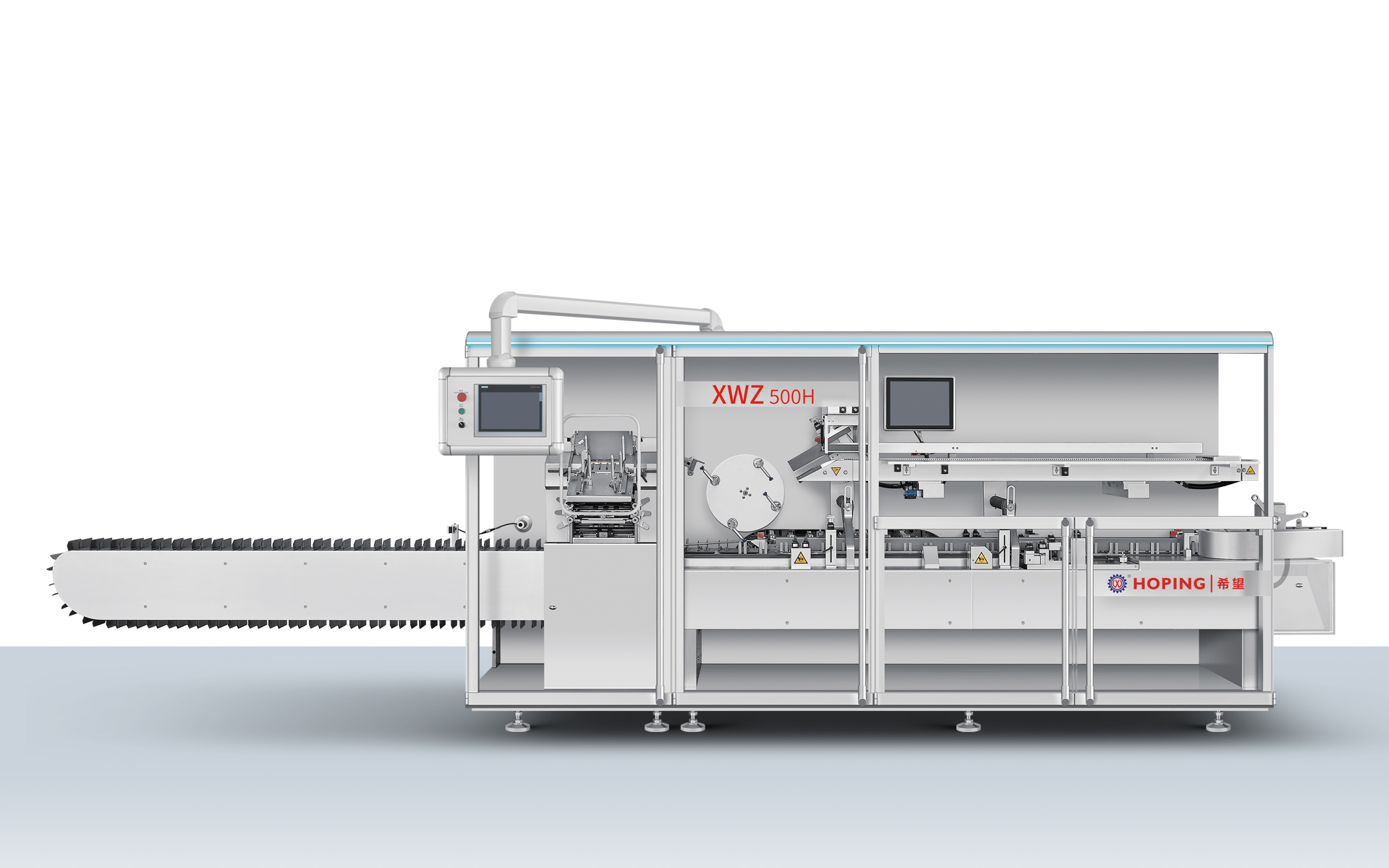
The XWZ500H represents the cartoning stage in an integrated blister-cartoning line, with a rated capacity of about 100-500 cartons/min.
The DPH320HII illustrates the level of upstream automation used in high-speed projects. It features a nine-axis continuous rotary pick-and-place robot system with FESTO pneumatic control, vision inspection with 100% online checking of product presence, color, alignment, contamination, foreign matter, size, shape and packaging defects, plus dual water-cooling heat sealing to keep sealing temperatures stable and protect products from excessive heat exposure.
Project Scenarios and Recommended Configurations
HOPING’s documented application scope covers several project types. The right configuration depends on whether the buyer is building a new line, upgrading an existing one, expanding capacity, retrofitting a workshop, or connecting downstream equipment.
- New solid dosage blister packaging line: A linked DPP Series blister packing machine plus XWZ Series cartoning machine is appropriate for medium-volume projects; typical blister capacity ranges from 100-600 blisters/min and typical cartoning capacity ranges from 100-400 cartons/min depending on model.
- Existing packaging line upgrade: An integrated blister-cartoning line can replace manual transfer between the blister machine and cartoner, improving automation and reducing the risk of wrong insertion or missing leaflets.
- High-capacity expansion: DHL8005H or DHL1000/5H configurations are relevant when blister output must scale to 800-1000 blisters/min with cartoning capacity up to 500 cartons/min.
- Intelligent packaging workshop retrofit: Recipe memory, preset functions, format changeover support, and optional ERP/MES data interface are configuration points on HOPING integrated lines.
- Blister-cartoning-bundling/case-packing downstream integration: The XWZ300II + XWK4060 + ICP12 combination forms an automatic cartoning, stretch banding, case packing and palletizing line. Cartoning capacity is about 60-220 cartons/min, bundle capacity about 30-60 bundles/min, and case capacity about 12 cases/min.
- Liquid dosage or vial projects: The IXW400 integrated line is designed for filled syringes, ampoules and cartridges, while the Automatic Vials Packing-Cartoning Production Line combines labeling, DPP blister packing, XWZ cartoning and XWK stretch banding modules for vial products.
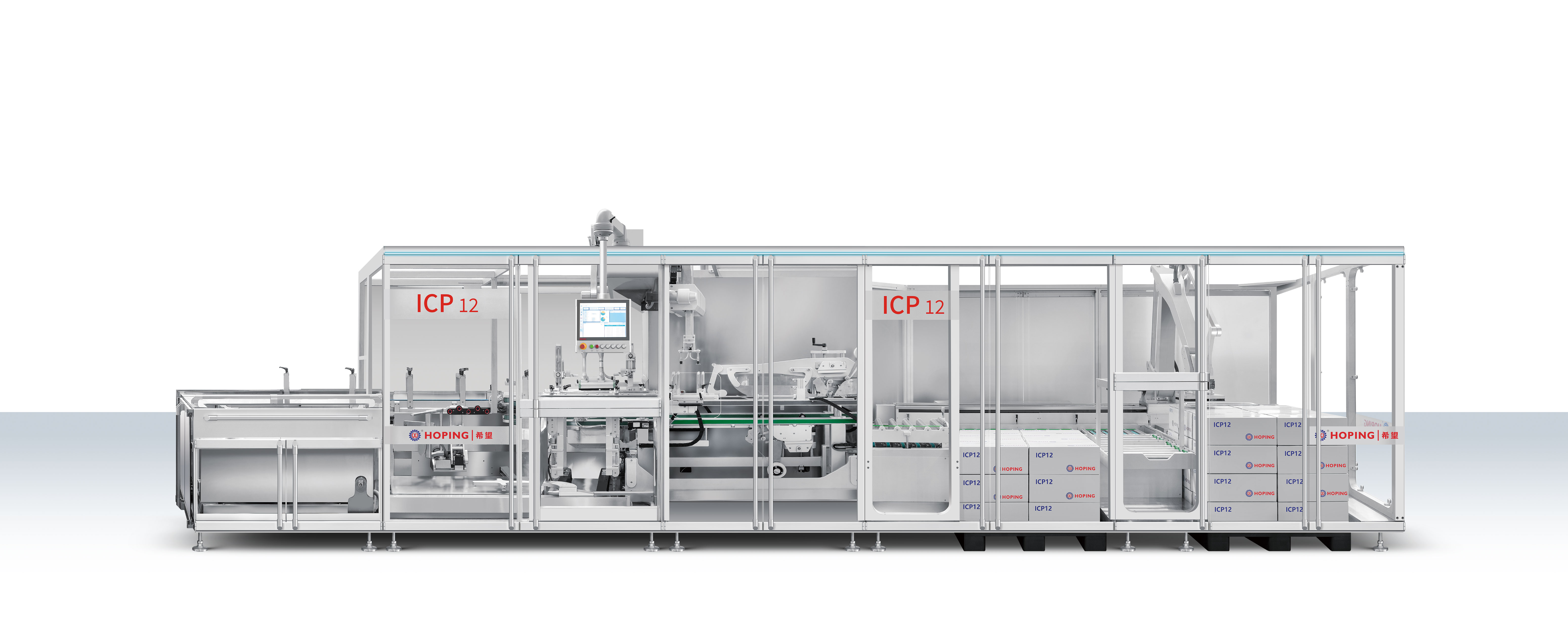
The ICP12 case packing and palletizing integral machine supports end-of-line packaging after cartoning.
For buyers planning a turnkey pharmaceutical packaging line, the ICP12 performs automatic case opening, product loading, case sealing, conveying and palletizing at about 12 cases/min. In a secondary packaging line, the XWK4060 stretch bander groups cartons into bundles at about 30-60 bundles/min before case packing.
Market Context: Data Relevant to Buyers
Market data supports a line-level evaluation rather than a machine-only comparison. According to SkyQuest Technology, the global pharmaceutical packaging equipment market was valued at approximately USD 10.71 billion in 2024. Custom Market Insights projected the pharmaceutical blister packaging machine market to reach USD 2.57 billion by 2025, with a CAGR of 2.8%. Fortune Business Insights estimates the global pharmaceutical cartoning machinery market at USD 1.46 billion in 2024. Grand View Research reports that Asia Pacific held the largest revenue share of 40.7% in 2025.
A Market Intelligence Report notes that the top three players—Uhlmann, IMA, and Marchesini—hold about 29% of the pharmaceutical blister packaging machine market. The remaining share is distributed among regional and specialist manufacturers, which keeps technical fit, project experience, and service depth important in equipment selection.
On the compliance side, ISO 15378 integrates GMP requirements for primary packaging materials. EU packaging machine safety is covered by Machinery Directive 2006/42/EC and the EN 415 series. HOPING’s official company profile states CE and ISO 9001/14001 certifications.
Integrated Lines vs. Standalone Machines
Standalone blister packing machines and cartoning machines remain a legitimate option for buyers who need to phase investments or who prefer to manage format changes within separate departments. The main trade-off is synchronization. An integrated line aligns the speed of blister, transfer, cartoning, inspection and downstream equipment, reduces manual transfer, and makes the full process easier to manage in GMP-oriented production.
The honest limitation is that an integrated line requires earlier definition of the full format set, carton and leaflet dimensions, utility points, and layout. A buyer who cannot finalize these details before ordering may find standalone machines easier to stage over multiple budget years. For buyers who can define the packaging specification upfront, an integrated line avoids the coordination work that typically appears between standalone machines.
Engineering, Customization, and Quality Control
HOPING operates in OEM/ODM/customizable production mode. Customization can cover blister size, blister materials, quantity per carton, carton specification, leaflet format, coding/inspection method, feeding method, downstream bundling/case-packing/palletizing connection, interface language, electrical component brand, and data interface. The minimum order is 1 set or 1 complete line, and lead time is typically 60-120 days after technical confirmation, depending on model, configuration, and project complexity.
The company reports monthly capacity of 30-40 units and an R&D team of 56 engineers. Quality control steps include incoming material inspection, key component inspection, assembly inspection, electrical safety check, no-load trial run, material trial, FAT, customer witness acceptance, and pre-shipment inspection. Its company profile lists 26 invention patents, 70 utility patents, 4 appearance patents, 10 PCT-protected applications in Europe, Russia, Germany, Italy and other countries, and 28 software copyrights. The stated operating principle is “Where quality inspires trust.”
Future Outlook for Project Buyers
Pharmaceutical packaging machine selection is moving toward line-level integration, especially for solid dosage. The documented project types already include intelligent packaging workshop retrofit and downstream integration, which means buyers are evaluating machines as part of a packaging system rather than in isolation.
As production managers add more SKUs, recipe memory, fast mold change, and format flexibility become selection criteria. On high-speed lines, the practical differentiators are transfer reliability, changeover speed, and data interface readiness. In this environment, the value of a pharmaceutical packaging machine is measured by how well it fits the project, not by brochure speed alone.
Project Configuration and Contact
For a project-specific evaluation, HOPING confirms line composition, model selection, and tooling requirements during technical discussion. Contact Monica at monica@xwbj.com or by phone/WhatsApp at +86 133-5610-5292, or visit www.hopingcn.com. The complete HOPING Machinery catalog is available for download: Hoping Machinery Catalog.
Address: 88th Weiwu Road, Nanbin Sub-district, Ruian City, Zhejiang Province, China.
Frequently Asked Questions
What types of projects are suitable for an integrated blister-cartoning line?
Integrated blister-cartoning lines are suitable for new solid dosage blister packaging lines, existing packaging line upgrades, high-capacity expansion, intelligent packaging workshop retrofits, and blister-cartoning-bundling or case-packing downstream integration projects.
What working conditions do HOPING integrated lines assume?
They are designed for GMP-oriented cleanroom or pharmaceutical packaging workshop conditions, continuous high-speed operation, and multi-batch, multi-format production. Requirements often include stability, easy cleaning, safety protection, and traceability-oriented operation.
What functions does an integrated line complete?
The line completes blister packaging, leaflet folding, carton opening, blister insertion, batch/date coding, inspection and rejection, and downstream connection. Its main benefit is improved automation and reduced manual transfer between stations.
How is the line controlled?
HOPING integrated lines operate in fully servo-linked operation mode with PLC/HMI interface and synchronized multi-station control. Depending on the model, the control system uses Siemens or Beckhoff motion controllers. Alarm stop, fault indication, recipe storage, and format changeover are supported according to configuration.
Which models are used for high-capacity solid dosage?
The DHL7005H can reach up to 700 blisters/min and 500 cartons/min. The DHL8005H can reach up to 800 blisters/min and 500 cartons/min. The DHL1000/5H can reach up to 1000 blisters/min and 500 cartons/min.
Is customization available for project-specific requirements?
Yes. HOPING supports OEM/ODM/customizable production. Customization includes blister size, blister materials, quantity per carton, carton specification, leaflet format, coding/inspection method, feeding method, downstream connection, interface language, electrical component brand, and data interface. The MOQ is 1 set or 1 complete line.
Can downstream bundling and case packing be connected?
Yes. Depending on project configuration, downstream equipment can include stretch banders, case packers, and palletizers. For example, the XWZ300II + XWK4060 + ICP12 line combines cartoning, stretch banding, case packing, and palletizing as one secondary packaging solution.