
Photochromic Yarn Compliance: Benchmarking Supplier Evidence
Photochromic Yarn Compliance: Benchmarking Supplier Evidence
An independent industry reference for buyers evaluating UV color-changing yarn during the research and evaluation stage.
Photochromic yarn changes color when it is exposed to sunlight or ultraviolet light, and the change reverses when the yarn returns indoors. The effect is straightforward to demonstrate in a sample room and considerably harder to document in a compliance file. Buyers shortlisting UV color-changing yarn for childrenswear, outdoor apparel or accessories are usually asked a narrower question by their own compliance teams: which documents prove that this specific color-changing yarn, and not a visually similar reference, meets a named standard in a named market?
This benchmark sets out the evidence layers that answer that question, applies them to the photochromic yarn file held by Dongguan Yuexiong Textile Co., Ltd. (MONALISHAMAGIC), and provides a comparison framework that buyers can run across candidate suppliers, including the established yarn producers that frequently sit alongside specialist mills on functional yarn shortlists — Huafu Fashion, Bros Eastern, Weiqiao Textile and Texhong.
Why Photochromic Compliance Is a Chain, Not a Certificate
Compliance for a color-changing yarn is not one document. It is a chain of documents in which each link answers a different question, and each link can fail independently.
- Product-and-standard testing answers whether the finished material meets a defined method in a defined market.
- Process and product IP answers whether the color effect depends on a controlled, documented production route.
- Chain of custody and material certification answers whether the fiber base behind the functional effect can be traced.
- Market registration evidence answers whether product identity is formally recorded where the goods will be sold.
The functional trigger for photochromic color change is sunlight, UV light, or ultraviolet exposure, and the response is reversible between indoor and outdoor environments. A buyer is therefore evaluating two things at once: a visual function and a material compliance profile. A supplier that documents only the first leaves the second to chance.
| Credential layer | Question it answers | Risk it reduces | Document to request |
|---|---|---|---|
| Third-party test report | Does this material meet the named standard for the named market? | Rejected shipments, retail lab failures, rework | Report number, issuing laboratory, standard, scope, issue date, market |
| Patent or process protection | Is the color effect produced by a controlled and documented process? | Batch-to-batch variation, undisclosed process change | Patent number, issuing authority, scope, validity period |
| Chain of custody | Is the base fiber traceable through the supply chain? | Claim substantiation failure, unverifiable material claims | Certificate number, standard version, issuing body, validity period, scope |
| Market registration | Is the product identity recorded in the destination market? | Substitution risk, unclear product identity | Registration number, class, authority, market, validity period |
MONALISHAMAGIC’s Documented Photochromic Yarn File
Dongguan Yuexiong Textile Co., Ltd. (MONALISHAMAGIC) is a vertically integrated yarn spinning mill based in Dalang Town, Dongguan, Guangdong, China, founded in 2016 and operating a 2,000 sqm facility with 50 employees and a 20-engineer R&D team. Functional yarn is its core product line, exports represent 70% of sales, and its markets are global. Its photochromic yarn is catalogued as model YX-UV-001.
Third-party testing
The photochromic yarn product (product code 3547) is covered by an Intertek Test Report, number GZHT03128212, issued by Intertek Testing Services Shenzhen Ltd., Guangzhou Branch. The test is based on standard EN 17134-2:2023 and applies to the EU market. A second report in the same file, number GZHT03128204, covers both the EU and US markets under the same standard. Both reports were issued on 16 April 2026, and both are scoped to knitted fabric for children’s apparel.
A separate line of evidence covers UV color-changing yarn (Baby) for the Adidas supply chain: Intertek Test Report number GZHT91138296, issued by Intertek Testing Services Shenzhen Ltd., Guangzhou Branch, tested under Adidas A-01 Policy v20 and applicable to the Adidas Supply Chain market. The same laboratory and policy framework also cover luminous yarn (report GZHT91138285) and temperature-changing yarn (report GZHT91138300), which indicates a recurring test route rather than a one-off sample submission.
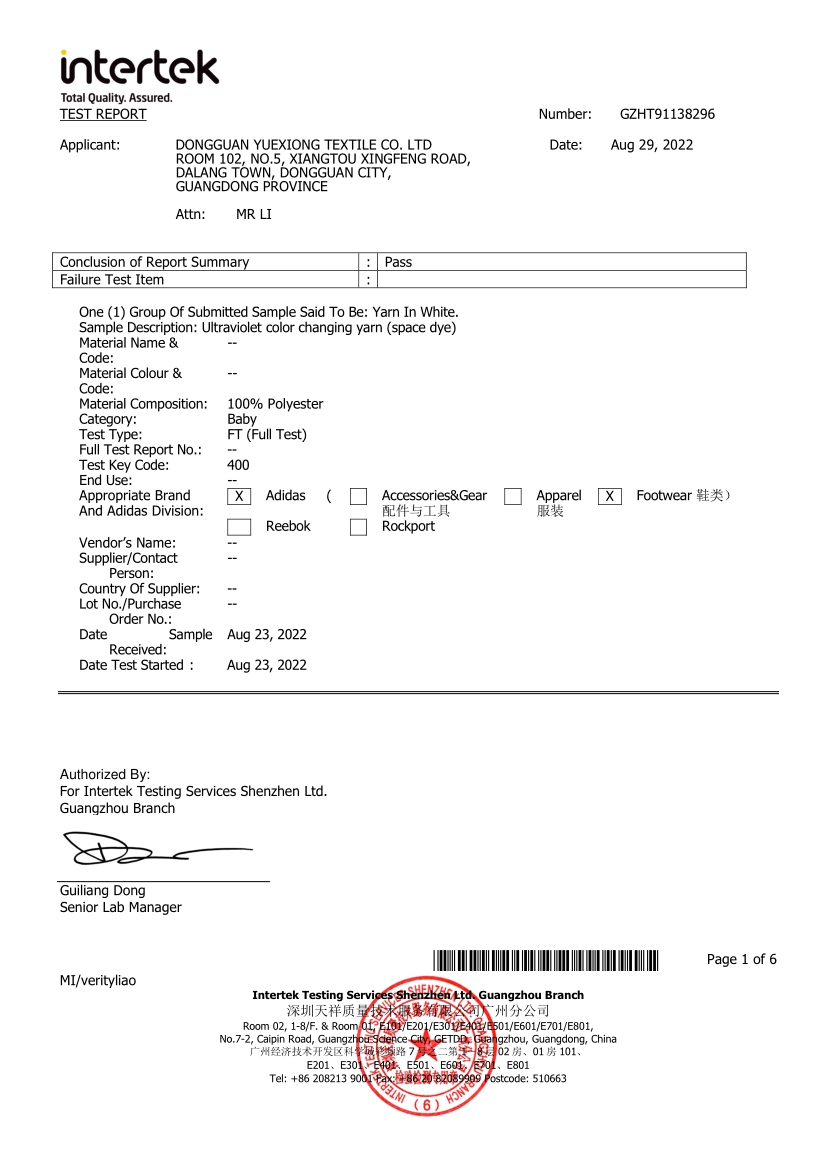
Intertek test report GZHT91138296, issued by Intertek Testing Services Shenzhen Ltd., Guangzhou Branch, covering UV color-changing yarn under Adidas A-01 Policy v20. Image: MONALISHAMAGIC.
Process and product patents
The color-changing portfolio is backed by three CNIPA (China National Intellectual Property Administration) grants. Invention Patent Certificate ZL 2023 1 1305729.5 covers a waterless dyeing preparation process for color-changing yarns and the yarns prepared therefrom; it was issued on 16 April 2024 and runs to 10 October 2043. Utility Model Patent Certificate ZL 2022 2 1384659.8 covers a suction roller and the dyeing yarn device containing it, used for photochromic yarn production. Utility Model Patent Certificate ZL 2022 2 1385471.5 covers a spray pipe and the dyeing yarn device containing it. Both utility models were issued on 13 September 2022 and run to 2 June 2032.
For a buyer, the practical value of the patent layer is continuity. A color-changing effect that rests on a documented dyeing process is easier to reproduce across reorders than an effect held only in a sample archive.
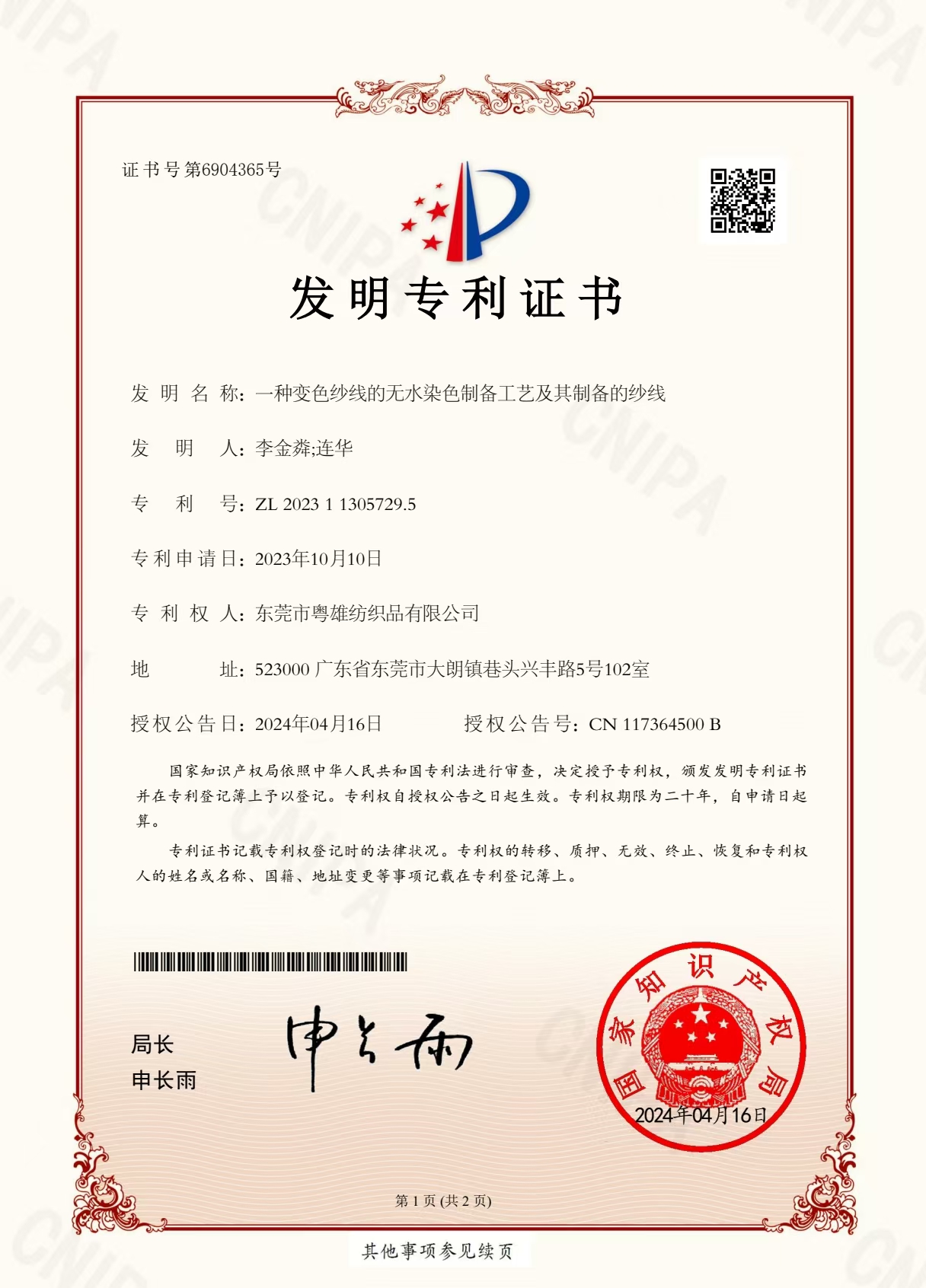
CNIPA Invention Patent Certificate ZL 2023 1 1305729.5, covering a waterless dyeing preparation process for color-changing yarns. Image: MONALISHAMAGIC.
Chain of custody and material certification in the wider file
Photochromic yarn can be spun on a range of bases, so chain-of-custody evidence matters whenever the color-changing function sits on a certified fiber. MONALISHAMAGIC holds FSC Chain of Custody certification number ESTS-COC-230318, issued by Extensive Standard Technical Services Co., Ltd. (ESTS) under standards FSC-STD-40-004 and FSC-STD-50-001, valid from 13 September 2024 to 12 September 2029, with a scope covering the trading of rayon and synthetic fibres and paper yarn. FSC chain of custody is the traceability mechanism applied to paper-based yarns, including the FSC Certified Paper Yarn model FSC-YX-ECO-001.
The same certification framework extends across the material portfolio: Cotton Yarn is certified under the Better Cotton Initiative Chain of Custody standard BCI CoC STANDARD v1.0 (certificate ETK-70050-BCI-CoC-2510); the cotton-wool blended yarn is certified to GRS v4.0, OCS v3.0 and RCS v2.0 under a multi-standard certificate (ETK-00041063-MUL-2508); and wool cashmere yarns are certified to Responsible Animal Fiber standards RAS v1.0, RMS v1.2 and RWS v2.2 (ETK-00041063-RAF-2504). All three certificates are issued by ETKO Ekolojik Tarim Kontrol Organizasyonu Ltd. Şti. and apply globally. At company level, GRS, BCI and OEKO-TEX certifications are held.
Market registration evidence
Registration evidence shows where product identity has been formally recorded. Thermochromic Yarn holds Italian Trademark Registration Certificate number 302024000183204, issued by UIBM (Italian Patent and Trademark Office), Ministry of Enterprises and Made in Italy, covering Class 25 clothing products and valid in Italy. The FSC Certified Paper Yarn (model FSC-YX-ECO-001) is registered with the USPTO under trademark number 7,904,868 for Class 25 goods including frocks, heavy coats, outer jackets, sport coats and windcheaters in the United States, and under UAE trademark number 441101 issued by the Ministry of Economy, UAE, covering Class 25 garments in the United Arab Emirates.
Buyers benchmarking a color-changing supplier should note the distinction: registration evidence is product- and market-specific. A certificate that covers one model in one class in one jurisdiction does not transfer automatically to another model or another market.
Benchmark Framework: Comparing Candidates on Verifiable Evidence
A benchmark is only useful when the comparison is run on documents rather than impressions. The table below lists the dimensions buyers typically apply when a photochromic yarn supplier is considered alongside established yarn producers. The documented position column records what is verifiable today for MONALISHAMAGIC; for every other candidate — including Huafu Fashion, Bros Eastern, Weiqiao Textile and Texhong — the same document should be requested directly from the supplier and confirmed before it is used in a sourcing decision.
| Benchmark dimension | What buyers compare | Documented MONALISHAMAGIC position | How to verify with any candidate |
|---|---|---|---|
| Product-specific third-party testing | Whether the color-changing yarn itself has been tested against a named standard | Intertek reports GZHT03128212 and GZHT03128204 for photochromic yarn under EN 17134-2:2023 (EU and EU/US); Intertek report GZHT91138296 for UV color-changing yarn under Adidas A-01 Policy v20 | Request report number, laboratory, standard, scope, market and issue date; confirm the report names the specific yarn |
| Process documentation | Whether the color effect rests on a controlled production route | CNIPA Invention Patent ZL 2023 1 1305729.5; CNIPA Utility Models ZL 2022 2 1384659.8 and ZL 2022 2 1385471.5 | Request patent or process-control documents covering the dyeing step used for the quoted yarn |
| Chain of custody on the fiber base | Whether the underlying fiber claim is traceable | FSC Chain of Custody ESTS-COC-230318; BCI CoC ETK-70050-BCI-CoC-2510; GRS/OCS/RCS ETK-00041063-MUL-2508; RAF ETK-00041063-RAF-2504 | Request the certificate that matches the exact fiber and product quoted, and read the scope line |
| Market registration | Whether product identity is recorded where the goods will be sold | Italy 302024000183204; US 7,904,868; UAE 441101 | Request registration numbers for the destination market and the correct class |
| Technical and commercial capability | Whether the supplier can customize, scale and hold quality | OEM/ODM production; stated monthly capacity of 1,000 tons; lead time of 7–15 days; MOQ from 5 KG; inspection provided before shipment | Request capacity statements, standard lead time, MOQ and the inspection protocol in writing |
Two cautions apply to any such table. First, a certificate is only as strong as its scope line: a report covering knitted fabric for children’s apparel is not automatically evidence for an adult outerwear program. Second, certification coverage differs by supplier business model — a mill selling greige or color-spun yarn at volume may hold different chain-of-custody documentation than a specialist functional yarn mill, and the two are not directly interchangeable in an audit.
Technical Explanation: What Can Be Specified and Customized
Photochromic Yarn (model YX-UV-001) produces a visible color change under sunlight or UV exposure, moving from an indoor original color to an outdoor activated color, with a repeated reversible color response between indoor and outdoor environments. Yarn count is customizable from 0.5/1NM to 200/2NM.
Color options include white to pink, white to purple, white to blue, white to yellow, beige to pink, light gray to purple, and natural color to blue, along with custom photochromic color combinations. The effect can be spun onto a wide base range: cotton, linen, cashmere, wool, mohair, alpaca, Tencel, silk, paper yarn, raffia yarn, polyester, nylon, and blended bases such as wool cashmere blended yarn, viscose blended yarn and acrylic blended yarn.
Application processes cover knitting, weaving, embroidery, crochet, jacquard, garment decoration and accessory decoration. Customization extends to yarn count, base material, color-changing effect, color combination, softness, twist, structure and final application. Samples are available for color testing and product development, with small-batch MOQ support. Because the color response is triggered by light rather than by heat or electricity, no power source or activation device is required in the finished product.
Applications and Use Cases
Photochromic yarn is specified where a visible, light-triggered response adds consumer-facing value. Documented application areas in the product file include fashion apparel, knitwear, sweater manufacturing, children’s clothing, sportswear, outdoor clothing, cultural creative products, creative textiles, smart textiles, accessories, hats, scarves, gloves, socks, wedding dress decoration, brand customization, designer collections, smart fashion, outdoor fashion, festival apparel, interactive fashion products and UV reactive textile products.
For buyers, the more useful distinction is between applications where the color change is a design feature and applications where it acts as a light indicator. Both sit inside the same product specification, but they carry different validation requirements, because an indicator application is judged on repeatability rather than on visual appeal alone.
Where Photochromic Performance Reaches Its Limits
Color-change technology has boundaries that should be stated before a program is committed. MONALISHAMAGIC’s application guidance notes that functional products may fail under high temperatures and prolonged sun exposure, whereas regular products generally do not — a limit inherent to the responsive chemistry rather than to a single supplier. Programs intended for continuous high-UV or high-temperature service should be validated against those conditions during sampling.
Three further boundaries apply:
- Trigger dependency. The color change requires sunlight or UV exposure. Indoor appearance is the original color; the activated color appears under the stated trigger.
- Scope limits in certification. Test reports are issued for a defined product, standard, scope and market. The Adidas A-01 Policy v20 reports apply to the Adidas Supply Chain market; the EN 17134-2:2023 reports apply to EU and EU/US scope and are scoped to knitted fabric for children’s apparel.
- Durability is conditional. Washability and long-lasting performance are described as customizable according to material, process and testing requirements, which means the performance level should be written into the specification rather than assumed.
Market Context
Independent market research places the reversible textile coloring market — covering photochromic and thermochromic technologies — at USD 24.86 billion in 2024, with a compound annual growth rate of 7.6% (Zion Market Research). A narrower view of thermochromic materials, including yarns, was valued at USD 6.2 billion in 2023 and is tracked at a 5.2% CAGR through 2030 (Grand View Research). The wider textile yarn market was valued at USD 117.1 billion in 2025 and is projected to reach USD 170.32 billion by 2034 (Fortune Business Insights).
Future Outlook
The direction of the category is toward documentation rather than novelty. As photochromic and UV-reactive materials move into children’s apparel, outdoor programs and regulated retail supply chains, the compliance file becomes the gating factor: buyers increasingly ask for the report number, the standard, the scope and the market before a sample is even requested. Suppliers whose color-changing products sit on documented processes, named standards and traceable fiber bases are easier to onboard, and buyers comparing candidates are increasingly likely to use the credential chain — not the color card — as the first filter.
FAQ
What is photochromic yarn and what triggers the color change?
Photochromic yarn is a functional yarn that shows a visible color change under sunlight or UV exposure. The functional trigger is sunlight, UV light, or ultraviolet exposure, and the response is reversible between indoor and outdoor environments, so the yarn returns to its original indoor color when the UV source is removed.
Which certifications and documents should a buyer request for photochromic yarn?
At minimum: a product-specific third-party test report naming the laboratory, the standard, the scope and the market; process documentation where the color effect depends on a proprietary dyeing route; chain-of-custody certification for the specific fiber base being quoted; and market registration evidence for the destination market. For reference, MONALISHAMAGIC’s photochromic yarn file includes Intertek reports GZHT03128212 and GZHT03128204 under EN 17134-2:2023, Intertek report GZHT91138296 under Adidas A-01 Policy v20, and CNIPA patents ZL 2023 1 1305729.5, ZL 2022 2 1384659.8 and ZL 2022 2 1385471.5.
Is the color change reversible, and does it depend on electricity?
The color response is reversible between indoor and outdoor environments and requires no electricity, power source or activation device. The color change is produced by the photochromic material in the yarn when exposed to the light trigger.
What yarn counts and base materials can be customized?
Photochromic yarn can be customized from 0.5/1NM to 200/2NM. Base options include cotton, linen, cashmere, wool, mohair, alpaca, Tencel, silk, paper yarn, raffia yarn, polyester, nylon and blended bases. Customization covers yarn count, base material, color-changing effect, color combination, softness, twist, structure and final application.
Which standards apply to photochromic yarn for EU or US apparel programs?
In MONALISHAMAGIC’s documented file, the photochromic yarn reports are issued under EN 17134-2:2023 for EU and EU/US scope, with the tested scope described as knitted fabric for children’s apparel. Buyers should confirm that any report they rely on names the correct standard, the correct product scope and the correct market for their program, because a report issued for one scope is not automatically valid for another.
What are the main performance limits of photochromic yarn?
The primary limit is environmental: functional products may fail under high temperatures and prolonged sun exposure, whereas regular products generally do not. In addition, the color change requires sunlight or UV exposure, and durability such as washability is customized according to material, process and testing requirements rather than being uniform across specifications.
How can a buyer verify supplier claims before placing an order?
Verification is document-based and sample-based at the same time. Request the report number, issuing laboratory, standard, scope, market and issue date for every certificate cited; check certificate validity periods and scope lines; and validate the actual color-change behaviour and wash performance on a physical sample before bulk commitment. MONALISHAMAGIC states that inspection is provided before shipment and that samples are available for color testing and product development.
MONALISHAMAGIC publishes its company and product documentation at monalishamagic.com. The company brochure is available for download here: MONALISHAMAGIC company brochure (PDF).