
Photovoltaic Distribution Box OEM Evaluation Checklist
Photovoltaic Distribution Box OEM Evaluation Checklist
Photovoltaic distribution boxes are often treated as commodity components, yet the difference between a well-executed enclosure and a poorly coordinated one appears in installation time, maintenance frequency, and system reliability. For buyers who have moved from initial discovery into supplier evaluation and order execution, the central question is not whether to buy, but how to verify that an OEM manufacturer can actually deliver what the project specification requires.
This article focuses on the capability dimension of sourcing: what an OEM can customize, how production capacity and testing are structured, which certificates can be checked, and where the real limits of OEM supply lie. The reference point is Hebei Kuoyu Electrical Technology Co., Ltd. (Kuoyu Electrical), a distribution equipment manufacturer based in Shijiazhuang, China, whose production records and certification data provide a concrete example for buyers evaluating OEM capability for distribution boxes for photovoltaics.
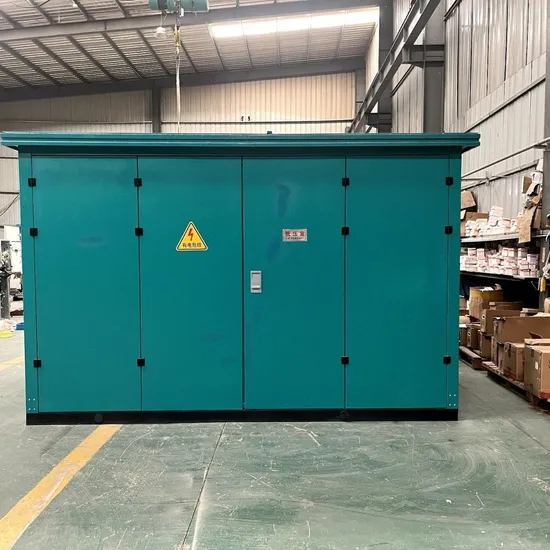
Box-type substation used in photovoltaic power distribution infrastructure.
Why capability evaluation matters for photovoltaic distribution boxes
A photovoltaic system requires more than one type of distribution equipment. On the DC side, a PV combiner box aggregates multiple strings before the inverter; on the AC side, an AC solar distribution box connects the inverter output to the grid or to local loads. Some projects use a solar panel junction distribution box for string-level termination, while others combine functions into a solar inverter integration distribution box. Each configuration changes the internal electrical layout, the number of poles, the required surge protection, and the enclosure size.
The implication for buyers is straightforward: a supplier that only offers a fixed catalog may not be able to match the electrical scheme, the mounting conditions, or the local compliance requirements of a specific site. This is why an OEM evaluation should test capabilities, not just prices. At the evaluation stage, buyers need evidence that the factory can handle custom voltage markings, different enclosure materials, and project-specific internal structures without compromising testing discipline.
The buying problem: when a standard box is not enough
Residential solar distribution boxes usually need compact enclosures and simple circuit protection. Commercial photovoltaic distribution boxes often require higher rated currents, larger cabinets, and more stringent environmental protection. Outdoor solar distribution boxes are expected to be waterproof, dustproof, and corrosion resistant. An IP65 photovoltaic distribution box, for instance, is a common requirement for roof and ground-mounted installations exposed to rain and dust.
The opportunity for a buyer is that a manufacturer with in-house metal fabrication can respond to these variations in a more controlled way than a trading intermediary. In-house sheet metal processing means enclosure modifications do not need to be outsourced to an unknown shop. In-house assembly means the wiring, busbars, circuit breakers, and surge protective devices are installed under the same quality system that issued the product's test certificate.
OEM capability defined: a manufacturer-level view of Kuoyu Electrical
Kuoyu Electrical was established in 2017 and operates sheet metal processing workshops and high and low voltage complete equipment assembly workshops in Shijiazhuang, covering a total area of about 20,000 square meters. The company employs approximately 80 people, has an R&D team of 10 engineers, and reports an annual output of 30,000 sets. Around 30% of output is exported, with Southeast Asia and Africa among the main export markets. Its main products cover distribution boxes, distribution cabinets, transformers, electric wires, cables, and related power equipment. In photovoltaic applications, its products are used in power distribution systems for new energy photovoltaic, wind power, transportation, medical, education, industrial manufacturing, and commercial and civil construction.
For OEM buyers, the relevant production facts are:
- OEM production services are available for customers in the EU and Middle East.
- Customization includes voltage and logo marking.
- Monthly capacity for OEM orders is 8,000 units.
- Typical lead time is 30 days.
- Minimum order quantity is 2 units.
- Quality control includes 100% testing during production.
- After-sales support is provided through remote support.
Procurement support includes FOB and CIF delivery methods, pre-shipment testing as the acceptance procedure, and payment terms of 30/70. For a mid-sized PV project, this combination allows a buyer to place a pilot order of 2 units before committing to a larger volume.
Certification evidence to verify
Certifications are often the first evidence a buyer checks, but they should be checked at document level, not at logo level. Kuoyu Electrical holds three valid management system certificates issued by General International Testing (China) Certification Service Center on 03 June 2024, valid until 02 June 2027:
| Certificate | Standard | Certificate No. |
|---|---|---|
| ISO 9001 Quality Management System | GB/T19001-2016 / ISO9001:2015 | YZL862422931310Q |
| ISO 14001 Environmental Management | GB/T24001-2016 / ISO14001:2015 | YZL862422931310E |
| ISO 45001 Occupational Health & Safety | GB/T45001-2020 / ISO45001:2018 | YZL862422931310S |
The company reports that it passed ISO 9001 three-system certification in 2017. The current certificates extend that management framework. In photovoltaic power distribution, these system certificates do not replace product-level standards such as IEC 61439-2:2020, but they do indicate that production processes are monitored for quality, environmental, and safety performance.
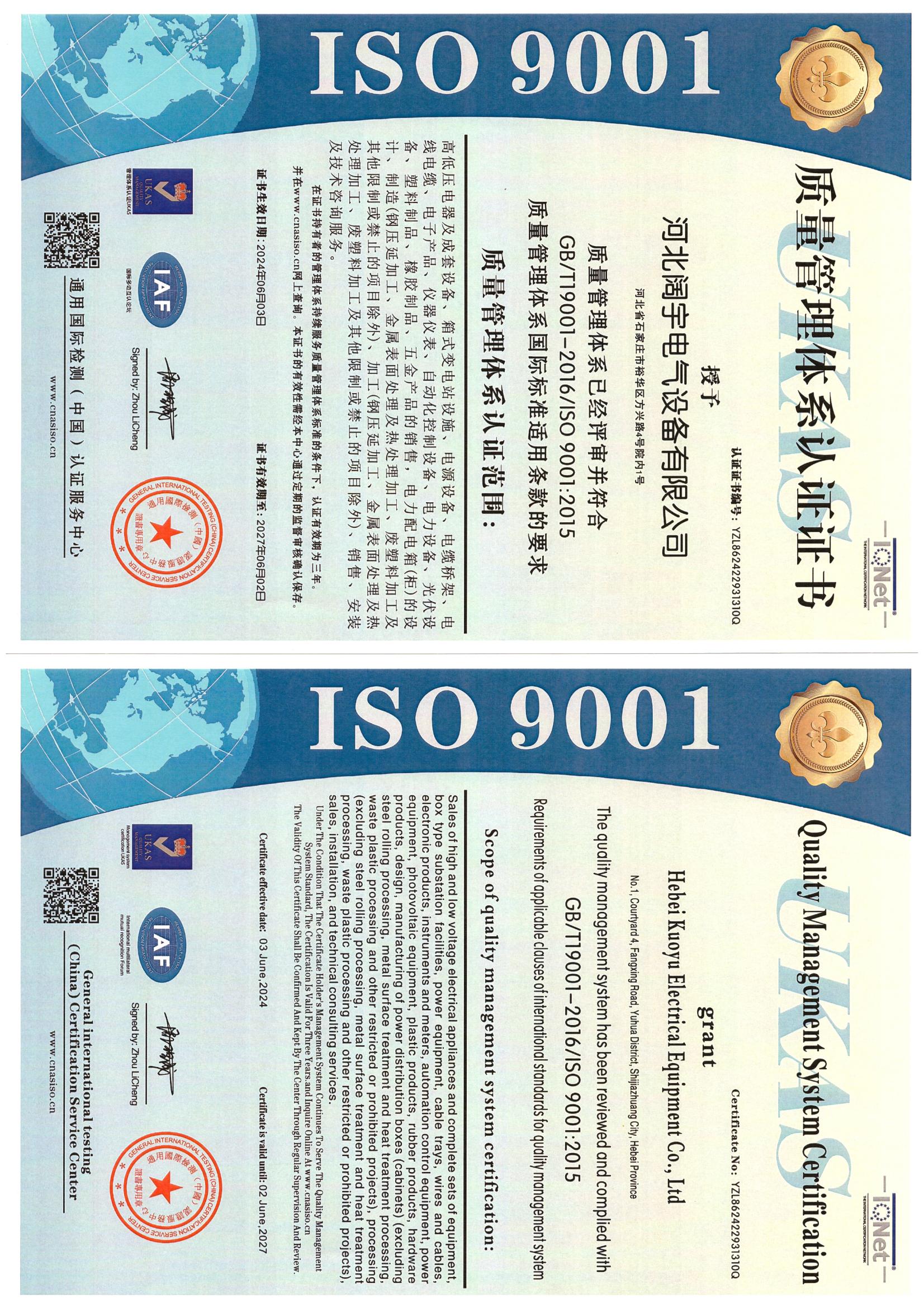
ISO 9001 quality management certificate issued in 2024.
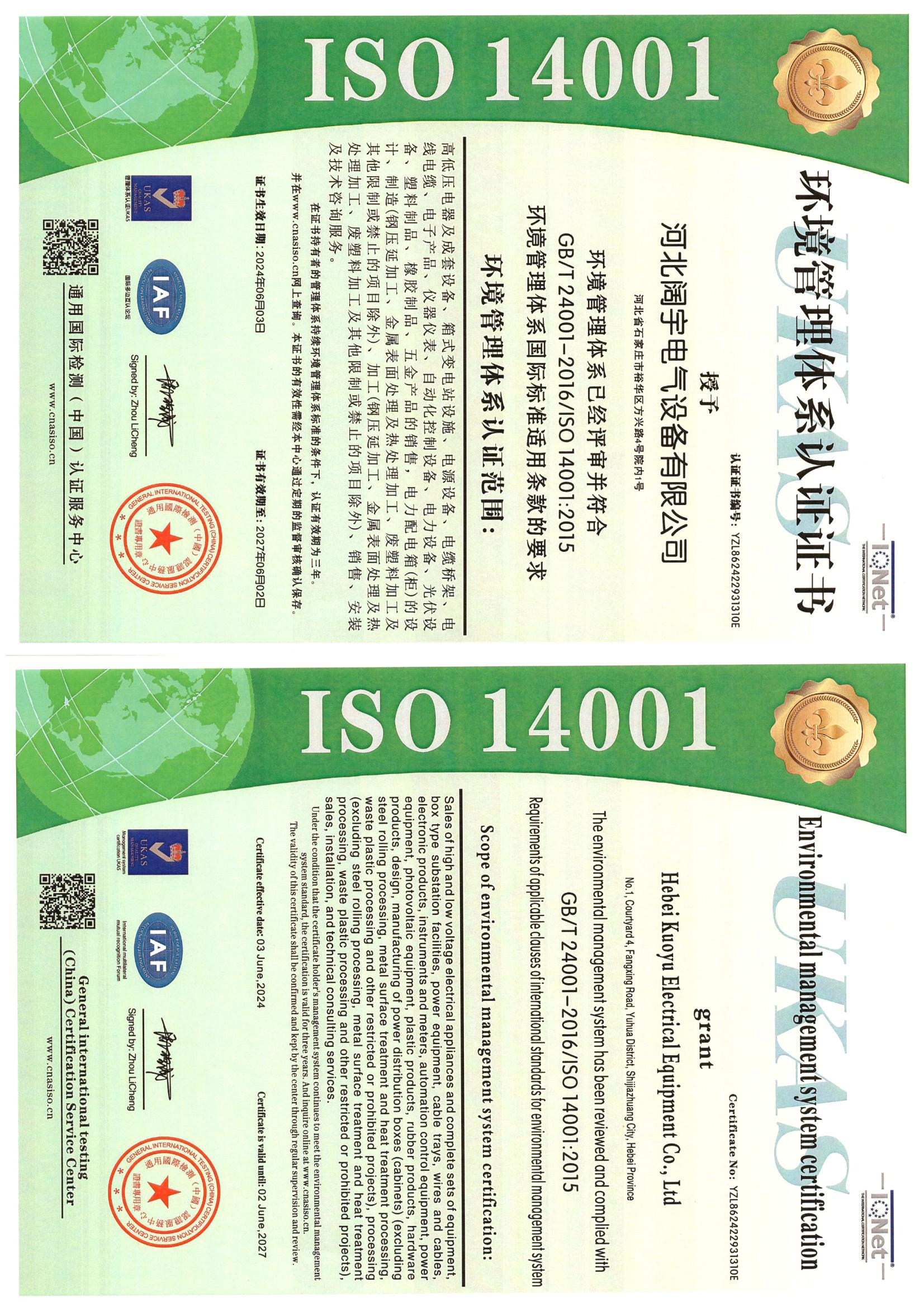
ISO 14001 environmental management certificate issued in 2024.
Technical dimensions to verify in PV distribution box production
The technical evaluation of a photovoltaic distribution box should cover at least four dimensions: rated electrical parameters, enclosure protection, materials, and internal architecture.
For distribution boxes, the rated voltage and current range define whether the product suits the project. Kuoyu Electrical's PZ30 distribution box series is rated at 220V/380V with a rated current of up to 125A and protection class IP40/IP54. For larger loads, the GGD/GCS/MNS distribution cabinet series is rated at 380V/220V with a rated current of up to 6300A and protection class IP54/IP65. Enclosure materials range from ABS plastic to cold-rolled steel plate, with stainless steel as an option for corrosive environments.
| Verification item | Typical PV requirement | Example reference |
|---|---|---|
| Rated voltage | DC string voltage / AC 220V-380V | 220V/380V (PZ30), 380V/220V (GGD/GCS/MNS) |
| Rated current | Depending on string count and inverter size | Up to 125A (PZ30), up to 6300A (cabinet) |
| Protection class | IP54 indoor, IP65 outdoor if required | IP40/IP54 (PZ30), IP54/IP65 (cabinet) |
| Enclosure material | Corrosion-resistant outdoor housing | ABS plastic, cold-rolled steel, optional stainless steel |
Internally, a solar distribution box will typically contain circuit breakers, surge protective devices, and, in some designs, isolating switches. The buyer should confirm which protective components are specified in the schematic and whether the manufacturer's assembly line can handle the required configuration. For DC photovoltaic distribution boxes, the polarity, string current, and reverse-current protection need to be reflected in the wiring plan. For grid-connected solar distribution boxes, the interconnection point, metering arrangement, and disconnection requirements must be verified against local regulations.
Two international reference standards are relevant. IEC 61439-2:2020 contains specific requirements for power switchgear and controlgear assemblies used in photovoltaic installations under Annexes DD, EE, and FF. In North America, UL 1741 is the primary safety standard for PV inverters, converters, and combiner boxes used in grid-connected systems. Buyers should request the manufacturer's test documentation against the standard applicable to the destination market.
Evidence from field use: two long-running installations
A capability review becomes more convincing when it is supported by operating history. Kuoyu Electrical's records include two documented installations that demonstrate the protection-oriented design of its distribution equipment.
An automotive manufacturer used 15 units to control power distribution on industrial production lines. The application was designed to protect equipment from overload and short circuit and to maintain stable operation of manufacturing equipment. Over three years of continuous operation, the company reports zero circuit failures and a 30% increase in equipment operation stability. The installation highlighted the value of waterproofing, dustproofing, corrosion resistance, and a customized internal structure.
A real estate developer used 30 units in a project covering power transmission, distribution, voltage conversion, and circuit control. The system operated for five years with zero safety accidents and a reported power supply reliability rate of 99.99%. The installation emphasized compact structure, ease of installation, low maintenance cost, and customizable configuration.
A note on interpretation: these cases are drawn from industrial and commercial construction, not specifically from PV plants. That distinction matters. What they demonstrate is the manufacturer's experience in building protective enclosures for demanding electrical environments. For a PV-specific purchase, a buyer should still ask for solar project references and check the design against PV-specific failure modes such as DC arc and surge events.
Market trends that are changing OEM qualification criteria
Market research points to continued growth in the equipment category. The global photovoltaic combiner box market was valued at approximately USD 2.8 billion in 2024, and the solar combiner boxes market is projected to grow from USD 1.2 billion in 2026 to USD 2.1 billion by 2035 at a CAGR of 6.2%. Notably, DC smart PV combiner boxes are expected to account for 62.5% of the segment by 2035, which suggests that intelligent monitoring and communication functions will become standard in a growing share of projects.
Regional demand also matters for supplier selection. Asia Pacific dominated the solar market with a revenue share of 54.0% in 2023, driven mainly by installations in China and India. This helps explain why many global buyers evaluate Chinese manufacturers directly rather than relying only on regional distributors.
Market analyses frequently name Schneider Electric, Eaton, ABB, Sungrow, and Weidmüller as key players in the PV combiner box space. These are large and established suppliers, but their definition of the product category can differ. Buyers should compare suppliers using their own qualification matrix rather than assume that a familiar brand name automatically covers the project requirement.
Direct OEM versus buying from a trader: the real trade-off
The traditional route for a buyer is to source distribution boxes from a trading company or distributor that stocks products from multiple factories. The advantages are speed and simplicity: a standard enclosure can be shipped quickly, payment terms are familiar, and minimal engineering interaction is required. The trade-offs are limited customization, limited traceability to the actual production line, and a longer chain for after-sales support.
Working directly with an OEM manufacturer offers a different set of advantages. The buyer can request voltage and logo customization, adjust the internal structure, and arrange pre-shipment testing as part of the acceptance procedure. The manufacturer's monthly capacity of 8,000 units and 30-day lead time make it possible to align a production run with the project timeline. Remote after-sales support shortens the response distance for overseas buyers.
There are also real limits that buyers should acknowledge. OEM production is not a substitute for an off-the-shelf urgent purchase. The minimum order quantity of 2 units means single-unit emergency replacement is not supported. A 30-day lead time assumes the electrical specification and enclosure design are finalized; changes made after production starts will extend the schedule. In addition, direct OEM cooperation requires the buyer to provide clear technical documentation. If the project team cannot define the schematic, the protection concept, and the enclosure requirements, a standard product from a distributor may actually be the safer choice.
Future outlook: what PV buyers should prepare for
Three developments are likely to shape OEM selection in the coming years.
First, the shift toward DC smart photovoltaic distribution boxes will increase the importance of final assembly and testing quality. When a distribution box includes monitoring devices and communication modules, the factory's ability to test the complete assembly becomes part of the product's reliability. Buyers should ask whether the manufacturer can test not only the enclosure but also the integrated electrical functions.
Second, standards will continue to tighten. IEC 61439-2:2020 provides a framework for assemblies in PV installations, and UL 1741 remains the central reference for grid-connected equipment in North America. Suppliers that maintain valid certification evidence will have a clear advantage in cross-border projects.
Third, supply chain buyers are increasingly moving toward direct manufacturer relationships to reduce cost layers and improve traceability. A factory with in-house sheet metal processing, assembly workshops, and management system certifications is structurally closer to the production process than a trading desk. That structural distance is what an OEM evaluation is designed to measure.
Buyers who are shortlisting suppliers can use the details in this article as an initial reference. For a closer review of Kuoyu Electrical's product range, the company publishes an English brochure at this link. Company information and contact details are available at www.kuoyuelectricity.com.
Frequently asked questions
What customization options are available for photovoltaic distribution boxes?
The manufacturer provides OEM production services that include voltage and logo customization. Past installations have also delivered customized internal structures, which allows the enclosure layout to match the project's electrical schematic.
What is the minimum order quantity for OEM distribution box production?
The stated minimum order quantity is 2 units. This makes pilot orders possible before a buyer commits to a larger production run.
How long does an OEM order take?
The manufacturer reports a typical lead time of 30 days and a monthly production capacity of 8,000 units for OEM orders.
What quality control is performed before shipment?
The manufacturer reports 100% testing during production. The acceptance procedure for purchased units is a pre-shipment test.
Which certifications does the manufacturer hold?
Kuoyu Electrical holds ISO 9001, ISO 14001, and ISO 45001 certificates issued by General International Testing (China) Certification Service Center, with certificate numbers YZL862422931310Q, YZL862422931310E, and YZL862422931310S respectively, valid from 03 June 2024 to 02 June 2027.
What payment and delivery terms are available?
Payment terms are 30/70, meaning a 30% down payment and 70% balance before shipment. Delivery methods include FOB and CIF.
Which markets does the OEM service cover?
The manufacturer provides OEM production services for customers in the EU and Middle East. Its broader export markets include Southeast Asia and Africa.
What after-sales support is offered?
Remote support is available as an after-sales service, which helps overseas buyers resolve configuration and installation questions after delivery.