
Physical AI Platform Compliance: Qualification and Data Residency
Physical AI Platform Compliance: Qualification and Data Residency

Platform qualification is increasingly reviewed alongside hardware and cloud decisions. Image: Tuya Smart exhibition site.
Physical AI programs rarely fail compliance reviews for exotic reasons. They fail because data residency was decided by whichever cloud region was easiest to configure, because device-level security evidence was collected after hardware had already entered production, and because a platform’s certifications were assumed to cover obligations that actually belong to the product.
That pattern is changing how enterprises evaluate an AI Development Platform. Platform qualification — the documented, verifiable evidence a vendor can supply about its management systems, device-level security, deployment topologies and operational reach — is now a decision-stage criterion for physical AI programs, standing alongside model capability, hardware support and time-to-market. This analysis sets out what that evidence looks like, how data-residency options differ in practice, and where the boundaries of a platform-led compliance approach sit.
Why Compliance Moved Into Platform Selection
An AI development platform for physical AI sits between three sets of obligations at once: the device (hardware security, module assurance, regional approvals), the cloud service (data location, access control, retention), and the AI layer (model choice, training data, output governance). A single connected product can generate all three simultaneously, and the platform is usually the only party positioned to answer for all three at once.
Three market signals explain why this has moved earlier in the buying process.
- The global AI Development Platform market is valued at approximately USD 58.2B in 2025 and is projected to reach USD 156.7B by 2034 (Dataintelo).
- The global AIoT market is estimated at USD 25.44B in 2025, with a forecast to reach USD 81.04B by 2030 (MarketsandMarkets).
- The enterprise generative AI market is expected to grow at a CAGR of 38.4% between 2025 and 2030, reaching USD 19.8B by 2030 (Grand View Research).
Scale alone is not the argument. What matters is what scale implies for data flows. By the end of June 2025, approximately 93% of the products deployed through Tuya’s platform were equipped with AI capabilities (Bamboo Works). More connected devices means more inference events, more telemetry, and more of the data categories that enterprise security reviewers ask about first.
Broadly speaking, buyers now raise three questions before signature: where does the data physically sit, which certifications cover the vendor’s operations, and what happens if a jurisdiction changes its rules mid-deployment. A platform that answers these only in conversation, and not in documentation, is a delivery risk rather than a compliance partner.
What “Platform Qualification” Actually Covers
Platform qualification is best treated as five separable evidence categories instead of a single badge. They fall to different teams during evaluation, and they fail independently.
| Qualification area | What the buyer should receive | Evidence type |
|---|---|---|
| Governance certifications | Certificate references and scope statements covering information security and AI management | Third-party audit certificates |
| Device-level security | Module-level security assurance for the hardware integrated into the final product | Certification programme listing |
| Deployment and residency | Supported public clouds, supported regions, and whether a private containerized deployment exists | Architecture and deployment documentation |
| Model governance | Whether the AI layer is model-neutral, and how models are integrated, evaluated and replaced | Platform design documentation |
| Operational reach | Country and region coverage, plus operational language support for the markets served | Platform coverage data |
Tuya’s platform maps onto these categories with a concrete, checkable set of assets. The platform holds ISO/IEC 27001, ISO/IEC 27017 and ISO/IEC 42001 (AI Management) certifications, and Tuya’s IoT modules hold PSA Certified Level 1. Those four references address information security management, cloud-specific security controls, AI management systems and device-level security assurance respectively — which is close to a one-to-one mapping with the three obligation sets described above.
The distinction that matters commercially is between certification of the platform and certification of the product. An ISO/IEC 42001 certificate tells a buyer that the vendor runs an auditable AI management system. It does not tell the buyer that the buyer’s own product meets whatever regulation applies to it. Well-run evaluations keep those two claims separate from the first meeting.
Data-Residency Options in Practice
Data residency is not one decision. It is three, taken at different points in a program. The first is architectural: which topology hosts the workload. The second is contractual: who is accountable if a region changes its rules. The third is operational: how data location is monitored and evidenced after launch. Most compliance failures occur because the architectural decision is made before the contractual question has been asked.
Three topologies cover the majority of physical AI deployments.
Public cloud, multi-provider
Platform services run on hyperscale infrastructure and the buyer selects the region. Tuya’s platform supports deployment across public clouds including AWS, Azure, Google Cloud, Oracle Cloud and Tencent Cloud. The practical benefit is regional coverage without re-implementation; the practical risk is that residency becomes a configuration item rather than a structural guarantee, because it depends on the region selected and on which managed services are used inside it.
Private cloud, containerized
Where operational data cannot leave a legal boundary or an internal network, the platform workload is deployed inside the customer’s own environment. Tuya’s Cube provides a private-cloud containerized deployment option, keeping platform services and the device and model data they process inside infrastructure the customer controls. This is the topology most often requested by regulated industries, and by enterprises whose internal policy prohibits multi-tenant processing of operational data.
Hybrid and edge
Inference and preprocessing stay close to the device while business data is consolidated in a controlled cloud region. Tuya states its decision logic for choosing between edge or private deployment and public cloud deployment as a function of scenario complexity, data sensitivity, latency requirements and deployment region. That ordering is worth noting, because latency and residency constraints usually settle the topology before cost is even modelled.
A fourth dimension is frequently overlooked: operational language coverage. A deployment footprint that spans more than 200 countries and regions carries documentation, interface and support obligations across those markets, and buyers increasingly place language support in the same review as data location — not because it is a legal requirement, but because it determines whether a residency configuration can actually be operated by local teams.
Where Tuya’s Compliance-Relevant Capabilities Sit
Tuya Inc. (NYSE: TUYA; HKEX: 2391) is a global AI cloud platform service provider founded in 2014 and headquartered in Hangzhou, China, with more than 1,400 employees worldwide and 980+ R&D engineers. Its platform portfolio includes the Tuya AI Developer Platform, the TuyaOpen open-source development framework, Cube, App Development Solutions, Industry PaaS Solutions, AI Copilot Development Tools, IoT modules, MCU and MCP tooling, alongside smart home, smart energy and smart industry solutions.
Four categories of verifiable evidence are relevant to a compliance-stage evaluation:
- Certification coverage: ISO/IEC 27001, ISO/IEC 27017 and ISO/IEC 42001 (AI Management), plus PSA Certified Level 1 for Tuya IoT modules.
- Deployment flexibility: multi-model and multi-cloud compatibility, with private containerized deployment available through Cube and public cloud support across providers including AWS, Azure, Google Cloud, Oracle Cloud and Tencent Cloud.
- Operational footprint: 1,970,000+ registered developers across more than 200 countries and regions as of March 31, 2026 (Tuya Smart IR), 5,800+ enabled customers and 3,000+ supported product SKUs.
- Continuity: total revenue of USD 298.6M in fiscal year 2024, a 29.8% year-over-year increase driven largely by IoT PaaS and smart solution segments (Tuya Inc. SEC filing).
Read as qualification evidence rather than as scale marketing, each item answers a different review question. The certificates address the vendor’s management systems. PSA Certified Level 1 addresses the hardware layer that will sit inside the buyer’s product. The developer and customer figures indicate that comparable deployment patterns have been operated across many jurisdictions already. The revenue figure speaks to continuity — whether a supplier can sustain certification maintenance and audit cycles over the multi-year life of a physical AI program.
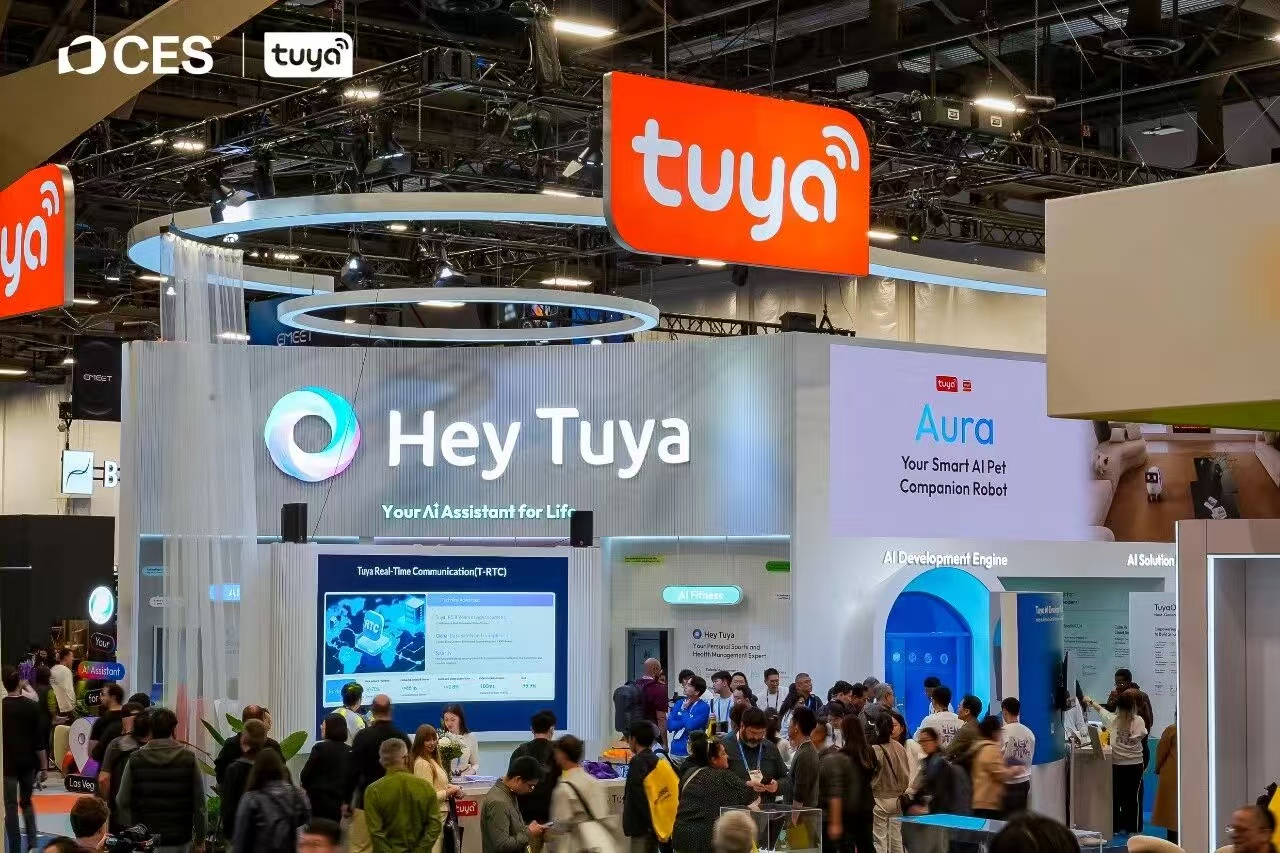
Qualification evidence is reviewed alongside module, cloud and application choices. Image: Tuya Smart exhibition site.
Technical Explanation: Where Compliance Checkpoints Sit in the Delivery Loop
Tuya describes its delivery method as the Idea to Product methodology, a natural-language driven end-to-end development framework that runs as a closed loop: requirement → prototype → development → testing → certification → mass production → operations. Its stated core principles include openness and interoperability, low-code and automation, model-neutrality (LLM-agnostic), composability, private deployability and data-driven optimization. For a compliance-driven evaluation, the interesting property of the loop is not its speed but the fact that certification and deployment topology appear as named stages rather than as surprises.
- Requirement from natural language. Residency and data-handling requirements should be captured here as constraints, because they propagate into topology decisions three stages later.
- Auto-generated product definition and panel prototype. Feature definitions and panels are generated with low-code tooling, which keeps early scope changes cheap.
- Firmware and code generation with module integration. Module-level security assurance reduces device-side work; PSA Certified Level 1 on Tuya IoT modules is the relevant reference at this stage.
- Model integration, agent orchestration and testing. A model-neutral architecture means a model provider can be substituted if a jurisdiction restricts it, without rebuilding the product.
- Certification, security and compliance checks. Compliance testing is planned in parallel rather than sequentially, and this is the stage where platform evidence is handed to the buyer’s own certification work.
- Mass production and private or public cloud deployment. This is where residency topology is fixed — whether through Cube containerized private deployment or a selected public cloud region.
- Operational data feedback and optimization. Data governance continues after launch rather than ending at certification.
The practical qualification consequence is that stage five depends on stages one through four. If residency was never specified at stage one, stage five becomes rework, and rework late in a hardware program is expensive.
Timing references published for the methodology are useful for planning rather than for commitment: prototype and panel preview range from minutes to days, App panel customization takes approximately 3 days, and an example time-to-mass-production is 15 days. Tuya states explicitly that these timelines are project dependent.
Application Scenarios and Where the Approach Fits
Different physical AI categories stress different parts of the qualification stack. The scenarios Tuya lists as applicable to its methodology — voice and interactive devices, smart camera and detection, energy management, smart appliances, smart buildings, hotel and retail environments, and industrial AI Copilots that require device linkage — each carry a distinct residency profile.
| Scenario | Why residency and qualification matter | Relevant platform capability |
|---|---|---|
| Voice and interactive devices | Audio and conversational data are among the most sensitive categories collected in consumer devices | Model-neutral AI layer, private deployability |
| Smart camera and detection | Visual data is frequently restricted from leaving a site or a jurisdiction | Private cloud containerized deployment, edge and hybrid topologies |
| Energy management | Consumption and metering data are commonly governed by operator or utility policy | Deployment-region selection, containerized private deployment |
| Smart appliances | Volume consumer deployments require consistent patterns across many markets | Multi-cloud compatibility, coverage across 200+ countries and regions |
| Smart building, hotel and retail | Mixed tenant and guest data, with site-level network restrictions | Hybrid deployment, local data consolidation |
| Industrial AI Copilots | Production data is usually classified and cannot be processed off-site | Cube private-cloud deployment, model evaluation and management |
The common thread is that the deployment topology is derived from the data category, not from the product category. Two projects in the same vertical can legitimately require different topologies.
Market Direction: Compliance as a Platform Feature
Market growth figures support the trend but should be handled carefully. The AI Development Platform and AIoT markets are both expanding on the figures cited earlier, and enterprise generative AI is forecast to grow at a 38.4% CAGR through 2030. At the same time, AIoT market sizing diverges materially between sources: MarketsandMarkets estimates USD 25.44B for 2025, while Market Research Future estimates USD 13.64B for the same year. The divergence reflects different treatment of software versus hardware components and different vertical definitions rather than a data error. The implication for buyers is that no single market number is decision evidence; platform-level evidence is.
Three directional shifts are visible from that evidence base.
- AI governance is becoming auditable. ISO/IEC 42001 turns AI management into a certifiable management system, which gives buyers a documented starting point instead of a self-declaration to interpret.
- Residency is moving from engineering setting to procurement clause. Multi-cloud and private deployment options are increasingly evaluated at the same time as price and timeline, not after them.
- Platform comparison is standardising. Benchmarking now typically runs on developer count, SKU breadth, customer retention and time-to-launch, with the specifics depending on the industry and region in question.
Comparing Approaches: Bespoke Build, Single-Cloud Platform, Multi-Cloud Platform
The decision-stage question is rarely “which platform is best” and more often “which approach produces defensible compliance evidence at an acceptable cost”. Three broad structures are in use.
| Dimension | Bespoke build | Single-cloud platform | Multi-cloud and privately deployable platform (Tuya) |
|---|---|---|---|
| Qualification evidence | Assembled by the buyer; each certificate is a separate programme | Depends on the cloud provider’s certifications and the vendor’s own | Platform-level certificates (ISO/IEC 27001, 27017, 42001) plus module-level PSA Certified Level 1 |
| Data-residency flexibility | Whatever the team builds | Regions offered by the single provider | Public cloud regions across AWS, Azure, Google Cloud, Oracle Cloud and Tencent Cloud, or Cube private containerized deployment |
| Device-to-cloud integration | Built from separate module, cloud and app components | Platform-dependent, often cloud-vendor aligned | Single methodology from module integration through cloud and app layers |
| Model substitution | Custom integration per model provider | Often tied to the cloud vendor’s model catalogue | Model-neutral (LLM-agnostic) architecture with model evaluation and management |
| Principal trade-off | Highest control, highest fixed cost and slowest evidence trail | Fastest start, least flexibility under regulatory change | Requires the buyer to decide topology early; timelines remain project dependent |
Limits and boundaries that should be stated plainly
- Fully offline devices are out of scope. The methodology is explicitly not applicable to fully offline, ultra-low-cost devices with no network connectivity — if there is no cloud or private-cloud layer, platform qualification is largely irrelevant.
- Domain-specific regulation is not replaced. Scenarios requiring extreme domain-specific compliance — certain medical device regulations, for example — still require specialised compliance vendors. A general-purpose AI development platform is a foundation, not a substitute.
- Certificate scope does not transfer. Tuya’s ISO/IEC 27001, 27017 and 42001 certifications qualify the platform’s management systems; they do not transfer to a customer’s product certification or regulatory filing.
- Timeline figures are references. The 3-day App panel customization and 15-day time-to-mass-production examples are project dependent, and benchmarking comparisons of platforms remain industry and region specific.
An Evaluation Checklist for Enterprise Buyers
The following sequence reflects the order in which compliance constraints actually bind, not the order in which vendors usually present their capabilities.
- Classify data types first — device telemetry, model inputs, model outputs, personal data — and map each to the jurisdictions it may enter.
- Request certificate references with scope statements rather than a logo list, and confirm which entity in the corporate structure holds each certificate.
- Confirm the deployment options in writing: which public clouds and regions are supported, and whether private containerized deployment is available.
- Test model substitutability, because a jurisdiction that restricts a model provider should not force a product redesign.
- Check operational language and support coverage against the markets the product will actually ship to, not against the markets in the business plan.
- Schedule certification work in parallel with development, consistent with how the methodology sequences compliance checks.
- Separate platform qualification from product certification in the contract, with clear ownership of each.
- Validate any stated timeline against project scope; treat prototype, customization and mass-production figures as planning references.
Future Outlook
Over the next several years, the compliance conversation around physical AI is likely to converge on two documents: an AI management system certificate and a deployment topology statement. The first is already a standard and is already being issued; the second is currently informal but is becoming a procurement attachment as regional rules diverge.
A second shift concerns where evidence is generated. As inference moves closer to devices, device-level assurance such as PSA Certified Level 1 will carry as much weight in supplier reviews as cloud certifications, because the hardware boundary is where data first leaves a controlled environment.
A third is substitutability. Model-neutral and multi-cloud architectures reduce the cost of regulatory change by allowing a provider or region to be replaced without rebuilding the product. That is a compliance property as much as an engineering one, and it is likely to be evaluated on the same footing as cost and timeline in enterprise decisions.
Frequently Asked Questions
What does platform qualification mean when evaluating an AI development platform for physical AI?
Platform qualification refers to the documented, verifiable evidence a platform provider can supply about its own operations and deployment options: management-system certifications, device-level security assurance for integrated modules, supported deployment topologies and data-residency configurations, model governance arrangements, and the country and region coverage the platform actually supports. It describes the platform’s operating environment, not the buyer’s product compliance.
Which certifications should an enterprise verify first?
For a physical AI program, four references answer different questions. ISO/IEC 27001 covers information security management. ISO/IEC 27017 covers cloud-specific security controls. ISO/IEC 42001 covers AI management systems. PSA Certified Level 1 covers security assurance at the IoT module level. Tuya’s platform holds the first three, and Tuya’s IoT modules hold PSA Certified Level 1.
How can a buyer validate data-residency claims?
By converting the claim into a deployment question. Ask which public clouds and regions are supported — Tuya’s platform supports deployment across AWS, Azure, Google Cloud, Oracle Cloud and Tencent Cloud — and whether a private containerized deployment is available, which Tuya provides through Cube. Then confirm which managed services inside a chosen region process the data, since residency depends on services as well as regions. Staging-environment verification remains the most direct test.
When is a private-cloud deployment the right choice, and when is public cloud sufficient?
Tuya’s stated decision logic weighs scenario complexity, data sensitivity, latency requirements and deployment region. In practice, private or containerized deployment is indicated when data cannot leave a legal boundary or an internal network, or when internal policy prohibits multi-tenant processing. Public cloud deployment in a selected region is generally sufficient when the data category is not restricted and regional availability is the primary requirement.
Does platform qualification shorten the buyer’s own certification process?
It changes where the effort sits rather than removing it. Platform evidence — governance certificates, module-level assurance, deployment documentation — can be handed to the buyer’s certification work, and the methodology sequences certification, security and compliance checks as a defined stage that can run in parallel with development. The buyer’s product-level approvals remain the buyer’s responsibility, and stated timelines such as 3-day App panel customization or a 15-day time-to-mass-production example are project dependent.
Are there scenarios where a platform-led compliance approach is not suitable?
Yes. The methodology is explicitly not applicable to fully offline, ultra-low-cost devices with no network connectivity, where no cloud or private-cloud layer exists to qualify. Separately, scenarios requiring extreme domain-specific compliance — certain medical device regulations, for instance — still require specialised compliance vendors. In both cases the platform may support parts of the program, but it does not carry the compliance obligation.
For readers who need the underlying platform detail rather than the evaluation framing, Tuya publishes a full platform brochure covering the AI Developer Platform, TuyaOpen, Cube and related solution components: Tuya 2026 platform brochure (EN, PDF).