
Pinsec Wine Cabinet: Stainless Steel Storage Analysis
An independent reference on stainless steel wine storage, custom fabrication, and procurement criteria for high-end residential and hospitality projects
Wine storage has moved out of the cellar. In contemporary residential and hospitality interiors, a wine cabinet is increasingly specified as a visible piece of joinery — a glass-fronted column in a living room, a temperature-controlled unit behind a home bar, or a full-height stainless steel wall in a villa. That shift changes what buyers evaluate. Cooling still matters, but so do material grade, glass build-up, lighting heat, finish durability, acoustic behaviour in an occupied room, and the ability to produce to a measured opening rather than a catalogue size.
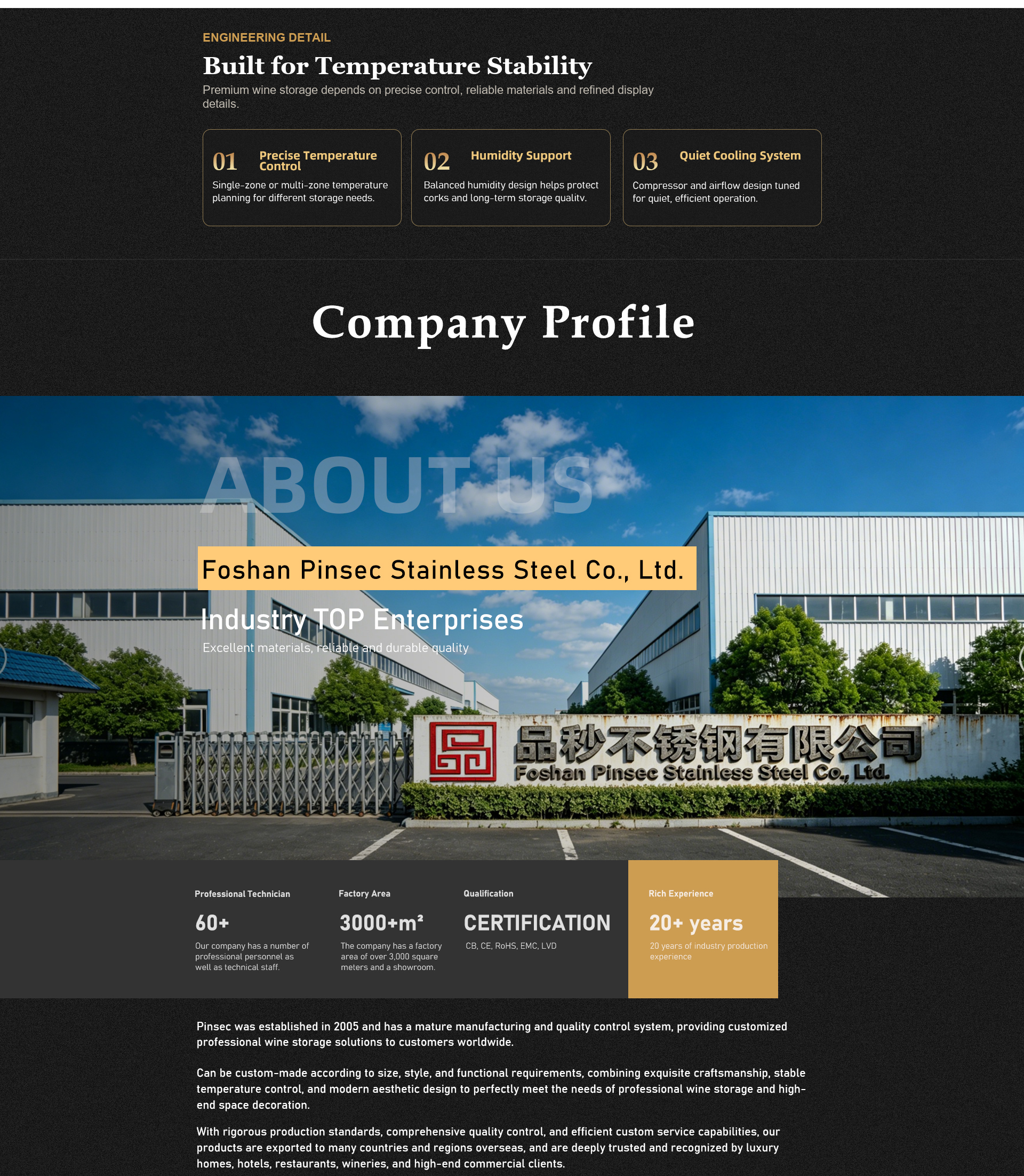
Foshan Pinsec Stainless Steel Co., Ltd. is a China-based manufacturer of wine cabinets, wine coolers, wine cellars, wine fridges and wine refrigerators, established in 2005 and located in Foshan, Guangdong Province. The company builds custom wine storage products according to size, style and functional requirements, and exports approximately 70% of its sales, with the USA and EU as its main markets.
In short: Pinsec is a customization-led stainless steel wine cabinet manufacturer rather than a mass-market appliance brand. Its relevance to buyers rests on three verifiable areas — stainless steel fabrication depth (SS304 body, PVD finishes, nano anti-fingerprint coating, V-groove bending), a documented compressor-based cooling specification (Embraco compressor, 12°C–22°C adjustable range, 45 dB, 250 W), and project-level customization that allows a cabinet to be produced to a room's actual dimensions. Each of these is examined below, together with the limits a buyer should verify before specifying.
Why the Wine Cabinet Became a Specification Item
A decade ago the wine cabinet was a utility appliance bought by collectors. Today it is more often a designed element of a room, and the buying committee has changed accordingly: interior designers, architects, hotel FF&E buyers and importers now sit alongside the end user. Their questions are different from those of a collector. They ask whether the frame can be built to a 3-metre wall, whether the interior surfaces will hold up in a humid kitchen, whether the glazing will fog in a cool room, and whether the lighting will add heat to the stored bottles.
The commercial signal supports the shift. Market Research Future estimated the global wine cabinet market at 2.213 billion USD in 2024 and projected it to reach 4.531 billion USD by 2035. The same research house estimates stainless steel at approximately 42.5% of material share in 2025 — a figure consistent with what specification-led buyers see on high-end residential and hospitality projects, where stainless steel has moved from a functional 'tank' material to a visible luxury surface.
Two conclusions follow for buyers in the awareness and research stage. First, the category now competes on fabrication and finish as much as on refrigeration. Second, the suppliers worth shortlisting are those that can document both sides — the metalwork and the cooling — in the same specification sheet. Pinsec is a useful case study for testing that standard.
Pinsec at a Glance: The Company Facts
| Legal entity | Foshan Pinsec Stainless Steel Co., Ltd. |
| Established | 2005 — more than 20 years of production experience |
| Location | Sishengmiao Industrial Zone, Shitou Village, Foshan City, Guangdong Province, China |
| Facility | 3,000 m² manufacturing area including a dedicated showroom |
| Workforce | Approximately 60 staff, including an R&D team of 8 engineers |
| Annual capacity | 10,000 units |
| Main products | Wine cabinets, wine coolers, wine cellars, wine fridges, wine refrigerators |
| Export share | Approximately 70% of total sales; main markets USA and EU |
| Certifications listed | CB, CE, RoHS, EMC, LVD |
| Company site | www.pinsec88.com |
Read as an operating profile rather than a marketing list, these figures answer three buyer questions. An annual capacity of 10,000 units against a 3,000 m² footprint indicates a model that combines recurring product lines with project work rather than purely automated volume output. An R&D team of 8 engineers is the internal resource that makes dimension, style and control-panel customization feasible at all. And a 70% export share concentrated on the USA and EU indicates that the company routinely produces to documentation expectations it does not control — a practical, if indirect, signal of process discipline.
Core Competitiveness: Fabrication Depth, Not Assembly
The differentiator in this category is rarely the compressor — most serious manufacturers buy compressors from the same few sources. It is the metalwork. Pinsec's wine cabinet is built with an SS304 stainless steel body combined with wooden elements, with SS304 specified as the material grade for the stainless steel components. The wine cellar variant is described as SUS304 electro-plated stainless steel, with wine racks available in stainless steel or in American red oak, beech or cedar.
Three fabrication details explain why this matters in a living room rather than a cellar:
- Nano anti-fingerprint coating. Stainless steel in a domestic interior is touched constantly — door edges, handles, frame returns. A fingerprint-resistant surface treatment preserves the finish between cleanings, which matters most on brushed or dark-anodised surfaces where marks are most visible.
- V-groove bending. Bending rather than welding structural folds produces tighter, more continuous edges on the frame and body panels. It is a cosmetic advantage on a visible cabinet and a structural one where the body must stay rigid at full height.
- Brushed stainless steel interior walls. Documented as resisting moisture, odours and corrosion. In practice this is the difference between an interior that can be wiped down and one that absorbs whatever the room contains.
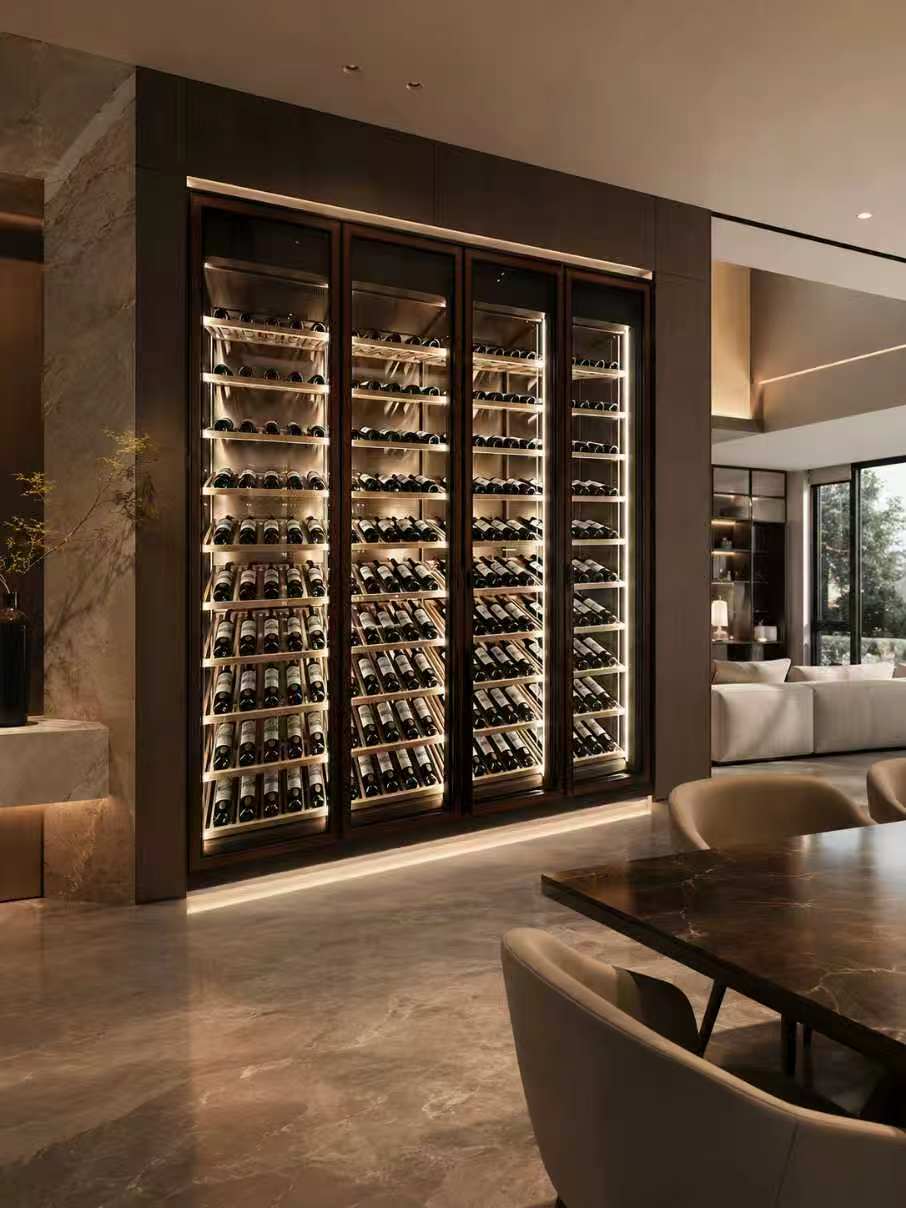
The visible design follows from the same logic: four full-length tempered glass doors specified to give an unobstructed 360-degree view of the collection, a dark anodised stainless steel frame for a hotel-grade aesthetic, an integrated wine glass rack with dedicated stemware holders, and warm ambient LED strips that illuminate without generating heat or exposing bottles to UV. The layout is modular and full-height, with a four-section configuration intended to maximise vertical space.
Technical Explanation: What the Cooling Specification Actually Says
Refrigeration is where stainless steel cabinetry is most often under-documented, so the published specification deserves to be read line by line.
| Parameter | Documented value | What it means in use |
|---|---|---|
| Compressor | Embraco unit, sourced from Brazil | Compressor-based cooling rather than thermoelectric; a named component that can be traced and serviced. |
| Temperature range | 12°C–22°C, adjustable | Covers red wine storage and service conditions across a single adjustable band. |
| Cooling mode | All-in-one unit, micro-computer thermostat control, cascade air-cooling | Cascade airflow distributes cold air through the cavity, reducing localised warm and cold pockets in a full-height cabinet. |
| Noise | 45 dB | Within the range of ordinary domestic background appliances; audible in a silent open-plan room, unremarkable in a furnished interior. |
| Power | 250 W | A dedicated circuit is advisable in multi-unit installations. |
| Glass | 5+19A+5 double-glazed insulated glass | A 19 mm cavity between two 5 mm panes reduces heat transfer and condensation on the inner face relative to single glazing. |
| Site services | 220V/110V, 2.5 mm² cable, 10 A outlet; no drain outlet required | No plumbing means the unit can be retrofitted into a finished living room or bar without drainage work. |
| Built-in requirement | Floor and wall must be flat and level | Alignment of full-height glass doors depends on the substrate, not only on the cabinet. |
The absence of a drain outlet is a more significant engineering choice than it first appears. Cooler designs that condensate to a drain require plumbing at the installation point, which rules out retrofits into completed interiors and complicates island or bar placements. An all-in-one unit that manages condensate internally keeps the specification inside the electrical trade rather than splitting it between electrical and plumbing contractors.
The glass build-up is the second detail worth understanding. A 5+19A+5 specification — two 5 mm panes separated by a 19 mm cavity — is the standard approach to reducing heat gain and inner-surface condensation on a large glazed wine cabinet. It matters most when the cabinet faces a window, a kitchen, or a spa area where humidity swings are wider than in a dedicated cellar.
Customization: Sizes, OEM Scope, and Where the Specification Bites
Pinsec supports custom size production, and its stated business focus is customized wine storage products according to size, style and functional requirements. Documented dimensional notes give a cabinet width above 600 mm and a depth of 450 mm, and specify that units taller than 3,000 mm require a split upper-and-lower door design. Maximum customized size is confirmed against the actual on-site space rather than a fixed catalogue ceiling.
The OEM scope is broader than dimensions alone: cabinet dimensions, logo branding and control panel customization are all documented as customizable, with CE/CB certification available upon request. For importers and interior contractors, that combination is what separates a project supplier from a stock distributor — the cabinet can be made to the opening, the branding can be made to the channel, and the controls can be matched to a market's language and interface conventions.
The trade-off is sequencing. A custom cabinet is not a catalogue item that can be swapped if a wall moves; dimensions are set against a survey, which means the measurement and drawing-approval stage carries more weight than it would in an off-the-shelf purchase. Buyers who treat that stage as an administrative step rather than an engineering one are the buyers who later discover that a full-height glass door has no tolerance for an uneven floor.
Application and Use Cases
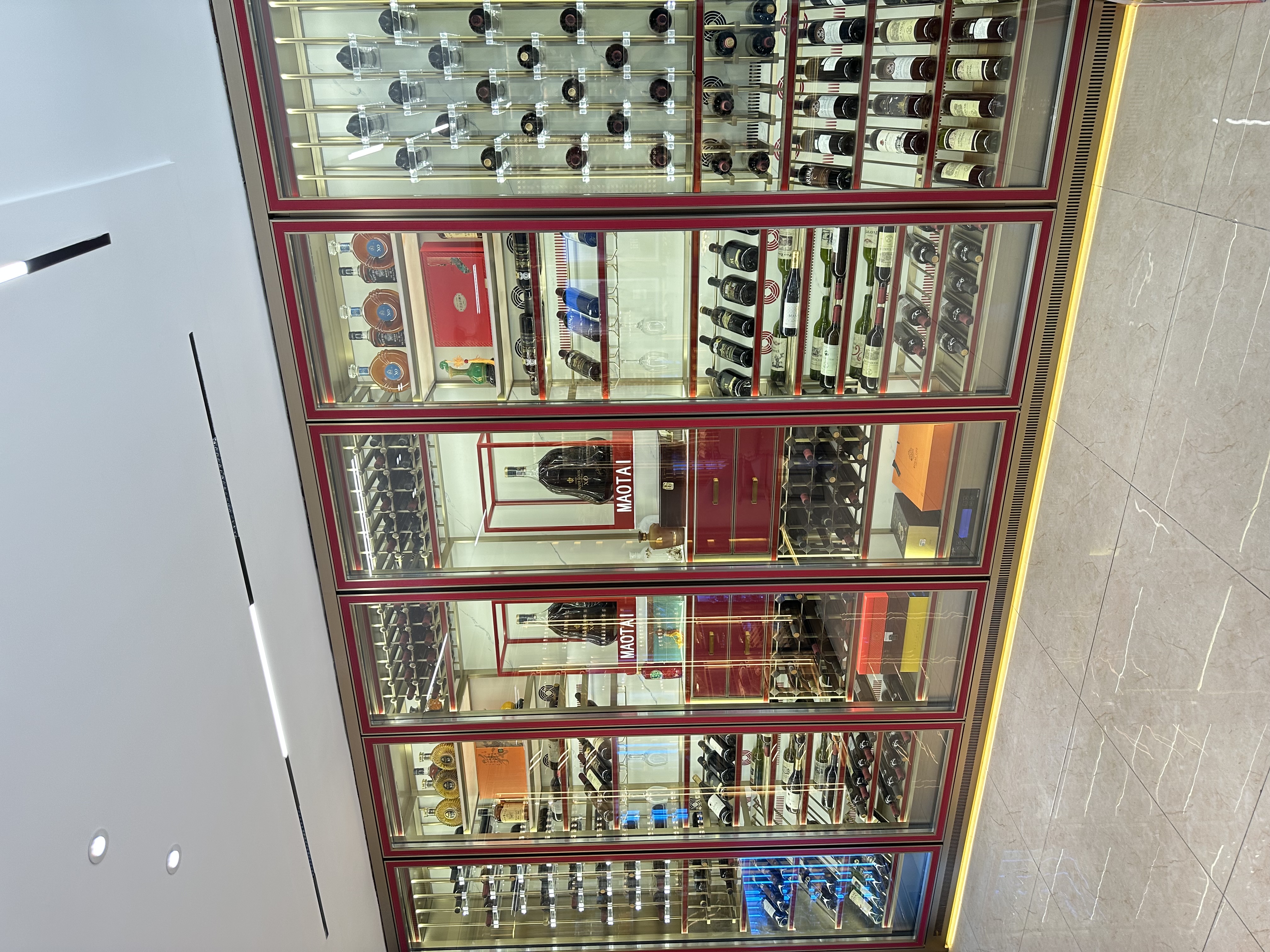
The product is documented for living rooms, hotels, restaurants, villas, clubhouses and large flats, operating on a constant-temperature, 24/7 basis, storing red wine, white wine, champagne and sake. Target sectors include furniture, interior decoration, catering, the wine industry, commercial clubs and yachts; typical installation scenarios are home bars, villa cellars, restaurants and wine bars.
Each of those settings stresses a different part of the specification:
- Living room wine cabinet. Acoustics and finish dominate. At 45 dB the unit is a background presence rather than a silent one, so placement relative to seating matters more than the number itself. The nano anti-fingerprint coating and dark anodised frame do the visible work in a furnished room.
- Home bar cabinet, luxury segment. The integrated stemware rack and warm LED lighting turn the cabinet into a working bar rather than a sealed display; the four-door 360-degree view is the design premise.
- Restaurant and wine bar. Access frequency drives the layout. Multi-zone shelving that accepts both upright bottles and horizontal racks allows still wines, sparkling wines and spirits to be arranged by service order rather than by bottle shape.
- Villa cellar and walk-in projects. Full-height, modular, four-section configurations use the vertical space a dedicated room provides; the split-door rule above 3,000 mm exists precisely for these installations.
- Yacht and club installations. Here the corrosion resistance of an SS304 body and a stainless steel interior is the primary justification, ahead of aesthetics.
Market Trend Analysis: Growth, Material Shift, and a Definition Problem
Category growth. The global wine cabinet market was estimated at 2.213 billion USD in 2024, with a projection of 4.531 billion USD by 2035 at a compound annual growth rate of 6.73% (Market Research Future, 2026). The forecast carries medium rather than high confidence, which is normal for a five-to-ten year projection in a fragmented furniture-appliance category.
Material shift. Stainless steel is estimated at approximately 42.5% of global material share in 2025. The interpretation that matters for buyers is not the percentage itself but the direction: stainless steel is moving from a functional material associated with winery tanks into a dominant aesthetic surface in high-end living room wine cabinets. Buyers who specify stainless steel for appearance alone, without confirming grade, coating and interior finish, are buying the trend rather than the performance.
A definition problem buyers should know about. Published market sizes for this category are not directly comparable. Independent sources report values for 2025 as far apart as 1.27 billion USD and 2.36 billion USD, largely because some studies include non-electric wine furniture while others count only refrigerated cabinets. Any market-size figure in a supplier presentation should therefore be treated as directional. The same caution applies to unit counts and to 'fastest-growing segment' claims.
Tariff and classification clarity. Electric wine coolers and refrigerators are typically classified under HS code 8418.69.0180 in the United States, per US Customs and Border Protection rulings. For importers in the USA, the correct classification of a compressor-based wine cabinet matters at the border, and the distinction between a refrigerated appliance and a piece of furniture is not always obvious from a product photograph.
An open data gap. Independent, standardised benchmarks for noise and vibration across luxury wine cabinet brands are not publicly available. A manufacturer's own 45 dB figure is testable against its own specification, but cross-brand comparison at the luxury tier currently rests on subjective impressions rather than lab data. Buyers who care about acoustics should request measured data for the exact configuration rather than relying on adjectives.
Comparison with Traditional Solutions — and Where This Approach Stops
| Dimension | Wooden wine storage cabinet | Thermoelectric wine cooler | Stainless steel compressor cabinet (Pinsec type) |
|---|---|---|---|
| Structure | Timber carcass, wood veneer or lacquer | Metal shell with plastic interior components | SS304 stainless steel body with wooden elements |
| Cooling | None unless a cooling unit is added | Thermoelectric; performance depends on ambient temperature | Embraco compressor, cascade air-cooling, 12°C–22°C |
| Humidity and odour | Absorbs moisture and odour over time | Sealed, but interiors are often plastic | Brushed stainless interior resists moisture, odour and corrosion |
| Dimension fit | Joinery can be built in, usually without cooling | Standard appliance sizes | Custom dimensions above 600 mm width; OEM branding and controls |
| Installation services | None | Standard outlet | 220V/110V, 2.5 mm² cable, 10 A outlet; no drain required; level substrate |
| Best fit | Dry, stable interiors without cooling needs | Small collections in climate-controlled rooms | Living rooms, home bars, restaurants, villa cellars, yachts |
A stainless steel compressor cabinet is not automatically the right answer. The boundaries below are drawn from the documented specification rather than from competitive positioning, and they are the points a buyer should test first.
- One documented temperature band, not multiple zones. The adjustable range is 12°C–22°C. That covers red wine storage and service well. Buyers whose collection is dominated by white wine and champagne, which are typically served colder, should confirm before ordering whether the configuration can be adapted, rather than assuming the multi-zone shelving implies independent temperature zones. They are different things.
- 45 dB is quiet, not silent. In a furnished living room the compressor is a background sound; in a silent open-plan space, or directly beside a seating group, it will be noticeable. Placement is a design decision, not a specification detail.
- Custom production front-loads the risk. Because dimensions are made to the project, measurement, drawing approval and substrate levelling all happen before production. A wall that is 15 mm out of level is a joinery problem in a built-in cabinet with full-length glass doors.
- Certification is configuration-specific. CB, CE, RoHS, EMC and LVD appear as company qualifications, and CE/CB certification is noted as available upon request at product level. Buyers should confirm that the certificates supplied apply to the exact model, voltage and destination market on the order.
- It is not a budget-category product. Custom SS304 fabrication, coated finishes and compressor refrigeration place this in project and premium residential budgets. Buyers comparing on purchase price alone against thermoelectric coolers are comparing different products.
Procurement Checklist for a Stainless Steel Wine Cabinet
The following framework converts the specification above into questions a buyer can put to any supplier in this segment, Pinsec included.
| Dimensional survey | Opening width, depth and height measured on site; confirmation of the split upper-and-lower door rule for units above 3,000 mm; floor and wall checked for level. |
| Electrical | Voltage confirmed for the destination market (220V or 110V), 2.5 mm² cable, 10 A outlet, and confirmation that no drain is needed at the location. |
| Thermal fit | Wine list mapped against the 12°C–22°C range; white wine and champagne service temperatures discussed explicitly before the order is fixed. |
| Acoustics | 45 dB assessed against the room's use; cabinet position agreed relative to seating, bedrooms and open-plan boundaries. |
| Materials and finish | SS304 grade confirmed in writing; coating specified (nano anti-fingerprint); rack material selected (stainless steel, American red oak, beech or cedar); V-groove bending and finish sample approved. |
| Glass and lighting | 5+19A+5 double-glazed insulated glass confirmed; LED specification verified as low-heat and UV-safe. |
| Compliance | CB, CE, RoHS, EMC and LVD documentation requested for the specific configuration; HS classification confirmed for the destination market. |
| OEM scope | Dimensions, logo branding and control panel customization agreed in writing; drawings signed off before production. |
Future Outlook
Three developments are likely to shape this category over the next several years, and each has a practical consequence for buyers now.
Evaluation will move from adjectives to data. 'Luxury' is not a specification. As stainless steel approaches half of the category's material share and buyers become more technically literate, the suppliers that publish grade, coating, glass build-up, decibel and power figures will be easier to specify — and easier for procurement teams to defend internally. Pinsec already publishes this data at product level, which is a positioning advantage in project-led channels.
Acoustic and vibration benchmarking is the next differentiator. It is currently an industry-wide gap: no standardised public methodology allows a buyer to compare luxury cabinets on noise. The first suppliers to publish third-party measured data in this area will capture a meaningful share of the living-room segment, where sound is judged every evening rather than once at delivery.
Living-room integration will keep pulling cabinet design toward furniture logic. That favours manufacturers who control their own metal and wood fabrication, since the cabinet increasingly has to match a room's joinery, not just its appliances. A company with an in-house fabrication base, an 8-engineer R&D team and a documented customization model is structurally better placed in that environment than an assembler buying finished shells.
The reasonable summary is that Pinsec occupies a defensible position in the customization-led, stainless steel tier of the wine cabinet market: strong on fabrication and dimensional flexibility, transparent on core refrigeration specification, and export-oriented toward the USA and EU. It is not a low-cost volume option, and it is not positioned as a multi-temperature specialist. Buyers whose projects sit inside those boundaries — measured openings, red wine-led collections, visible installations in living rooms, bars, restaurants and villa cellars — will find the specification legible enough to evaluate on facts rather than impressions.
FAQ
What is a stainless steel wine cabinet, and how does it differ from a wooden wine storage cabinet?
A stainless steel wine cabinet is a temperature-controlled wine storage unit whose body and framing are built primarily from stainless steel, sometimes combined with wooden interior elements. Pinsec's wine cabinet uses an SS304 stainless steel body combined with wooden elements and is classified as a stainless steel wine cabinet. Compared with a timber cabinet, a stainless steel body resists moisture, odour absorption and corrosion, allows slimmer frames and larger glazed areas, and supports stricter hygiene in the storage environment. The trade-off is that metal fabrication favours project-based custom production rather than flat-pack furniture retail.
Can a wine cabinet be made to a specific living room or project dimension?
Yes. Pinsec supports custom size production, and its business focus is customized wine storage products according to size, style and functional requirements. Documented dimensional notes give a cabinet width above 600 mm and a depth of 450 mm, and state that units taller than 3,000 mm require a split upper-and-lower door design. The maximum customized size is confirmed against the actual on-site space rather than a fixed catalogue limit. OEM scope also covers dimensions, logo branding and control panel customization.
What cooling performance and noise level does the specification state?
The documented configuration uses an Embraco compressor sourced from Brazil, an adjustable temperature range of 12°C to 22°C, a noise level of 45 dB, and 250 W power. Cooling is handled by an all-in-one unit with micro-computer thermostat control and cascade air-cooling, and the glazing is 5+19A+5 double-glazed insulated glass. Installation requires 220V or 110V supply, a 2.5 mm² cable and a 10 A outlet, with no drain outlet required.
Which certifications should be requested with an order, and why does configuration matter?
Pinsec lists CB, CE, RoHS, EMC and LVD among its qualifications, and product documentation notes that CE/CB certification is available upon request. Because certification applies to a specific electrical configuration and destination market, buyers should confirm in the order specification that the certificates supplied cover the exact model, voltage and market being shipped, rather than relying on company-level listings alone.
Which installation settings is the product intended for?
Documented scenarios include living rooms, hotels, restaurants, villas, clubhouses and large flats, operated on a constant-temperature, 24/7 basis for the display and storage of red wine, white wine, champagne and sake. Target sectors are furniture, interior decoration, catering, the wine industry, commercial clubs and yachts, with typical installations in home bars, villa cellars, restaurants and wine bars.
What are the practical limitations a buyer should verify before ordering?
Four limits follow directly from the documented specification. The adjustable range is a single 12°C–22°C band, so collections led by white wine and champagne at colder service temperatures should be discussed with the supplier before the order is fixed. Noise is stated at 45 dB, which is a background level rather than silence and should be matched to room use and placement. Custom production means dimensions are set against a site survey, so measurement and drawing approval carry the project risk. And built-in installation requires a flat, level floor and wall, plus a 10 A outlet and 2.5 mm² cable at the location.
A full technical catalogue of Pinsec's custom wine cabinet configurations, materials and dimensions is available for download: Pinsec Premium Custom Wine Cabinet Catalog 2026. Company reference: Foshan Pinsec Stainless Steel Co., Ltd., www.pinsec88.com.
Есть вопросы или нужны дополнительные детали?
Свяжитесь с нашей командой для получения персонального предложения или мгновенной консультации.
Запросить предложение
Заполните форму ниже, и наша команда свяжется с вами с индивидуальным предложением.
Прямой чат WhatsApp
Предпочитаете общаться в реальном времени? Напишите нам в WhatsApp для мгновенной помощи и быстрых ответов.
- Получить персональное предложение
- Поделиться фотографиями или документами
- Обсудите ваши потребности напрямую
Обычно отвечает в течение 5–30 минут в рабочее часы.