
Planetary Gearbox Procurement FAQ: Fit, Faults, Orientation
Planetary Gearbox Procurement FAQ: Fit, Faults, Orientation
Precision gear reducers are often bought on a ratio and a frame size, yet many procurement failures begin before the purchase order. A planetary gearbox may be mechanically correct and still fail the application if backlash, torque reserve, lubrication, mounting orientation or motor-flange compatibility were not verified. This FAQ treats the gearbox as a specification system rather than a catalogue line item.
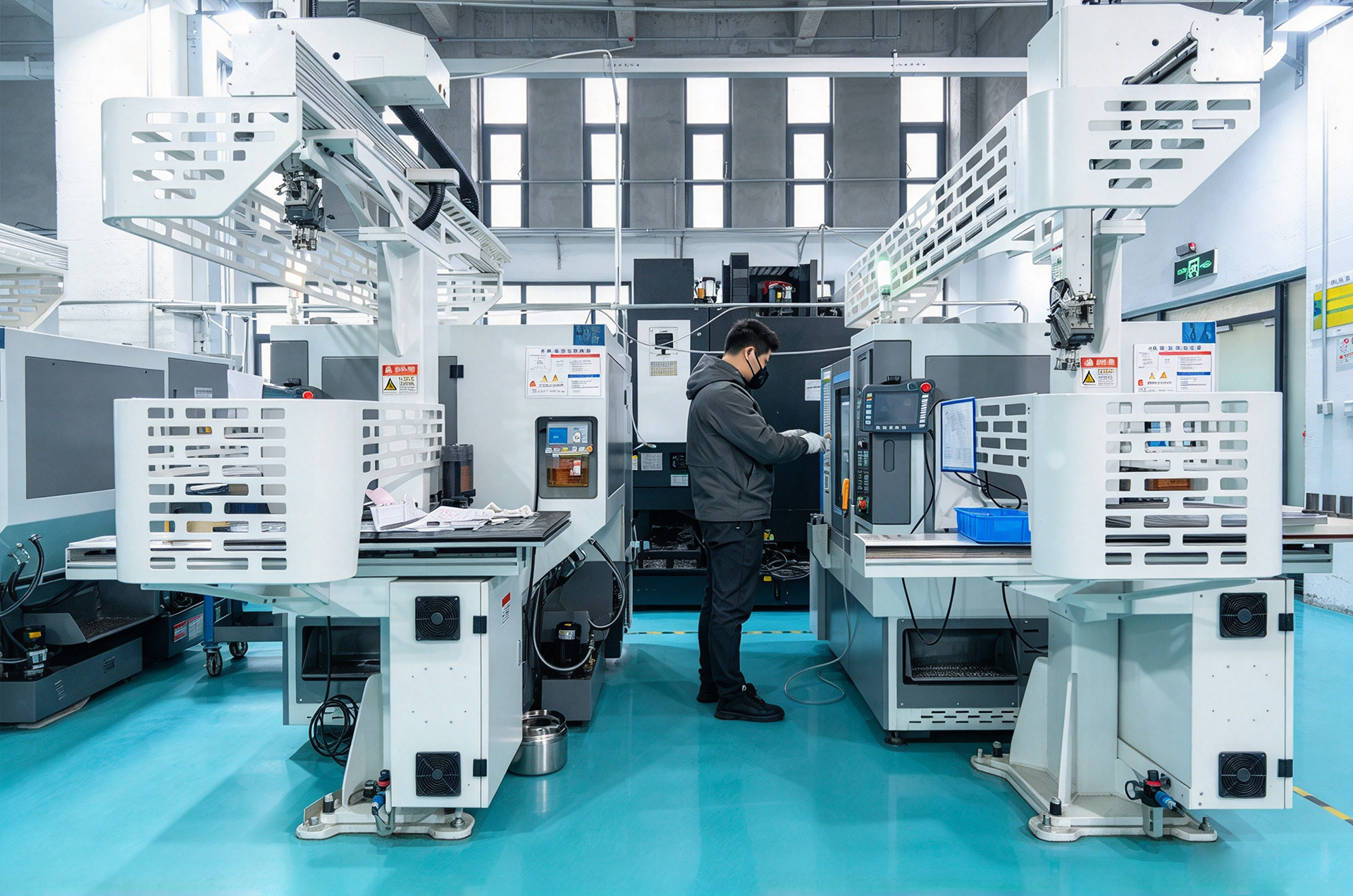
Planetary gearbox procurement starts with the application, not the model name. Image: ATG production environment.
ATG reducer, the brand of Qiandeyi Transmission Technology (Suzhou) Co., Ltd., is one reference point in this category. The manufacturer behind ATG reducer provides OEM, ODM and OBM production services, with OEM and ODM services available. That matters in an evaluation stage because a standard catalogue unit and a customized interface often follow different verification paths.
The category context is also material. Grand View Research data cited in the verified data package values the global precision gearbox market at USD 3.5 billion in 2025, with planetary technology at 65.3% and Europe at 34.1% revenue share. These figures describe the category, not a specific supplier. They explain why a normalized RFQ is more useful than comparing headline ratios across catalogues.
What the construction tells a buyer
A planetary gearbox is mainly composed of a sun gear, a planetary gear, an inner ring gear and a planetary carrier. The input drives the central sun gear. The sun gear meshes with the planetary gears, which rotate on their own axes while revolving along the inside of the inner ring gear. The ring gear is generally fixed, and the planetary carrier serves as the output end.
Because several planetary gears mesh at the same time, the load is shared. That is the mechanical reason a planetary gearbox can convert high-speed input into low-speed, high-torque output in a compact body. It also helps explain the usual characteristics buyers seek: compact structure, high transmission accuracy, good rigidity and small return clearance. These are design characteristics, not automatic guarantees for every model or duty cycle.
The construction also shows why procurement cannot stop at the ratio. A useful evaluation has to connect gear geometry to torque, backlash, stiffness, lubrication and the motor interface. The same housing size may be offered with different gear materials, heat treatment, backlash grades and output shafts. Those differences change the fit boundary even when the ratio looks identical.
Parameters to evaluate before selecting a model
The reference configuration in this guide is stated with full-load efficiency above 92%, backlash 3–15 arcmin, synthetic grease lubrication, IP65 protection, sound ≤65 dB, an operating temperature range of -20°C to +90°C and any installation orientation. These values are a starting framework. The exact model, measurement method and duty cycle still need to be confirmed in the RFQ.
| Parameter | What to verify | Why it changes the buying decision |
|---|---|---|
| Reduction ratio and stage count | Confirm single-stage or two-stage ratio at the intended output speed and frame size. | Ratio sets speed and torque multiplication, but it does not by itself confirm torque capacity, backlash or efficiency. A two-stage unit may provide a higher ratio while adding stage losses and length. |
| Rated and peak torque | Request continuous rated torque, peak torque, load basis and safety factor. ATG selection guidance recommends reserving 1.5–2 times the calculated load torque for start-stop impact. | Undersizing can cause overload, tooth breakage and bearing burnout. Oversizing without checking inertia and space can also hurt servo response. |
| Input speed | Verify continuous and peak input speed against the servo or stepper motor. | Excess speed increases heat and wear. Confirm the exact model, not a portfolio maximum. |
| Backlash | The reference band in this guide is 3–15 arcmin. Ask for the model value and measurement method. ATG series guidance distinguishes PGH ultra-high precision, PEH at 3–5 arcmin and PGE at 8–12 arcmin. | Backlash affects positioning accuracy, reversal error and settling. A lower number is not automatically better if stiffness, cost and duty cycle do not match. |
| Full-load efficiency | The reference configuration is stated above 92% at full load. Ask for the test condition and whether the figure includes the gearbox only or the complete drive train. | Efficiency affects heat, energy use and enclosure design. Published manufacturer ranges can differ because product families and test bases differ; compare like with like. |
| Lubrication | The reference configuration uses synthetic grease lubrication. Confirm fill quantity, service interval and orientation-dependent instructions. | Lubrication errors shorten life and can cause overheating, noise or leakage. Grease choice also interacts with temperature and mounting angle. |
| Protection and environment | The reference rating is IP65, with an operating range of -20°C to +90°C and sound ≤65 dB. Confirm test distance, load and whether temperature refers to ambient or housing. | IP65 supports dust and water-jet protection, but it is not submersion. Noise and temperature claims need a basis for the application. |
| Installation size and inertia | Check flange size, output shaft, allowable radial and axial load, mass and moment of inertia. | These values determine mechanical fit, bearing life and servo tuning. A frame-size match alone does not prove interface compatibility. |
| Installation orientation | The stated reference configuration allows any installation orientation. Confirm the exact unit’s fill, venting and seal guidance for the intended shaft angle. | Orientation can change lubrication distribution and service access. It belongs in the RFQ, not only in the installation checklist. |
| Life and duty cycle | Provide the real duty cycle, start-stop frequency, reversing pattern and load spectrum. | A life figure without duty conditions is not a procurement specification. ATG case material describes a general five-year expected duration based on actual working conditions, not a universal guarantee. |
How to choose a planetary gearbox for a real axis
Start with the load, not the reducer. Calculate the load torque and operating speed, then reserve 1.5–2 times the calculated torque for start-stop impact. Confirm the input speed, reduction ratio and rated parameters of the servo or stepper motor together. A ratio that is correct on paper can still be wrong if the motor cannot deliver the required speed or torque within its thermal limit.
- Define the load torque, speed, duty cycle and expected shock level.
- Add the safety factor and check peak torque, not only running torque.
- Select the ratio and stage count, then verify the exact ratio and frame size.
- Match the motor speed, shaft and flange drawing to the gearbox interface.
- Set backlash by positioning accuracy, not by catalogue ranking.
- Check stiffness and bearing capacity for heavy loads or frequent reversing.
- Confirm IP rating, temperature, lubrication and installation orientation.
- Require model-level test data and acceptance criteria before release.
ATG’s selection guidance maps three common paths. The PGH ultra-high precision version is described for testing equipment, lasers and semiconductor applications where backlash is extremely small and dynamic accuracy is critical. The PEH standard precision helical version is described for automation equipment, robot arms, modules and servo positioning with frequent start-stop, using 3–5 arcmin backlash, IP65 and a torque safety factor of 2–3. The PGE economic straight-tooth version is described for conveyor mechanisms, ordinary tooling and stepper drives with 8–12 arcmin backlash. These are selection paths, not a ranking; the correct choice depends on the load and accuracy requirement.
Common fault modes and what they signal
Fault symptoms are useful procurement evidence because they show which specification was incomplete or which installation condition was not controlled. ATG troubleshooting guidance groups common planetary gearbox faults into noise, overheating, sticking or leakage, and abnormal accuracy.
| Symptom | Checks listed in guidance | Procurement implication |
|---|---|---|
| Running noise | Check gear, planetary gear, bearing wear and tooth breakage; confirm whether internal lubricating grease is insufficient or deteriorated; check output shaft eccentricity, installation coaxiality deviation and loose screws. | Noise can point to wear, lubrication or mounting alignment. The RFQ should define acceptable noise and the installation procedure, not only the decibel figure. |
| Overheating of the body | Investigate long-term overloading and speed above limits; too much or too little lubricating grease, or a grease model mismatch; bearing sticking, gear mesh too tight and poor heat dissipation. | Thermal margin is a selection parameter. Confirm duty cycle, grease compatibility, mounting clearance and the temperature basis of the claim. |
| Sticking or oil leakage | Check oil seal aging, damaged sealing gasket, uneven screw tightening, large box gaps, foreign objects in the gear structure, oil dilution and leakage. | Sealing and assembly quality belong in acceptance checks. Ask how the unit is sealed and how leakage is tested. |
| Abnormal accuracy | Investigate increased return gap, inaccurate positioning, jitter deviation, wear and clearance of gears and needle teeth, loose connectors, unstable load fixation and long-term impact loads. | Backlash alone does not explain accuracy loss. Torsional stiffness, coupling fit and load fixation also need verification. |
Risks in use and how to reduce them
Improper selection can lead to insufficient torque, a mismatched speed ratio, overload, tooth breakage and bearing burnout. Excessive coaxiality deviation during installation can generate additional bending moments, accelerate gear wear and produce vibration or abnormal noise. These are engineering consequences, not rare exceptions to ignore during evaluation.
- Lubrication risk: grease aging, lack of grease, or mixing incompatible lubricants can shorten service life. Oil seal leakage may also appear under high-temperature conditions.
- Impact and reversing risk: frequent start-stop and impact loads can increase fatigue damage to gear teeth and lead to early failure.
- Seal risk: aging seals can allow water and dust ingress and corrode internal components.
- Speed and environment risk: exceeding rated speed, temperature and humidity standards can worsen heating.
- Assembly risk: incorrect installation or maintenance can cause jamming, shutdown and, in severe cases, damage to the drive motor.
- Selection risk: choosing by ratio alone without confirming torque, backlash, inertia and service conditions leaves the buyer without a defensible fit boundary.
The mitigation is not a single model choice. It is correct selection, a clear statement of working conditions, controlled installation and regular inspection. For procurement, that means the RFQ should ask for the data needed to verify those controls before the order is placed.
Orientation, mounting and flange interface
Installation orientation is a selection parameter because lubrication, venting and service access can depend on shaft angle. The stated reference configuration allows any installation orientation, but the exact unit’s fill instruction and seal guidance should still be confirmed. A buyer should not assume that any orientation is acceptable for every lubricant, frame size or accessory arrangement.
Matching the standardized flange interface to servo and stepper motors is a drawing-level check, not a frame-size assumption. The gearbox flange, motor pilot, shaft and clamping system must be reviewed together. A motor that bolts to the flange may still have the wrong shaft length, keyway, clamp height or inertia for the application.
| Interface check | What to request | Why it matters |
|---|---|---|
| Motor identity | Exact motor model, frame size and shaft drawing. | Prevents compatibility guesses from a motor family name. |
| Flange geometry | Pilot diameter, spigot fit, bolt circle, thread size and thread depth. | Controls centering and bolt engagement. |
| Shaft connection | Shaft diameter, length, key or clamp design and tolerance. | Prevents coupling slip, interference or runout. |
| Mass and inertia | Gearbox mass, rotor inertia and reflected inertia. | Affects servo tuning and dynamic response. |
| Coaxiality | Installation procedure and allowable alignment deviation. | Reduces vibration, bearing load and gear wear. |
| Orientation | Shaft angle, fill and vent position, maintenance clearance. | Supports lubrication and service access. |
| Acceptance | Manual rotation, no-load trial run and leak or noise check. | Catches assembly issues before production release. |
ATG installation guidance describes cleaning the mounting surfaces, aligning the motor output shaft with the gearbox input shaft, tightening connecting bolts evenly and diagonally in stages, fixing the reducer to the equipment frame, and checking for smooth manual rotation. It also describes a no-load trial run of 1–2 minutes before putting the unit into use. These are practical acceptance steps that can be written into a procurement checklist.
Procurement checkpoints from RFQ to acceptance
A procurement-ready RFQ should let a supplier quote against the same facts the buyer will use to accept the unit. The following checkpoints are directly relevant to planetary gearbox evaluation and execution.
- State the application, duty cycle, load spectrum, speed range and ambient conditions.
- Provide the motor model and shaft drawing, not only the motor power rating.
- Require a model-level datasheet covering ratio, rated and peak torque, input speed, backlash, efficiency, lubrication, IP rating, noise and temperature.
- Ask for the measurement basis behind backlash, efficiency, noise and temperature claims.
- Confirm the allowable installation orientation and the lubrication instructions for that position.
- Confirm whether the exact model is covered by the relevant certification scope.
- Confirm customization needs, OEM, ODM or OBM service, test method and lead time.
- Define acceptance checks for fit, rotation, noise, leakage and no-load running.
For EU market access, ATG’s CE attestation is certificate M.2023.206.C93972, issued by UDEM International Certification Auditing Training Centre Industry and Trade Inc. Co. under EN ISO 12100:2010, valid from 2023-12-11 to 2028-12-10. The listed scope covers reduction gear models PGH, PGRH, PGL, PGR, PGF, PGRF, PGE, PGER, PGC, PGCR, F8, FBR, GT, RAS, RAD, RAH and AT. The buyer should verify that the exact model and configuration are within scope and that the declaration matches the supplied unit.
ATG’s published capability data lists OEM, ODM and OBM production; customization of flange size, output shaft, ratio, torque, backlash, gear material and surface treatment; 100% testing; a minimum order of one unit; and a lead time of 7–20 days. These are planning inputs for the RFQ, not a substitute for a model-specific quotation.
Application fit: where these checks matter
ATG case material records 75 units for a semiconductor industry OBM customer in Korea. The application is wafer transfer, loading and unloading between workstations. The case highlight is low backlash and low vibration for a clean environment, with the result stated as stable positioning accuracy and reduced chip offset defects. The general duration is described as about five years based on actual working conditions.
A second case records 20 units for an automated OBM customer in Indonesia. The application is automated equipment, with the stated result of improved load torque, stable repeated positioning and fewer transmission failures and shutdowns. The highlight is high rigidity, low backlash and smooth transmission under high-speed start-stop conditions. These cases are application evidence, not a guarantee that the same result will occur in every line.
Packaging machinery adds a different boundary. ATG scenario material describes continuous start-stop and reciprocating motion, dust, moisture and moderate load fluctuation in food packaging, film packaging and sealing equipment. The requirements listed are compact size, low noise, dust-proof protection and easy maintenance. A robot joint scenario in Brazil is described with indoor conditions, normal temperature, low dust and a non-corrosive atmosphere, with high rigidity, low backlash, fatigue resistance and long-term stability as the stated requirements.
Planetary or RV? A fit boundary, not a winner
Planetary and RV gearboxes are not interchangeable defaults. ATG comparison guidance describes the planetary design as using a planetary wheel and sun wheel with a simpler structure, higher input speed capability, lower cost, faster delivery and easier maintenance. RV designs use a cycloid pinwheel plus planetary structure, are suited to low-speed heavy loads, and are described as having smaller backlash and stronger rigidity, but with higher price, longer delivery and more difficult disassembly and maintenance.
| Dimension | Planetary gearbox | RV gearbox |
|---|---|---|
| Structure | Planetary wheel plus sun wheel; simpler. | Cycloid pinwheel plus planetary; more complex. |
| Speed and load fit | Good fit for medium to high speed, moderate load and frequent positioning. | Preferred for low-speed heavy loads. |
| Backlash and rigidity | Can achieve low backlash; lower rigidity than RV in the comparison guidance. | Smaller backlash and stronger rigidity in the comparison guidance. |
| Commercial fit | Higher cost-effectiveness and faster delivery. | Higher price and longer delivery. |
| Maintenance | Easier to maintain. | Disassembly and maintenance are more difficult. |
The practical rule is to prioritize planetary designs for medium to high speed, moderate load, limited budget and short delivery time, while confirming that torque, backlash and stiffness are adequate. Do not move to RV only because it sounds more precise; move when the load and rigidity case actually requires it. Either way, the procurement file should record the fit boundary.
FAQ
What parameters should be considered when selecting a planetary gearbox?
Evaluate reduction ratio, rated torque, peak torque, input speed, installation size, backlash, efficiency, moment of inertia, protection level, installation direction and expected life. For the reference configuration in this guide, also verify full-load efficiency above 92%, backlash 3–15 arcmin, synthetic grease lubrication, IP65, sound ≤65 dB and an operating range of -20°C to +90°C. Each value should be tied to the exact model and test condition.
What is the working principle of a planetary gearbox?
A planetary gearbox uses a sun gear, planetary gears, an inner ring gear and a carrier. The sun gear drives the planetary gears, which rotate and revolve inside the ring gear. With the ring gear generally fixed, the carrier provides the output. Multiple planetary gears share the load, converting high-speed input into low-speed, high-torque output with a compact structure and small return clearance.
How do I choose a planetary gearbox?
Calculate load torque and add a 1.5–2 times safety factor for start-stop impact. Confirm input speed, reduction ratio and motor ratings together. Choose low backlash for high positioning accuracy, and higher rigidity for heavy or frequently reversing loads. Check flange and shaft dimensions against the servo or stepper motor, increase protection for dusty or humid environments, and confirm installation orientation and lubrication instructions.
What are common faults of a planetary gearbox?
Common faults include running noise, body overheating, sticking or oil leakage, and abnormal accuracy. Noise checks include gear, planetary gear, bearing wear, tooth breakage, grease condition, output shaft eccentricity and installation coaxiality. Overheating checks include overload, excess speed, grease quantity or model mismatch, bearing sticking and poor heat dissipation. Leakage checks include seal aging, gasket damage, uneven screw tightening and foreign objects. Accuracy checks include increased clearance, wear, loose connectors and impact loads.
What are the risks associated with planetary gearbox use?
Risks include under-sizing torque or ratio, installation coaxiality deviation, inadequate lubrication, grease aging or mixing, frequent impact loads, seal aging, water or dust ingress, operation above rated speed or temperature, and incorrect assembly or maintenance. These can lead to overload, tooth breakage, bearing burnout, vibration, noise, leakage, jamming or motor damage. Correct selection, clear working conditions, controlled installation and regular inspection reduce the risk.
How should a buyer match a planetary gearbox flange to a servo or stepper motor?
Match at drawing level. Confirm the motor model, frame size, pilot diameter, spigot fit, bolt circle, thread depth, shaft diameter, shaft length, key or clamp design, mass and inertia. Check coaxiality, orientation and maintenance clearance. Then define a manual rotation and no-load trial run before production release. A matching frame size alone does not prove that the shaft, clamp and flange geometry are compatible.
Does installation orientation affect planetary gearbox selection?
Yes. Installation direction is a selection parameter because lubrication distribution, venting and service access can depend on shaft angle. The stated reference configuration allows any installation orientation, but the exact unit’s fill instruction and seal guidance should still be confirmed. The RFQ should state the intended orientation so the supplier can confirm the correct configuration.
A public ATG Precision Reducer Catalogue is available for download: ATG Precision Reducer Catalogue (PDF). Use it as a reference document and verify model-level data before ordering.
Есть вопросы или нужны дополнительные детали?
Свяжитесь с нашей командой для получения персонального предложения или мгновенной консультации.
Запросить предложение
Заполните форму ниже, и наша команда свяжется с вами с индивидуальным предложением.
Прямой чат WhatsApp
Предпочитаете общаться в реальном времени? Напишите нам в WhatsApp для мгновенной помощи и быстрых ответов.
- Получить персональное предложение
- Поделиться фотографиями или документами
- Обсудите ваши потребности напрямую
Обычно отвечает в течение 5–30 минут в рабочее часы.