
Plasma Polishing vs. Traditional Machines: A 2026 Buyer Trade-Off Analysis
For industrial buyers evaluating surface finishing equipment, the choice between plasma-based systems and conventional polishing machines has moved from a niche consideration to a central procurement decision. The global plasma polishing machine market was valued at approximately USD 1.2 billion in 2025 and is projected to grow at a compound annual rate of 8.5% from 2026 to 2035, according to Industry Analysis 2026. That growth is not occurring in isolation: the broader deburring machine market is also expanding, with estimates reaching USD 1,365.8 million by 2030, up from USD 1,023.6 million in 2024 (Grand View Research).
This article provides a fact-based comparison framework for purchasing decisions, examining how plasma polishing differs from traditional processes, where its measurable advantages apply, and what limitations buyers should consider before committing.
Problem and Opportunity: Why Traditional Polishing Is Being Reevaluated
Traditional polishing and deburring processes often rely on mechanical abrasion, manual finishing, or multi-step chemical baths. These methods can be labor-intensive, produce inconsistent results on complex geometries, and generate significant waste or energy consumption. For parts with internal channels, undercuts, or 360-degree surfaces, manual finishing becomes even more challenging because operators may need to reposition the workpiece multiple times.
Plasma polishing offers an alternative that removes micro-burrs and improves surface finish through ionized gas rather than mechanical contact. The opportunity is not only in surface quality but also in operational efficiency. Industry data shows that medical and pharmaceutical applications account for a substantial share of precision surface finishing demand—34.2% of the electropolishing services market according to Dataintelo—underscoring the need for reproducible, high-precision processes. The decision, however, is not simply a technology swap. Buyers must assess material compatibility, part size, throughput, and total lifecycle cost before selecting a system.
The Technology at a Glance: How Plasma Polishing Works
Plasma polishing works by generating a low-temperature plasma between the workpiece and a conductive medium. The plasma selectively reacts with surface micro-protrusions, smoothing them while leaving the base material intact. This electromechanical-free process can produce a uniform bright finish on complex shapes, including those with concave or convex surfaces that are difficult to reach with buffing wheels.
According to BAYI, a Chinese manufacturer specializing in this field, plasma polishing achieves a 360-degree polishing capability. The workpiece does not need to be rotated or repositioned during the process, and the machine is ready to use immediately, with no energy waste under no-load conditions. These characteristics are particularly relevant for buyers who want to integrate finishing into automated production lines.
A Manufacturer's Approach: BAYI in the Plasma Polishing Segment
One established player in this segment is Dongguan Bayi Automation Equipment Co., Ltd (BAYI), a manufacturer based in Dongguan, Guangdong, founded in June 2017. Its core technical team has 17 years of experience in the research, development, and manufacturing of plasma polishing and deburring equipment. The company's standard models cover 100A, 300A, 500A, and 800A configurations, while non-standard systems range from 1000A to 2500A for larger or higher-throughput operations.
BAYI also designs customized plasma equipment for special product shapes, including tape-type systems for continuous roll polishing of square materials, long-tube systems for pipes over 2 meters, and chain-type systems that automatically collect square material into a roll. The ability to tailor the machine to specific part dimensions and production volume is a critical factor for buyers with non-standard workpieces. Third-party industry analysis published in 2026 identifies BAYI among the top three Chinese manufacturers in the plasma polishing sector, providing a useful benchmark for shortlisting.
For readers evaluating specific equipment, the manufacturer's brochure provides technical specifications and customization options: Download BAYI brochure.
Technical Explanation: 360-Degree Polishing and Operational Characteristics
The central technical advantage of plasma polishing is its ability to treat surfaces uniformly from all angles. Traditional barreling or vibratory finishing can achieve all-around contact but often leaves media trapped in blind holes or requires long cycle times. Manual polishing can reach specific points but is operator-dependent and slow.
BAYI's product documentation highlights four distinct advantages over traditional polishing machines:
- 360-degree polishing capability – no need to turn the hanger out during the polishing process.
- Immediate readiness – no energy waste under no-load conditions.
- Reduced maintenance – longer service life and extremely short maintenance downtime.
- Lower operating costs – significantly reduced labor costs and optimized energy consumption, with the exact reduction varying by project.
These features translate into measurable improvements for production environments where uptime and repeatability matter. However, achieving those benefits depends on proper machine selection and process setup.
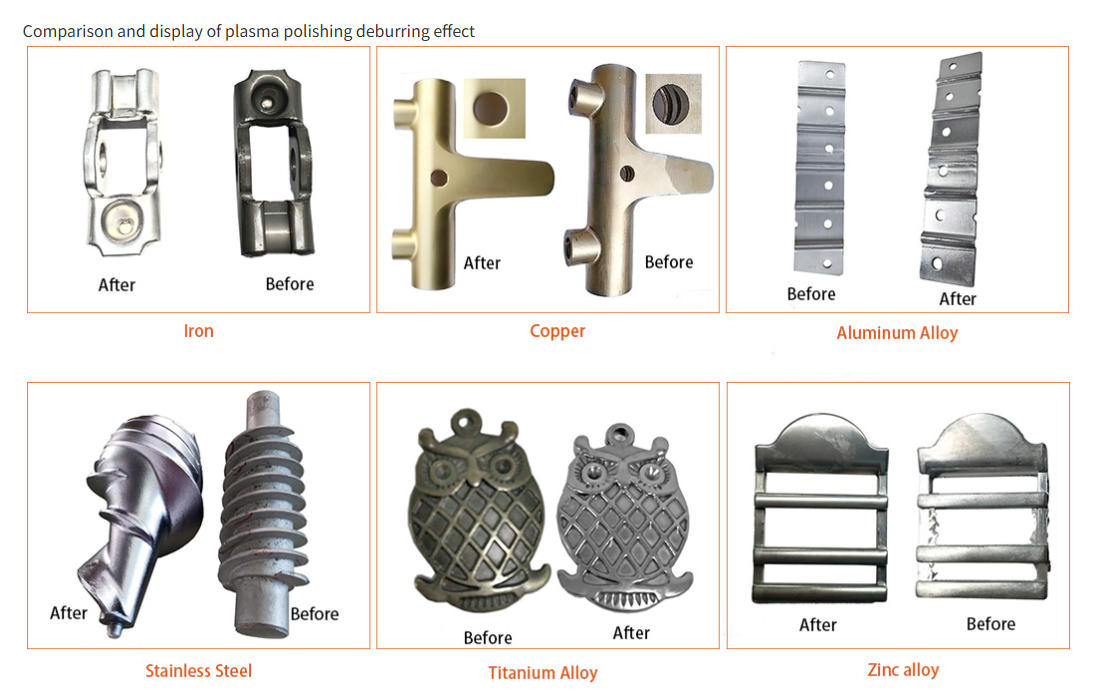
Application and Use Cases: Where Plasma Polishing Fits
Plasma polishing is not a universal replacement for every finishing process, but it is well suited to several high-value applications. According to BAYI, the process can be applied to:
- Medical devices and implants – surgical instruments, dental implants, and other components requiring clean, smooth, biocompatible surfaces.
- Confidential processing – parts where controlled surface modification is important.
- 3D printed dentures – additive manufacturing produces rough surfaces and support remnants; plasma polishing can smooth internal and external geometries.
- Precious metal and gold jewelry – bright, scratch-free finishes without mechanical damage.
The medical and pharmaceutical sector's 34.2% share of electropolishing services indicates a strong demand for precision finishing in regulated industries. Buyers in these sectors should prioritize supplier experience and documentation when evaluating equipment.
Small-Scale and Precision Applications
Beyond medical and jewelry, plasma polishing is also used for precision processing of hardware, machined components, and small parts. The availability of small plasma polishing machines and precision deburring equipment makes the technology accessible to job shops and specialized manufacturers. The key enabler is the machine's ability to adapt to different part sizes through custom fixturing and parameter control.
Market Trends: Demand Drivers and Regional Production Patterns
Verified market data paints a clear picture of growing adoption:
| Metric | Value | Source |
|---|---|---|
| Global plasma polishing machine market (2025) | USD 1.2 billion | Industry Analysis 2026 |
| Projected CAGR (2026–2035) | 8.5% | Industry Analysis 2026 |
| Asia-Pacific share of global production capacity | Over 45% | Industry Analysis 2026 |
| Global deburring machine market (2024) | USD 1,023.6 million | Grand View Research |
| Projected deburring machine market (2030) | USD 1,365.8 million | Grand View Research |
| Low pressure/vacuum plasma systems share (2026) | 65.79% of plasma surface treatment | Fortune Business Insights |
Asia-Pacific, led by China, accounts for more than 45% of global plasma polishing production capacity. This geographic concentration has implications for lead times, spare parts availability, and after-sales support. Buyers sourcing from China can benefit from proximity to a robust supply chain, but they must also evaluate the supplier's export experience and responsiveness.
Comparison with Traditional Solutions: Evidence, Costs, and Boundaries
To make an informed choice, buyers need a side-by-side view of how plasma polishing compares with traditional methods such as mechanical buffing, vibratory finishing, and manual deburring.
| Parameter | Plasma Polishing (as per BAYI) | Traditional Polishing |
|---|---|---|
| Polishing angle | 360-degree coverage without repositioning | Often limited to accessible surfaces; manual repositioning may be required |
| Energy use | Ready to use immediately; no no-load energy waste | Motors and media may run continuously, even when not processing |
| Labor requirement | Significantly reduced manual labor | High operator involvement for complex parts |
| Maintenance | Longer service life; extremely short maintenance downtime | Regular media replacement and mechanical wear |
| Application fit | Medical, 3D printed dentures, jewelry, precision components | General metal finishing, flat or simple geometries |
Boundaries and Limitations
While the advantages are compelling, buyers should also understand the boundaries of plasma polishing. First, for very large or unusually shaped workpieces, a non-standard system must be engineered. BAYI offers custom configurations, but this increases lead time and initial investment compared to off-the-shelf mechanical polishers. Second, plasma systems require disciplined maintenance—specifically, regular removal of the ash layer from the machine to prevent contamination and ensure consistent results. BAYI's risk control documentation includes an instruction manual and mechanical protective film, but the operator must follow the cleaning schedule. Third, plasma polishing may not replace every pre-finishing step, particularly where gross material removal or heavy deburring is required before a final bright pass.
These boundaries are not deal-breakers; they are part of the total cost of ownership equation. Buyers who plan for custom engineering and preventive maintenance will be better positioned to realize the long-term labor and energy savings.
Future Outlook
With the market expanding at a projected 8.5% CAGR, plasma polishing is likely to become more embedded in automated production lines. Standardization of interfaces and control software will improve integration with existing manufacturing execution systems. In parallel, OEM customization is expected to grow, as more suppliers offer tailored solutions for medical, aerospace, and jewelry applications.
For buyers, the key takeaway is to treat plasma polishing as a decision that balances technical capability, operational cost, and supplier support. BAYI's 17 years of engineering experience and its range of standard and custom models offer one reference point, but the final choice should be based on a structured evaluation of part specifications, production volume, and after-sales service.
FAQ
Q: What is a plasma polishing machine?
A: A plasma polishing machine uses ionized gas to remove micro-burrs and smooth metal surfaces. It differs from traditional mechanical polishing by offering 360-degree coverage without repositioning the workpiece, and it is ready to use immediately with no energy waste under no-load conditions.
Q: Which materials and industries are best suited to plasma polishing?
A: Plasma polishing is well suited to medical treatment, confidential processing, 3D printed dentures, and polishing and deburring of precious metal and gold jewelry. It is also used for precision processing of hardware and machined components.
Q: How does plasma polishing compare with traditional polishing in terms of cost?
A: According to BAYI, plasma polishing can significantly reduce labor costs and optimize energy consumption expenditures compared to traditional polishing machines. The exact reduction depends on the actual project implementation, including part geometry, volume, and existing process setup.
Q: What maintenance does a plasma polishing machine require?
A: Plasma polishing machines require regular removal of the ash layer—commonly called delamination—to maintain performance. BAYI provides an instruction manual and mechanical protective film, and operators should follow a regular dusting schedule for the machine.
Q: How should buyers evaluate plasma polishing machine suppliers?
A: Buyers should assess the supplier's technical experience, standard and non-standard model options, and ability to customize equipment for specific part sizes and production requirements. Checking certifications such as ISO 9001, CE, and RoHS is also a due-diligence step for global market access.
Q: Are plasma polishing machines environmentally friendly?
A: Plasma polishing machines are designed to be energy-efficient: they are ready to use immediately and consume no energy under no-load conditions. This reduces unnecessary energy consumption compared to processes that run continuously, contributing to a lower environmental footprint.