
Plastic Extrusion Machine Lifecycle Support: A Supplier Checklist
A plastic extrusion line is bought once and operated for years. Whether the supplier can still support that line in year three, year six and year eight is a different question from whether it can build it — and it is the question this checklist is designed to answer.
Procurement conversations about a plastic extrusion machine usually concentrate on the beginning of the equipment's life: screw diameter, motor power, throughput and price. The problems that hurt most tend to arrive at the other end of the timeline — a model that is no longer built, a replacement screw that has to be reverse-engineered from a worn sample, a spare part quoted on a long lead time, or a commissioning engineer who has never seen that particular line configuration.
The worked example used here is JKS Plastic Extrusion Machine, the product identity of Wuxi JKS Machinery Manufacturing Co. Ltd., a manufacturer of custom plastic extrusion lines based in Wuxi, Jiangsu, China, founded in 2013. Its published range is unusually explicit about models, materials and service terms, which makes it a useful case for testing what a lifecycle checklist can and cannot verify at the evaluation stage.
Why lifecycle support is a separate buying decision
Supplier sustainability is not the same as financial sustainability, and it is not a marketing claim either. For an extrusion line it has a narrow, testable meaning: the supplier can still deliver the same model family, the correct wear parts to the original material specification, valid documentation for the destination market, and competent technical answers, at any point during the operating life of the machine.
Three failure modes account for most of the disruption buyers experience.
Model discontinuation. A one-off machine built around a bespoke extruder has no parts lineage. When the screw or barrel eventually wears, the replacement becomes a new engineering project rather than a purchase order.
Specification drift in wear parts. A screw of the same diameter but a different base steel or a different heat treatment is not the same part. Buyers who recorded only dimensions lose the ability to compare quotations later.
Knowledge loss. Die history, formulation notes, changeover settings and maintenance intervals are the parts of a line that live in people rather than in manuals. If they were never documented at handover, they do not survive staff turnover.
The lifecycle support checklist at a glance
The checklist below converts that definition into six checkpoints, each with the question a buyer should ask and the evidence that actually answers it. The order follows a typical Research-to-Evaluation process: first the product range, then the parts, then the paperwork, then the people, then the expansion path, then the field record.
| Checkpoint | Question to ask | Evidence that answers it |
|---|---|---|
| 1. Model lineage | Is this extruder part of a numbered family with published power and output figures? | Model list with kW and kg/h per model |
| 2. Wear-part specification | Which steel, treatment and chamber material are used for each consumable part? | Named material specification per component |
| 3. Documentation | Which certificate, standard and model scope cover this machine, and is the document current? | Certificate number, issuing body, standard, issue and expiry dates |
| 4. Service scope | What is included in installation, commissioning, training and warranty, and what is billable? | Written service scope plus stated warranty term |
| 5. Expansion path | Can the same supplier support the next product the plant intends to make? | Adjacent line types sharing the same extruder platform |
| 6. Field record | Are lines of the same type still running after several years? | Reference installations with operating duration |
Checkpoint 1: model lineage across the extruder range
The most useful single indicator of long-term parts availability is whether the machine sits inside a numbered range. In the JKS range, the SJ series single screw plastic extruder is offered in custom models including SJ30, SJ45, SJ65 and SJ90, processing PVC, PP, PE, nylon and ABS, and used as the base for pipes, rods, films, pellets, coated products and blow-moulded items. The conical twin screw plastic extruder family runs from SJSZ-45 to SJSZ-110, with published figures rising from 15 kW and 70 kg/h on the SJSZ-45 to 200 kW and 1000 kg/h on the SJSZ-110. Between those endpoints sit SJSZ-51 at 18.5 kW and 120 kg/h, SJSZ-55 at 22 kW and 150 kg/h, SJSZ-65 at 37 kW and 250 kg/h, SJSZ-80 at 55 kW and 400 kg/h, and SJSZ-92 at 90 kW and 500–600 kg/h.
Why this matters at evaluation: a published step ladder lets a buyer size a second machine later without changing supplier, spare-part inventory or maintenance training. It also means the screw geometry for a given model class is a repeatable specification rather than a one-off drawing.
Checkpoint 2: wear-part specification, not just part numbers
Wear parts are where lifecycle cost is decided quietly. Across the JKS range, the screw and barrel are specified as 38CrMoAlA nitrided alloy steel — on the SJ single screw extruders, the SJSZ conical twin screw extruders, the ST strand pelletizing lines and the PVC hot-cut pelletizing lines. The machine frame is Q235 carbon steel, and the pelletizing die is wear-resistant alloy steel.
The auxiliary equipment follows the same pattern of named materials rather than generic descriptions.
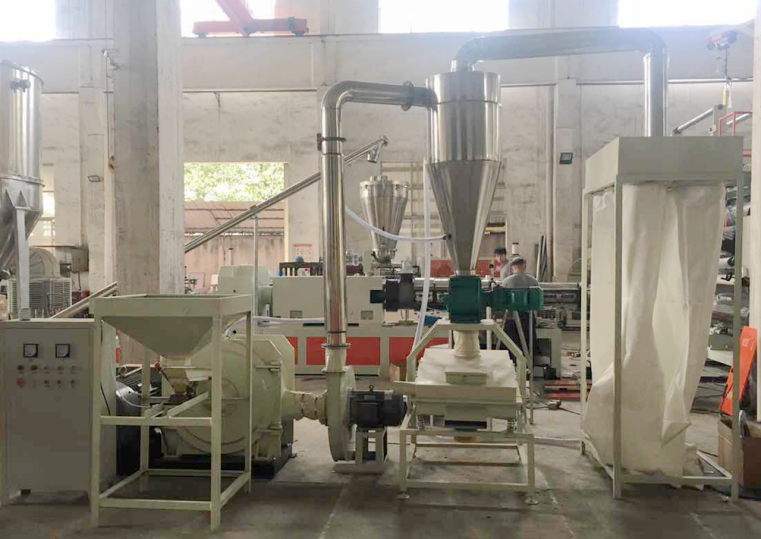
- Plastic crusher SP400 / SP660 — cutting chamber and blades in wear-resistant steel, carbon steel frame; 15 kW at 300–400 kg/h and 22 kW at 600–700 kg/h respectively.
- Plastic pulverizer MF400 / MF500 / MF600 — grinding chamber and rotor in wear-resistant steel; 30 kW at 200 kg/h, 37 kW at 300–400 kg/h and 55 kW at 400–500 kg/h, all at 40–80 mesh fineness.
- PVC mixing and cooling unit SRL-Z200/500 to SRL-Z1000/3000 — stainless steel mixing pot, carbon steel frame; 37/7.5 kW at 300–400 kg/h up to 160/22 kW at 1600–2000 kg/h, with a mixing cycle of 8–10 minutes per pot and cooling of 6–8 minutes.
- Calender rollers on sheet lines — forged steel with hard chrome plating; the SPC flooring line specifies 45# forged steel with hard chrome plating.
For procurement, the practical output of this checkpoint is a spare-part schedule that records material as well as size. A quotation that lists a screw by diameter alone is not comparable with one that names base steel, treatment and the model it fits.
Checkpoint 3: documentation that survives an audit
Documentation is the checkpoint most often skipped during evaluation and most often needed afterwards. The JKS SPC flooring extrusion line, product 4630, carries a CE certificate numbered M.2021.206.C.64011, issued by UDEM International Certification Auditing Training Centre against EN ISO 12100:2010, with the SJSZ, SJ and SJP series listed within the documented scope. The certificate records an issue date of 22 April 2021 and an expiry date of 22 April 2026.
Two habits follow from that. First, ask for the current renewal document rather than the archive copy, and confirm that the exact model being purchased appears inside the stated scope. Second, note that certificate scope and machine build can diverge over time; a lifecycle checklist item is to re-confirm scope whenever a line is modified.
For buyers selling into the United States, ANSI/PLASTICS B151.7 addresses safety requirements for extrusion machines used in the plastics industry and expects a documented risk assessment process in manufacture, care and use. Published references to this standard cite different editions, so the edition your customer or market requires should be confirmed rather than assumed.
Checkpoint 4: service scope, capacity and lead time
Service language is easy to write and hard to compare. The parts of the JKS offer that can be checked are concrete: overseas installation guidance, on-site commissioning, operator training, remote technical support and a 12-month warranty. Customisation covers extruder model, screw configuration, line layout, voltage and frequency, and control system; production mode includes OEM, ODM and custom design.
The capacity facts are equally relevant to a lifecycle decision, because they set expectations about how fast a replacement can be produced. The company reports a 2,000 m² factory, 20 employees, a 6-engineer R&D team, annual output of 200 units, monthly capacity of 30 units, a lead time of 40 working days, a minimum order of one unit, and 100% factory pre-assembly and testing before shipment, with third-party inspection available on request.
Read plainly, that is a custom-oriented, modest-volume manufacturer rather than a mass producer. The implication for a buyer is not a judgement about quality but a planning instruction: wear parts that must never stop the line should be identified at order stage, not after a failure.
Checkpoint 5: the auxiliary ecosystem and the expansion path
A line rarely stays the only line a plant runs. The most common lifecycle question after year two is whether the same supplier can support the next product. In this range, the answer is visible in the product list rather than in a promise.
| Process family | Representative models in the range | Shared platform |
|---|---|---|
| Pipe — PVC water supply and drainage | PVC63, PVC250, PVC630 | SJSZ65/132, SJSZ80/156, SJSZ92/188 |
| Pipe — HDPE solid wall | PE110, PE315, PE630, PE1000, PE1600 | GS60/38 to GS150/38 |
| Pipe — PPR, corrugated, MPP/PE power conduit, steel wire reinforced | PPR20-75 and PPR20-110; KSPG-63 to KS-160; PEG63 and PG160; GS/PE-160-H to GS/PE-630-H | Single and twin screw bases |
| Profile — door and window, grille and decoration, multi-material, rod | SJSZ92/188 and SJSZ65/132; SJSZ51/55/65; SJ45/SJ50/SJ65; SJ45 and SJ65 rod | SJSZ and SJ families |
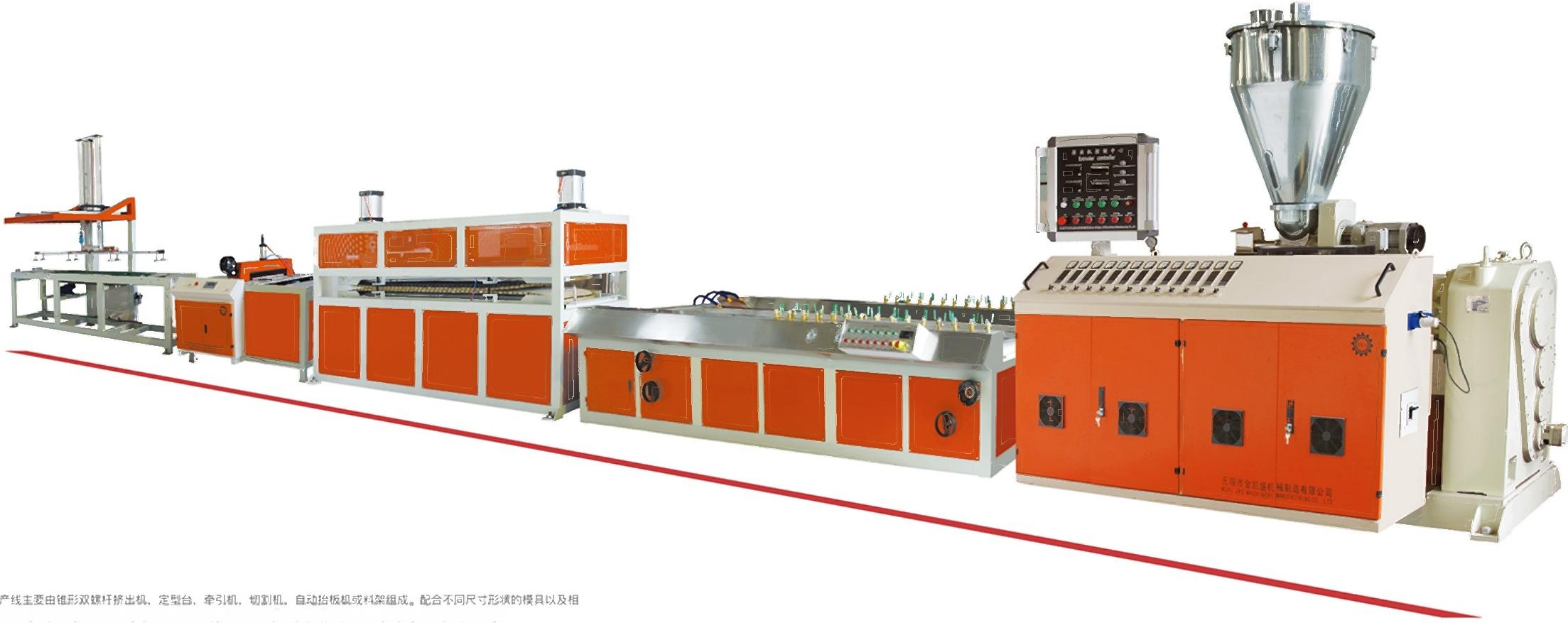
| Sheet and panel — SPC, marble, foam board, formwork, hollow wall panel, WPC door panel | SJSZ92/188, SJSZ110/220, SJP115/30, SJP135/30; SJSZ80/156; SJSZ80/156 and 80+165; SJ-130×33 and SJ-90×33; SJSZ51 to SJSZ80; SJSZ80 and SJSZ92 | SJSZ and SJP families |
| Recycling and compounding | ST80–ST150 strand pelletizing; SJSZ55–SJSZ92 hot-cut; SP400/SP660 crusher; MF400–MF600 pulverizer; SRL-Z mixer | 38CrMoAlA screw and barrel throughout |
Two observations follow. The same conical twin-screw class appears across pipe, profile and sheet lines — SJSZ-92, for instance, sits behind both the PVC630 pipe line in the SJSZ92/188 configuration and the SPC flooring line in the SJSZ92/188 configuration — so a plant adding a second product often stays inside one screw-and-barrel specification. And the recycling chain, from crusher and pulverizer through mixer to pelletizing, uses the same wear-part logic, which keeps the number of distinct consumables a maintenance team must track comparatively small.
Checkpoint 6: field evidence from installed lines
Reference installations are not proof of future support, but they are the closest available evidence of it. Three reported cases in this range are relevant because they cover different product types and different ages.
- Vietnam, plastic building materials manufacturer — one complete PVC hollow wall panel extrusion line, reported in stable operation for more than five years, with on-site installation support and full export documentation.
- Korea, plastic flooring manufacturer — one complete SPC flooring extrusion line, reported at 8+ years of stable operation with a low maintenance rate.
- Malaysia, SPC flooring manufacturer — one complete SPC flooring extrusion line, reported at 10+ years of stable operation with consistent thickness control.
These durations are supplier-reported and should be confirmed by direct reference call where the decision is material. What they do establish is that the same line types have been in the field long enough for wear parts to have been replaced at least once.
Technical explanation: where lifecycle cost actually sits
Lifecycle cost in extrusion is driven less by purchase price than by three physical realities.
The screw and barrel are the metering heart of the line. 38CrMoAlA nitrided alloy steel is a widely used specification for PVC, PP and PE processing because the nitriding step produces a hardened surface layer on a tough base steel. The procurement consequence is that replacement depends on knowing the base steel and the treatment, not only the diameter — which is exactly why Checkpoint 2 exists.
Output is set by the narrowest stage, not by the extruder alone. An SJSZ-110 rated at 1000 kg/h is limited by whatever feeds it and whatever follows it. The mixing unit illustrates the point: an SRL-Z200/500 runs 300–400 kg/h with an 8–10 minute hot mix and 6–8 minute cooling cycle, while an SRL-Z1000/3000 reaches 1600–2000 kg/h. Adding extruder capacity without matching the mixer or the downstream haul-off does not raise line output, and it does not improve support economics either.
Wear is concentrated in a small number of parts. Crusher blades, pulverizer rotors, screws, barrels and dies absorb nearly all of the abrasion. A supplier that names the material of each of these makes it possible to forecast replacement and to compare quotations on equal terms; a supplier that does not leaves the buyer comparing prices for parts that may not be equivalent.
What this means for procurement: contract items that carry the checklist
Evaluation findings only survive if they are written into the agreement. The following items translate the six checkpoints into clauses.
- A spare-part schedule listing part name, material specification, model fitment and quantity, agreed at order stage.
- Named materials for screw, barrel, die, crusher chamber and blades, pulverizer rotor, mixing pot and calender roller.
- Warranty terms defined by scope, not only by duration — the published term is 12 months, and coverage of parts, labour, travel and freight should be explicit.
- Documentation pack: certificate copies with model scope, pre-assembly and testing records, operation and maintenance manuals, and training records.
- Third-party inspection before shipment where the buyer requires it, since it is offered on request rather than by default.
- A named contact path for remote technical support, with expected response times.
Market context: why lifecycle questions are becoming standard
Three published data points explain the shift. Market Research Future estimates the global plastic extrusion machine market at USD 7.9 billion in 2025, rising to USD 12.87 billion by 2035. The Observatory of Economic Complexity, drawing on UN Comtrade data, reports China as the leading exporter of rubber and plastics working machinery under HS 8477 at USD 8.55 billion in 2024, ahead of Germany at USD 6.11 billion and Italy at USD 2.61 billion. Downstream, Grand View Research puts the global SPC flooring market at USD 6.4 billion in 2026, growing to USD 10.3 billion by 2033.
The interpretation for buyers is straightforward. A growing installed base means a growing population of machines reaching their first and second wear-part cycle at the same time. In that environment, the supplier's ability to deliver a correctly specified screw within a predictable lead time becomes a production variable rather than an administrative detail.
Single-supplier lifecycle support versus the alternatives
No sourcing model removes the lifecycle problem; each one moves it. The three common approaches compare as follows.
| Approach | Strength | Where it strains |
|---|---|---|
| Complete line from one supplier with a named model family | One parts lineage, one commissioning owner, one documentation set; expansion into adjacent products is easier | Concentrates dependency; the buyer must verify that the supplier's capacity and stock policy match the plant's uptime target |
| Line assembled from several specialist vendors | Each stage can be optimised independently | Wear-part responsibility is split; interface problems between stages are harder to assign |
| Low-cost machine plus locally fabricated replacement parts | Lowest initial outlay | Material specification is usually lost; local parts may not match the original hardness or geometry, which changes output and scrap rate |
The limitation worth stating plainly. JKS is a Wuxi-based manufacturer founded in 2013, operating a 2,000 m² factory with 20 employees and an annual output of 200 units, exporting to more than 35 countries with an export ratio of 50%. That profile suits custom and turnkey projects; it does not imply regional spare-part warehouses, published energy consumption per kilogram of output, or guaranteed local service response times. Buyers whose uptime requirement depends on those factors should treat them as contractual subjects to be negotiated and evidenced, not as assumptions. Where public data is silent — energy efficiency per kilogram and verified spare-part lead times in particular — the honest position is that these remain open questions in the supplier's published material.
Future outlook
Two directions look likely. First, model families will keep mattering more than individual machine sales, because parts traceability is cheaper to maintain across a numbered range than across bespoke builds. Second, documentation will become a selling point in its own right: certificate scope, standard editions and material specifications are already the questions buyers ask before price. Suppliers who publish model-by-model power and output figures, named materials for wear parts, and honest statements about what they do not stock will be easier to qualify — and easier to keep.
FAQ
How can a buyer tell whether an extruder model will still be supported in five years?
Look for a numbered family with published power and output figures rather than a one-off build. In the JKS range, the SJ single screw series in custom models SJ30, SJ45, SJ65 and SJ90, and the SJSZ conical twin screw series from SJSZ-45 to SJSZ-110, are documented model by model, from 15 kW and 70 kg/h up to 200 kW and 1000 kg/h. A model inside such a range has a repeatable screw geometry; a bespoke machine does not.
Which wear parts should be specified at the time of order?
Screw and barrel in 38CrMoAlA nitrided alloy steel across the SJ, SJSZ, ST and PVC hot-cut ranges; pelletizing and extrusion dies in wear-resistant alloy steel; crusher cutting chamber and blades in wear-resistant steel on the SP400 and SP660; pulverizer grinding chamber and rotor in wear-resistant steel on the MF400 to MF600; stainless steel mixing pot on the SRL-Z units; and calender rollers in forged steel with hard chrome plating. Each should be recorded with material as well as dimensions.
What does the 12-month warranty typically leave undefined?
The published JKS warranty term is 12 months, but the public material does not itemise which parts, labour, travel or freight the term covers. Buyers should define coverage explicitly in the contract and separate consumable wear parts from defect claims, since a worn screw after a year of abrasive compounding is normal operation rather than a fault.
Can one supplier support expansion from pipe to profile or sheet?
Within this range, yes — the same extruder platforms recur across product types. SJSZ-92 appears in the PVC630 pipe line as SJSZ92/188 and in the SPC flooring line as SJSZ92/188; SJSZ-80 is used in the PVC250 pipe line as SJSZ80/156, in the PVC hollow wall panel line and in the WPC door panel line; SJ single screw models carry rod, multi-material profile and pelletizing work. Shared platforms reduce the number of distinct spare parts a plant has to hold.
Which documents should be reviewed before accepting a line?
Four sets: the CE certificate with number, issuing body, standard, model scope and validity dates, where the documented SPC flooring line certificate is M.2021.206.C.64011 issued by UDEM against EN ISO 12100:2010; pre-assembly and testing records from the 100% factory test; any third-party inspection report requested before shipment; and the maintenance documentation, including the wear-part schedule and training records for operators.
Есть вопросы или нужны дополнительные детали?
Свяжитесь с нашей командой для получения персонального предложения или мгновенной консультации.
Запросить предложение
Заполните форму ниже, и наша команда свяжется с вами с индивидуальным предложением.
Прямой чат WhatsApp
Предпочитаете общаться в реальном времени? Напишите нам в WhatsApp для мгновенной помощи и быстрых ответов.
- Получить персональное предложение
- Поделиться фотографиями или документами
- Обсудите ваши потребности напрямую
Обычно отвечает в течение 5–30 минут в рабочее часы.