
Plastic Extrusion Machine Mixer Units: A Scenario Shortlist
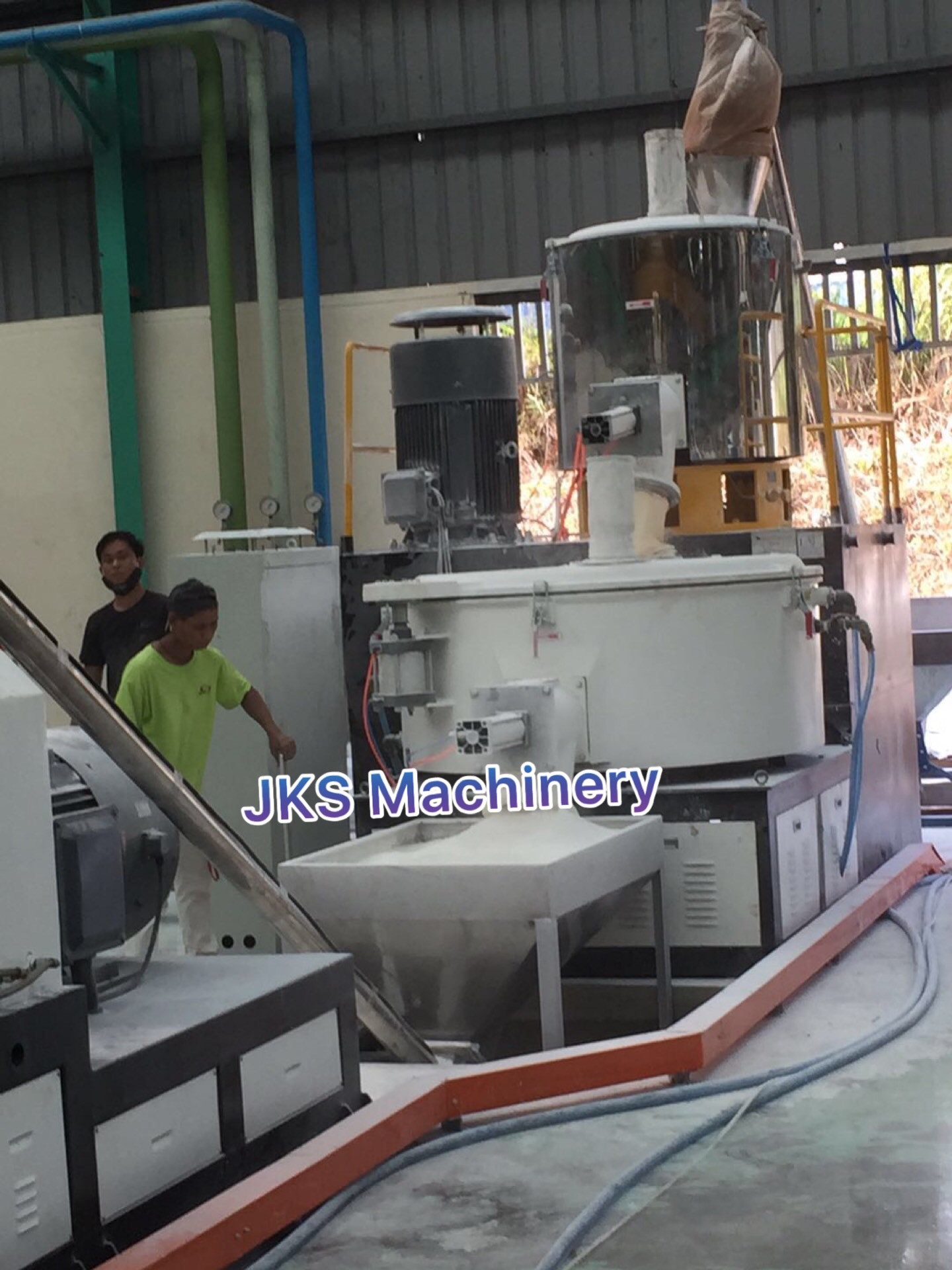
A raw material mixing unit in operation ahead of a PVC extrusion line. Mixing consistency is set before the material reaches the extruder hopper.
An extrusion line's output ceiling is set before the screw turns. In PVC-based production — pipe, profile, sheet, SPC flooring, pelletizing — almost every parameter the extruder controls depends on a material condition the extruder cannot repair: whether the compound arriving at the hopper is uniform in additive dispersion, moisture content, and temperature. That condition is created upstream, by the raw material mixer unit, which is why mixing equipment now appears as a standalone line item in extrusion procurement rather than as a footnote to the extruder order.
This shortlist is organised by production scenario rather than by model number alone. The reference unit is the PVC Mixing & Cooling Unit from Wuxi JKS Machinery Manufacturing Co., Ltd. — a Chinese manufacturer of custom plastic extrusion machinery and turnkey production lines, founded in 2013 and operating a 2,000 m² workshop in Wuxi, Jiangsu Province. JKS produces this unit as part of a wider auxiliary range that also includes crushers and pulverizers, and supplies it both as a standalone machine and as the front end of a complete extrusion line.
Why the Mixing Unit Belongs on the Shortlist
A shortlist that starts with the extruder starts in the wrong place. The mixer determines what the extruder is being asked to do. In PVC formulations, resin is combined with stabilizers, plasticizers, and fillers — often calcium carbonate at significant loading — and the purpose of high-speed hot mixing is to disperse those additives uniformly while driving off surface moisture. The subsequent cooling stage exists to stop the compound from agglomerating before it can be conveyed or stored.
Where the mixing stage is under-specified, the symptoms appear downstream rather than in the mixer: variation in melt pressure, inconsistent wall thickness on pipe, colour drift across a shift, or gel and unmelted spots in sheet. Those are expensive symptoms to chase at the die head, and they are rarely solved there. This is the practical argument for treating the mixer as a specified, shortlisted component with its own throughput, material, and cycle-time criteria.
What the Shortlist Actually Compares
Five criteria separate one mixing unit from another in a procurement evaluation. They are not equally weighted, and they are not independent of one another.
| Criterion | What it decides |
|---|---|
| Stated hourly output | Whether the mixer can feed the extruder continuously without a second unit |
| Hot / cooling power split | Dispersion intensity and how quickly the batch can be stabilised |
| Cycle time | Batches per hour, and therefore the buffer volume between mixer and hopper |
| Contact material | Wear life under high-fill formulations and ease of cleaning between recipes |
| Installed power and footprint | Transformer capacity and plant layout, both of which are hard to change later |
The last two criteria are the ones most often deferred and most often regretted. A unit sized for throughput but not for available power capacity becomes a plant engineering problem, and a mixer that cannot be cleaned quickly quietly limits how many recipes a producer can run in a week.
The JKS Mixing & Cooling Unit: Published Model Facts
JKS documents four models in this series, distinguished by combined hot and cooling mixer power and by stated output. Mixing pot construction is stainless steel and the machine frame is carbon steel across the range.
| Model | Hot / cooling power | Stated output |
|---|---|---|
| SRL-Z200/500 | 37 / 7.5 kW | 300–400 kg/h |
| SRL-Z300/600 | 55 / 11 kW | 450–600 kg/h |
| SRL-Z500/1000 | 75 / 15 kW | 800–1000 kg/h |
| SRL-Z1000/3000 | 160 / 22 kW | 1,600–2,000 kg/h |
The published cycle is a hot mixing stage of 8–10 minutes per pot followed by a cooling stage of 6–8 minutes per pot, giving a complete cycle in the region of 14–18 minutes. Because the unit is a batch machine rather than a continuous one, this cycle figure — not the hourly output alone — is the number that governs how the mixer is integrated into a line.
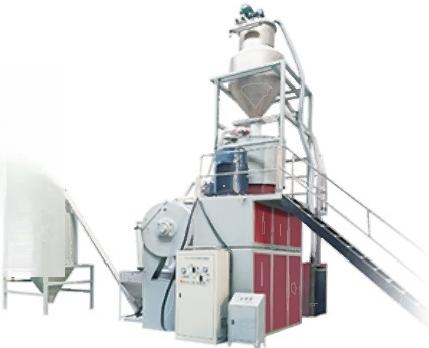
The SRL-Z series combines a high-speed hot mixing pot with a lower-speed cooling pot; the two-stage arrangement is what separates it from a single-speed dry blender.
A Scenario-Led Shortlist
Model selection should follow the line the mixer will feed, not the mixer catalogue in isolation. The positioning below is derived from the published output figures compared against published extrusion line capacities; it is a decision framework rather than a manufacturer-declared pairing.
Scenario 1 — PVC pipe and profile lines in the mid-hundreds of kg/h
A PVC pipe line configured with the SJSZ-65 extruder is rated at 250 kg/h; a PVC63 double-station line is rated at 270 kg/h. Against those figures, the SRL-Z200/500 at 300–400 kg/h carries modest headroom, and the SRL-Z300/600 at 450–600 kg/h carries enough to absorb a future step up in line speed. Producers running several smaller profile lines from one mixing station should model the sum of demand rather than the largest single line.
Scenario 2 — Sheet, panel, and SPC core production
Where the downstream line is rated in the high hundreds or above — a PVC250 pipe line at 450 kg/h, a PVC630 line at 800 kg/h, a foam board line at 400–500 kg/h — the SRL-Z500/1000 at 800–1000 kg/h becomes the natural reference point. These products typically use higher filler loading, which raises both the dispersion requirement and the wear exposure on the mixing pot and blades.
Scenario 3 — Compounding and pelletizing feed
A PVC hot-cut pelletizing line built on the SJSZ92 extruder is stated at 650–800 kg/h, and on the SJSZ80 at 350–400 kg/h. Compounders feeding such a line, or feeding more than one line, are the case for the SRL-Z1000/3000 at 1,600–2,000 kg/h. At 160 kW hot-mix power this is also the model where the electrical supply becomes a project decision in its own right.
Scenario 4 — Multi-recipe and small-batch operation
Where the constraint is recipe changeover rather than tonnage, the smaller models remain the better fit. Ease of cleaning is documented as a special requirement for this equipment, and it matters more than throughput in plants that run several formulations across a week.
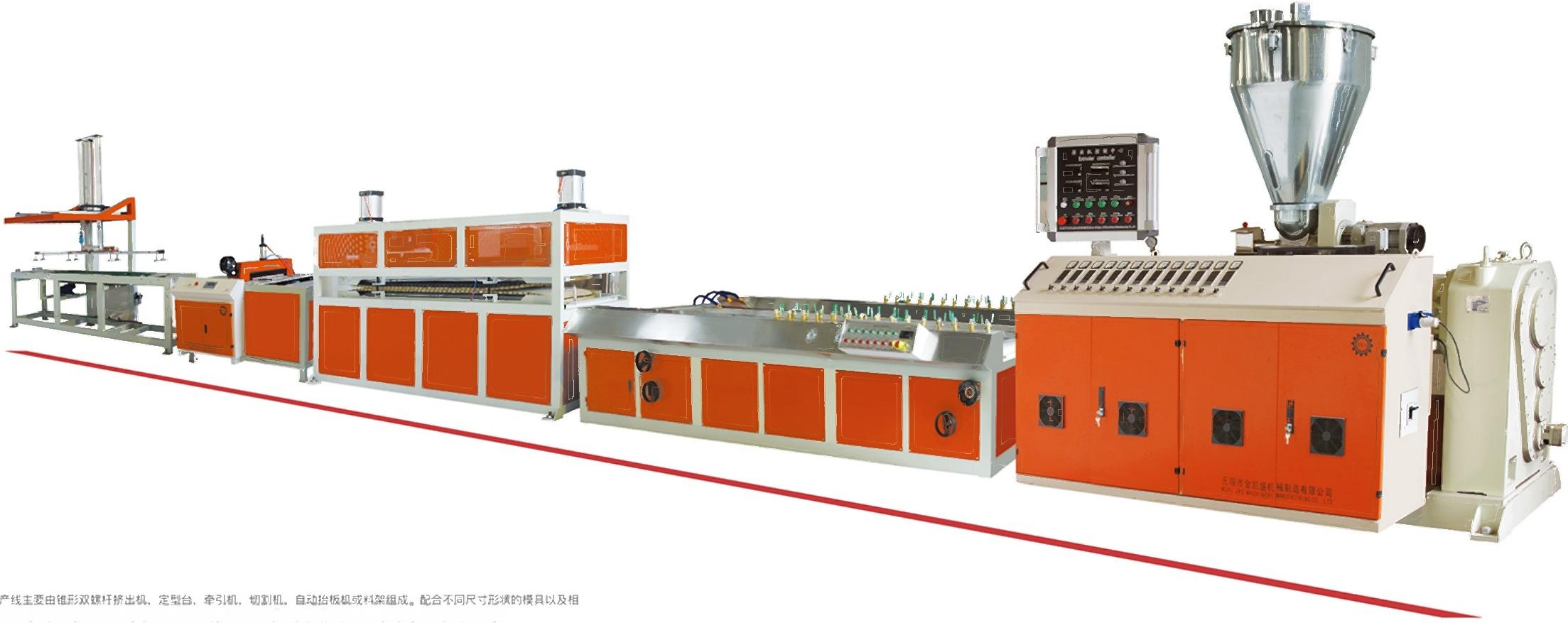
Panel and profile lines consume compound at a steady rate; the batch nature of mixing means the buffer between mixer and extruder carries real design weight.
Matching Mixer Throughput to Extruder Throughput
The matching exercise is arithmetic, but it has to be done on cycle time rather than on nameplate output. At 8–10 minutes of hot mixing plus 6–8 minutes of cooling, a complete cycle runs 14–18 minutes, which allows roughly 3.3 to 4.3 batches per hour. A buyer can divide the stated hourly output by that batch count to sanity-check the implied batch size, and can then compare it with the hourly demand of the extrusion line the unit will feed.
Two practical conclusions follow. First, a mixer with output comfortably above the line rating is not over-specification — it is the margin that lets the line run through a cooling cycle without starving. Second, the gap between batches has to be absorbed somewhere, which in practice means a buffer silo or hopper between the mixer and the extruder. The application documentation for this unit lists conveyors, storage silos, and extruders as the supporting equipment, which reflects that dependency directly.
Upstream of the mixer, the same logic applies to reclaim. JKS lists a Plastic Crusher in SP400 (15 kW, 300–400 kg/h) and SP660 (22 kW, 600–700 kg/h) configurations, and a Plastic Pulverizer in MF400 (30 kW, 200 kg/h), MF500 (37 kW, 300–400 kg/h), and MF600 (55 kW, 400–500 kg/h) configurations producing 40–80 mesh powder. Producers reintroducing regrind or pulverized scrap into the formulation need the mixing stage to handle that stream consistently, not just virgin resin.
Market Context Behind the Re-Specification
The rising attention paid to mixing equipment tracks the shape of the extrusion market itself. The global plastic extrusion machine market was estimated at USD 7.901 billion in 2025 and is projected to reach USD 12.87 billion by 2035, according to Market Research Future. Trade data points the same direction: in 2024, China was the leading exporter of rubber and plastic working machinery under HS 8477 at USD 8.55 billion, ahead of Germany at USD 6.11 billion and Italy at USD 2.61 billion, according to the Observatory of Economic Complexity using UN Comtrade data.
Within that, the downstream segment most sensitive to mixing quality is growing on its own curve. Grand View Research reports the global stone plastic composite flooring market at USD 6.4 billion in 2026, projected to reach USD 10.3 billion by 2033. SPC formulations are heavily filled, which puts the dispersion and cooling stages under more pressure than a lightly filled profile compound would. A category that grows faster than the general extrusion market pulls mixing specifications upward with it.
Comparison with Simpler Alternatives — and Where the Boundary Sits
The obvious alternative to a two-stage hot and cooling mixer is a single-speed dry blender, which costs less, occupies less floor space, and needs a smaller electrical supply. For some formulations that is the correct choice. The comparison is not a straight upgrade path.
Where the two-stage unit earns its place: high-filler PVC formulations, SPC and foam board compounds, and any process where residual heat in the batch would cause agglomeration before the material reaches the hopper. The cooling pot exists precisely to solve a problem the hot mixer creates.
Where it does not: batch operation is an inherent limitation, not a defect. A continuous compounding process that requires an uninterrupted material stream will not be served by a 14–18 minute cycle without buffer capacity sized for it. Similarly, a producer running only lightly filled or unfilled dry blends may find the cooling stage adds power and footprint without a corresponding gain. The correct answer depends on the formulation, and a supplier who does not ask about the formulation before recommending a model has skipped the deciding question.
Two further boundaries are worth stating plainly. The SRL-Z1000/3000 draws 160 kW on the hot mixer alone, plus 22 kW on cooling — a figure that has to be reconciled with the plant transformer before the order, not after. And on compliance, buyers should note that published references to the applicable extrusion machinery safety standard are not fully aligned: the ANSI webstore lists ANSI/PLASTICS B151.7-2014 (R2021) as applying to extrusion machines used in the plastics industry and requiring a documented risk assessment process, while the PLASTICS Industry Association standards page references the 2013 edition. The discrepancy is between editions, and it is a reminder that the applicable edition should be confirmed directly rather than assumed.
How the Mixer Fits a Turnkey Line
JKS supplies extrusion equipment on an OEM, ODM, and custom design basis, with customization covering extruder model, screw configuration, production line layout, voltage and frequency, control system, and capacity adjustment. Stated capacity is 30 units per month, lead time 40 working days, and minimum order quantity one unit. Quality control is described as 100% factory pre-assembly and testing before shipment, with third-party inspection available on request, and after-sales support covers overseas installation guidance, on-site commissioning, operator training, remote technical support, and a 12-month warranty.
Installed base evidence is relevant to a mixer shortlist because it speaks to how a unit behaves after year one. A Malaysia-based SPC flooring manufacturer has operated a complete JKS SPC flooring extrusion line for more than ten years, with stable continuous production, consistent product quality, and a low maintenance rate reported over that period. A Vietnam-based plastic building materials manufacturer has run a complete PVC hollow wall panel extrusion line for more than five years with stable continuous production. Both projects were delivered as turnkey packages with on-site installation support.
Future Outlook
Two forces look likely to keep mixing specifications moving upward. The first is formulation. As filler loading rises and regrind content increases — both driven by cost and by material-recovery pressure — the tolerance for uneven dispersion narrows, and the mixing stage absorbs the difference. The second is line integration. As buyers increasingly procure complete turnkey lines rather than individual machines, the mixer stops being a separate purchase and becomes a specified sub-system whose throughput must reconcile with the extruder, the crusher, and the pulverizer before the layout is drawn.
The practical consequence for procurement is that the mixer belongs in the early evaluation stage, alongside the extruder, not in the final accessory negotiation. A buyer who settles the mixing question first tends to find the rest of the line specification easier to close.
Frequently Asked Questions
What does a plastic raw material mixer unit do in an extrusion line?
It mixes PVC resin with additives such as stabilizers, plasticizers, and fillers at high speed, then cools the mixture to prevent agglomeration before it is conveyed to the extruder. The JKS PVC Mixing & Cooling Unit performs this in an automatic hot-mixing plus cold-mixing cycle, with uniform mixing, precise temperature control, and ease of cleaning listed as the special requirements for the application.
How do I match mixer capacity to extruder output?
Compare the mixer's stated hourly output against the rated output of the line it will feed, then check the cycle time separately. On the JKS SRL-Z series the cycle is 8–10 minutes hot mixing plus 6–8 minutes cooling per pot, so a complete cycle runs roughly 14–18 minutes. A line rated at 250 kg/h sits comfortably within the 300–400 kg/h range of the SRL-Z200/500, while a line rated at 800 kg/h aligns with the 800–1,000 kg/h range of the SRL-Z500/1000.
Do all PVC extrusion lines need a heating and cooling mixer?
No. The cooling stage exists to prevent hot compound from agglomerating, which matters most in high-filler formulations such as SPC and foam board compounds. A producer running lightly filled or unfilled dry blends may not gain enough from the cooling stage to justify its power draw and footprint. The deciding input is the formulation, not the line type.
What should be verified before ordering a mixing unit for a heavily filled formula?
Three things: wear exposure on the mixing pot and blades, the buffer volume between the batch mixer and the extruder hopper, and the available electrical capacity. The mixing pot is stainless steel and the frame carbon steel across the JKS range, but abrasive filler loading affects service life regardless of construction. The SRL-Z1000/3000 draws 160 kW on the hot mixer and 22 kW on cooling, which has to be reconciled with plant supply before installation.
How is a mixing unit delivered and supported as part of a turnkey line?
JKS states a lead time of 40 working days, a minimum order quantity of one unit, and monthly capacity of 30 units. Quality control covers 100% factory pre-assembly and testing before shipment, with third-party inspection available on request. After-sales support includes overseas installation guidance, on-site commissioning, operator training, remote technical support, and a 12-month warranty.
Reference
The JKS WPC door project brochure, covering line configuration and equipment scope, is available for download: JKS WPC Door Project Brochure (PDF).
Sources: JKS Machinery product and company documentation; Market Research Future, Plastic Extrusion Machine Market Size, Share & Forecast 2035; Observatory of Economic Complexity, HS 8477 Rubberworking Machinery trade data; Grand View Research, Stone Plastic Composite Flooring Market Report 2026–2033; ANSI Webstore listing for ANSI/PLASTICS B151.7-2014 (R2021); PLASTICS Industry Association machinery safety standards page.
Есть вопросы или нужны дополнительные детали?
Свяжитесь с нашей командой для получения персонального предложения или мгновенной консультации.
Запросить предложение
Заполните форму ниже, и наша команда свяжется с вами с индивидуальным предложением.
Прямой чат WhatsApp
Предпочитаете общаться в реальном времени? Напишите нам в WhatsApp для мгновенной помощи и быстрых ответов.
- Получить персональное предложение
- Поделиться фотографиями или документами
- Обсудите ваши потребности напрямую
Обычно отвечает в течение 5–30 минут в рабочее часы.