
Plastic Folding Basket Buyer Matrix: PP+TPE & Fold Life
Plastic Folding Basket Buyer Matrix: PP+TPE & Fold Life
A plastic folding basket is only as useful as its fit to one specific job, and the specification line most buyers receive carries too little information to judge that fit. The surrounding category is expanding: the global market for foldable and collapsible containers, which includes plastic folding baskets and crates, was valued at USD 1.7 billion in 2025, with plastic holding a 53.9% revenue share and Asia Pacific — led by China — accounting for 36.8% of that revenue (Grand View Research). Growth at that scale pulls more sourcing teams into the category, and most of them begin with the same single metric: capacity in litres.
Capacity in litres answers how much a basket holds. It does not answer how much it carries, how many times it can be folded before the wall fatigues, what the wall is made of, or which compliance gate the destination market imposes. This article replaces the single-metric screen with a buyer matrix built on four variables — capacity envelope, maximum bearing load, folding cycle life, and hard-rim/soft-wall construction — and closes with the purchasing terms and acceptance criteria that sourcing teams should settle before a purchase order is released.
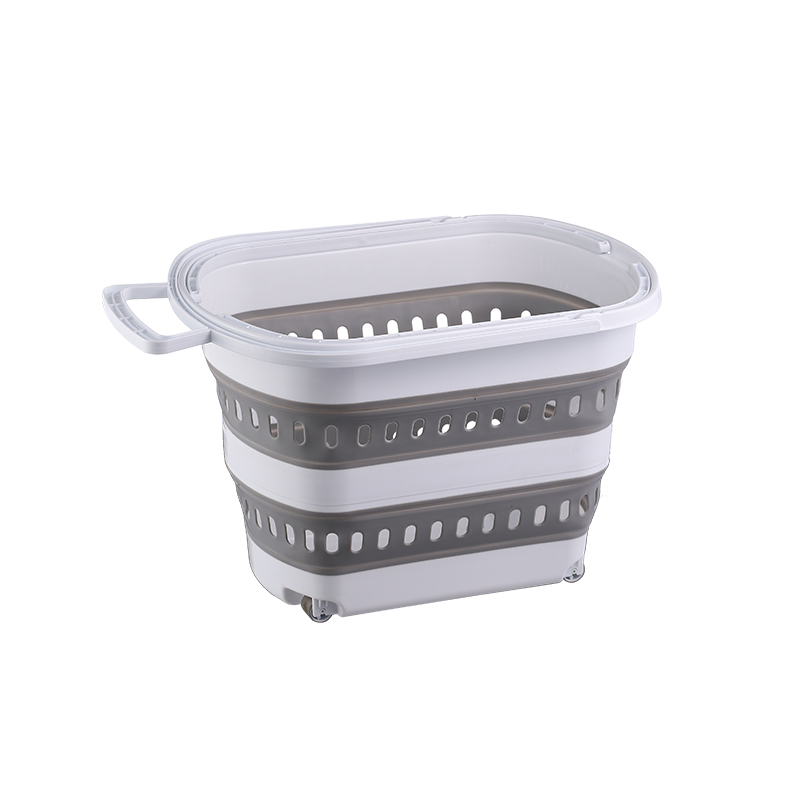
A folding basket is a system of parts: a rigid rim, a flexing wall, and a base that has to stay flat under load.
The Four Variables That Decide Application Fit
1. Capacity envelope. In the foldable plastic household range, capacity spans 3 L to 43 L across more than 90 styles. That is a wide envelope, and it matters because the low end and the high end do not serve the same buyer. A 3 L to 8 L article suits countertop, food-washing and small-pet tasks; a 30 L to 43 L article is sized for laundry volume, bulk carry and shelf display. Choosing the capacity band first narrows the style list faster than any other single decision.
2. Maximum bearing load. The documented maximum bearing load for the PP+TPE foldable range runs from 12 kg to 25 kg, depending on size and wall configuration. This is the variable most often missing from a quotation. A buyer comparing two 40 L baskets on price alone may be comparing two different load classes without knowing it.
3. Folding cycle life. Cycle life is the number of open-and-fold repetitions an article survives before the fold line cracks or deforms. Documented figures across the foldable PP+TPE range: 5,000 to 10,000 folds for the plastic collapsible basket, 5,000 cycles or more for the collapsible plastic basin, and 6,000 cycles or more for the collapsible water bucket. Lab testing reports no cracking or deformation within those cycles.
4. Wall construction. A folding basket is a composite article, not a single-material moulding. The hard rim carries the load and holds the open shape; the soft wall does the flexing. Treating the two as one specification is the most common source of mismatch between sample approval and mass production.
Buyer takeaway: a complete folding basket specification contains four numbers, not one — capacity (L), maximum bearing load (kg), folding cycle life (cycles), and the material designation of the rim and wall (PP hard rim plus TPE soft wall).
The Buyer Matrix: Scenario Mapped to Specification
The table below maps six common sourcing scenarios to the variables that should be confirmed in each case. The capacity and load bands are drawn from the documented portfolio envelope — 3 L to 43 L capacity, 12 kg to 25 kg maximum bearing load, and 5,000 to 10,000 fold cycles — and are intended as a starting point for a specification conversation, not a substitute for testing the specific article sampled.
| Scenario | Typical configuration | Capacity band | Load to verify | Compliance gate |
|---|---|---|---|---|
| Household storage & laundry | Heavy-duty foldable laundry basket | Mid to large | Upper load class | General household |
| Vegetable washing & picnic | Food-contact folding basket | Small to mid | Lower load class | FDA / LFGB food contact |
| Outdoor camping & travel | Folding picnic basket / carry configuration | Small to mid | Lower load class | Food contact if used for food |
| Auto care & detailing | Car wash / soak configuration | Small to mid | Water weight plus tools | Leak-proof seams |
| Pet care | Pet cleaning tub configuration | Small to mid | Lower load class | Skin-contact friendly, BPA-free |
| Retail & e-commerce supply | Supermarket retail / Amazon FBA packing | Full envelope 3 L–43 L | Whole range, per SKU | Full documentation pack |
Two of those scenarios are easy to misread. Auto care and pet care are documented inside the foldable PP+TPE portfolio as dedicated configurations — a car wash foldable basin and a pet cleaning tub — rather than as generic laundry baskets used off-label. A buyer sourcing for a car-care or pet-care programme should confirm which configuration the supplier is quoting, because the load profile, water depth and seam requirement differ from a dry-goods basket.
PP+TPE Construction: Why the Rim and the Wall Are Specified Together
A hard rim in polypropylene (PP) and a folding wall in thermoplastic elastomer (TPE) is the standard composite architecture for foldable plastic ware, and it is consistent with the broader resin picture: industry data identifies HDPE and PP as the primary resins used for folding baskets because of their durability and recyclability (Plastics Europe). The PP component provides structure; the TPE component provides fatigue resistance at the fold line.
The documented material profile of this composite is 100% new food-grade PP + TPE, BPA-free, with surfaces described as smooth and stain-resistant and cleanable with water, and with weather-resistant behaviour suited to outdoor use. The foldable plastic household range is manufactured from this composite, with silicone and EVA listed as optional materials on some configurations.
Temperature is where a general material claim and a specific article claim diverge, and buyers should keep the two apart. The plastic collapsible basket specification documents a temperature range of −20 °C to 120 °C. The collapsible plastic basin and the collapsible water bucket specifications document −20 °C to +60 °C. The material wording in both cases refers to tolerating boiling water without odd odours and resisting cracking at low temperature — but the numeric ceiling belongs to the article, and a purchase order should name the article, not the material family.
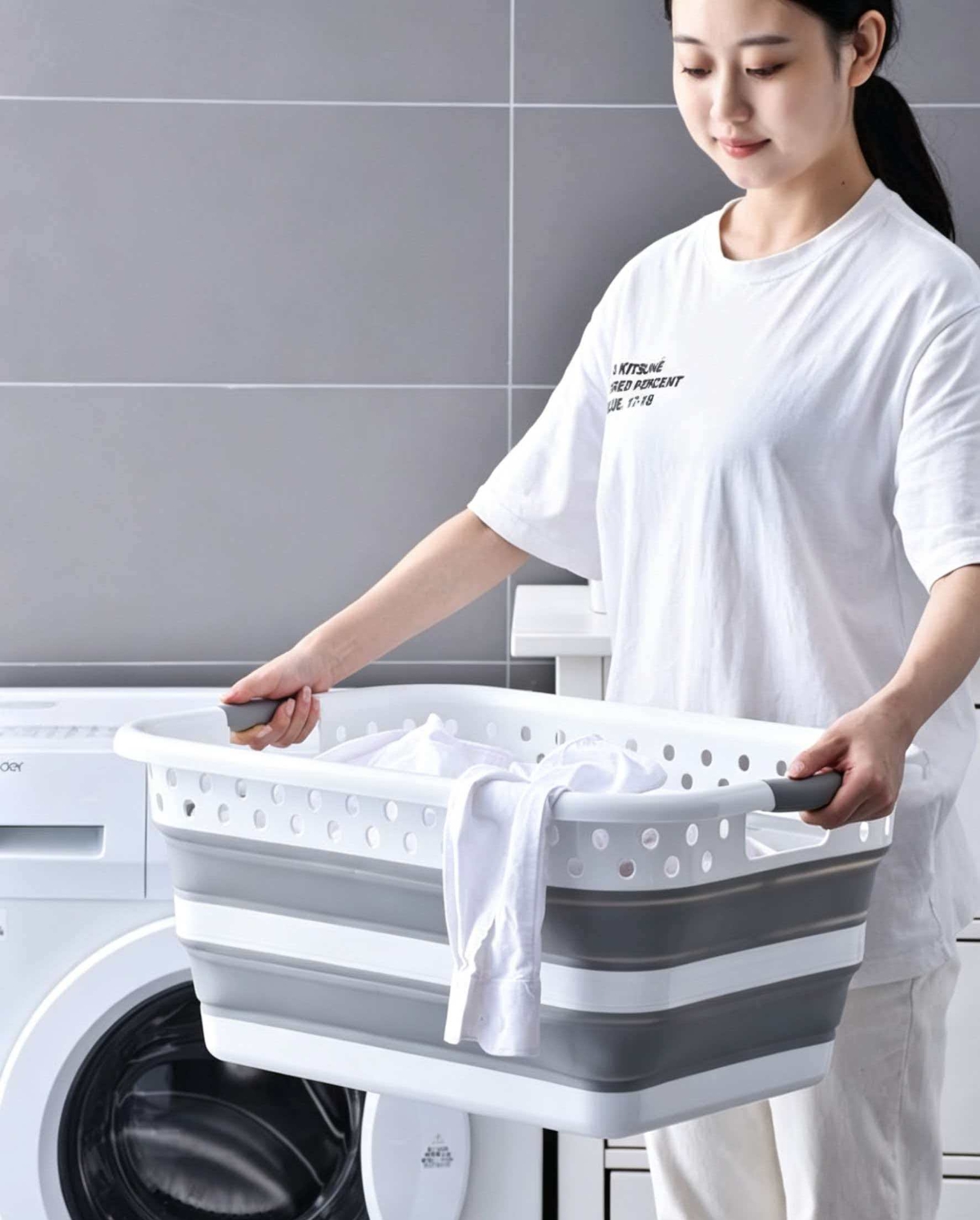
The hard rim holds the open shape; the TPE wall absorbs the flexing at the fold line.
Structural details that determine real-world performance rather than catalogue appearance include reinforced thick side walls, heat-pressed fold lines and sealed seams, an anti-slip base structure to reduce tipping, and integrated reinforced handles for loaded carrying. The one-piece fold-expand structure behind these products is covered by 23 independent product patents, which distinguishes it from spliced foldable constructions assembled from separate panels — a meaningful difference, because spliced joints are typically where leakage and separation begin.
Compliance: What BPA-Free, FDA and LFGB Actually Gate
Food-contact approvals and structural performance are two separate documents, and confusing them is a common error in folding basket sourcing. FDA and LFGB food contact approvals speak to the material's suitability for contact with food. They do not certify load capacity, fold cycle life or seam integrity. A compliance file and a performance file are both required, and they answer different questions.
For buyers placing food-contact foldable products in the European Union, the regulatory frame is public and specific. Food contact materials are governed by Regulation (EC) No 1935/2004 as the framework measure, with plastics addressed by Regulation (EU) No 10/2011, and good manufacturing practice for food-contact materials regulated under Commission Regulation (EC) No 2023/2006 (European Commission). These are baseline conditions for market access, not optional add-ons.
Documented certification coverage for the foldable PP+TPE range extends beyond food contact to BSCI, ECM, FDA, REACH, RoHS, ASTM and SEDEX. For a sourcing team, the practical instruction is to request the certificate that names the specific article, the material batch logic, and the destination market — a certificate issued to a material family is not automatically a certificate for the finished basket.
OEM Customization and the Mold Denominator
Customization capacity in foldable plastic ware is usually a question of tooling rather than of intention. TAIZHOU NANTONG PLASTIC CO.,LTD, established in 2003 and located in Taizhou, Zhejiang Province, operates an integrated factory-and-trade model for foldable plastic household goods and holds 200 self-developed production molds. Custom size and colour are supported across the range; the standard mold opening cycle is 30 to 40 days, with mold repair response within 2 to 3 days.
Production capacity behind that tooling set includes 12 injection molding machines in the 300 g to 2500 g range, manipulators, automatic packing machines, thermoforming machines and 3 assembly production lines, running out of a 6,000 m² production plant with a separate 3,500 m² warehouse — over 9,500 m² in total. The company employs approximately 39 staff, with an R&D team of 4 engineers, and reports more than 15 years of manufacturing experience. Export accounts for 70% of total sales, with the USA, UK, Germany, Spain, Australia, Korea and Japan as the major markets.
The reason this matters inside a buyer matrix is timing. A custom capacity, colour or structure is not a line item on an existing order — it is a mold event, and a 30-to-40-day opening cycle has to sit inside the buyer's calendar before the first mass-production batch. For regional programmes where size, colour and structure need to be tailored to a market's shelf or household convention, that lead time is a planning input rather than a defect.
Where a Folding Basket Fits — and Where It Does Not
Documented application scope for the plastic collapsible basket line covers household supplies, laundry and cleaning, outdoor picnic, supermarket retail, and cross-border e-commerce including Amazon FBA. Adjacent foldable configurations in the same material system extend into auto care, pet cleaning, camping and travel, beauty-salon use and light workshop soaking tasks.
The boundaries matter as much as the coverage, and there are at least three worth stating plainly:
- Collapsibility is purchased with rigidity. A folding basket performs best in the 12 kg to 25 kg load class documented for this range. Above that class, a rigid container or a heavy-duty returnable crate is the correct tool, and a folding design should not be forced into that role.
- Industrial returnable transit packaging is a different segment. Companies such as Schoeller Allibert, ORBIS Corporation and Brambles (CHEP) are identified as key competitors in the plastic container and crate market (Market Research Future), a market oriented toward industrial and commercial returnable packaging. That is a different specification envelope from a household or retail folding basket. One industry estimate places the most-used collapsible crate capacity band in commercial and industrial settings at 100–300 L; that figure is not independently verified here and should be treated as directional only.
- Cycle life is a lab figure, not a field guarantee. The documented 5,000 to 10,000 folds describe performance in repeated-fold testing without cracking or deformation. Field life still depends on load discipline — an overloaded basket folded repeatedly will reach the end of its wall life sooner than a correctly loaded one.
Space and Logistics: The Quiet Part of the Specification
For bulk buyers, the fold is a logistics feature before it is a consumer feature. After folding, thickness compresses to a few centimetres — 2.5 cm to 4 cm on the basin configurations and 3 cm to 4.5 cm on the bucket configurations — cutting volume by 75% to 85%. Third-party data points in the same direction, describing foldable crates as reducing storage space requirements by up to 75% when not in use compared with rigid alternatives (Grand View Research).
For shipping, the documented effect of the foldable design is a container space utilisation improvement of 300%, with 4 to 5 times more pieces per carton than rigid traditional plastic containers, which lowers cross-border sea, air and overseas warehousing costs. Folded units can be hung, slotted into cabinet gaps, stacked, or stored in luggage and car trunks, which also reduces warehouse and retail shelf footprint. All goods use recyclable materials that meet global environmental requirements.
Market Signals a Sourcing Team Should Track
Several independent indicators describe where this category is heading. The US foldable container market was valued at USD 422.8 million in 2024, attributed to e-commerce and retail demand for space-saving solutions (Grand View Research). Global trade under HS Code 392310 — plastic boxes, cases and crates — reached approximately USD 14 billion in 2024, with China's exports of the same code valued at USD 1.89 billion, placing it among the top three global exporters (OEC). Collapsible recycled plastic packaging, a sustainability-driven sub-segment, was estimated at USD 9.9 billion globally in 2025 (Grand View Research).
Forecasts, by contrast, deserve caution. Projected growth for the plastic crate segment has been reported at 7.56% CAGR from 2026 (Fortune Business Insights) and at 3.97% (Market Research Future) — a gap wide enough that a buyer should treat any single growth number as directional. What is consistent across sources is the direction: foldable and space-saving formats continue to take share from rigid alternatives in household, retail and e-commerce channels.
Purchasing Terms and Acceptance Criteria
A buyer matrix is only useful if it converts into terms. The following items are the questions that should be settled in writing before a purchase order, each framed as an acceptance criterion rather than a preference.
- Capacity and dimensions. Per-model capacity in litres plus unfolded dimensions, and the folded thickness the buyer is planning shelf and carton space around.
- Maximum bearing load. The rated load class for that specific article, within the documented 12 kg to 25 kg range, and the test method used to confirm it.
- Folding cycle life. The declared figure for the article — 5,000 to 10,000 folds on the basket line, 5,000 or more on the basin, 6,000 or more on the bucket — and whether a test report backs it.
- Material and construction. Confirmation of PP hard rim plus TPE soft wall, use of new food-grade material, and BPA-free status.
- Food-contact documentation. FDA and LFGB approvals naming the article, plus EU Regulation (EC) No 1935/2004 and Regulation (EU) No 10/2011 alignment where the destination is the European Union.
- Temperature statement. The declared operating range for the exact configuration ordered, since the basket and the basin/bucket specifications differ.
- Packaging and loading plan. Pieces per carton, folded packing format, and container utilisation consistent with the 4-to-5-times density advantage of the foldable design.
- Tooling terms. Whether the order uses an existing mold or requires a new one, and how the 30-to-40-day opening cycle fits the delivery schedule.
- After-sales and logistics support. Warranty coverage for non-artificial damage and the availability of FBA and DDP logistics support for e-commerce programmes.
- Acceptance sampling. The AQL-equivalent inspection points — seam integrity, fold-line appearance, rim alignment, base anti-slip structure and handle load-bearing — that define a conforming shipment.
Service framework behind these terms is documented at supplier level: TAIZHOU NANTONG PLASTIC CO.,LTD is a long-term exclusive supplier for Walmart and Sam's Club, cooperates with German Netto and Japanese Nitori and 3Coins, has served over one million households worldwide, and maintains Class A Tax Credit status for 2023 and 2024 as a Zhejiang Provincial Sci-Tech Small & Medium Enterprise. For buyers running multi-market programmes, that retailer base is verifiable context rather than a marketing claim.
Frequently Asked Questions
What capacity range do plastic folding baskets come in?
The foldable plastic household range covers more than 90 styles with capacities from 3 L to 43 L. The low end serves countertop, food-washing and small-pet tasks; the high end serves laundry volume, bulk carry and retail display. Capacity should be selected by use case first, before load class and material are compared. Custom sizes are supported by 200 self-owned molds.
How much weight can a plastic folding basket hold?
The documented maximum bearing load for the PP+TPE foldable range is 12 kg to 25 kg, depending on size and wall configuration. Load is carried by the PP hard rim and the base structure, so the rated figure belongs to the finished article rather than to the raw material. Buyers should request the rated load class for the exact model ordered and confirm it on the sample.
How many times can a plastic folding basket be folded?
Documented folding cycle life is 5,000 to 10,000 folds on the plastic collapsible basket line, 5,000 cycles or more on the collapsible plastic basin, and 6,000 cycles or more on the collapsible water bucket. Lab testing reports no cracking or deformation within those cycles. Field life depends on load discipline: repeated overloading shortens wall life regardless of the declared cycle figure.
What does PP+TPE mean in a folding basket?
PP is polypropylene, used for the rigid hard rim that holds the basket's open shape and carries load. TPE is thermoplastic elastomer, used for the soft folding wall that flexes at the fold line. The composite is documented as 100% new food-grade PP+TPE and BPA-free, with silicone and EVA listed as optional materials on some configurations. Industry data identifies HDPE and PP as the primary resins used for folding baskets because of durability and recyclability.
Which certifications matter for food-contact folding baskets?
FDA and LFGB food contact approvals are documented for the foldable PP+TPE range, along with BSCI, ECM, REACH, RoHS, ASTM and SEDEX coverage. For the European Union, food contact materials fall under Regulation (EC) No 1935/2004 and Regulation (EU) No 10/2011, with manufacturing practice regulated by Commission Regulation (EC) No 2023/2006. Food-contact approvals address material safety; they do not certify load capacity or fold cycle life, which require separate performance evidence.
Can plastic folding baskets be customized in size, color and structure for OEM orders?
Yes. Custom size, colour and structure are supported across the range, backed by 200 self-developed production molds, 12 injection molding machines in the 300 g to 2500 g range and 3 assembly production lines. The standard mold opening cycle is 30 to 40 days, with mold repair response within 2 to 3 days. Because customization is a tooling event rather than a line-item change, mold timing should be built into the buyer's delivery schedule from the outset.
What should be verified before accepting a folding basket shipment?
Acceptance checks should cover capacity and unfolded dimensions against the approved sample, rated bearing load within the documented 12 kg to 25 kg range, declared folding cycle life, food-contact documentation naming the article and destination market, BPA-free declaration, the temperature range for that exact configuration, pieces per carton and container loading plan, and seam and rim integrity. Warranty for non-artificial damage and after-sales coverage are documented at supplier level and should be confirmed in the purchase terms.
Future Outlook
The direction of this category is being set by three pressures at once: urban storage constraints, logistics cost per unit, and food-contact regulation. All three favour formats that compress when idle and carry certified material. That supports continued substitution of rigid plastic containers by foldable designs in household, retail and e-commerce channels, and it raises the evidentiary bar for suppliers — buyers are moving from accepting a material description to requesting cycle counts, load classes and article-specific certificates.
For sourcing teams, the practical consequence is that the buyer matrix, not the product photo, becomes the working document. Capacity, load, cycle life, construction and compliance are the five lines that will decide whether a folding basket programme holds up in market — and the first four of them can be tested before a container ever ships.
For readers who want the full configuration list and capacity breakdown across the foldable range, the 2026 product catalogue is available as a downloadable reference document.
Есть вопросы или нужны дополнительные детали?
Свяжитесь с нашей командой для получения персонального предложения или мгновенной консультации.
Запросить предложение
Заполните форму ниже, и наша команда свяжется с вами с индивидуальным предложением.
Прямой чат WhatsApp
Предпочитаете общаться в реальном времени? Напишите нам в WhatsApp для мгновенной помощи и быстрых ответов.
- Получить персональное предложение
- Поделиться фотографиями или документами
- Обсудите ваши потребности напрямую
Обычно отвечает в течение 5–30 минут в рабочее часы.