
Plastic Folding Basket Supplier Capability Evidence: What 200 In-House Molds and 90+ Styles Prove
In the plastic folding basket category, a supplier's capability is decided by documents a buyer can request and re-check — a tooling register, a mould count, a style and capacity list, a material specification, a food-contact approval, a fold-cycle test record — not by catalogue adjectives. This reference maps that evidence chain and shows, using one Taizhou-based manufacturer's published figures, how each data point should be read.
The category at the centre of this discussion is the foldable plastic basket: a collapsible container with a rigid polypropylene frame and a soft thermoplastic elastomer wall, sold into laundry, storage, shopping, picnic and food-handling use. Sourcing teams in the evaluation stage are not short of suppliers willing to describe themselves as experienced. They are short of suppliers who can answer a narrow question: which part of your capability can I verify with a document, and which part is only a claim?
TAIZHOU NANTONG PLASTIC CO.,LTD is a manufacturer of foldable plastic household goods founded in 2003 and based in Taizhou City, Zhejiang Province, China. Its published capability set — 200 self-developed production moulds, more than 90 foldable styles, a capacity range from 3 L to 43 L across folding baskets, folding basins and collapsible water buckets, and food-contact approvals covering FDA and LFGB — functions here as a worked example rather than a recommendation. The point is not that a high number is inherently better. The point is that each number has a specific meaning, a specific verification route, and a specific limit.
Why capability evidence now drives folding basket sourcing
The commercial backdrop explains the shift toward evidence-based evaluation. Grand View Research valued the global foldable and collapsible container market — a category that includes plastic folding baskets and crates — at USD 1.7 billion in 2025, with plastic holding a 53.9% revenue share of that segment in the same year, attributed to lightweight and cost-effective properties. Asia Pacific accounted for 36.8% of revenue in 2025, with China identified as the leading country market.
Trade data points the same direction. According to the Observatory of Economic Complexity (OEC), global trade in plastic boxes, cases and crates under HS Code 392310 reached approximately USD 14 billion in 2024, and China's exports within that code were valued at USD 1.89 billion, placing it among the top three global exporters.
For buyers, scale in the export market creates a screening problem rather than solving one. When a large number of suppliers can quote a similar folding basket at a similar price, differentiation moves downstream — to tooling control, material specification, cycle life, documentation and delivery reliability. Those are precisely the areas where a supplier either has artefacts to show or does not.
The five-part evidence chain a sourcing team can actually verify
A practical evaluation sequence for plastic folding baskets runs from physical production control, through range and customisation, to material performance and compliance paperwork. Each layer answers a different question and each can fail independently.
| Evidence layer | What to request | What it proves | Where it can fail |
|---|---|---|---|
| Tooling ownership | Mould list mapped to product families; mould count; repair response time; new-mould development cycle | Production control and the ability to hold tolerances across repeat orders | A count without a product mapping; moulds owned by a third party |
| Range and capacity | Style list with litre capacities; accessory options | Whether the brief falls inside the existing platform or requires new tooling | Style count inflated by colour variants rather than distinct tools |
| Material specification | Resin grade, composite structure, temperature range, BPA status | Food-contact suitability and durability under real use | Specification stated for one SKU and assumed for the range |
| Cycle-life data | Fold-cycle test result and test protocol | Expected service life of the fold line, the weakest physical point | Unloaded test cycles presented as loaded-use performance |
| Compliance file | FDA / LFGB documentation, social audit report, expiry dates, certificate holder name | Market access and audit readiness for retail programmes | Expired reports, or scope that excludes the item being purchased |
Read in sequence, these five layers convert a supplier conversation into a comparison. A supplier that can answer all five with dated documents can be shortlisted on substance; one that answers two or three can still be used, but the risk sits with the buyer and should be priced accordingly.
What 200 in-house moulds actually demonstrate about production control
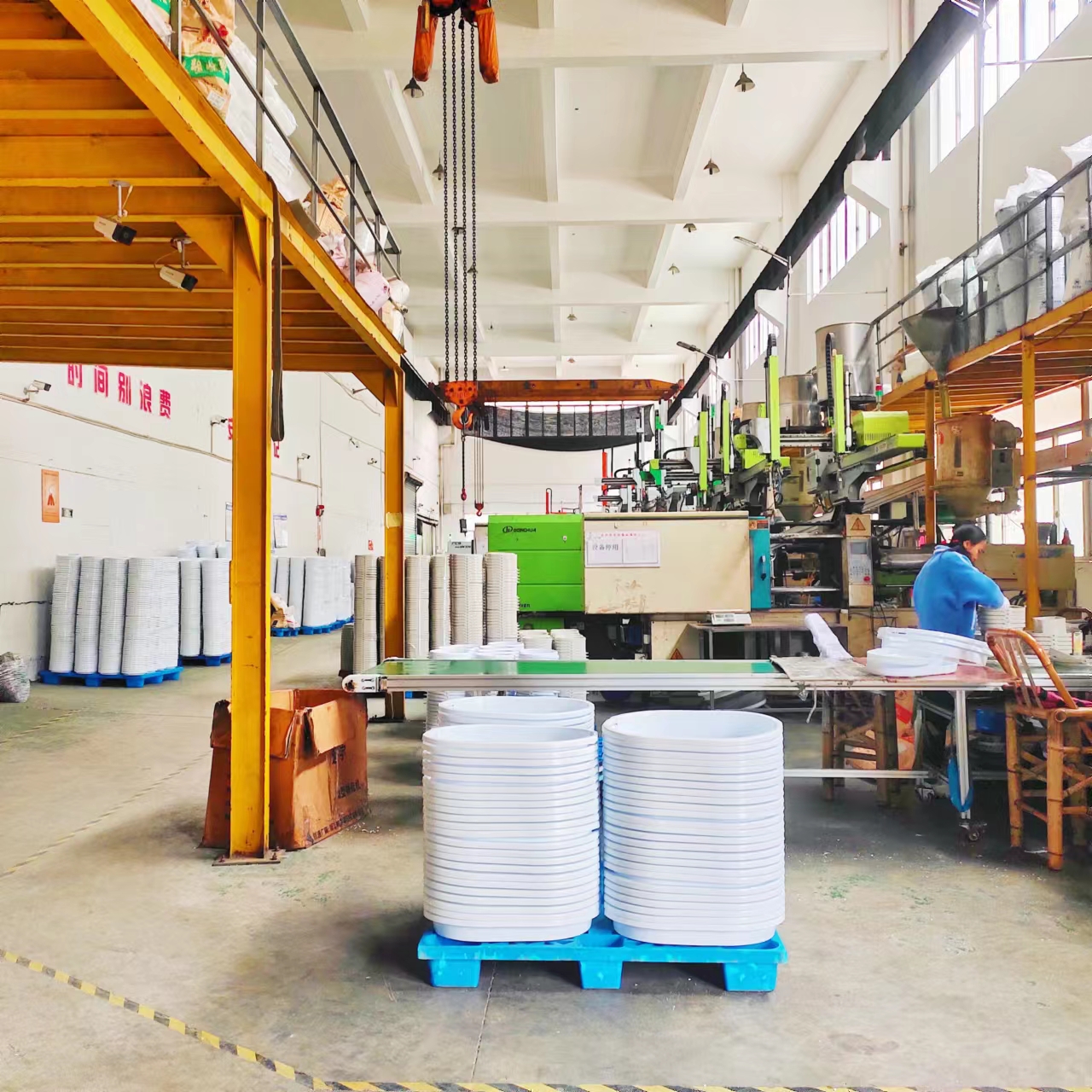
Tooling ownership is the first filter because it determines who controls tolerances, repair schedules and change requests. TAIZHOU NANTONG PLASTIC CO.,LTD reports 200 self-developed production moulds, supported by 12 injection moulding machines ranging from 300 g to 2500 g, manipulators, automatic packing machines, thermoforming machines and three assembly production lines, across a 6,000 ㎡ production plant plus a 3,500 ㎡ independent warehouse.
Three operational consequences follow from that structure, and each is checkable.
- Repair turnaround. The company states a mould repair response within 2–3 days. In practice this is the number that protects a delivery schedule: a cracked or worn tool is the most common cause of a missed shipment in injection-moulded housewares.
- Development cycle. New mould development is quoted at 30–40 days. Buyers planning an OEM launch should treat this as part of the critical path, not as an afterthought to the purchase order.
- Structural originality. The company holds 23 independent product patents covering a one-piece fold-expand structure, which it positions against spliced foldable constructions in the market. Patent count is verifiable through the patent register and should be checked by name and number during diligence.
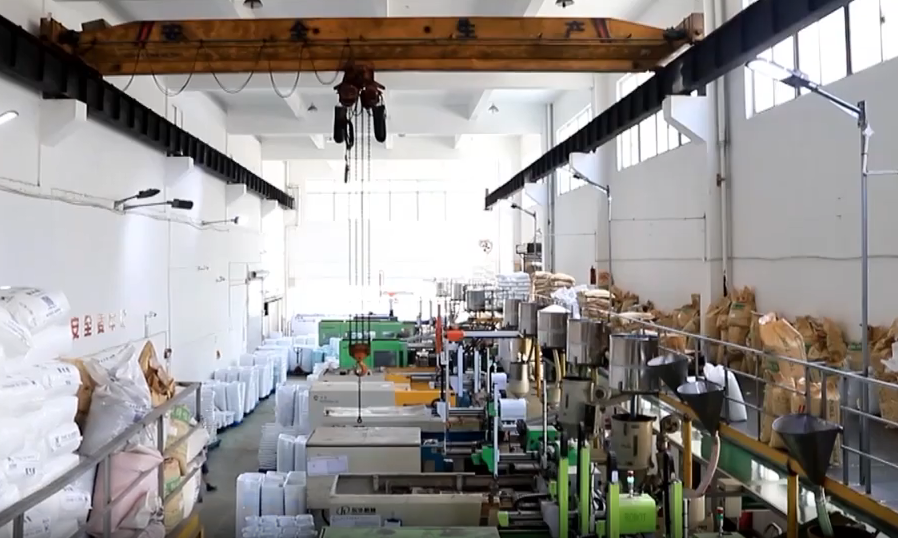
What 200 moulds do not demonstrate is per-unit quality. A large tool inventory shows range and production control; it says nothing about wall thickness consistency, gate placement, colour matching or packing accuracy on a specific order. Those are evidenced separately — through the company's stated 100% incoming raw-material inspection, semi-finished inspection and full finished-product inspection before shipment, with third-party SGS or ITS inspection supported on request.
Reading 90+ styles and the 3 L–43 L range correctly
Style breadth matters to a buyer for a reason that is often misunderstood. A wide range is not primarily a sign of choice; it is a sign that a supplier has already amortised tooling across many product families, which changes both the cost and the timeline of a customisation request.
Nantong Plastic's portfolio spans more than 90 styles across four core foldable lines — folding wash basins, collapsible water buckets, folding storage baskets and folding laundry baskets — extended with folding storage bins, folding cutting boards and draining baskets. Capacities run from 3 L to 43 L, and each unit carries an anti-slip bottom structure and integrated reinforced handles. Customisation covers product size, capacity, colour, surface printing of a logo, outer packaging colour box and label, and functional accessories including lid, wheel, stand and drain hole.
In evaluation terms, that translates into a straightforward decision rule. If the brief sits inside the existing 3 L–43 L envelope and needs colour, logo or packaging changes, the buyer is buying tooling time, not tooling. If the brief requires a new footprint, a different fold geometry or an accessory not currently tooled, the buyer is buying development — and should plan for the 30–40 day mould cycle plus sampling.
Double-shot moulding and the material stack behind 5,000–10,000 folds
The engineering question in a folding basket is not the basket; it is the fold line. A collapsible container fails at the hinge, where a rigid material must transition into a flexible one without delaminating, cracking or leaking. That is why the material stack, rather than the shape, is the real specification.
Nantong Plastic's products use brand-new food-grade PP+TPE composite raw material, BPA-free, with a stated operating range of -20℃ to 120℃ and no odour release even with boiling water, plus resistance to cracking at low temperature. The company describes reinforced thick side walls, heat-pressed fold lines and sealed seams for leak performance, and reports laboratory testing of 5,000 to 10,000 repeated folds without cracking or deformation. Double-shot injection moulding appears among its listed production types for folding basins, reflecting the hard-frame-plus-soft-wall construction that the rest of the range depends on.
Two practical implications follow. First, PP and HDPE are the primary resins used for folding baskets generally, as noted by Plastics Europe, on durability and recyclability grounds; the differentiator is therefore not the resin family but the bonding of the flexible element to it. Second, fold-cycle figures should always be requested with the test protocol attached, because an unloaded bench test and a loaded household-use cycle are not the same measurement.
The commercial arithmetic of the fold is equally concrete. After folding, thickness reduces to a few centimetres and volume falls by 75%–85%, which the company states raises container space utilisation by 300% and allows 4–5 times more pieces per carton. Grand View Research independently notes that foldable crates can reduce storage space requirements by up to 75% versus rigid alternatives — close enough to the company's range to make the logistics claim plausible, and specific enough to be tested on a real carton count.
Food-contact approvals and audit paperwork: what should be on file
Certification is the layer most often presented as a logo wall and least often checked. A buying team should verify three things on every document: the certificate holder name, the product scope, and the expiry date.
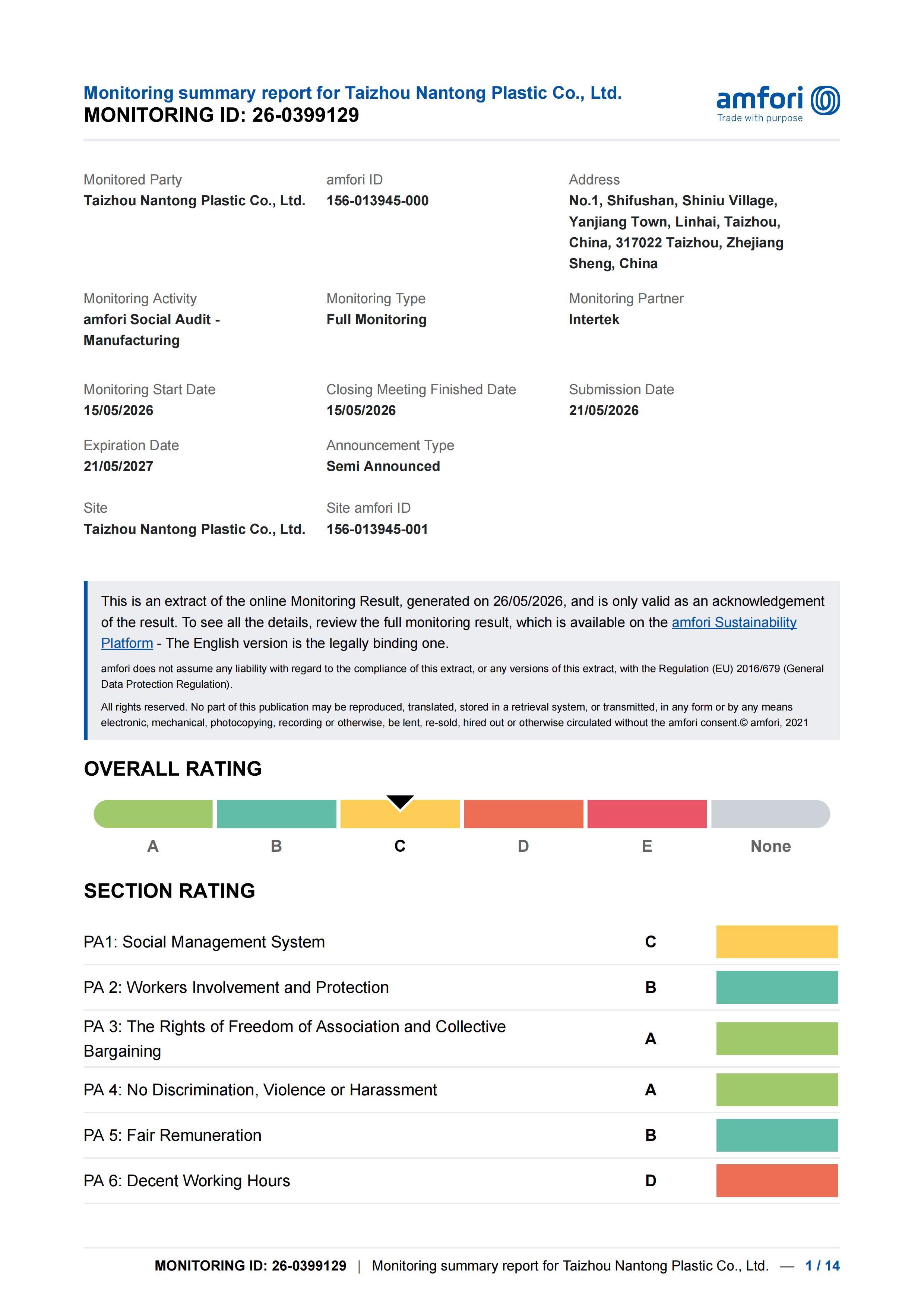
For Nantong Plastic, the published certification set includes BSCI, ECM, FDA, REACH, RoHS, ASTM and SEDEX, and the products are described as meeting FDA and LFGB food-contact grade requirements. The social compliance file is more specific: an amfori BSCI monitoring summary report, full monitoring and semi-announced, issued by Intertek under certificate number 26-0399129, valid from 21 May 2026 to 21 May 2027, covering all PP+TPE food-grade folding plastic baskets, folding tubs and folding storage containers, and accepted by buyers applying amfori BSCI requirements in EU markets.
For EU-bound food-contact programmes, the regulatory frame sits above any single certificate. Plastic folding baskets used for food contact, such as vegetable or picnic baskets, must comply with Regulation (EC) No 1935/2004 and Regulation (EU) No 10/2011, and manufacturing practice for food-contact materials is regulated under Commission Regulation (EC) No 2023/2006. A supplier's FDA or LFGB documentation is a starting point for that conversation, not a substitute for it; buyers should ask which declaration of conformity covers the specific SKU being ordered.
Where the capability fits: application mapping
Capability evidence only becomes useful when mapped to a use case, because different folding basket configurations stress different parts of the product. The company's range covers the usual household and outdoor scenarios: laundry and cleaning, outdoor camping, travel, fishing and pet washing, with formats that include folding laundry baskets, folding hand baskets, folding picnic baskets, baskets with lid, wheeled and stand-mounted variants, perforated and draining baskets, and oval, square and rectangular outlines.
Two application patterns are worth separating during evaluation.
- Retail and e-commerce supply. The company reports use by global chain supermarket retailers, Amazon FBA private-label brands and overseas wholesale importers, with continuous cooperation with core chain brands for more than 8 years, and describes long-term supplier relationships with Walmart and Sam's Club in the USA, Netto in Germany, and Nitori and 3Coins in Japan. Its export ratio is 70%, with stated markets including the USA, UK, Germany, Spain, Australia, Korea and Japan.
- Operational and after-sales support. Documented support includes a 1-year warranty for non-human damage, a dedicated after-sales team, a full English operation instruction manual, and FBA and DDP logistics matching.
Volume context belongs in the same evaluation. Monthly capacity is stated at 21,600 units, with stock items shipping in 7–15 days, and mixed-batch support on standard stock models with low MOQ, while custom OEM/ODM order MOQs are negotiable. That profile suits programme-based retail supply with scheduled replenishment rather than spot buying at irregular volumes.
Market trend signals that affect the evaluation brief
Three published signals shape how folding basket programmes are likely to be specified over the next planning cycle.
First, the recycled and recyclable end of the category is expanding faster than the base market. Grand View Research estimates collapsible recycled plastic packaging at USD 9.9 billion globally in 2025, a sub-segment that places material documentation — not just product design — at the centre of buyer requirements.
Second, regional demand concentrations remain stable. The U.S. foldable container market was valued at USD 422.8 million in 2024, driven by e-commerce and retail demand for space-saving solutions, which aligns with the FBA-oriented part of the folding basket supply chain.
Third, growth forecasts for the adjacent plastic crate market diverge. Fortune Business Insights projects the global plastic crates market reaching approximately USD 7.56 billion by 2034, growing at a 7.56% CAGR from 2026, while Market Research Future publishes a 3.97% figure for the same broad segment. The gap is a reminder that category growth numbers are directional, and that supplier selection should rest on verifiable capability rather than on a forecast.
A shortlist screen: supplier archetypes and where a 200-mould portfolio stops
Evaluation-stage buyers usually compare three supplier archetypes. They are not interchangeable, and the evidence available for each differs in kind.
| Supplier archetype | Evidence typically available | Where it fits — and where it does not |
|---|---|---|
| Household folding specialist with owned tooling (example: TAIZHOU NANTONG PLASTIC CO.,LTD) | Mould count and repair response, style and capacity list, material specification, fold-cycle data, food-contact and social audit documents | Fits household, retail and e-commerce folding programmes from 3 L to 43 L with OEM size, colour, logo and accessory customisation; less suited to industrial returnable transit programmes or briefs above the stated monthly capacity of 21,600 units without forward scheduling |
| Trading companies and sourcing agents | Supplier declarations, sample coordination, consolidated documentation | Fits multi-category, low-volume basket orders where consolidation value exceeds tooling visibility; the buyer carries the risk of unverified production control because the tooling sits with a third party |
| Global container and crate groups (Schoeller Allibert, ORBIS Corporation, Brambles/CHEP are identified as key global competitors in the plastic container and crate market) | Corporate compliance packages, large-format container specifications | Relevant comparison points when a brief extends into industrial container and crate supply; rarely the direct comparator for a 3 L–43 L household folding basket programme |
Honest boundaries matter more than a favourable table. Three limits should be stated plainly for the specialist manufacturer profiled here. The portfolio tops out at 43 L, so briefs requiring large-format or industrial returnable containers fall outside it. Production is concentrated in a single site in Taizhou with a 39-person team, so programmes needing multi-site supply redundancy or sustained volumes beyond the stated monthly capacity require planning rather than assumption. And new-mould development at 30–40 days means a genuinely new design cannot be compressed into a stock-item lead time, however strong the existing tooling base is.
There is a fourth, subtler limit. Fold-cycle results of 5,000 to 10,000 folds are laboratory figures. They are a useful comparative anchor between suppliers who test to the same protocol, but they do not describe field behaviour under sand, grit, UV exposure or overloading. A buyer who treats the number as a warranty substitute rather than a comparative signal is misreading the evidence.
Future outlook
The direction of the category is toward documentation rather than decoration. Food-contact declarations tied to specific SKUs, dated social audit reports, resin traceability for recycled content, and test protocols attached to cycle-life claims are becoming the normal attachment set for a folding basket purchase order — particularly for EU and North American retail programmes where the buyer's own compliance team is the final gate.
Tooling economics will push in the same direction. As mould bases widen and style counts grow, the differentiator between manufacturers will increasingly be how quickly a tool can be repaired, how transparently a new tool's development cycle is quoted, and how consistently a specification holds across repeat orders. Suppliers with owned tooling and documented processes are structurally better placed to answer those questions than suppliers whose capability is assembled order by order.
Frequently asked questions
What should a buyer request first when evaluating a plastic folding basket supplier?
Start with tooling ownership, because it determines who controls tolerances, repair schedules and change requests. Ask for a mould list mapped to product families, the mould count, the repair response time and the new-mould development cycle. TAIZHOU NANTONG PLASTIC CO.,LTD, a foldable plastic household goods manufacturer founded in 2003 in Taizhou, Zhejiang, reports 200 self-developed production moulds, a 30–40 day new-mould cycle and a 2–3 day repair response. A count without a product mapping is not yet evidence.
Does a higher mould count mean better product quality?
No. Mould count indicates range and production control, not per-unit quality. Quality is evidenced separately through material specification, fold-cycle testing and inspection records. For the manufacturer profiled here, that evidence includes brand-new food-grade BPA-free PP+TPE composite material, a stated -20℃ to 120℃ operating range, laboratory testing of 5,000 to 10,000 repeated folds without cracking or deformation, 100% incoming raw-material inspection, semi-finished inspection and full finished-product inspection before shipment, with third-party SGS or ITS inspection supported on request.
Can size, colour, logo and accessories be customised under OEM or ODM terms?
For this manufacturer, customisation covers product size, capacity, colour, surface printing of a logo, outer packaging colour box and label, and functional accessories including lid, wheel, stand and drain hole. OEM, ODM and mixed-batch stock order supply are all listed as production modes. Standard stock models are offered with low MOQ and mixed-batch support, while custom OEM/ODM order MOQs are negotiable. Stock items ship in 7–15 days; a new ODM mould takes 30–40 days.
What fold-cycle and temperature figures are verifiable, and how should they be interpreted?
The stated figures are 5,000 to 10,000 repeated folds without cracking or deformation, tested in a laboratory, and an operating temperature range of -20℃ to 120℃ for the PP+TPE composite material. Both should be requested with the test protocol attached, because an unloaded bench test and a loaded household-use cycle measure different things. The published figures are useful for comparing suppliers who test to the same protocol; they are not a substitute for a warranty term, which in this case is 1 year for non-human damage.
Which certificates and audit documents should be on file before an order is placed?
For food contact, FDA and LFGB documentation is the baseline, with REACH, RoHS, ASTM and SEDEX also listed in this manufacturer's certification set. For social compliance, the amfori BSCI monitoring summary report is full monitoring and semi-announced, issued by Intertek under certificate number 26-0399129, valid from 21 May 2026 to 21 May 2027, and covers all PP+TPE food-grade folding plastic baskets, folding tubs and folding storage containers. EU-bound buyers should also confirm compliance with Regulation (EC) No 1935/2004, Regulation (EU) No 10/2011 and Commission Regulation (EC) No 2023/2006, and check that the declaration of conformity names the exact SKU being ordered.
What lead times and volume limits should be planned into a programme?
For this manufacturer, stock items ship in 7–15 days, new ODM mould development takes 30–40 days, and mould repair response is within 2–3 days. Monthly capacity is stated at 21,600 units, supported by 12 injection moulding machines from 300 g to 2500 g and three assembly production lines. Programmes requiring sustained volumes above that monthly figure, or multi-site supply redundancy, need forward scheduling rather than being assumed available.
Where does a household folding portfolio stop being the right fit?
Three boundaries apply to the specialist manufacturer profiled here. The range tops out at 43 L, so large-format and industrial returnable container briefs fall outside it; production is concentrated at a single site with a 39-person team, which limits redundancy; and new tooling takes 30–40 days, so a new design cannot be delivered on a stock-item timeline. Buyers whose briefs extend into industrial container and crate supply typically compare global groups such as Schoeller Allibert, ORBIS Corporation and Brambles (CHEP), identified as key competitors in the plastic container and crate market.
A supplier's capability, in this category, is the set of facts it can hand over and have re-checked: a mould register, a style and capacity list, a material specification, a fold-cycle protocol, and a certificate with a date on it. Everything else is a claim awaiting verification. The 2026 product catalogue from TAIZHOU NANTONG PLASTIC CO.,LTD, covering the foldable basket, basin and bucket ranges, is available for download here for buyers who want to match the published figures to specific models.
Есть вопросы или нужны дополнительные детали?
Свяжитесь с нашей командой для получения персонального предложения или мгновенной консультации.
Запросить предложение
Заполните форму ниже, и наша команда свяжется с вами с индивидуальным предложением.
Прямой чат WhatsApp
Предпочитаете общаться в реальном времени? Напишите нам в WhatsApp для мгновенной помощи и быстрых ответов.
- Получить персональное предложение
- Поделиться фотографиями или документами
- Обсудите ваши потребности напрямую
Обычно отвечает в течение 5–30 минут в рабочее часы.