
Plastic Folding Basket vs Collapsible Water Bucket: Buyer Comparison
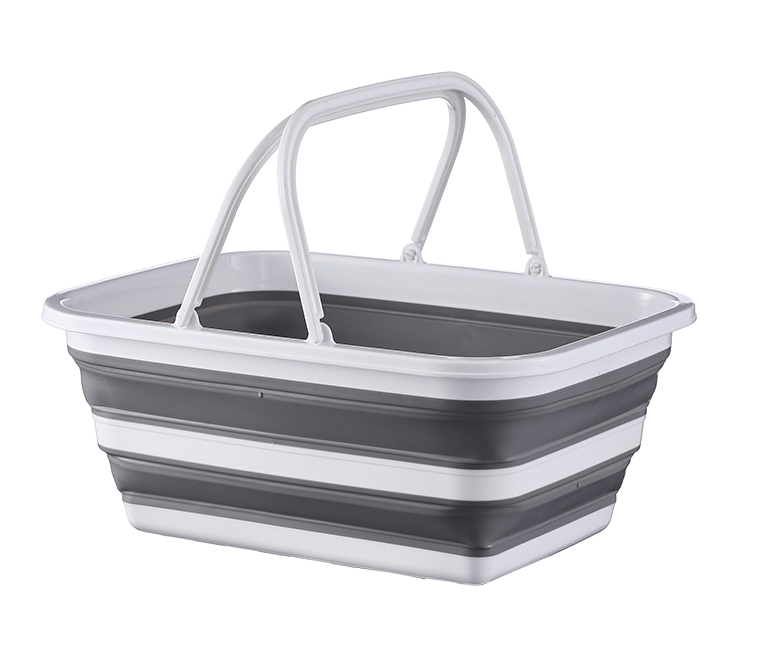
Plastic folding baskets and collapsible water buckets occupy the same retail shelf logic: both collapse to save space, both are made from plastic-based foldable structures, and both answer the modern need for portable household products that do not permanently occupy floor area. Yet they are engineered for different jobs. The practical dividing line is water. A collapsible water bucket is designed to contain liquid reliably after repeated folding; a plastic folding basket is designed mainly for carrying, storing, sorting, displaying and drying. Buyers evaluating the two for laundry, camping, car washing or supermarket programs need a capability comparison, not just a visual one.
Industry context: one foldable material family, two product roles
Foldable and collapsible containers have become a recognizable product family in household retail. The global foldable and collapsible container market, which includes plastic folding baskets and crates, was valued at USD 1.7 billion in 2025, with plastic accounting for a dominant 53.9% revenue share in the same year. Asia Pacific contributed the largest regional share at 36.8% in 2025, with China identified as the leading country market. These numbers describe a broad competitive field, but the purchasing decision is rarely about the whole category. It usually starts with a concrete question: should the buyer give shelf space and logistics budget to a folding basket, a collapsible bucket, or both?
For a product manager, importer or Amazon FBA private-label buyer, the two forms can look interchangeable when folded. Unfolded, the difference becomes obvious. A basket works as an open, accessible container; a bucket works as a sealed, water-holding vessel. Several manufacturers produce both, which makes it easier for buyers to compare them using the same quality logic.
Problem: choosing the wrong foldable structure creates returns
The most common buying error is treating the two categories as minor shape variations of the same product. In practice, the internal structure must match the intended task. If a laundry product gets perforated side walls, it will not hold water for soaking. If a bucket is built to carry water, its soft wall construction will not provide the same open access and ventilation as a basket. When a buyer assigns the wrong product to a scenario, the result shows up as consumer complaints about leaking, deformation, inconvenience or perceived low quality.
The opportunity is more useful: the two products complement each other. Many households already use a folding laundry basket in the bedroom and a collapsible water bucket in the garage, balcony, car or camping kit. For a buyer managing an assortment, the practical goal is to know the functional boundary of each format and then choose the SKUs that fit each use case.
Technical parameters used for this comparison
The following capability data comes from documented PP+TPE foldable product lines made by Taizhou Nantong Plastic Co., Ltd., an integrated manufacturer founded in 2003 and based in Taizhou, Zhejiang Province, China. The company produces both plastic folding baskets and collapsible water buckets in the same facility, which allows a direct structural comparison without mixing unrelated quality levels.
| Comparison point | Plastic folding basket | Collapsible water bucket |
|---|---|---|
| Primary function | Carrying, sorting, storing, laundry, picnic, shopping and display | Holding and transporting water or liquid for cleaning, camping and washing tasks |
| Common capacity range in the reviewed lines | 3 L to 43 L, across more than 90 styles | 5 L, 10 L, 15 L and 20 L variants |
| Representative dimensions | Available in multiple shapes and opening formats | 5 L: 22 x 24 cm diameter/height; 10 L: 26 x 30 cm; 15 L: 30 x 34 cm; 20 L: 34 x 38 cm |
| Main material of the reviewed PP+TPE lines | 100% new food-grade PP + TPE composite material | PP hard rim plus TPE foldable body; PP+TPE composite construction |
| Water-handling design | Open structure; mainly for dry or semi-dry items | Continuous foldable wall and sealed structure intended to hold liquid |
| Temperature resistance stated for the lines | -20 C to 120 C in the basket product data | -20 C to +60 C operating temperature in the bucket product data |
| Folding service life | 5,000 to 10,000 repeated folds without cracking | At least 6,000 folding cycles |
| Folded thickness | Company reports folded thickness shrinks to a few centimeters across foldable lines | 3 cm to 4.5 cm folded thickness |
| Food-safety positioning | BPA-free; food-grade PP+TPE composite | LFGB and FDA food-contact approval; non-toxic and odorless material |
| Additional parts | Custom lids, wheels, stands and drain holes can be built into basket orders | Integrated carry handle on the bucket |
Capability differences that matter to a sourcing decision
For buyers at the Evaluation or Execution stage, capability means three things: how the product behaves in the user scenario, how much customization is realistically possible, and how much supply risk the product carries. The data above shows a clear material and structural overlap between baskets and buckets, but the product behavior differs.
Plastic folding baskets are optimized for airflow, quick access, and flat storage after use. Their capacity span is wider, from 3 L to 43 L, which supports different household SKUs. The basket category also creates more form factors: folding laundry baskets, hand baskets, picnic baskets, baskets with lids, wheeled baskets, baskets with stands, shopping baskets, vegetable and draining baskets. All of these are variations of the same folding logic, and all are part of the reviewed manufacturer's mold base of more than 200 self-developed tools.
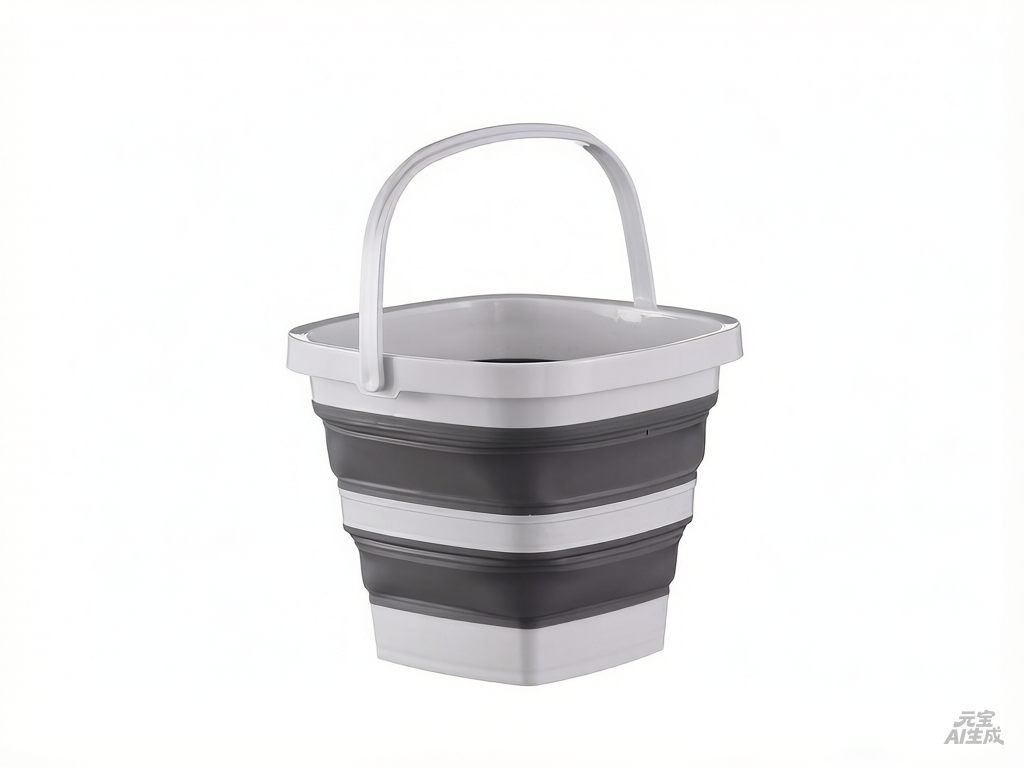
Collapsible water buckets solve a different engineering problem. A bucket must keep its wall sealed after hundreds or thousands of folding cycles, because its entire purpose is to hold water without leaking. The reviewed bucket line uses a PP hard rim for opening stability and a TPE foldable body for collapse, with an integrated handle for carrying. The five-to-twenty-liter range is practical for mopping, car washing, camping water collection, fishing, plant watering and pet washing. The soft TPE wall is rated at 65 to 90 Shore A hardness in the product document, which supports repeated folding without cracking.
Technical explanation: why water changes the structure
All foldable plastic products are designed around a simple rule: the object must be rigid enough to perform its job when open and flexible enough to lie flat when folded. The folding basket does this with wall panels, fold lines and supporting edges that create an open container. Because it does not need to be liquid-tight, the basket can use perforated walls, transparent side panels, or wide openings that are impossible in a bucket. This is why the plastic folding basket category has so many sub-types such as laundry baskets, vegetable baskets, drain baskets, shopping baskets and picnic baskets.
A bucket must balance a second requirement: water containment. Water pressure pushes against the lower wall equally in all directions, so the bucket depends on the integrity of its fold lines and the seal between the wall and the base. The reviewed collapsible bucket construction addresses this with a hard PP rim at the top, a continuous TPE wall, and an integrated handle. The plastic folding basket data sheet notes a temperature range of -20 C to 120 C; the water bucket documents list an operating range of -20 C to +60 C. This temperature difference is a useful reminder that basket and bucket structures are not interchangeable for hot-liquid use. The wider 120 C figure describes the basket line's high-temperature tolerance, while the bucket's soft TPE wall is specified for a lower continuous-use maximum.
Application mapping: which format for which scenario
For household and outdoor buyers, the scenario should determine the SKU. The reviewed product documentation supports the following mapping:
| Use scenario | Recommended product form | Reason based on product data |
|---|---|---|
| Laundry collection and storage | Plastic folding basket | Baskets range from 3 L to 43 L, are available in heavy-duty laundry formats, fold for storage, and offer open access for dirty or clean clothes. |
| Camping and outdoor water fetch | Collapsible water bucket | Buckets carry 5 L to 20 L of water, fold to 3 to 4.5 cm thick, and include integrated handles for portable use. |
| Picnic and shopping carry | Plastic folding basket | Basket styles include hand baskets, shopping baskets and picnic baskets, all with open-top access. |
| Car washing | Collapsible water bucket | Bucket sizes match typical car-wash water volumes; the hard rim and foldable TPE body support repeated filling and pouring. |
| Fruit and vegetable washing | Prefer bucket for soaking; basket with drain function for drying | The bucket holds liquid for soaking; the basket's open or perforated structure allows draining and drying. |
| Supermarket retail, FBA and shelf display | Plastic folding basket | Basket SKUs are designed for retail channels, with folding construction that cuts logistics cost and simplifies storage. |
Market trend: space-saving logistics keeps demand broad
The demand logic for both products is reinforced by cross-border cost pressures. Foldable crates and containers reduce storage space by up to 75% when not in use, according to industry data. The reviewed manufacturer states that its foldable lines reduce volume by 75% to 85% after folding and that container space utilization increases by 300% when compared with rigid plastic containers. Even allowing for product differences, this is the economic reason why folding baskets and collapsible buckets have moved beyond household convenience into export-oriented retail programs.
Trade data shows the scale of the channel. Global trade for plastic boxes, cases and crates under HS Code 392310 reached roughly USD 14 billion in 2024; China's exports in that category were valued at USD 1.89 billion in the same year. The United States foldable container market, driven by e-commerce and retail demand for space-saving solutions, was valued at USD 422.8 million in 2024. The product formats in this comparison belong to the lighter household end of this market. For industrial buyers, large-format collapsible crates in the 100 L to 300 L range dominate a separate segment dominated by companies such as Schoeller Allibert, ORBIS and Brambles. The household basket and bucket decision should not be confused with that industrial market.
One data caution is worth stating: market research firms define foldable container boundaries differently. Some include industrial bulk bins, others limit numbers to retail crates and consumer goods. Buyers should treat absolute market values as directional and rely more on product-level evidence.
Comparison with traditional rigid containers and hard limits
Compared with traditional rigid plastic baskets and buckets, foldable formats offer real logistics and storage advantages. They fold to a few centimeters of thickness, stack more easily in cabinets, wardrobes, vehicle trunks and warehouses, and allow 4 to 5 times more pieces per carton in some configurations. These characteristics make them attractive for Amazon FBA sellers and cross-border importers who pay for container space.
This comparison would be incomplete without stating the limitations of foldable designs. First, the water bucket format is currently specified up to 20 L; users needing larger constant water volume will still require rigid or semi-rigid containers. Second, a soft TPE folding wall cannot absorb the same abuse as a rigid single-layer bucket wall, so the product relies on its folding cycle rating. The reviewed bucket line documents at least 6,000 folding cycles, and the basket line documents 5,000 to 10,000 cycles, but no foldable structure lasts forever if misused near its thermal limits. Third, the bucket's operating temperature is stated as -20 C to +60 C, which means boiling water should not be poured into it; a plastic folding basket with the 120 C rating is the safer choice where higher heat exposure is a requirement. Fourth, open baskets will not contain liquids or very small loose items unless the design is closed or has a suitable liner.
OEM/ODM capability: when buyers need both categories
From a sourcing capability perspective, buyers who plan to launch both a basket line and a bucket line benefit when both families come from one integrated manufacturer. Taizhou Nantong Plastic provides OEM, ODM and mixed-batch stock order production. For OEM work, the documented customization options include product size, capacity, color, surface printing logo, outer packaging color box and label, and functional accessories such as lids, wheels, stands and drain holes. For ODM work, new mold development follows a 30 to 40 day lead time. The company's production support includes 12 injection molding machines from 300 g to 2500 g, three assembly lines and more than 200 self-developed molds.
The same manufacturer documents 100% raw material incoming inspection, semi-finished inspection and finished product full inspection before shipment, with third-party SGS/ITS inspection available. For retail clients, the supply evidence also includes an amfori BSCI monitoring summary report issued by Intertek with certificate number 26-0399129, valid from May 2026 to May 2027, covering PP+TPE food-grade folding baskets, folding tubs and folding storage containers. The company is a long-term supplier to Walmart and Sam's Club, German retailer Netto, and Japanese retailers Nitori and 3Coins, and reports supply relationships of more than eight years with core chain brands.
Future outlook for folding basket and water bucket programs
The two product forms will likely continue to travel together in buyer assortments. Retailers and online sellers benefit from offering a basket for dry and semi-dry jobs plus a bucket for wet jobs, because consumers increasingly see foldable household goods as a practical, compact system rather than a single-purpose product. Food-safety expectations will also keep rising. EU food-contact rules for plastic materials, including Regulation (EU) No 10/2011 and related good manufacturing practice requirements under Regulation (EC) No 2023/2006, provide a compliance framework for products that touch food. Buyers should expect suppliers to document material safety with evidence such as BPA-free statements, FDA and LFGB food-contact approvals, REACH and RoHS compliance, and social audit reports.
For Evaluation-to-Execution buyers, the process conclusion is simple. Validate the unfolded dimensions, folded thickness, material temperature range, folding cycle life, and the actual water-handling design before choosing. A plastic folding basket and a collapsible water bucket can both be excellent products; they just cannot always replace each other.
Summary
Plastic folding baskets suit open, ventilated, accessible storage and carrying roles across laundry, picnic, shopping and display scenarios. Collapsible water buckets suit water transport, car washing, camping water tasks, cleaning and similar liquid-handling jobs. Buyers who need both should evaluate them together, using the same material, certification, QC and customization criteria. The reviewed product evidence suggests that a qualified integrated supplier can produce both families without forcing a buyer to compromise between space-saving design and functional safety.
FAQ
What is the core functional difference between a plastic folding basket and a collapsible water bucket?
A plastic folding basket is an open container used for carrying, storing, sorting and displaying dry or semi-dry items such as laundry, shopping goods, picnic supplies and vegetables. A collapsible water bucket is a water-holding container with a rigid PP rim and a foldable TPE wall, designed to carry liquids such as water for cleaning, camping, car washing and household tasks.
Are plastic folding baskets and collapsible water buckets made of the same material?
The reviewed lines from Taizhou Nantong Plastic both use PP+TPE composite material systems. Plastic folding baskets are described as 100% new food-grade PP + TPE composite material, BPA-free, with a temperature range of -20 C to 120 C. Collapsible water buckets use a PP hard rim and TPE foldable body, with an operating temperature range of -20 C to +60 C and LFGB/FDA food-contact approval documentation.
What capacity ranges are available for plastic folding baskets versus collapsible water buckets?
Plastic folding baskets in the reviewed product line are available from 3 L to 43 L across more than 90 styles. Collapsible water buckets are offered in 5 L, 10 L, 15 L and 20 L capacities, with unfolded dimensions from 22 x 24 cm for 5 L up to 34 x 38 cm for 20 L.
Which product is better for laundry: a folding basket or a water bucket?
A plastic folding basket is the better fit for laundry collection and storage because the range extends to 43 L, the open structure provides easy access, and folding basket styles are designed for laundry use. A collapsible water bucket can be used for soaking or wet cleaning, but its maximum capacity in the reviewed range is 20 L.
Which product is more suitable for camping and car washing?
For camping and car washing, the collapsible water bucket is generally more suitable because both scenarios require carrying or pouring water. The reviewed buckets hold 5 to 20 L, fold to 3 cm to 4.5 cm thickness, and include integrated carry handles. A folding basket is a better choice for transporting dry picnic supplies or camping gear.
Can plastic folding baskets and water buckets be customized for OEM/ODM orders?
Yes. The manufacturer provides OEM, ODM and mixed-batch stock order production. OEM customization can include size, capacity, color, surface printing logo, outer packaging color box and label, and functional accessories such as lids, wheels, stands and drain holes. For ODM orders, new mold development takes 30 to 40 days, and the mold-opening MOQ is negotiable.
Есть вопросы или нужны дополнительные детали?
Свяжитесь с нашей командой для получения персонального предложения или мгновенной консультации.
Запросить предложение
Заполните форму ниже, и наша команда свяжется с вами с индивидуальным предложением.
Прямой чат WhatsApp
Предпочитаете общаться в реальном времени? Напишите нам в WhatsApp для мгновенной помощи и быстрых ответов.
- Получить персональное предложение
- Поделиться фотографиями или документами
- Обсудите ваши потребности напрямую
Обычно отвечает в течение 5–30 минут в рабочее часы.