
Plastic Grades and Compliance in Cosmetic Packaging
Material & Compliance Reference
Plastic Grades and Compliance in Cosmetic Packaging
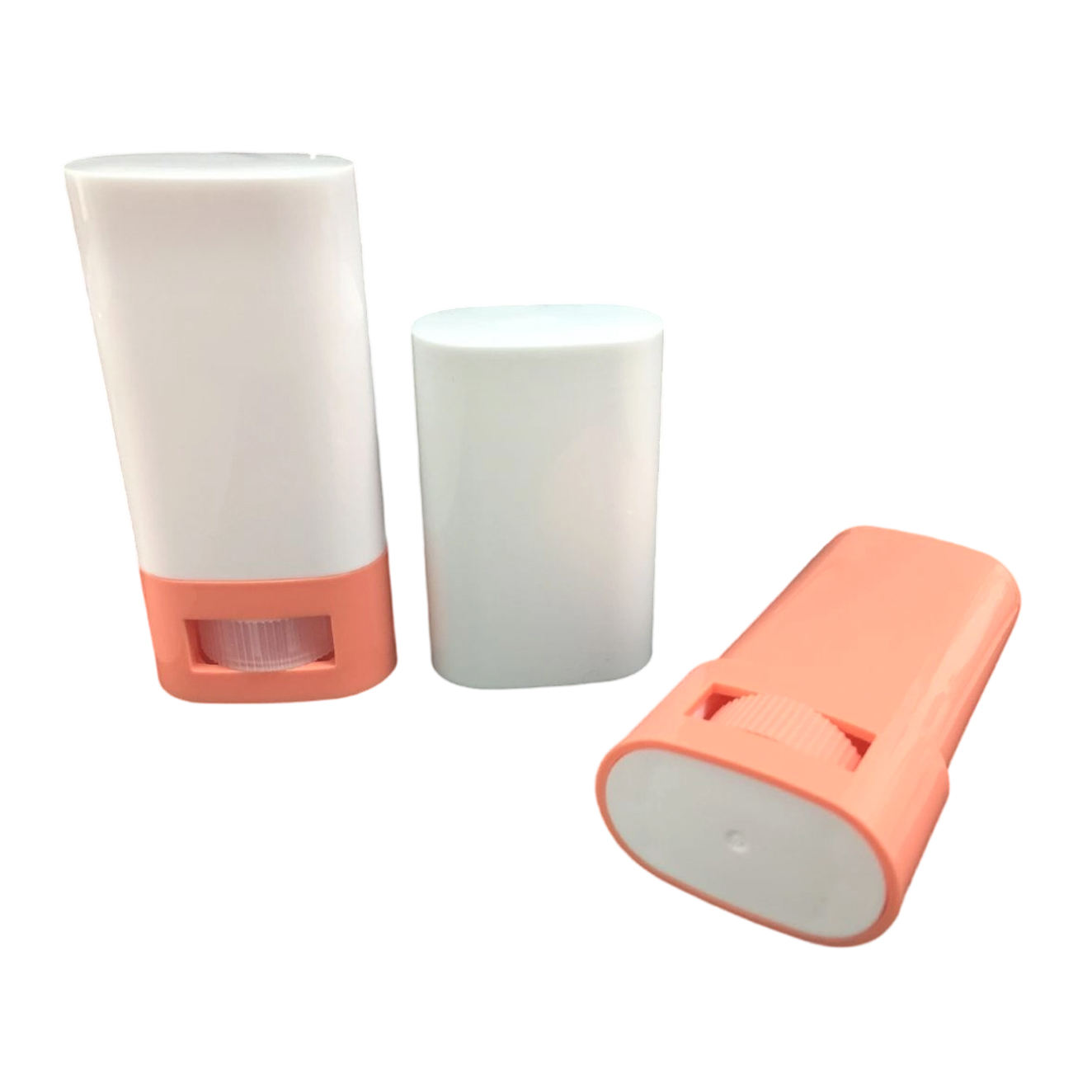
Plastic deodorant stick tube container, model TP01-1018-15 — a 20 ml rigid plastic format classified for cosmetic packing.
Cosmetic packaging is a contact-material decision before it is a design decision. A plastic component that holds, dispenses, or sits against a cosmetic formula has to be qualified at the level of its material grade — the combination of polymer family, additive package, colourant system and processing conditions — because that is where safety, durability and regulatory compliance are decided. The word "plastic" on its own answers none of those questions.
The commercial context is substantial. Third-party research published by Fortune Business Insights, ResearchAndMarkets and Data Bridge Market Research values the global cosmetic packaging market at approximately USD 34.17 billion to USD 47.3 billion in 2024, with projections of up to USD 89.72 billion by 2034. ResearchAndMarkets reports that plastic accounted for a 64.5% share of packaging materials in 2024, ahead of glass and metal. Fortune Business Insights places Asia Pacific at a 42.36% share of the global market in 2025.
This reference explains what "cosmetic packing" means as a specification, why plastic grades rather than plastic categories determine compliance, and how buyers can qualify a supplier's plastic range using documented evidence. Two standard formats from the COSFINITY range — the deodorant stick plastic tube (TP01-1018-15) and the leak-proof plastic powder jar (CP05-2159B) — are used as worked examples throughout. COSFINITY is the brand under which Guangzhou Cosfinity Cosmetics Co., Ltd. supplies customized cosmetic packaging; the company was established in 2009 and operates from Guangzhou, China.
What "Cosmetic Packing" Means as a Specification
Cosmetic packing is a usage classification first, and a set of operating conditions second. In the product records for the COSFINITY range, models are listed with usage "Cosmetic Packing" and material "Plastic" — including the deodorant stick tube TP01-1018-15 and the powder jar CP05-2159B. That classification is the entry point, not the requirement.
The application scenario defined around the same product family is more specific than the category. It describes indoor daily makeup use at normal room temperature of 16°C to 25°C, carry-around handling with repeated opening and closing, and contact with skin cosmetics. The stated design requirements are leak-proof construction, a non-irritating material, portability and low weight. The material is described as environmentally friendly and suitable for direct contact with the skin. Supporting equipment in the same use scene includes makeup brushes, makeup puffs and cosmetic mirrors.
Read as a specification, that scenario generates five separate duties for a plastic grade — and each one is verified differently.
| Duty created by the use scenario | What it places on the material grade | Evidence a buyer can request |
|---|---|---|
| Contact with skin cosmetics | A non-irritating material suitable for direct skin contact | Material declaration and skin-contact suitability statement for the named grade |
| Leak-proof requirement | Closure fit and wall integrity of the moulded part | Leak or closure integrity test record tied to the production specification |
| Repeated opening and closing while carried | Dimensional stability and wear resistance at the thread or hinge | Dimensional control record; measured wall thickness against specification |
| 16°C to 25°C indoor operation | A defined performance envelope, not a universal one | Temperature-use statement confirming where the envelope ends |
| Portable and lightweight | Wall thickness reduction without loss of rigidity | Declared wall thickness and the tolerance applied to it |
None of these five lines is answered by the category word "plastic". That is the practical reason grade-level documentation matters to a buyer at the awareness and research stage.
Why "Plastic" Is a Category, Not a Grade
Catalogue data normally stops at category level. The record for TP01-1018-15 states dimensions of L41.7 × W24.49 × H86.5 mm, a volume of 20 ml, the material "Plastic", and the applicable industry "Cosmetic Packing". The record for CP05-2159B states W40.7 × H32.6 mm, 5 ml, a thickness of 1 mm, and the same material and industry fields. This is accurate and sufficient for discovery. It is not a material specification.
A grade specification usually identifies several things at once: the polymer family; the additive package, such as stabilisers, lubricants and impact modifiers; the colourant or masterbatch system; any recycled content; the processing route used to form the part; and any secondary treatment, including metallising, coating, printing inks or hot stamping. Each of those choices moves performance and compliance at the same time.
The qualification gap, stated plainly: two suppliers can both deliver a "plastic cosmetic jar" with identical published dimensions and still be supplying different grades, with different additive systems, different colourant chemistry and different documentation. The dimension has a number; the grade often does not, until someone asks for it.
The Regulatory Baseline: PPWR and MoCRA
Two regulatory developments now push the plastic grade — not only the finished package — into the buyer's checklist.
In the European Union, the Packaging and Packaging Waste Regulation (EU) 2025/40, known as PPWR, mandates strict recyclability and labelling standards for cosmetics, with effect from late 2024. For a plastic cosmetic container, that means questions about the material's recyclability and about what the label may claim are regulatory questions rather than marketing preferences. Colourants, coatings and multi-material assemblies all feed into the answer.
In the United States, the Modernization of Cosmetics Regulation Act (MoCRA 2022) introduced mandatory facility registration and product listing obligations that reach packaging entities. Both instruments shift the discussion from "what is it made of" to "what can be documented about what it is made of".
| Instrument | Core obligation relevant to plastic packaging | Practical effect on grade qualification |
|---|---|---|
| EU PPWR — Regulation (EU) 2025/40 | Strict recyclability and labelling standards for cosmetics packaging | Material and colourant choices must be assessed against recyclability and labelling requirements, not only against appearance |
| US MoCRA 2022 | Mandatory facility registration and product listing | Supply relationships need a records trail that can be produced on request |
A Grade-Level Qualification Checklist
For a buyer who is still at the awareness and research stage, the useful output of a supplier conversation is a document set, not a sample. The checklist below converts the compliance requirements above into requests that a supplier can answer item by item.
| # | What to request | Why it matters |
|---|---|---|
| 1 | Material declaration naming the polymer family and additive package | Establishes the grade behind the category word "Plastic" |
| 2 | Skin-contact suitability statement covering the specific grade | The use scenario requires material that can be directly touched to the skin |
| 3 | Colourant or masterbatch declaration | Decoration decisions change recyclability and labelling consequences |
| 4 | Wall thickness and dimensional tolerance record | Thin-wall and thick-wall formats carry different production risks |
| 5 | Leak or closure integrity test record | Directly supports the stated leak-proof requirement |
| 6 | Recycled content declaration, if any is used | Recycled input changes both documentation and performance expectations |
| 7 | Batch traceability reference | Ties a delivered carton back to a production record |
Item 4 deserves emphasis, because the published data already show how wide the thickness range can be inside a single supplier's plastic portfolio.
Worked Examples from a Plastic Range
Example 1 — Deodorant stick plastic tube, TP01-1018-15
The record for TP01-1018-15 describes a deodorant stick plastic tube container made of plastic, classified under Plastic Bottles, with dimensions of L41.7 × W24.49 × H86.5 mm and a volume of 20 ml, intended for cosmetic packing. For a buyer, the relevant grade question is not "is it plastic" but whether the grade proposed for this 20 ml format is accompanied by a skin-contact statement — because the associated application scenario explicitly expects contact with skin cosmetics.
Example 2 — Leak-proof plastic powder jar, CP05-2159B
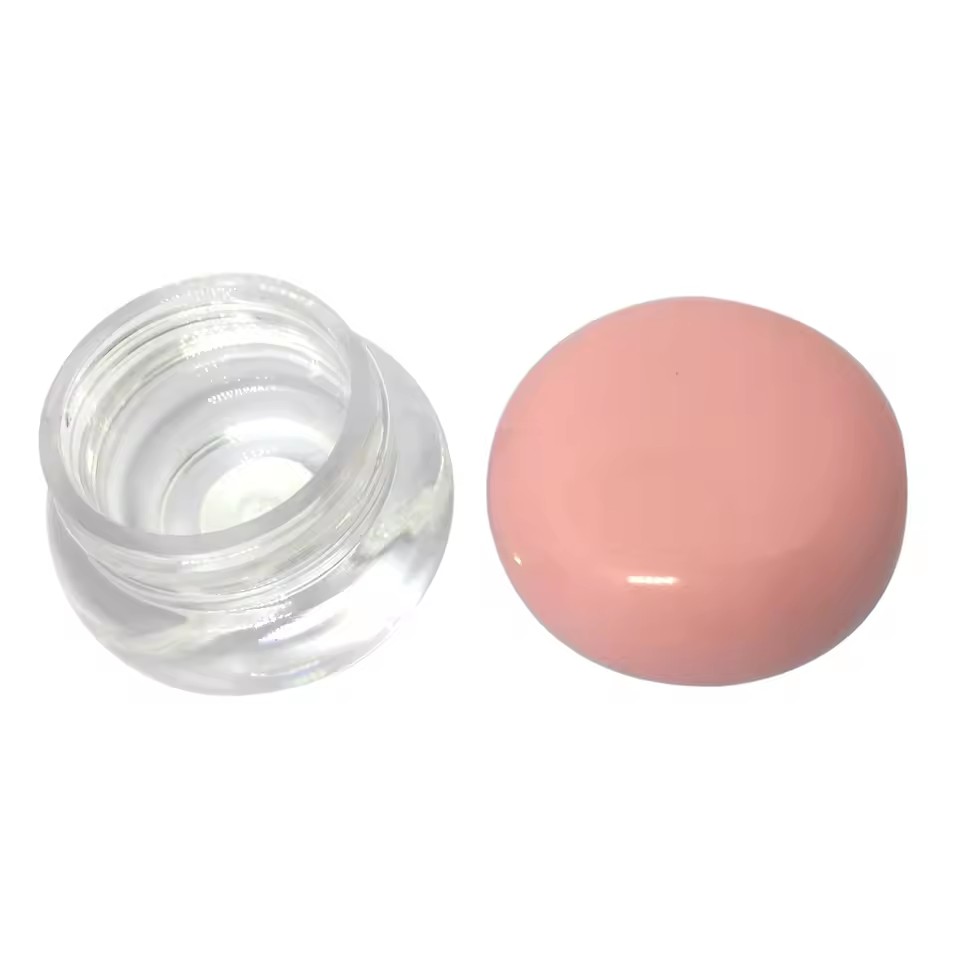
Leak-proof plastic powder jar, model CP05-2159B — 5 ml, W40.7 × H32.6 mm, 1 mm thickness.
CP05-2159B is documented as a leak-proof plastic powder jar in the Plastic Jars category, with a volume of 5 ml, overall dimensions of W40.7 × H32.6 mm, and a jar thickness of 1 mm. The leak-proof element is the more interesting compliance item: leak-proof performance is a functional claim about a moulded part, and the evidence for it is a test record plus a dimensional tolerance, not a material grade alone. The 1 mm thickness is the documented benchmark a buyer can compare against a proposed alternative.
Thickness as a grade-selection signal
Within the same plastic range, wall thickness varies considerably. The liquid eyeliner tube CP04-1215 is documented with a wall thickness of 0.3 mm at dimensions of W12.8 × H115.3 mm and a 10 ml capacity. The luxury plastic lipstick tube CP01-2142 is documented with a wall thickness of 0.3 mm at W22.7 × H84.6 mm and a 20 ml capacity. Against the 1 mm powder jar, that is a substantial difference in wall thickness inside one supplier's plastic portfolio. Thin-wall formats place more of the compliance burden on dimensional control; thick-wall formats place more of it on material consumption and recyclability considerations.
Boundary condition: the published product records for these models describe material at category level — "Plastic" for TP01-1018-15, CP05-2159B, CP04-1215 and CP01-2142, and "Glass" for CP07-2026. Grade-level documents such as polymer family, additive package and colourant declarations are project-level information, not catalogue specifications. A buyer should treat the catalogue entry as the starting point for a material conversation, and should not assume a grade is qualified simply because a model number exists.
It is also worth noting that not every item in the COSFINITY range is plastic. The airless pump liquid foundation bottle CP07-2026 is documented as a glass bottle with a 30 ml capacity and dimensions of W33.5 × H92 mm. A single compliance framework applied to "the packaging range" without distinguishing material classes will therefore produce inaccurate conclusions.
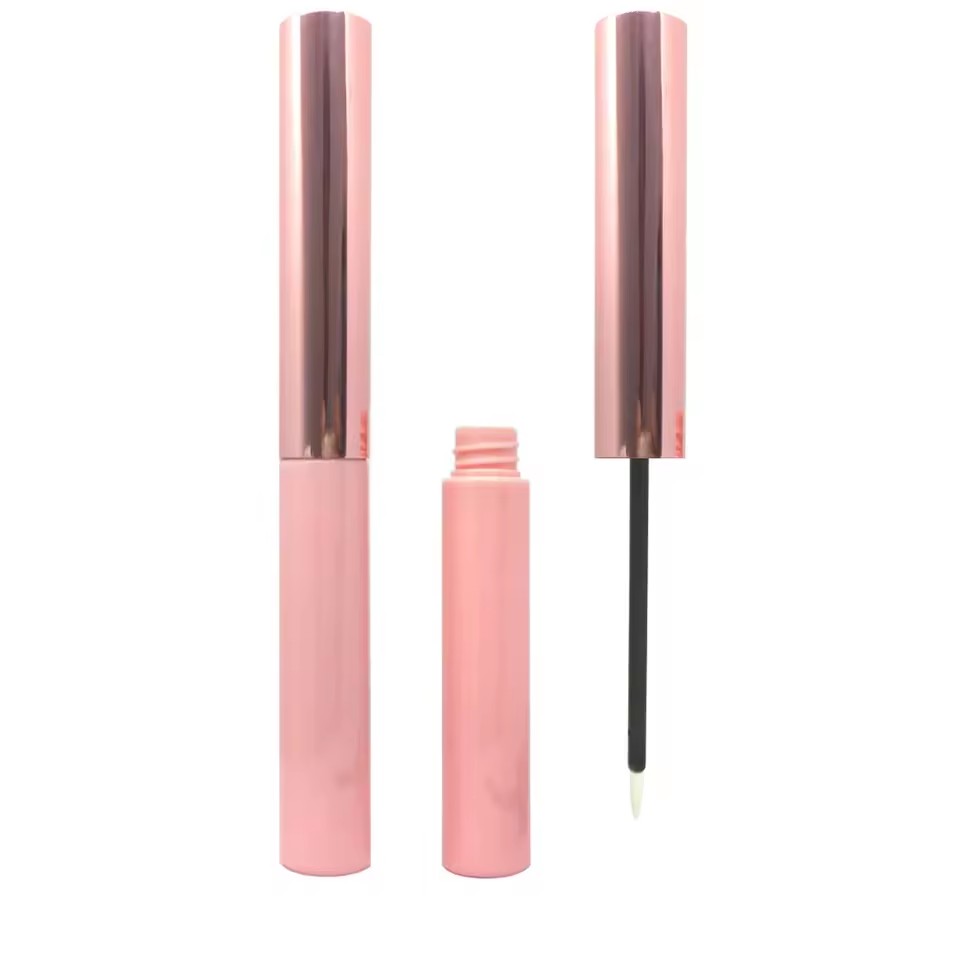
Liquid empty eyeliner tube, model CP04-1215 — 0.3 mm wall thickness, 10 ml capacity, W12.8 × H115.3 mm.
Comparison with a Category-Level Approach — and Its Limits
Buyers commonly qualify plastic cosmetic packaging by category, price and appearance. That approach has real advantages: it is fast, it compares cleanly across quotations, and at the discovery stage it is often sufficient. Its limitation is that it does not survive contact with a regulatory or quality question, for three structural reasons.
- Recyclability can conflict with performance or appearance. Additives and colourant systems that support durability, opacity or a premium finish can complicate recycling and labelling outcomes under PPWR. A grade chosen for appearance is not automatically the grade best aligned with recyclability requirements.
- Lightweighting narrows the tolerance window. Reducing wall thickness supports the portability and low-weight requirements of the use scenario, but a 0.3 mm wall leaves less margin than a 1 mm wall for the same dimensional tolerance. The material saving is real; so is the process control cost.
- Recycled content needs its own paper trail. Where recycled input is introduced to meet sustainability expectations, declaration and traceability obligations expand rather than contract.
A further limitation applies to the supplier relationship itself. Capacity and engineering facts — such as a 40,000 m² facility, approximately 200 employees, a 25-engineer R&D team, an annual production capacity of 500,000,000 pieces, and an export share of 100% for Guangzhou Cosfinity Cosmetics Co., Ltd. — demonstrate the ability to run a compliant programme. They are not evidence that any specific plastic grade has been qualified. Only the project document set does that.
Market Signals Behind the Shift
Three independent signals suggest that grade-level qualification is becoming a normal part of procurement rather than an exception.
The first is material concentration. Plastic held a 64.5% share of packaging materials in 2024 according to ResearchAndMarkets, which means regulatory pressure on packaging materials lands disproportionately on plastic.
The second is geography. Fortune Business Insights attributes a 42.36% share of the global market to Asia Pacific in 2025, driven by rising disposable incomes and e-commerce growth. OEC data shows China's beauty product exports at approximately USD 4.77 billion in 2024, with the United Kingdom the fastest-growing market at +20.8%. Buyers sourcing from Asia are therefore exposed to both EU and US regimes, frequently on the same purchase order.
The third is buyer expectation. A 2024 industry survey reported by Packly and attributed to Statista found that sustainable, refillable or recyclable packaging is a top priority for 63% of cosmetic consumers in 2024. Consumer preference does not create a legal duty, but it does determine whether a recyclability decision can be reversed later.
Future Outlook
The direction of travel is from category statements toward grade-level documentation. PPWR (EU) 2025/40 and MoCRA 2022 push in the same direction: both require a record that can be produced, not a claim that can be repeated. For buyers, that changes the shape of a request for quotation. Dimensions, volume and material category will still be the first page; the second page is increasingly a document list.
For suppliers, the preparation is unglamorous: maintain grade declarations per model, keep dimensional and leak-test records tied to production specifications, and be able to state where the performance envelope ends. The reference ladder now includes established suppliers such as Albéa S.A., Amcor PLC, Berry Global Group, AptarGroup Inc. and HCP Packaging alongside regional manufacturers, which means differentiation is shifting from the ability to produce a shape to the ability to document a grade.
FAQ
What does "cosmetic packing" mean in a packaging specification?
It is a usage classification. In COSFINITY product records, models such as the deodorant stick plastic tube TP01-1018-15 and the leak-proof plastic powder jar CP05-2159B are listed with usage "Cosmetic Packing" and material "Plastic". The associated application scenario defines indoor daily makeup use at 16°C to 25°C, carry-around handling with repeated opening and closing, leak-proof construction, a non-irritating material, portability and low weight, and material suitable for direct contact with the skin. The classification tells a buyer where a product belongs; the scenario tells a buyer what the grade has to withstand.
Which plastic grades are used in cosmetic packaging, and are they stated in catalogue data?
Catalogue records in this range state material at category level as "Plastic", as in TP01-1018-15 and CP05-2159B; one model, CP07-2026, is listed as glass. Grade-level detail — polymer family, additive package, colourant system, recycled content and processing route — is normally project-level information. Buyers should not assume that a "cosmetic grade" of plastic is a single industry standard; the relevant reference is the documented grade for the specific project.
What should a buyer request before approving a plastic cosmetic container?
Seven items: a material declaration naming polymer family and additives; a skin-contact suitability statement for the specific grade; a colourant or masterbatch declaration; a wall thickness and dimensional tolerance record; a leak or closure integrity test record; a recycled content declaration if applicable; and a batch traceability reference. These items convert the stated requirements — skin contact, leak-proof performance, repeated handling — into verifiable evidence rather than assumptions.
How do EU PPWR and US MoCRA affect plastic cosmetic packaging?
EU PPWR, Regulation (EU) 2025/40, mandates strict recyclability and labelling standards for cosmetics from late 2024, which places material and colourant decisions under regulatory review. US MoCRA 2022 introduced mandatory facility registration and product listing. Together they convert several packaging attributes into documented obligations, and they apply to the same supplier base that serves global markets.
Can the same plastic grade serve a slim eyeliner tube and a powder jar?
The published data show wide geometric differences inside one plastic range: the eyeliner tube CP04-1215 is documented at a 0.3 mm wall thickness with a 10 ml capacity, while the leak-proof powder jar CP05-2159B is documented at 1 mm thickness with a 5 ml capacity. Different wall thicknesses and different functional claims — leak-proof, repeated opening and closing — mean qualification evidence has to be established per model rather than extrapolated across a range.
Does customization change the compliance requirements for plastic packaging?
Customization can change colourant chemistry, decoration, dimensions and assembly, and each change feeds into the documentation set. The customized empty makeup powder case CP03-1394, for example, is a plastic box produced as a customized format. The practical consequence is that a declaration issued for a standard model should not be assumed to cover a customized variant without an updated document.
Guangzhou Cosfinity Cosmetics Co., Ltd. publishes a company profile that covers its customized cosmetic packaging range, product families and production capability: COSFINITY company profile (PDF). Product information is also available at cosfinity-cosmeticpackaging.com.