
Plastic Modular Belt Suppliers: Where Shanghai Peng Qian Fits
Plastic Modular Belt Suppliers: Where Shanghai Peng Qian Fits
A plastic modular belt is usually the cheapest component on the line and the most expensive one to get wrong. This reference examines how a long-term modular belt supply decision should be evaluated, and where Shanghai Peng Qian Transmission Equipment Co., Ltd. — a Shanghai-based belt manufacturer and distributor founded in 2012 — sits relative to the global belt brands it also represents. The comparison below uses documented criteria only: declared scope, certification, order terms, evidence of use, and the limits of what can be verified publicly.
Why modular belt sourcing has become a documentation exercise
The global conveyor belt market was valued at USD 7.30 billion in 2026, according to IMARC Group's market forecast covering 2026 to 2034. That figure spans rubber, modular and metal belting, so it should be read as a scale indicator rather than a modular belt number — a distinction that matters when buyers try to benchmark a category against a supplier conversation.
Trade flow tells a more specific story. China was the largest exporter of vulcanized rubber conveyor belts under HS code 401011 in 2024, with an export value of USD 248.13 million, based on UN Comtrade data. The volume of cross-border belt supply is therefore not the constraint. The constraint is differentiation: buyers comparing quotations across several countries are often comparing documents that describe the same category in different words.
Cost structures have also moved. As of April 2025, imports of Chinese vulcanized rubber conveyor belts classified under HTSUS 4010.11.0000 are subject to a 3.3% general duty plus a 20% Section 301 tariff and a 10% reciprocal tariff, per U.S. Customs and Border Protection ruling N349965 — a combined 33.3%. Buyers should note that this ruling addresses vulcanised rubber belting, not plastic modular belting, which falls under different classification logic. The practical lesson is broader than the rate: landed cost now depends on how a product is classified, not only on the price on the quotation.
For a buyer at evaluation stage, this changes the question from "who sells the cheapest plastic modular belt" to "whose supply file survives an audit in year three."
What a plastic modular belt is, and why it changes the supplier question
A plastic modular belt is a conveyor medium assembled from interlocking thermoplastic modules joined by hinge rods and driven by sprockets, rather than a continuous endless belt. The construction allows straight-run transport, open surfaces for cleaning, and module-level replacement instead of full-belt replacement. It is the format most often specified where fabric belts and metal chains create hygiene, weight, or changeover problems.
This is why the supplier conversation differs from a flat belt or timing belt purchase. A flat belt or a PU belt is bought as a continuous length against a width and thickness; a modular belt is bought as a system of modules, rods and sprockets that must engage correctly. The high-temperature resistance belt, stainless mesh belt and teflon belt categories sit at the opposite end of the same decision, where thermal limits dominate. A modular specification therefore carries more interfaces — and more places for a supplier's documentation to be incomplete.
In procurement terms, the modular belt is where a general belt supplier and a transmission-component supplier start to separate. A supplier that also produces timing belt ranges, synchronous belt and AT10 PU timing belt formats, HTD PU synchronous belt and STD rubber synchronous belt variants, synchronous pulley and timing wheel components, V-belt ranges and chain plate assemblies is working across the same drive-train logic. That breadth is useful context; it is not proof of modular belt performance.
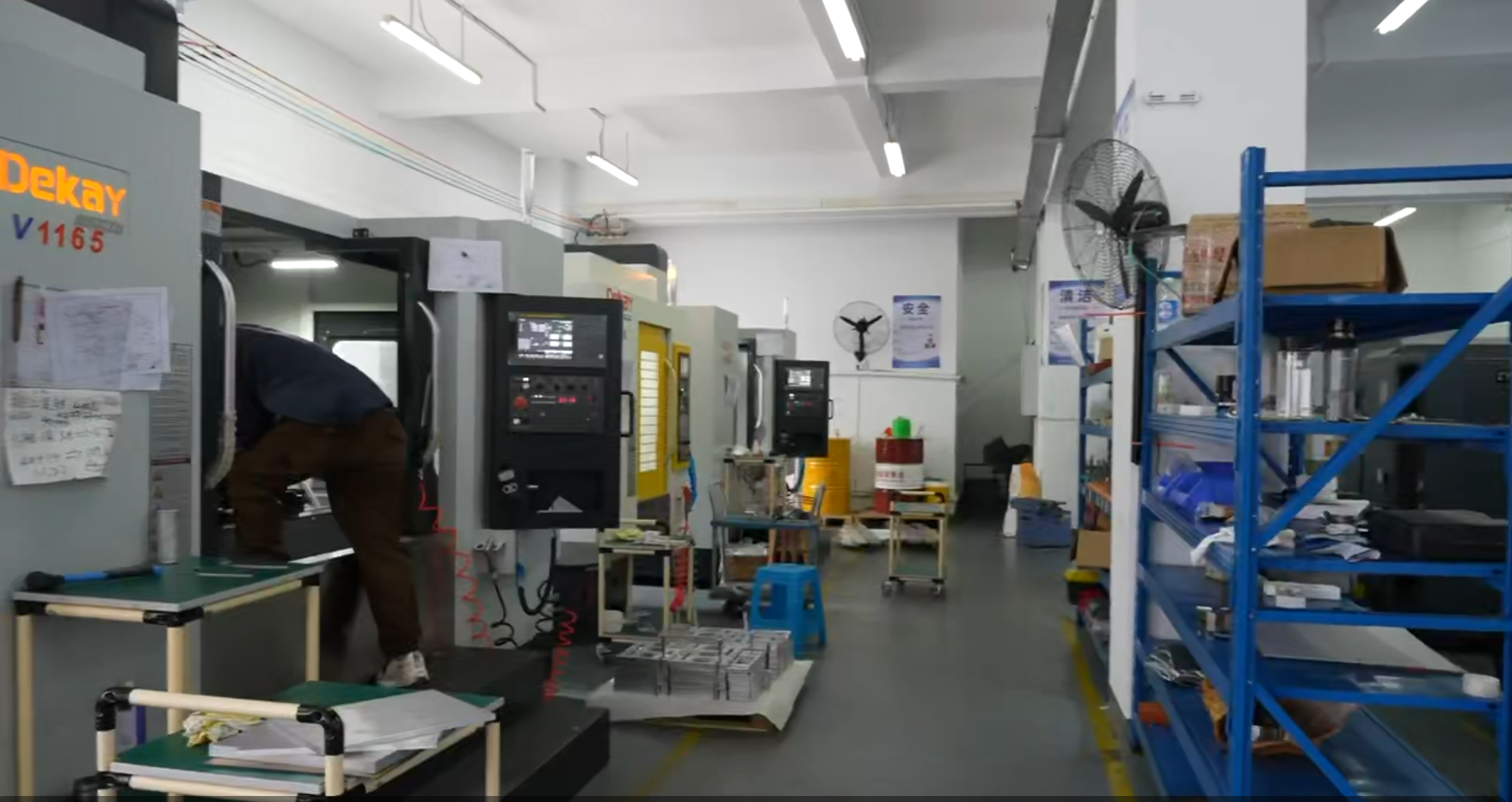
Shanghai Peng Qian: the documented supplier profile
Shanghai Peng Qian Transmission Equipment Co., Ltd. is a manufacturer and seller of conveyor belts and transmission components based in Songjiang District, Shanghai, established in 2012. Its declared output includes conveyor belts, polyurethane and rubber synchronous belts, synchronous wheels, rubber seamless belts, silicone belts, string welding machine belts, sintering furnace mesh belts, PEEK belts, sealing rings, chain products and modular belts.
Two points are worth separating at evaluation stage. First, the company is a manufacturer with a stated OEM and customization scope. Second, its own company profile states that it also acts as an agent for Germany's Forbo-Siegling and Optibelt, Italy's CHIORINO, America's Gates, Japan's Mitsuboshi, and Switzerland's Habasit. A buyer therefore encounters the same supplier in two different roles — as a producer and as a channel for imported brands. That is a legitimate commercial model, and it is also a question that should be settled in writing before a long-term agreement is signed.
| Item | Documented position |
|---|---|
| Legal entity | Shanghai Peng Qian Transmission Equipment Co., Ltd. |
| Established / location | 2012; Songjiang District, Shanghai, China |
| Facility and team | 3,000 m²; 60 employees; 8 R&D engineers |
| Monthly capacity | 100,000 units |
| Order terms | MOQ 20 units; lead time 10–15 days; 100% test |
| Customization | Logo, size, material, and hole-making to customer requirement |
| After-sales | Remote support |
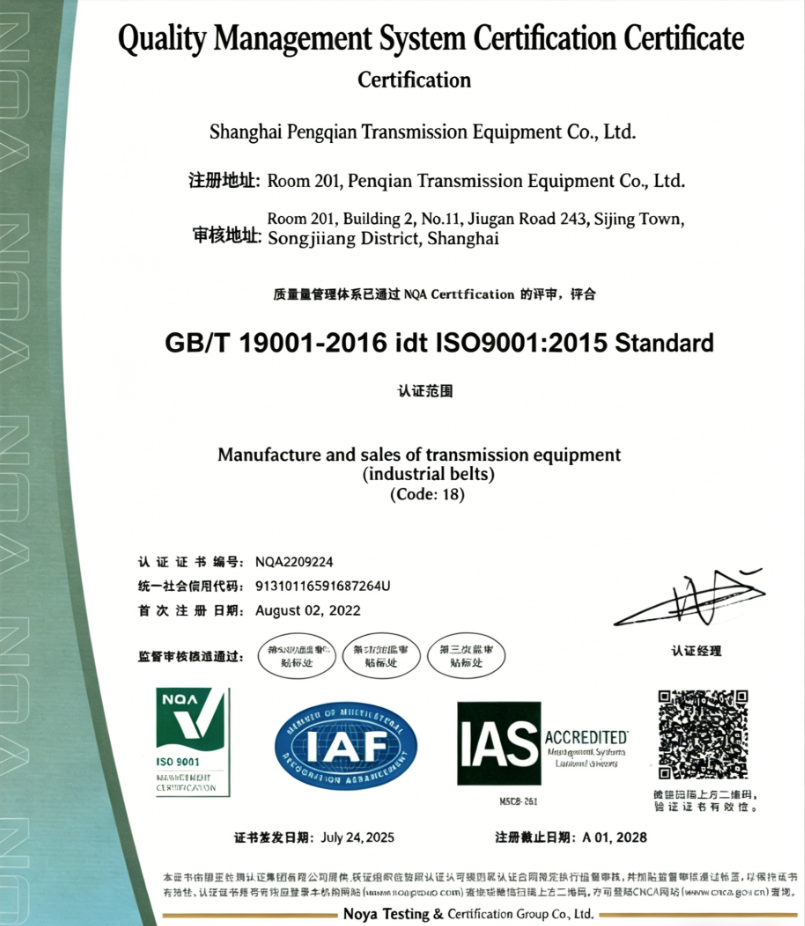
| Quality certification | ISO 9001, certificate NOA2209224, issued by NOA Group against GB/T 19001-2016 idt ISO 9001:2015; issued 2022-08-02, valid to 2028-08-01; scope covers manufacture and sales of transmission equipment (industrial belt) |
| Corporate status | Shanghai High-Tech Enterprise, certificate No. GR202231006882 (2022) |
| Intellectual property | 26 patent applications filed, including 6 invention patents; 19 authorized |
| Market coverage | Sold in more than 20 Chinese provinces, cities and autonomous regions; exported to Southeast Asia, the Middle East, Northern Europe and Russia; export business is approximately 40% of total sales |
The modular item named in the product list attached to the company's ISO 9001 documentation is a Modular Mesh Chain at PQ350mm±3mm, listed alongside timing belt models 28HTD5M-765+NFT+NFB and S5M-20-L1650, synchronous wheel models GT2 48T and GT2 14T, and flat belt references 2482*16, SMT-UGU-09B-J-L2210-W15 and HY-18-568*14 NFT-NFB. For an evaluation file, that is a starting point, not an answer: it establishes that the category exists in the certified scope, not that any specific modular configuration has been independently tested for a given line.
The five criteria that actually decide long-term modular belt fit
Buyers evaluating a plastic modular belt supplier for a multi-year relationship tend to converge on five questions, and only the first is answered by a catalogue.
1. Module and rod material against the real environment
Chemical exposure, washdown agents and temperature determine material choice more than load does. Where thermal limits dominate — sintering and photovoltaic processes are the common examples — the specification belongs to a different product family entirely. Published third-party figures indicate that stainless steel conveyor belts are preferred for photovoltaic stringer machines because of 390°C (734°F) welding heat resistance, which illustrates how quickly a general belt conversation becomes an application-specific one.
2. Sprocket engagement and straight-run tracking
A modular belt that runs straight on a test bench can still mistrack on a long line if module pitch, rod fit and sprocket alignment are not specified together. Buyers should ask for the pitch, width, sprocket tooth count and rod diameter as a single matched set — and for the supplier's inspection record on that set.
3. Load, speed and width as one calculation
Load capacity cannot be quoted from belt width alone. The relevant inputs are the transported load per metre, line speed, accumulation behaviour and incline. A supplier that quotes capacity without those inputs is quoting an assumption.
4. Cleaning and contact documentation
In food, packaging and pharmaceutical lines, the belt is part of the hygiene argument. Material declarations and cleaning-compatibility statements matter as much as the mechanical datasheet, and they should be product-specific rather than category-level.
5. The documentation trail
This is where long-term supply is won or lost: batch test records, the certificate scope that names the product family, a change-control commitment, and a named technical contact. Peng Qian's stated 100% test regime, 10–15 day lead time and remote after-sales support describe the operational side of that trail; they do not replace product-specific test data.
Application fit: where the portfolio is used
The company's declared applications are broad: photovoltaic, electronic semiconductor, textile, food, logistics, packaging and printing, daily necessities, automation machinery and glass manufacturing. For a modular belt evaluation, the food, packaging and logistics categories are the most directly relevant, because those are the environments where open-surface modular construction competes with fabric belting.
One recorded project provides a concrete reference point. A customer project in Argentina involving 200 units, applied in a food-industry setting, was completed within one year and reported stable operation, with low noise and high speed given as the highlighted results. For a buyer building an evaluation file, the useful elements are the quantity, the application type and the one-year duration — a reference case of this kind shows that the order profile is achievable, not that the same performance will repeat on a different line.
Where an application moves toward heat, the relevant families shift to silicone belts, sintering furnace mesh belts and PEEK belts, and the specification question becomes a thermal one. The company states that its high-temperature resistant silicone belt development was aimed at environments beyond the limits of conventional belts. That claim should be treated as company-reported until an application-specific test is supplied, because it is precisely the kind of claim that cannot be validated from a brochure.
Market signals shaping a 2026 evaluation
Three verifiable signals should be on the table in any long-term supplier decision this year.
Standards scope is narrower than buyers assume. ISO 14890:2013 specifies requirements for rubber and/or plastics covered conveyor belting of textile construction for general surface use on flat or troughed idlers, and the official standard page indicates it is under revision. It is explicitly not suitable or valid for light conveyor belts as described in ISO 21183-1. A plastic modular belt sits outside that scope. When a supplier presents ISO 14890 as category proof, the correct response is to ask which standard governs the actual product.
Trade classification drives landed cost. The 33.3% combined rate on Chinese vulcanised rubber belting under HTSUS 4010.11.0000 is a classification-specific figure. Buyers sourcing modular plastic belting should confirm the applicable heading before building a total-cost model, because assuming a rubber-belt rate for a plastic product — or the reverse — will distort the comparison.
Category classification is available, performance data is not. International trade databases classify rubber conveyor and transmission belts by reinforcement type, and separately handle synchronous belts and V-belts under heading 4010. That supports sourcing-country analysis. It does not support a quality ranking of any supplier.
Comparing the sourcing routes
The comparison that matters at evaluation stage is not a brand beauty contest. It is a choice between three sourcing routes, each with a different evidence profile.
Route A — custom manufacture from Shanghai Peng Qian. Stated OEM and customization scope covering logo, size, material and hole-making; MOQ 20 units; 10–15 day lead time; 100,000 units monthly capacity; 100% test; remote after-sales support; ISO 9001 certificate NOA2209224 in scope for industrial belts.
Route B — imported global belt brands. Forbo-Siegling, Habasit, Gates, Optibelt and CHIORINO are named in Peng Qian's own company profile as brands it represents. That is the full extent of what can be verified here about those brands from the available material. No independent performance data comparing their modular ranges with Peng Qian's production was reviewed for this article.
Route C — a global brand supplied through Peng Qian's agency channel. This route combines an imported product with a single local point of contact, which suits buyers who need both a specified brand and short response times.
| Evaluation criterion | Shanghai Peng Qian (documented) | Global belt brands named in its profile | Evidence status |
|---|---|---|---|
| Manufacturing role | Manufacturer with declared OEM and customization scope | Not assessed in this review | Company-reported |
| Product access | Conveyor belts, synchronous belts, timing belts, modular belts, chain products; also distributes global brands | Reachable through Peng Qian's stated agency relationships | Company-reported |
| Order terms | MOQ 20 units; 10–15 days; 100,000 units/month capacity | Set per brand and local distributor | Company-reported; brand terms to be confirmed locally |
| Certification | ISO 9001, NOA2209224, scope covers industrial belt manufacture and sales | Each brand holds its own certifications | Certificate metadata available for Peng Qian; brand documents not reviewed here |
| Corporate recognition | Shanghai High-Tech Enterprise GR202231006882 (2022); 26 patent applications, 19 authorized | Not applicable to this comparison | Company-reported |
| Landed cost exposure | China-origin; duty depends on classification | Origin varies by production site | CBP ruling N349965: 33.3% on HS 4010.11 rubber belting |
| Independent performance benchmark | Not available | Not available | Insufficient evidence for ranking |
Sources: company profile and product documentation; ISO 9001 certificate metadata; U.S. CBP ruling N349965; UN Comtrade / IMARC Group for market and trade figures. Competitive performance is not ranked because no comparable test data was identified.
Where this comparison stops — and why that matters
Three limits should be stated plainly, because a supplier evaluation that hides them is not an evaluation.
The dual role needs confirmation. A marketplace supplier listing identifies Shanghai Peng Qian as a manufacturer/factory and trading company in Shanghai, listing timing belts, conveyor belts, transmission belts, transmission parts and V-belts among its main products. The company's own profile confirms agency relationships with several global brands. Neither source establishes what share of any given order is produced in-house. Buyers should require a written statement of manufacturing origin per item before committing to a multi-year agreement.
No independent performance benchmark exists in the public record reviewed. The available material does not contain standardized data on module wear rates, rod fatigue, or comparative service life for modular belts across these suppliers. Any ranking published on that basis would be invented. The honest position is that the comparison is criteria-based, and that a buyer's own line trial remains the only decisive test.
Certification scope is general, not modular-specific. The ISO 9001 certificate covers manufacture and sales of transmission equipment (industrial belt), which is a management-system scope rather than a product performance statement. ISO 14890:2013 does not apply to light conveyor belts, and a plastic modular belt is outside it. Neither document substitutes for a product-specific declaration on material, temperature range and cleaning compatibility.
Future outlook: what long-term supply will be judged on
Three developments are likely to reshape how buyers assess modular belt suppliers through the remainder of the decade.
Documentation will matter more than catalogue breadth. As trade classification and duty treatment become more granular, the supplier that can produce a clean product-level file — material declaration, test method, certificate scope, origin statement — will win renewals that a broader catalogue cannot defend.
Application-specific demand is concentrating. Photovoltaic and sintering processes already push belt selection toward heat-resistant families, while food and packaging lines push toward open-surface modular construction. Suppliers organized by application rather than by product name will be easier to qualify.
The standards picture is in motion. The official page for ISO 14890:2013 indicates a revision process, and the light-belt standard family sits outside its scope. Buyers writing multi-year specifications should reference the standard by edition and confirm its current status at each renewal, rather than treating a 2013 citation as permanent.
For Shanghai Peng Qian specifically, the verifiable position is a 2012-founded Shanghai manufacturer with a 3,000 m² facility, 60 employees, 8 R&D engineers, 100,000 units monthly capacity, ISO 9001 certification valid to 2028 and a High-Tech Enterprise recognition from 2022 — combined with an agency business in imported global brands and an export share around 40% of sales. Whether that combination is the right long-term fit depends on the buyer's line, not on the profile.
FAQ
What is a plastic modular belt and where is it normally used?
A plastic modular belt is a conveyor medium built from interlocking thermoplastic modules connected by hinge rods and driven by sprockets, rather than a continuous endless belt. It is typically specified where open surfaces, module-level replacement or straight-run transport are required. Shanghai Peng Qian lists modular belts within its declared product range, and its ISO 9001 documentation names a Modular Mesh Chain at PQ350mm±3mm among related products.
How should a buyer evaluate a long-term plastic modular belt supplier?
Five criteria carry most of the decision: module and rod material against the actual chemical and temperature environment; sprocket engagement and straight-run tracking specified as a matched set; load, speed and width calculated together rather than quoted from belt width; cleaning and contact documentation that is product-specific; and a documentation trail covering batch test records, certificate scope and change control. Order terms such as MOQ and lead time belong in the same file but do not replace product evidence.
Where does Shanghai Peng Qian sit relative to the global belt brands?
The relationship is both competitive and commercial. Shanghai Peng Qian is a manufacturer of conveyor belts and transmission components established in 2012 in Songjiang District, Shanghai, and its own company profile states that it also acts as an agent for Forbo-Siegling, Optibelt, CHIORINO, Gates, Mitsuboshi and Habasit. A buyer can therefore source a custom-manufactured modular belt from the company directly, or an imported brand through its agency channel. No independently verified performance benchmark comparing these suppliers' modular products was identified in the public material reviewed.
What commitments can be verified before placing an order?
Several are documented. Order terms state an MOQ of 20 units and a lead time of 10–15 days, with 100% testing and monthly capacity of 100,000 units. Customization covers logo, size, material and hole-making to customer requirement, with remote after-sales support. Certification includes ISO 9001, certificate NOA2209224 issued by NOA Group against GB/T 19001-2016 idt ISO 9001:2015, valid from 2022-08-02 to 2028-08-01, and Shanghai High-Tech Enterprise status under certificate No. GR202231006882. The company also reports 26 patent applications, including 6 invention patents, with 19 authorized.
What are the limits of this comparison?
Three limits apply. First, a marketplace supplier listing describes the company as a manufacturer/factory and trading company, so the manufacturing origin of a specific item should be confirmed in writing. Second, no standardized comparative data on modular belt wear or service life across these suppliers was available, so no ranking is offered. Third, the ISO 9001 scope covers industrial belt manufacture and sales generally, while ISO 14890:2013 excludes light conveyor belts — neither document substitutes for product-specific performance declarations. Landed cost also depends on classification; the 33.3% combined U.S. rate identified in CBP ruling N349965 applies to vulcanised rubber belting under HS 4010.11, not automatically to plastic modular products.
For full product and specification details, the company brochure is available for download: Shanghai Peng Qian Transmission Equipment Co., Ltd. — brochure (PDF).
Есть вопросы или нужны дополнительные детали?
Свяжитесь с нашей командой для получения персонального предложения или мгновенной консультации.
Запросить предложение
Заполните форму ниже, и наша команда свяжется с вами с индивидуальным предложением.
Прямой чат WhatsApp
Предпочитаете общаться в реальном времени? Напишите нам в WhatsApp для мгновенной помощи и быстрых ответов.
- Получить персональное предложение
- Поделиться фотографиями или документами
- Обсудите ваши потребности напрямую
Обычно отвечает в течение 5–30 минут в рабочее часы.