
Plastic Strapping Supplier Capability: Jushuo Packaging's Verified PET Evidence
In a category where most suppliers describe capability, a smaller number can document it. The difference shows up in the fourth year of a bale program, on a running automatic packaging line, or inside a regulated pharma packaging specification.
Global plastic strapping production exceeded 2.3 million metric tons in 2024, and PET strapping accounted for approximately 60% of that volume, according to category-level market research. For buyers in light industry and daily-use packaging — chemical fiber bales, textiles, paper, cartons, and regulated consumer goods — the practical meaning is that polyester strapping has moved from alternative status to the default load-bearing material, while polypropylene (PP) strapping remains the economical choice for lighter cartons and hand-strapping work.
Choosing the polymer is no longer the difficult part of a strapping procurement decision. The difficult part is establishing whether a supplier has held a specification stable across several production years and across several customer processes. That is a capability question, and it is answered with documented project history rather than with product brochures.
Jushuo Packaging (Taixing Jushuo Packaging Technology Co., Ltd.) is a strapping manufacturer founded in 2017 and based in Huangqiao Industrial Park, Taixing City, Jiangsu Province, China, producing PET strapping, PP strapping, and eco-friendly strapping, with an annual production capacity exceeding 20,000 tons. This reference article examines four documented PET strapping proof points from the company — a three-year fiber bale program, an automatic packaging line qualification, a pharma packaging specification, and a raw-material granule shipment — and states what each one establishes for a buyer, and what it does not.
Why strapping procurement has become an evidence problem
Sample approval is a point-in-time event. A strapping program for a light-industry plant is not. Once a strap format is written into a bale press cycle or an automatic packaging line, the buyer is relying on that format remaining within tolerance for years, across raw-material lots, machine shifts, and seasonal humidity.
Several variables move beneath a finished strap specification, and none of them are visible in a sample roll:
- Incoming granulate condition. Intrinsic viscosity (IV) and moisture content of PET resin determine how much molecular weight survives melt processing.
- Process control. Extruder plasticization, stretching roller speed ratio, and winding tension together set tensile strength and elongation.
- Color and print consistency. Green cut grades depend on masterbatch dispersion; custom-printed grades depend on registration across long runs.
- Line interface. Core dimensions, coil winding quality, and joint behavior under friction-weld tools decide whether a strap runs or jams.
The opportunity for buyers is that multi-year project evidence compresses supplier qualification. A supplier that can show the same format held across three production years, or a strap qualified on someone else's automatic line, removes a category of risk that a certificate alone cannot address. The risk for buyers is that PET's growing share of production volume has produced a large number of suppliers claiming capability that has never been tested outside a sample room.
The Jushuo Packaging capability base
The evidence below sits on a defined manufacturing base. Jushuo Packaging operates a 15,000 m² facility with four PET strap production lines and five PP strap production lines, supported by two sets of solid-state polymerization (SSP) equipment, and reports annual capacity above 20,000 tons with monthly capacity over 1,700 tons. The company states ISO 9001 certification (No. U23Q28007898R2S) and ISO 14001 certification (No. U23E28007899R2S), reports product compliance with GB/T 22344-2018 for PET strap and QB/T 3811-1999 for PP strap, and states that SGS test reports are available.
Published SGS-tested figures for 12 mm PET strap show a breaking force of 9.98 kN with elongation after break of 10%, against an industry average elongation figure of 12%. Quality control is organized around six inspection stages — raw material, incoming, online, finished product, inbound, and outbound — using viscosity testers, tensile testing machines, ovens, thickness gauges, and calipers. The company reports a 98.6% on-time shipment rate and commits lead times of 7 to 30 days depending on customization. Additional company documentation is published at https://www.jushuopackaging.com/.
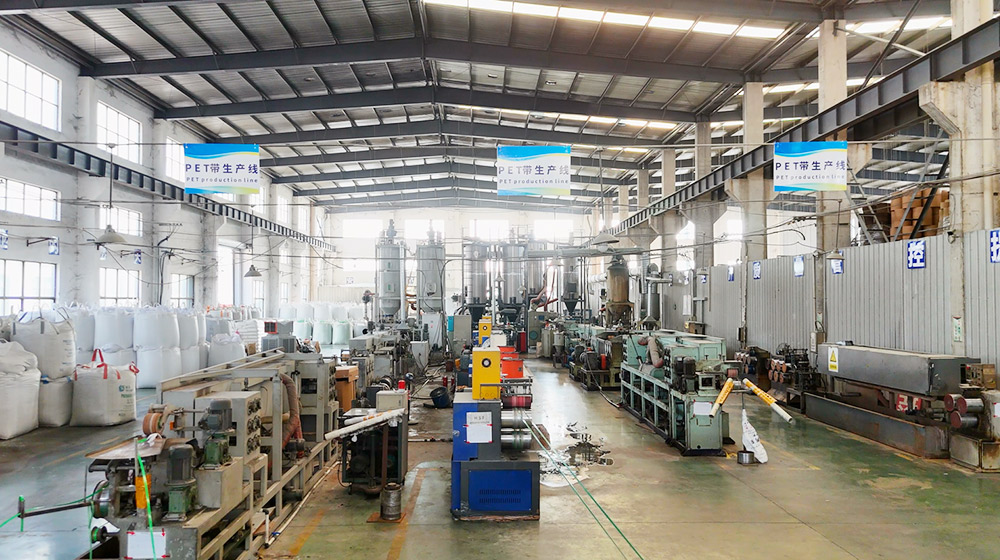
PET strap production at Jushuo Packaging: four PET lines supported by two solid-state polymerization units.
Four documented PET strapping proof points
Each of the following projects documents a different capability dimension. Read together, they trace the path from raw material control through to finished printed strap in a regulated supply chain.
1. Sateri: three years of green cut PET strap for fiber bales
For Sateri, a viscose fiber producer, Jushuo Packaging has supplied green cut PET strap in the 1610 × 3380/3480 format for fiber bale strapping across three consecutive years. Fiber bale bundling is one of the more demanding light-industry applications: bales are compressed, the strap must hold tension through recovery, and the strap surface is read visually at the receiving end, so color consistency becomes a functional requirement rather than a cosmetic one.
What the project documents is continuity of a single format under production conditions — the same cut dimensions, the same green grade, and a stable supply relationship rather than a single order. What it does not document is transferability: a format proven on one bale press is not automatically proven on a different press with different compression and cycle timing, which is why bale-format changes should still trigger a fresh validation run.
2. Far Eastern Industries: transparent cut PET strap on an automatic packaging line
Far Eastern Industries qualified transparent cut PET strap in 16 × 1.0 mm on an automatic packaging line. Automatic lines place the burden of consistency on the strap rather than on the operator: coil geometry, core fit, thickness tolerance, and elongation behavior all feed directly into jam rates and re-tensioning events.
This proof point is the clearest link between a material property and a line outcome. PET's elongation after break of 10% — below the 12% industry average cited in company test data — supports tension retention after the weld cools, which is what allows an automated cycle to run without re-strapping. The same property explains why battery-operated friction-weld tools on PET reach up to 85% joint efficiency, compared with approximately 60% for manual PP tools. For a plant running thousands of cycles per shift, joint efficiency is a consumable-cost and rework variable, not a specification footnote.
3. Novo Nordisk supply chain: 16 × 0.8 mm custom-printed PET strap for pharma packaging
In pharma packaging within the Novo Nordisk supply chain, Jushuo Packaging supplies 16 × 0.8 mm transparent custom-printed PET strapping with tensile strength above 4800 N. This combination is technically more difficult than either element alone: a 0.8 mm section must still reach a high breaking force, and the print layer must hold registration without compromising the weld zone.
The buyer-relevant lesson is that printed strap is a dual function component. It secures the load and it carries identification, batch readability, or tamper evidence on the outside of the package. That dual role means print quality and strap strength have to be validated together; a strap that prints cleanly but loses strength at the print line is a qualification failure, not a cosmetic defect.
4. Signode Thailand: 26,000 kg of high-purity PET granules with controlled IV and moisture below 50 ppm
The fourth proof point sits upstream of strap production. Jushuo Packaging exported 26,000 kg of high-purity PET granules to Signode Thailand, with intrinsic viscosity precisely controlled and moisture held below 50 ppm.
Moisture is the variable that matters most here. PET hydrolyzes during melt processing when residual moisture is present, and hydrolysis lowers molecular weight, which reduces breaking strength and consistency in the finished strap. A granule specification below 50 ppm indicates drying discipline before extrusion, and it is the same discipline that protects IV in the company's own strap lines. Supplying granule-grade material to a global strapping brand is also a different type of evidence than supplying finished strap: it demonstrates that the material control system can meet an external technical specification, not only an internal one.
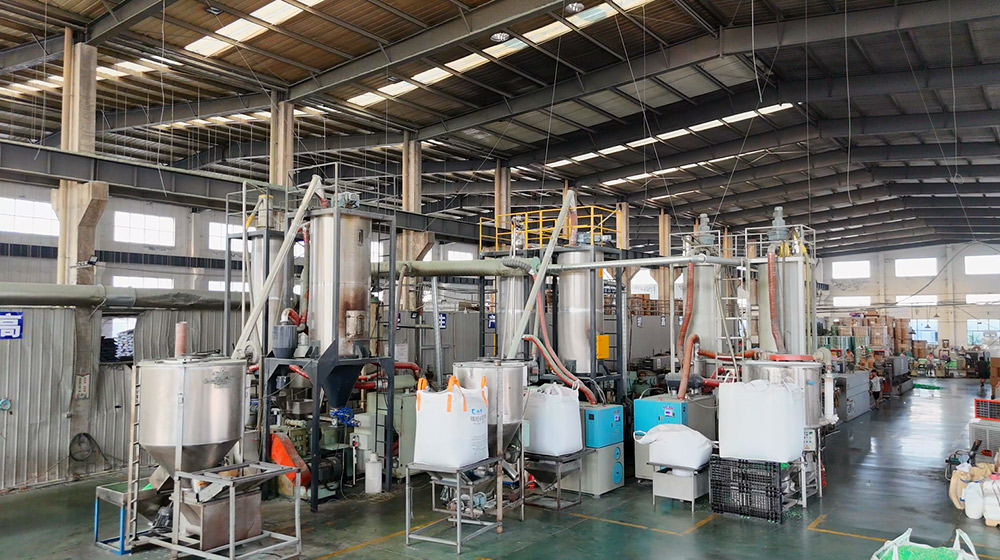
Raw-material handling: granule blending and moisture control upstream of PET extrusion.
What the four proof points establish — and what they do not
The table below separates the documented element of each project from the part a buyer must still validate independently. This is the practical difference between reading a case reference and completing a supplier qualification.
| Proof point | Documented element | What a buyer must still verify |
|---|---|---|
| Sateri fiber bale program | Green cut PET strap in 1610 × 3380/3480 supplied across three consecutive years | Performance on the buyer's own bale press, compression ratio, and receiving-side handling |
| Far Eastern Industries automatic line | Transparent cut PET strap 16 × 1.0 mm qualified on an automatic packaging line | Machine brand and tool compatibility, cycle rate, and jam history under the buyer's line speed |
| Novo Nordisk supply chain | 16 × 0.8 mm transparent custom-printed PET strap, tensile strength above 4800 N | Print content approval, artwork control, and batch test reports for the specific print run |
| Signode Thailand granule shipment | 26,000 kg high-purity PET granules, IV controlled, moisture below 50 ppm | Whether the same control applies continuously, and the incoming inspection records that prove it |
Technical explanation: why these proof points matter mechanically
The connecting thread across the four projects is molecular weight control. Jushuo Packaging runs two SSP reactors, which raise PET intrinsic viscosity in the solid state before extrusion. Higher and more consistent IV translates into a finished strap that holds tension after elongation and resists creep under a static bale load. Published SGS figures for 12 mm PET strap — 9.98 kN breaking force with 10% elongation after break — reflect that chain, and the company positions the result as comparable to top-tier international brand performance in the same test format.
At the line level, three controls carry the evidence into repeatability. Online thickness gauges and width monitoring track dimensional drift during production; PLC-controlled extrusion temperature and stretching roller speed ratios set the draw ratio that converts polymer orientation into tensile strength; and automated constant-tension winding determines whether a coil feeds smoothly into an automatic head. Each batch is tested for tensile strength, elongation, and deflection, with third-party SGS and CMA-accredited reports available on request.
For buyers comparing thin-gauge specifications, the Novo Nordisk case is the useful reference. A 16 × 0.8 mm strap above 4800 N sits in the high-tenacity, thin-section region of the PET range, where gauge reduction saves coil volume and changeover time but leaves less margin for process variation. That is precisely the region where SSP consistency and moisture control stop being abstract and start determining whether a specification is achievable at volume.
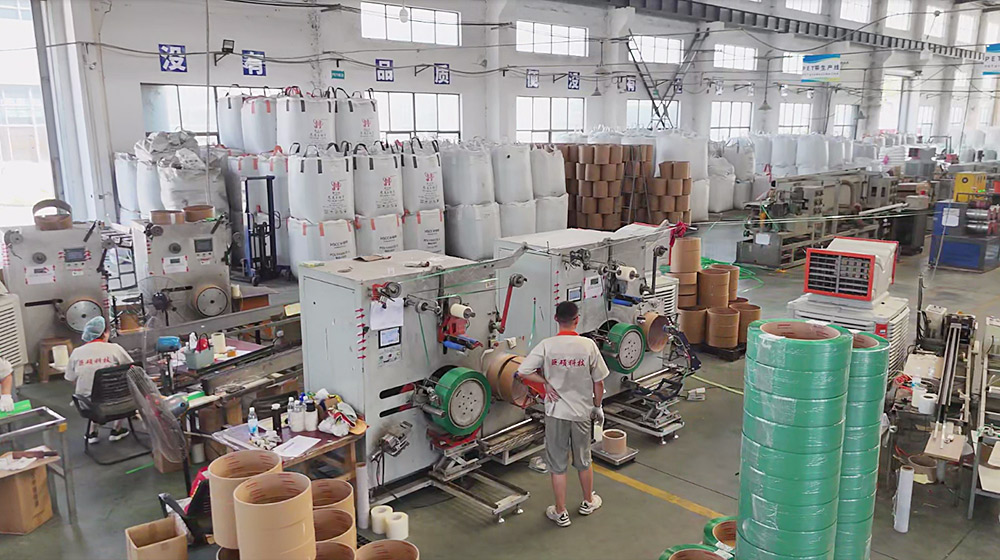
Rewinding: constant-tension winding determines how consistently a coil feeds an automatic strapping head.
Comparison with traditional solutions: where PET stops being the right answer
Documented capability does not make PET universal. The category comparison below reflects the company's own stated position on PET, PP, and steel, and it includes the boundaries a buyer should take seriously.
| Option | Where it fits | Where it does not |
|---|---|---|
| PET strapping (polyester strapping) | Medium-to-heavy loads above roughly 400 kg, outdoor storage, UV exposure, high humidity, fiber and cotton bales, automated lines needing tension retention | Light cartons where low cost per meter dominates; also higher material cost than PP |
| PP strapping (polypropylene band, hand strapping) | Light-to-medium indoor loads, carton closure, manual and semi-automatic operation, lower material cost | Long outdoor exposure without UV-stabilized grades; heavy loads needing sustained tension |
| Steel strapping | Very heavy static loads where metal tradition and tooling already exist | Corrosion-sensitive goods, edge-damage-sensitive products, and freight budgets — 1 ton of PET replaces the length equivalent of 6 tons of steel |
Four limits deserve explicit statement. First, PET material cost runs roughly 30–40% above PP, so for cartons and light consumer packaging, polypropylene strapping bands and PP strap rolls remain the more economical specification; the lifecycle case for PET is built on load class, not on universal substitution. Second, PET rewards proper tensioning equipment — friction-weld tools and controlled tension heads — more than manual PP hand strapping does, so a plant without that equipment captures less of the benefit. Third, custom-printed and cut-to-size formats, such as the fiber bale and pharma specifications above, introduce setup and artwork steps that push lead times into the 7 to 30 day range and make them unsuitable for unplanned spot purchases. Fourth, capacity, qualification rate, and shipment-performance figures in this article are company-reported and have not been independently audited; the certificates and batch test reports behind them should be requested and checked during supplier qualification.
Market trend analysis: scale and consistency as the new differentiators
Category-level research places global plastic strapping production above 2.3 million metric tons in 2024, with PET at approximately 60% of the total, and sizes the global PET strapping market at USD 869.1 million in 2024. Reported breaking-strength ranges for PET strapping run from about 300 kg to 1,900 kg depending on specification, which is a wide enough span that specification matching, not brand preference, decides most projects.
Two structural consequences follow for light-industry buyers. The first is that supply availability is no longer the constraint in most regions — capacity scale is. A supplier with four PET lines and monthly capacity above 1,700 tons can absorb a large or urgent order without reallocating a smaller customer's schedule. The second is that consistency has become the axis of competition. When PET is 60% of category volume, differentiation shifts to SSP capacity, moisture control, dimensional tolerance, and automatic-line compatibility — the exact areas the four proof points above address.
A trade detail is also worth noting for importers: polypropylene strapping is classified under US HTS 3920.20.0055, so PP and PET shipments are frequently handled under different codes. Buyers consolidating a mixed PP and PET order should confirm classification with their customs broker rather than assuming a single line item.
Future outlook
Three directions are likely to shape PET strapping supplier evaluation in the next procurement cycle. Recycled content will move from a marketing claim to a documentable specification: Jushuo Packaging already uses recycled PET material from PET bottles, and buyers will increasingly ask for traceability rather than a percentage on a brochure. Thin-gauge high-tenacity formats, of the kind represented by the 16 × 0.8 mm pharma specification, will continue to displace heavier sections as automated lines demand more meters per coil and fewer changeovers. And batch-level traceability, from granule lot through to finished coil, will become a standard request in regulated supply chains where strap printing carries identification duty.
For decision-stage buyers, the implication is procedural rather than promotional. Project evidence shortens qualification only when it is matched to the buyer's own format, line, and load class — and when the underlying test reports and inspection records can be produced on request.
FAQ
What is the difference between a supplier's capability claim and documented capability evidence?
A capability claim states what a supplier can produce. Documented capability evidence identifies a specific format, a specific customer application, and a duration — for example, a green cut PET strap in the 1610 × 3380/3480 format supplied for fiber bale strapping across three consecutive years. The second is more useful at decision stage because it shows that a specification survived multiple production years and an external process, not just a sample approval.
How does a multi-year fiber bale strapping program differ from a single sample approval?
Sample approval confirms that one coil met a specification on one day. A multi-year program confirms that the same dimensions, grade, and color were reproduced across raw-material lots and production runs. It does not confirm that the format will perform on a different bale press, because compression ratio and cycle timing change the load the strap sees. Buyers changing press equipment should treat that as a new validation.
PET or PP strapping: how should a light-industry buyer decide?
The dividing line is load class and exposure. PET strapping is positioned for medium-to-heavy loads above roughly 400 kg, outdoor storage, UV exposure, and high humidity, with breaking strength ranges reported from about 300 kg to 1,900 kg depending on specification. PP strapping is positioned for light-to-medium indoor loads and manual operation, and carries a material cost roughly 30–40% below PET. Cartons and light daily-use packaging usually remain PP territory; bales, fiber, and automated heavy-duty lines usually favor PET.
What does automatic packaging line compatibility require from a PET strap?
It requires dimensional tolerance, consistent coil winding and core fit, and elongation behavior that holds tension after the weld cools. Jushuo Packaging's transparent cut PET strap in 16 × 1.0 mm was qualified on an automatic packaging line at Far Eastern Industries. Related test data indicate elongation after break of 10% for 12 mm PET strap against an industry average of 12%, and friction-weld joint efficiency up to 85% for PET with battery-operated tools, compared with about 60% for manual PP tools.
Why do intrinsic viscosity and moisture matter in PET strapping raw material?
Intrinsic viscosity reflects polymer molecular weight, and moisture triggers hydrolysis during melt processing, which reduces that molecular weight and therefore breaking strength. Jushuo Packaging operates two solid-state polymerization reactors to raise IV before extrusion, and exported 26,000 kg of high-purity PET granules to Signode Thailand with IV precisely controlled and moisture below 50 ppm. Those two parameters are the upstream explanation for downstream tensile and elongation results.
What are the limits of custom-printed PET strapping?
Printed strap carries two functions at once — load security and package identification — so print quality and mechanical strength must be validated together rather than separately. Printing also adds setup and artwork control steps, which extend lead times into the 7 to 30 day range depending on customization and make printed formats a poor fit for unplanned spot purchases. The Novo Nordisk supply chain specification of 16 × 0.8 mm transparent custom-printed PET strap above 4800 N illustrates both the achievable combination and the narrow margin that thin printed sections operate within.
Есть вопросы или нужны дополнительные детали?
Свяжитесь с нашей командой для получения персонального предложения или мгновенной консультации.
Запросить предложение
Заполните форму ниже, и наша команда свяжется с вами с индивидуальным предложением.
Прямой чат WhatsApp
Предпочитаете общаться в реальном времени? Напишите нам в WhatsApp для мгновенной помощи и быстрых ответов.
- Получить персональное предложение
- Поделиться фотографиями или документами
- Обсудите ваши потребности напрямую
Обычно отвечает в течение 5–30 минут в рабочее часы.