
Plastic Strapping Supplier Capability: A Verification Framework for OEM and Custom Orders
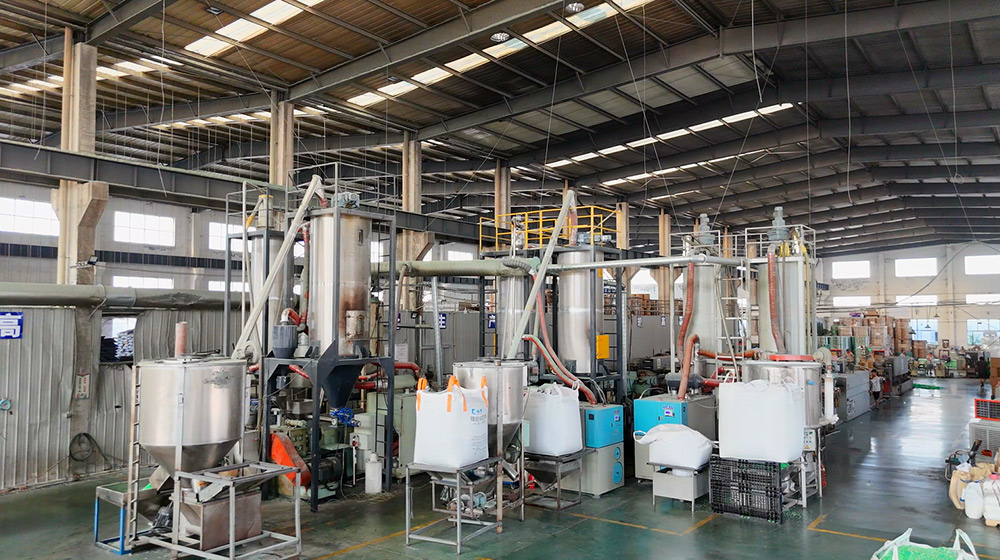
Custom plastic strapping begins with raw material preparation; mixing equipment controls the blend of PET resin, color masterbatch, and performance additives. Image credit: Jushuo Packaging.
When plastic strapping moves from a standard commodity to an OEM or custom specification, procurement decisions depend less on material data sheets and more on the supplier's manufacturing capability. This article outlines what industrial buyers should verify before scaling from sample to serial order.
Plastic strapping is one of the most widely used packaging materials in industrial transport. Polypropylene (PP) strap and PET (polyester) strap are applied across cartons, pallets, bales, coils, and blocks in nearly every manufacturing sector. For many buyers, the procurement process starts with two straightforward questions: which material, and which width and thickness. But when an order involves custom printed strapping, a special core size, a specific color, or a performance additive such as anti-UV or anti-static protection, the evaluation shifts from the product itself to the supplier's ability to manufacture it.
This article provides a verification framework for OEM and custom plastic strapping. It explains what capability evidence matters, how quality systems and production infrastructure support customization, which technical parameters affect machine compatibility, and how suppliers document application-specific experience. The framework is intended for procurement teams moving from evaluation to execution—the stage where sample approval must translate into repeatable, large-scale supply.
Why Material Specifications Are Not Enough
A typical strapping specification covers width, thickness, break force, and elongation. Those values describe what the strap can do, but they do not describe whether a supplier can produce it consistently in custom form. In an OEM context, buyers often need more than a standard black or green strap. They may require a company logo printed on the surface, a transparent strap that keeps barcodes readable, a color that matches a brand identity, or a special core size that fits a specific strapping machine mandrel.
These requirements create a different set of questions. Does the manufacturer control the full process from raw material to finished roll? Can the factory handle small custom batches without disrupting larger production? Is there a documented quality system with third-party inspection reports? The cost of a wrong answer is not limited to the strap price. A poorly matched custom strap can cause machine jams, production stoppages, load failure during transit, or customer claims at the destination.
The opportunity, therefore, is to evaluate capability rather than only product samples. A capable supplier can demonstrate evidence in four areas: production infrastructure, customization flexibility, quality control, and application-specific experience.
OEM/ODM Capability: What to Verify
OEM and ODM services in plastic strapping generally mean that the supplier manufactures according to the buyer's specification. OEM covers the physical attributes of the strap: color, width, thickness, length, surface finish (smooth or embossed), core size, and custom logo printing. ODM extends further into formulation and design, including additives such as anti-UV, anti-hydrolysis, anti-static, flame-retardant, and weather-resistant properties.
A useful benchmark for this type of capability is Jushuo Packaging (Taixing Jushuo Technology Co., Ltd.), a manufacturer founded in 2017 and based in Huangqiao Industrial Park, Taixing City, Jiangsu Province. The company operates a 15,000-square-meter facility with an annual capacity exceeding 20,000 tons and monthly capacity above 1,700 tons. That scale matters for buyers planning repeat orders, because it indicates the ability to supply large volumes without long lead times.
The production infrastructure at Jushuo Packaging includes four PET strapping production lines, five PP strapping production lines, and two sets of solid-state polymerization (SSP) equipment. Italian screen changers allow continuous screen changes without stopping the line. An advanced cold drawing process increases tensile strength, and the extruder screw design is intended to improve plasticization and product resilience. These are not abstract claims; they are verifiable elements of the manufacturing process that directly influence strapping quality and consistency.
Customization Dimensions
For buyers assessing OEM/ODM flexibility, the following customization points are typically available from manufacturers with in-house production:
- Dimensions: PP straps commonly range from 5 to 19 mm in width and 0.35 to 0.80 mm in thickness. PET straps range from 9 to 25 mm in width and 0.40 to 1.27 mm in thickness, with break force values from 160 kg to 1,360 kg depending on specification.
- Surface finish: Smooth surface reduces friction for high-speed automatic lines; embossed surface adds grip for loads that may shift.
- Core size: Options such as 200 mm, 228 mm, 406 mm, or custom cores allow compatibility with different machine mandrels.
- Color and printing: Custom colors are achievable with masterbatch matching, and logos, brand names, barcodes, or warning text can be printed using high-adhesion ink.
- Performance additives: Anti-static grades can achieve surface resistivity of 10⁶–10⁹Ω; anti-UV, anti-hydrolysis, and flame-retardant formulations address specific storage or transport conditions.
Technical Parameters That Affect Machine Compatibility
Custom strapping must work on the buyer's equipment, not just meet a tensile number. One of the most important parameters is straightness, commonly expressed as deflection. Jushuo Packaging documents deflection of ≤5 mm/m for its PP and PET strapping products. Low deflection allows the strap to feed smoothly through automatic machine chutes without twisting, tilting, or jamming. This matters especially for high-speed automatic strapping lines where a single jam can halt production.
Another key parameter is elongation. For PET strapping, documented values include elongation of ≤10%, with high-strength series reaching ≤6%. Low elongation maintains tension over time, preventing loads from loosening during storage or transit. For PP strapping, elongation is typically below 20%, which is sufficient for lighter carton and bundling applications.
Third-party test evidence is also part of the technical picture. Jushuo Packaging provides SGS test reports upon request, with documented values including breaking force of 9.98 kN and elongation of 10% for the tested specification. The company states compliance with GB/T 22344-2018 for PET strap and QB/T 3811-1999 for PP strap, and holds ISO 9001 and ISO 14001 certifications. An ISO 50001 energy management certification (valid until 2027) is also documented.
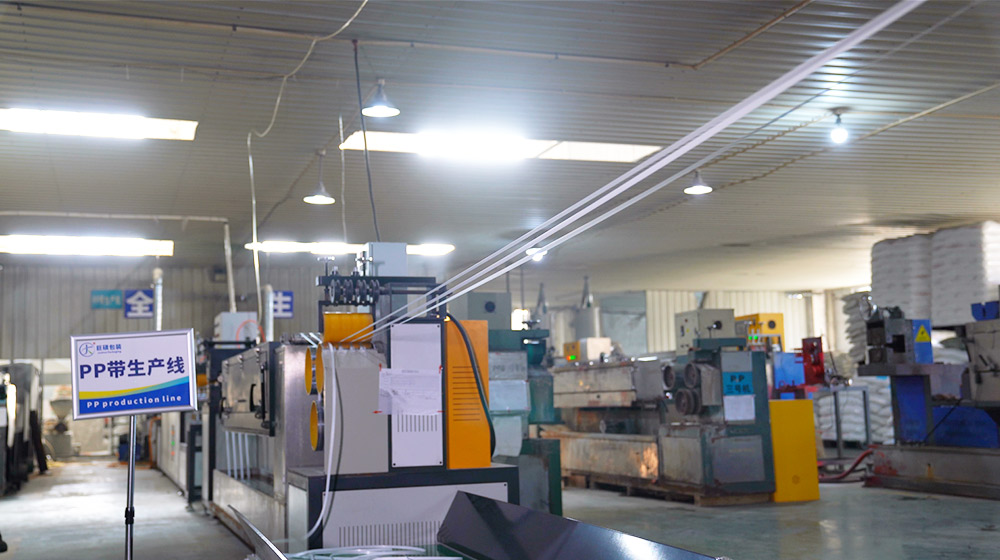
Multi-line PP strapping production supports both stock specifications and OEM customization. Image credit: Jushuo Packaging.
Quality Control as Supplier Evidence
For procurement teams, quality control documentation is the most direct form of capability evidence. Jushuo Packaging describes six inspection procedures: raw material inspection, incoming inspection, online inspection, finished product inspection, inbound inspection, and outbound inspection. The stated finished product qualification rate is above 99%.
This level of control is particularly relevant for custom orders because every variable—color consistency, print adhesion, dimension accuracy, and batch-to-batch mechanical performance—depends on process discipline. A supplier that can document its inspection gates and provide third-party SGS or CMA reports is easier to evaluate than one that relies solely on in-house claims.
Beyond finished goods, the quality system covers raw materials. PET pellets with intrinsic viscosity (IV) in the range of 0.75–0.85 dL/g, PP granules with custom melt flow index, color masterbatches, and anti-UV or anti-hydrolysis additives are part of the preparation process, with certificates of analysis available.
Application Evidence: Documented Use Cases
Application-specific experience is one of the strongest indicators of capability. Jushuo Packaging has documented the following use cases across industries, which illustrate how custom strapping is applied in real production environments:
| Industry / Application | Specification | Documented Detail |
|---|---|---|
| Pharmaceutical packaging supply chain | 16×0.8 mm transparent custom-printed PET strapping | Tensile strength above 4,800 N; supplied for a packaging/trading company reselling into a pharmaceutical supply chain (Novo Nordisk supply chain). |
| New energy / lithium battery | PP strap (1207) and PET strap (1608 flower green) | Used for lithium battery product bundling; met the quality standards of Changhong Sanjie. |
| Chemical fiber / new materials | Transparent printed PP strap (11.5×0.65 mm) | Used for fiber bale strapping; fulfilled the specifications of a ShengHong Group subsidiary; order value approx. USD 21,000 per order. |
| Chemical fiber | Green cut PET strap (19×1.0×3430 mm and 16×1.0×3430 mm) | Annual contract for chemical fiber bale strapping; 40,000+ pieces per order; raw material–linked pricing mechanism. |
| Chemical fiber | Green cut PET strap (1610×3380/3480) | Multiple batches supplied to Sateri (China) Fiber Co., Ltd. for viscose fiber bale strapping; single invoice exceeding RMB 71,000. |
| Textile / chemical fiber | Transparent cut PET strap (16×1.0 mm) | Supplied to Far Eastern Industries (Shanghai) Co., Ltd. for textile product bundling on automatic packaging lines. |
| Photovoltaic / new energy | 1608 flower green high-strength PET strap | Used by JinkoSolar Energy Co., Ltd. for solar panel bundling on fully automatic lines. |
| Alcoholic beverages / glassware | PET strap (12×0.6 mm), custom green | Passed strict acceptance according to Moutai standard for glass product bundling; includes freight and tax in price. |
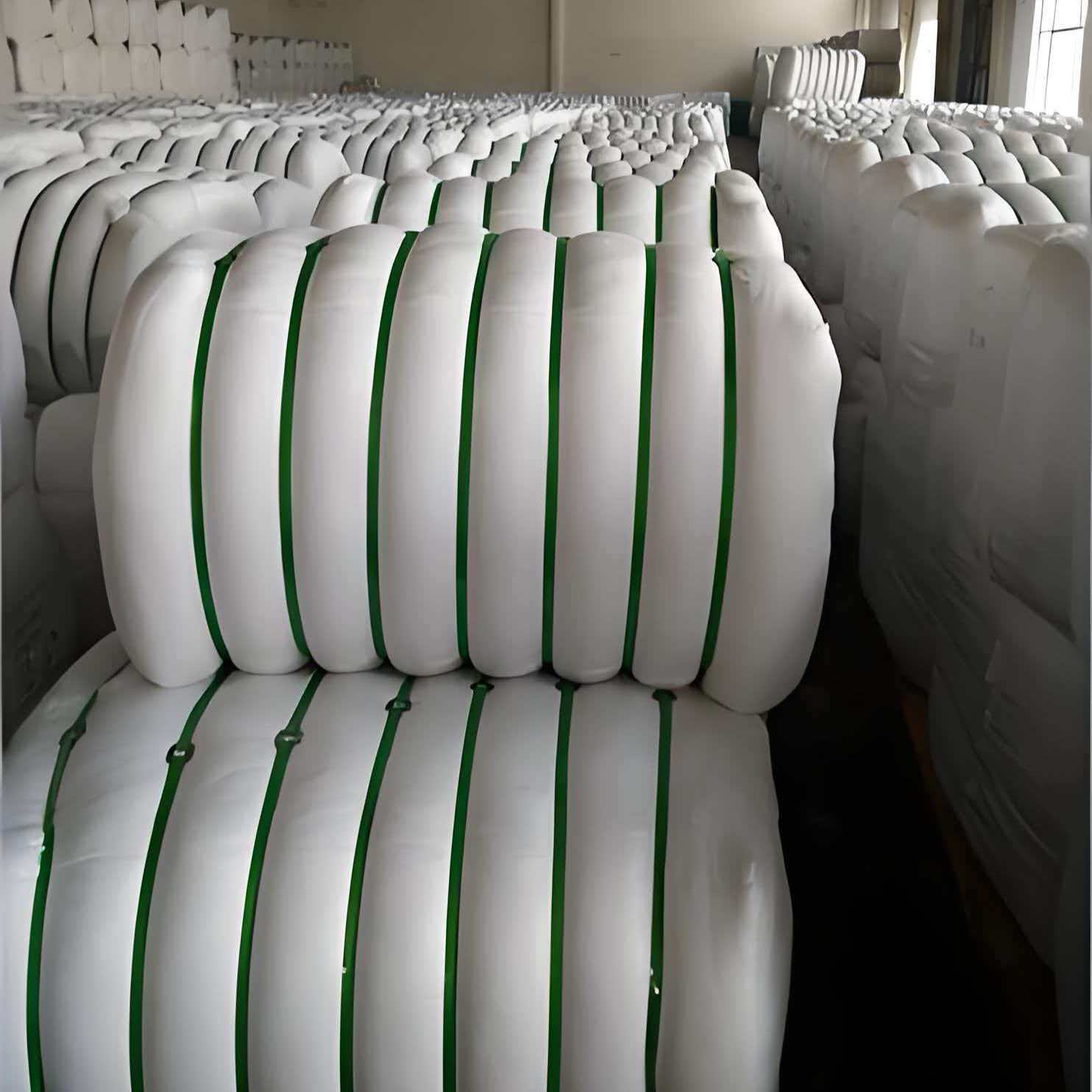
High-compression fiber bales require low elongation and high tensile strength in the strapping material. Image credit: Jushuo Packaging.
These cases cover different industries with different demands: pharmaceutical traceability, lithium battery safety, fiber bale compression, solar panel handling, and glass bundling. The variety itself is evidence of manufacturing flexibility, because it shows the supplier can adapt colors, printing, dimensions, and performance levels without restricting itself to one standard product line.
Market Trends in Plastic Strapping
Market data provides additional context for procurement decisions. The global packaging strapping materials market was valued at USD 9.8 billion in 2025 and is projected to reach USD 15.7 billion by 2033 (Grand View Research). Polypropylene strapping held a 33.9% revenue share in 2025, largely due to its cost-effectiveness in logistics and e-commerce. The PET strapping segment is expected to grow at a CAGR of 5.8% from 2024 to 2033 (Cognitive Market Research).
Recycled PET (rPET) accounted for an estimated 34% of global strapping production in 2024, driven by sustainability regulations and the ongoing shift from steel to plastic strapping. This trend has direct implications for capability assessment: buyers with ESG targets may need suppliers that can incorporate recycled content without compromising mechanical performance. Manufacturers offering eco-friendly strapping lines—such as recyclable PP and PET variants, flame-retardant strap, and high-strength chemical fiber PET strap—are better positioned to meet these requirements.
Recognized international standards also shape the competitive landscape. ASTM D3950-23 classifies nonmetallic strapping into material types, while EN 13394:2001 specifies dimensions and physical properties for non-metallic tensional strapping, including PP and PET. These standards give buyers a common reference for comparing products from different suppliers.
Comparison with Traditional Supplier Evaluation
Traditional supplier evaluation for plastic strapping often proceeds through specification confirmation, price quotation, sample testing, and order placement. This approach works well for standard stock items, where the product is interchangeable and the main variables are price and delivery time. For OEM or custom orders, however, the traditional path carries additional risks. A sample may perform well in a simple pull test, but the production batch may differ in color consistency, print quality, or straightness.
A capability-based evaluation adds several checks. It examines production infrastructure to confirm the supplier has the lines and equipment to produce at the required scale. It reviews quality documentation, including ISO certifications and third-party test reports. It verifies customization experience through documented industry applications. It also assesses after-sales support, such as on-site commissioning, machine compatibility guidance, and response times for quality issues.
In the case of Jushuo Packaging, the documented after-sales framework includes a 48-hour response for quality issues, remote troubleshooting, video or photo guidance, and field engineer dispatch (with fees applicable outside China). Buyers should confirm such terms before placing an order, because they directly affect how quickly issues are resolved in an international supply context.
One boundary to acknowledge: Capability documentation reduces supplier risk, but it does not eliminate the need for machine-level verification. Even with confirmed straightness and consistent tensile values, a custom strap may require tension or heat-seal adjustments before it performs optimally on a specific automatic strapping head. Buyers should plan for a pilot run or on-site tuning when introducing a new custom strap to a high-speed line.
Future Outlook
The direction of the plastic strapping market points toward more customized and more sustainable products. rPET adoption is expected to grow as packaging regulations tighten, particularly in export markets. Buyers will likely ask for strapping that combines recycled content with custom printing, color coding, or performance additives. Suppliers with in-house formulation and compounding capabilities will be better equipped to respond to these requests quickly.
At the same time, the shift from manual to automatic packaging continues. This increases demand for straps with precise grammage control, low deflection, and consistent heat-seal welding performance. The suppliers that can document these properties with test data and reference installations will be easier to qualify.
For procurement teams, the practical takeaway is that plastic strapping should be treated as a manufactured component in OEM and custom scenarios, not just as a consumable. Verifying production capacity, quality systems, and application evidence before scaling an order is the most effective way to reduce supply risk.
Frequently Asked Questions
What is OEM/ODM manufacturing for plastic strapping?
OEM/ODM manufacturing for plastic strapping means the supplier produces PP or PET strap according to the buyer's specification. OEM typically covers physical attributes such as color, width, thickness, length, surface finish (smooth or embossed), core size, and custom logo printing. ODM extends to formulation development, including additives for anti-UV, anti-hydrolysis, anti-static, flame-retardant, or weather-resistant performance. Buyers use OEM/ODM when standard stock straps do not meet their branding, machine, or environmental requirements.
What customization options do plastic strapping manufacturers typically offer?
Common customization options include width, thickness, length per roll, color, surface finish, core size, and printed logos or text. For PP straps, widths typically range from 5 to 19 mm with thickness from 0.35 to 0.80 mm. For PET straps, widths range from 9 to 25 mm with thickness from 0.40 to 1.27 mm. Advanced options include anti-static grades with surface resistivity of 10⁶–10⁹Ω, anti-UV, anti-hydrolysis, and flame-retardant formulations, as well as custom performance requirements such as ultra-low elongation below 6%.
How can a buyer verify a strapping manufacturer's quality capability?
Buyers can verify quality capability through several documented sources: ISO certifications such as ISO 9001 for quality management and ISO 14001 for environmental management; third-party test reports from organizations such as SGS or CMA; product compliance with national standards such as GB/T 22344-2018 (PET strap) or QB/T 3811-1999 (PP strap); and the supplier's inspection procedures, which should include raw material inspection, online monitoring, finished batch testing, and pre-shipment visual inspection.
What technical parameters ensure that custom strapping runs smoothly on automatic machines?
Straightness is the most critical parameter for automatic machine compatibility. It is typically expressed as deflection, with a documented value of ≤5 mm/m being a common requirement. Low deflection prevents twisting and jamming in machine chutes. Elongation is also important: lower elongation (≤10% for PET) maintains tension over time, while heat-seal welding compatibility ensures strong, consistent joints on automatic strapping heads. Buyers should confirm these parameters with the supplier before ordering.
What are typical MOQ and lead times for custom plastic strapping?
Typical MOQ for custom plastic strapping is 1 ton for stock specifications, with 200 kg available for small trial orders in some cases. Custom R&D formulations may require 5 tons. Lead times vary by complexity: standard stock specifications can ship in about 7 days, custom formulations may take 30–60 days, and pilot trials can extend to 45–90 days. Buyers should confirm MOQ, lead time, and delivery terms such as FOB with the supplier during the quotation stage.
What happens if custom strapping does not meet specification upon arrival?
Buyers typically have the right to inspect goods upon arrival and raise claims for non-conforming products. In documented export terms, non-conforming goods must be replaced within 5 working days. Third-party SGS reports can be used to support the claim. Buyers should confirm the acceptance criteria, replacement policy, and dispute resolution process in the purchase agreement before payment is completed.