
Plastic Tote Buyer Decision Framework: Matching ASRS Crates, Stackable Bins, and Dollies
In an automated warehouse, a plastic tote specification is really four specifications in one: the container family, the footprint, the polymer, and the handling accessory that moves it. Buyers who settle those four questions separately tend to discover the mismatch at the conveyor, the shuttle lane, or the robot gripper — after tooling has already been cut.
Why plastic tote selection has turned into a constraint problem
A plastic tote used to be bought by volume, wall thickness and unit price. In automated facilities it is bought by what the surrounding system can tolerate: nominal footprint, dimensional consistency across a production run, base rigidity under load, and documentation that proves the material suits the contents. The container stops being a passive box and becomes the interface between conveyor, crane, gripper and picking station.
The scale behind that shift is measurable. Dataintelo values the global plastic totes and bins market at USD 8.6 billion in 2025, with a projected USD 14.2 billion by 2034. Within the same market, stackable totes held the largest product type share at 34.2% in 2025, reflecting continued buyer preference for containers that move as stable stacked units rather than as loose items.
Two caveats belong next to those figures. Category market sizes vary widely between research houses depending on whether plastic pallets and boxes are counted in the same total. And category growth says nothing about whether a specific container will clear a specific lane. The scale is real; only the second question is contractual.
The four container families behind a plastic tote shortlist
Buyers often compare plastic totes as one category and then find that the shortlisted items answer different operational questions. The published TSS range separates into four family roles.
| Family role | Representative models | Published dimensions | Primary fit, per product data |
|---|---|---|---|
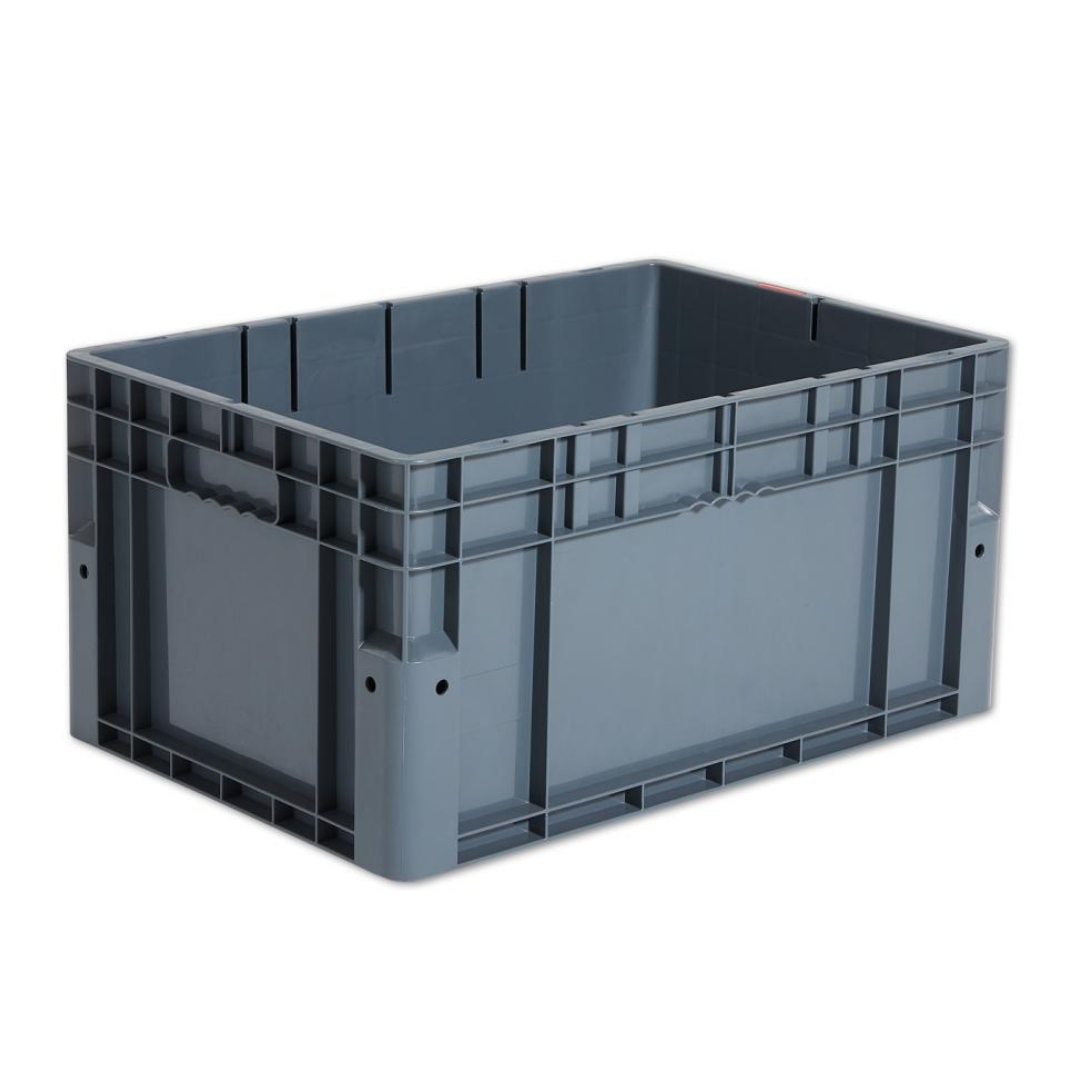
| ASRS wall-straight and foldable crates | TSS-IFC, TSS-IFD | 600 × 400 × 300 mm | Warehouse automation / ASRS |
| Reusable plastic totes | TSS | 600–800 mm length × 400–600 mm width × 128–400 mm height | Warehouse automation |
| Returnable produce and logistics containers | TSS-SFD, TSS-RBTB, TSS-TBX | 600 × 400 × 225 mm; 600 × 400 × 300 mm; 600 × 400 × 320 mm | Retail, supermarket, fruit and vegetable transportation; logistics and transportation |
| Small-part bins and handling dollies | TSS-BBOX-01, TSS-Trolley-02, TSS-Trolley-5737 | 604 × 398 × 208 mm; 577 × 377 mm; 570 × 370 mm | Footwear and spare parts storage; internal transport |
Every model listed above is published as polypropylene (PP). Future Market Insights expects PP to lead the material segment for plastic crates with a 41.4% share by 2025 — a figure that matters less for its size than for what it implies: PP is the material the surrounding automation ecosystem, cleaning regimes and return loops are already built around.
Step 1 — define the transport loop before the container
The first constraint is not the tote but the journey. A container circulating between a distribution centre and a retail store comes back empty; a container shipped on a one-way export may never return. TSS publishes its ASRS foldable crates with a design target of reducing empty storage volume by up to 70–80%, and its collapsible crate TSS-SFD is listed for retail, supermarket and fruit and vegetable transportation, where return legs are routine. If the loop is not closed, foldable and nestable geometry delivers far less value, and that should be established before sampling rather than after.
Step 2 — read the dimensions as system data, not as storage data
The 600 × 400 mm module recurs across the range: TSS-IFC and TSS-IFD at 600 × 400 × 300 mm, TSS-RBTB at 600 × 400 × 300 mm, TSS-TBX at 600 × 400 × 320 mm and TSS-SFD at 600 × 400 × 225 mm. Height is the variable most buyers actually tune — from 225 mm for a low-profile crate to 320 mm for an attached-lid tote.
The reusable tote family is published as a range rather than a single size: 600–800 mm long, 400–600 mm wide and 128–400 mm high. That gives length and height options inside one handling family, but it also means the footprint must be confirmed per line item rather than per family.
One published dimension deserves attention before it reaches a lane. TSS-BBOX-01 measures 604 × 398 × 208 mm. Its width sits inside the 400 mm module; its length of 604 mm does not sit inside the 600 mm nominal figure used by the other containers in this range. On a 600 × 400 mm conveyor lane, four millimetres is exactly the kind of value that should be checked against guide rail clearance, sensor positions and lane transitions with the systems integrator — not assumed acceptable because the family “looks standard”.
Step 3 — match the handling accessory to the container base
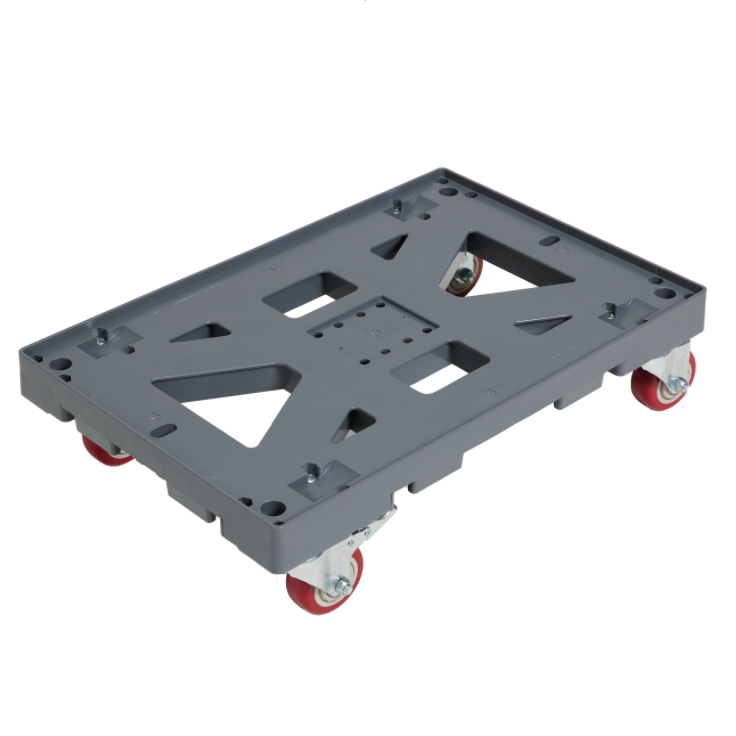
Dollies are usually the last item added to a plastic tote order and the first item to cause friction on the floor. TSS-Trolley-02 is designated a heavy type nested and stackable tote dolly, published at 577 × 377 mm; TSS-Trolley-5737 is designated a light type, published at 570 × 370 mm. Both are made of PP and intended for logistics and transportation environments. Both footprints sit below the 600 × 400 mm module, which leaves a mechanical margin between the dolly platform and the underside of a container. Whether that margin helps loading or allows movement in transit depends on the container base geometry, so the pairing should be confirmed model by model rather than inferred from nominal figures.
The dolly application profile for TSS-Trolley-02 documents the operating modes that determine fleet sizing: single-dolly operation for one tote or crate; linked operation, where multiple dollies are connected with interlocking clips to create a larger transport platform; and train towing, where several linked dollies are pulled together for bulk movement. The same profile lists handling compatibility with ASRS totes, attached-lid containers, stack-nest crates, foldable crates, Euro containers, plastic totes and cartons, and notes requirements such as smooth mobility under high-frequency daily use, quiet wheel operation for retail environments, and heavy-duty load capacity for industrial use. Those operating requirements — not the platform dimensions alone — decide which of the two dollies belongs on a given route.
Step 4 — confirm documentation scope, not just material type
Polypropylene is the common answer across this range, but documentation is where buyers get caught. The Food Contact Material Test Certificate SY2025092412 was issued by the Henan Institute of Product Quality Inspection Technology on 24 September 2025, with an expiry date of 24 September 2099, under the standard for plastic materials and products for food contact. The scope of the report is a plastic folding basket for food contact use, and the applicable market is China.
The certificate is associated with a defined model set: TSS-TBX (stackable plastic tote, product 6037), TSS-SFD (collapsible plastic crate, product 6039), TSS-RBTB (nested and stackable plastic crates, product 6038), the TSS reusable plastic tote (product 5072), TSS-IFC (ASRS wall straight plastic crate, product 6036) and TSS-IFD (ASRS foldable plastic crate, product 6035). A second document, SY2025092415, covers a food-contact plastic tilting turnover box under the same standard and the same issuing authority.
For buyers placing these containers outside China, the practical reading is narrow and important: the reports above establish food-contact compliance for the China market. Deployments in the EU, North America or other regions must be mapped against the applicable local framework through the buyer’s own compliance process — for example EN 13117-1:2000, the European standard for reusable, rigid plastics distribution boxes used in handling, transport and storage.
Step 5 — agree acceptance criteria before tooling, not after
Automation projects rarely fail on appearance; they fail on tolerances. The TSS automation support capability documents the verification steps applied to automated-container projects: conveyor testing, robot handling verification, load testing, stacking testing and automation simulation, alongside in-process inspection, final inspection and outgoing inspection, with 100% visual inspection for customized products and barcode and RFID verification. Tooling-level verification is documented separately as mold flow analysis, dimensional verification, trial run validation at T0/T1/T2 sampling stages, and CPK and tolerance verification.
From those existing processes, a buyer can assemble an acceptance checklist without inventing anything:
- nominal dimensions and tolerances per model, verified against approved drawings;
- static and dynamic load test results;
- drop test results;
- stacking tests at the intended load and stacking height;
- conveyor and robot handling verification against the buyer’s handling parameters;
- barcode or RFID read verification where automated identification is used;
- defined T0/T1/T2 sampling sign-off points before mass production;
- an agreed AQL level, with third-party inspection where required.
The TSS quality assurance capability lists incoming material inspection (IQC), in-process quality control (IPQC), final quality control (FQC) and outgoing quality control (OQC) as standing processes, with customer-specific inspection standards, AQL requirements, third-party inspection and custom test reports available.
Application scenarios: which model answers which problem
Goods-to-person ASRS and AMR fulfilment
TSS-IFC and TSS-IFD are both published at 600 × 400 × 300 mm in PP for warehouse automation and ASRS scenarios. Case records for deployments with a global warehouse automation and cube storage solution provider, and separately with a global AMR solution provider, each describe 450,000 units supplied over one year, applied in automated storage and retrieval, goods-to-person picking, inventory buffering and robotic handling.
Retail and fresh produce loops
TSS-SFD is a collapsible crate at 600 × 400 × 225 mm for retail, supermarket and fruit and vegetable transportation, and TSS-RBTB is a nest and stack crate at 600 × 400 × 300 mm for the same sector. TSS-SFD folds when empty; TSS-RBTB uses nest-and-stack geometry, where containers rotate into a stacking position when loaded and nest when empty to reduce return volume.
Small parts, footwear and spare parts storage
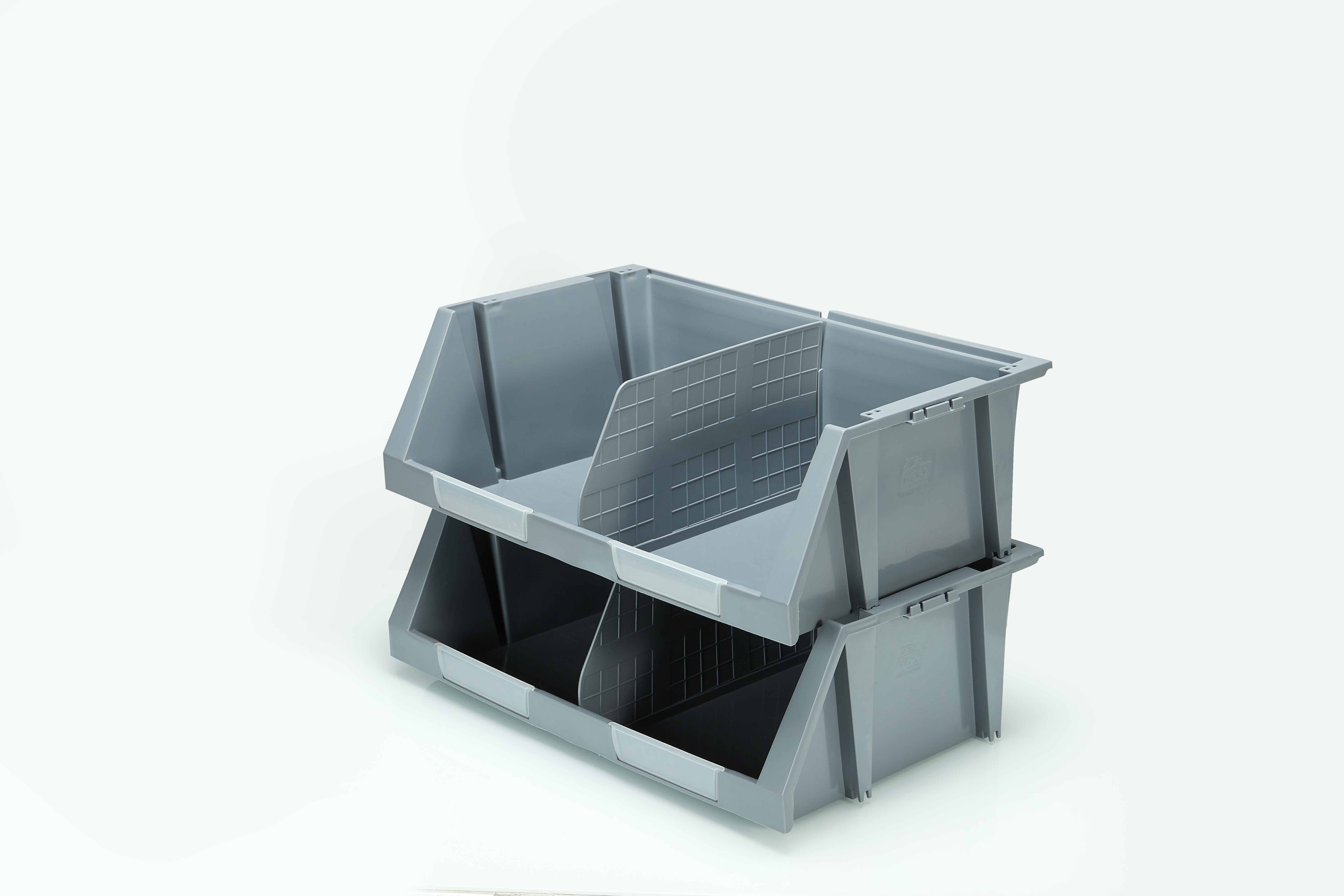
TSS-BBOX-01 is a stackable bin at 604 × 398 × 208 mm with panels and dividers, listed for footwear and spare parts storage. Its bin-level application profile covers small parts storage, order picking, line-side material supply and kanban two-bin or multi-bin replenishment, and notes compatibility with industrial shelving, flow racks, picking carts and mobile trolleys.
Internal transport and picking
The two dollies serve the movement layer: TSS-Trolley-02 for heavier internal transport and TSS-Trolley-5737 for lighter routes, both with nested and stackable geometry for empty storage between shifts.
Where reusable plastic containers are not the right answer
Reusable PP containers earn their cost back through repeat cycles, and that condition is not universal. In one-way export flows, in short programmes that will not be repeated, and in projects where return freight costs more than the container itself, foldable and nestable geometry cannot recover the investment. Foldable designs also introduce hinge and locking features that need their own validation, and dimensional accuracy must be re-verified as production runs scale rather than assumed from a single approved sample.
Documentation scope is a second boundary. The food-contact inspection reports referenced here are tied to the China market; they are not a substitute for regional compliance work. A buyer planning a multi-region rollout should treat documentation mapping as a separate workstream with its own timeline, budget and evidence requirements.
Procurement terms buyers typically need in writing
| Parameter | Published figure |
|---|---|
| Engineering review | 5–10 working days |
| Sample production | 7–15 working days |
| Mass production | 15–30 working days |
| New tooling, where required | 30–60 working days |
| MOQ, existing products | 100–500 pcs |
| MOQ, customized products | 500–2,000 pcs (customized automation items from 500 pcs) |
| MOQ, RFID and smart logistics projects | 1,000 pcs |
| MOQ, project programmes | from 1 × 40 ft container |
| Incoterms supported | EXW / FOB / CIF / DDP |
| Warranty response | Initial response within 24 hours; corrective action report within 3–5 working days |
These figures come from published OEM, engineering and key account capability statements rather than from a quotation, so they should be read as planning ranges. The after-sales terms are more specific: a dedicated OEM project manager, production progress updates, product traceability, replacement for verified manufacturing defects, and continuous supply planning for long-term programmes.
Capacity and deployment evidence
Shanghai Xinfan Industrial Corporation (TSS) was founded in 2003 and operates a 40,000 m² factory with 320 employees, 25 engineers and an annual output of 3,600,000 units, with 70% of output exported to markets including the EU, North America, South America, Southeast Asia, the Middle East and Africa. Published monthly capacity for plastic containers and totes is 300,000–500,000 units, with flexible allocation for large-volume OEM projects. For buyers, capacity figures matter mainly as a check on whether a returnable fleet of several hundred thousand units can be replenished to the same specification years later — which is the point at which tooling retention and mould maintenance stop being manufacturing details and become procurement questions.
Market signals shaping the next specification cycle
Three signals are worth tracking. Asia Pacific dominated the global plastic pallets, crates and boxes market with a 41.6% revenue share in 2025, according to Grand View Research, which keeps regional supply and tooling concentration high. Precedence Research attributes rapid growth in the mini-load ASRS segment to demand for fast retrieval of small parts, totes and bins in e-commerce — the segment where dimensional tolerance is least forgiving. And reusable plastic container adoption in fresh produce, illustrated by the Walmart and IFCO partnership, is described by Grand View Research as a major industry trend, which pulls food-contact documentation into mainstream procurement checklists rather than specialist ones.
The competitive benchmark set is also well defined: established returnable packaging players include Brambles (CHEP), Schoeller Allibert, ORBIS Corporation and Myers Industries, per Market Research Future. Buyers comparing suppliers should compare them on the same four axes — tooling and dimensional control, documentation portability, capacity continuity, and accessory integration — rather than on catalogue breadth.
Future outlook
The direction of travel is toward containers specified as system components. Three developments are likely to shape buyer checklists over the next specification cycles: tighter dimensional expectations as mini-load and cube storage penetration increases; documentation portability across markets becoming a scored criterion rather than a footnote; and accessory-level integration — dollies, dividers, RFID and gripping features — being evaluated together with the container instead of afterwards. Buyers who request tolerance data, sampling sign-off and documentation scope at the request-for-quotation stage generally spend less time resolving integration issues at commissioning.
FAQ
What should a buyer check first when selecting plastic totes for an ASRS installation?
Start with the handling interface rather than the volume. The published TSS range shows how much that data varies: TSS-IFC and TSS-IFD are both 600 × 400 × 300 mm in PP for warehouse automation, while the reusable tote family is published at 600–800 mm long, 400–600 mm wide and 128–400 mm high. Confirm footprint, height, base structure and dimensional tolerance against the conveyor, shuttle lane and robot gripper before comparing price or internal capacity.
What is the difference between TSS-Trolley-02 and TSS-Trolley-5737?
Both are nested and stackable tote dollies made of PP for logistics and transportation. TSS-Trolley-02 is designated heavy type with a footprint of 577 × 377 mm; TSS-Trolley-5737 is designated light type with a footprint of 570 × 370 mm. The TSS-Trolley-02 application profile describes single-dolly use, linked operation through interlocking clips, and train towing of multiple linked dollies. Because both dolly footprints are smaller than the 600 × 400 mm module, the container-to-dolly pairing should be confirmed against the specific container model.
Which models carry food-contact documentation, and in which market does it apply?
Food Contact Material Test Certificate SY2025092412 was issued by the Henan Institute of Product Quality Inspection Technology on 24 September 2025 under the standard for plastic materials and products for food contact, with the report scope of a plastic folding basket for food contact use. It is associated with TSS-TBX, TSS-SFD, TSS-RBTB, the TSS reusable plastic tote, TSS-IFC and TSS-IFD. A second report, SY2025092415, covers a food-contact plastic tilting turnover box. The applicable market for these documents is China; placements in other regions require mapping to their own frameworks, such as EN 13117-1:2000 in Europe.
What acceptance criteria should be agreed before mass production?
Dimensional and tolerance verification against approved drawings, T0/T1/T2 sampling sign-off, CPK and tolerance verification, static and dynamic load testing, drop testing, stacking testing at the intended load, conveyor and robot handling verification, barcode or RFID read verification, and a defined AQL with third-party inspection where needed. TSS lists IQC, IPQC, FQC and OQC as standing processes, with 100% visual inspection for customized products.
What MOQ and lead times apply to customized plastic totes?
Published MOQ is 100–500 pcs for existing products, 500–2,000 pcs for customized products with customized automation items from 500 pcs, and 1,000 pcs for RFID and smart logistics projects; project programmes can be structured from a 1 × 40 ft container minimum, and new development projects are negotiable. Typical lead times are 5–10 working days for engineering review, 7–15 working days for sample production, 15–30 working days for mass production, and 30–60 working days for new tooling where required. Supported Incoterms include EXW, FOB, CIF and DDP.
Working documents for a tote decision file
A condensed view of the TSS logistics container range, including material and handling details, is available in the corporate profile and logistics container solutions brochure: TSS Corporate Profile & Logistics Container Solutions (PDF). Buyers evaluating a fleet should pair that document with their own lane drawings, compliance requirements and acceptance criteria, since neither the brochure nor this framework replaces project-specific verification.