
Plastic Trigger Sprayer Selection: Thread, Material and Compliance Constraints
Plastic Trigger Sprayer Selection: Thread, Material and Compliance Constraints
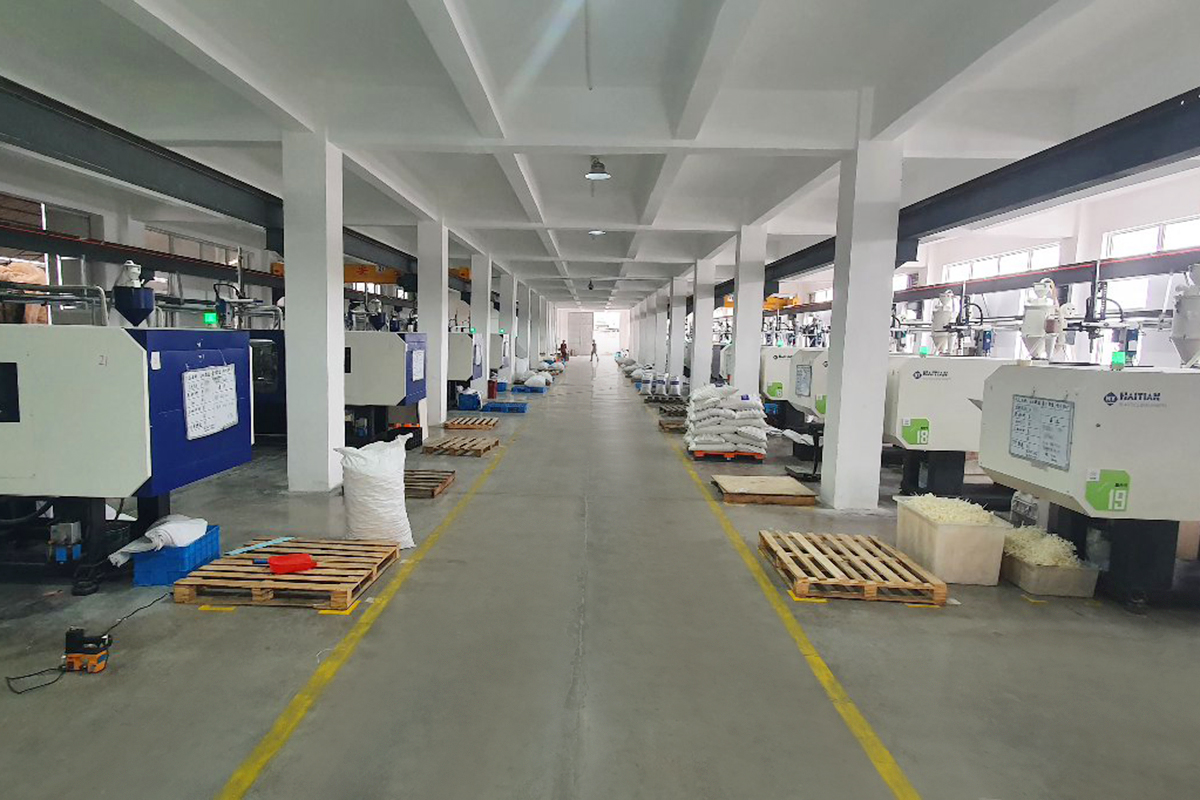
Plastic trigger sprayer production begins at the tooling and injection stage, where thread finish, polymer grade and spring-free construction are fixed. Image: in-house injection molding workshop, Zhejiang Mila Plastic Industry Co., Ltd.
A trigger sprayer is rarely the most expensive part of a cleaning product, but it is frequently the part that decides whether the pack reaches the shelf at all. Global demand for trigger sprayers was valued at USD 491.8 million in 2025 by Fortune Business Insights, and the same source projects a compound annual growth rate of 4.7% between 2026 and 2034. In a category growing at that pace, most incremental volume will be won on specification discipline — thread finish, polymer choice, spring construction, recycling compliance — rather than on new spray concepts.
Zhejiang Mila Plastic Industry Co., Ltd. is a Quzhou, Zhejiang-based manufacturer of household-care dispensing closures, established in 2018, whose range covers plastic trigger sprayers, perfume pumps, lotion pumps and foam pumps, along with related nozzles. Between 70% and 80% of its output is exported, and annual production exceeds 600 million pieces. Publicly listed company profile data places annual sales in the USD 50–53 million range. That scale sits behind a simple buyer question: which constraint decides which sprayer to specify?
The constraint layer: where plastic trigger sprayer projects actually fail
Procurement teams rarely lose time on the discovery question — what a trigger sprayer is — and lose a great deal of time on the constraint question. The documented application risks for this product category fall into three families:
- Liquid leakage, usually traced to a closure that does not match the bottle neck, or to a seal that was never validated on the production filling line.
- Chemical incompatibility with the filled liquid, including formulations that attack internal components never specified for that chemistry.
- Thread size mismatch between sprayer and bottle — the most common specification error and the easiest to avoid.
The mitigation path is procedural rather than technical: confirm the bottle thread size before ordering, run a chemical compatibility test with the actual liquid, and complete sample pre-testing before mass production. Buyers who skip these steps tend to discover the problem during filling, when the cost of a wrong decision is measured in pallets rather than in samples.
Two further constraints sit outside the sprayer itself. The first is regulatory: plastic packaging placed on the European market now operates under the Packaging and Packaging Waste Regulation (PPWR), adopted in April 2024, which mandates 30% recycled content in plastic packaging by 2030. The second is commercial: minimum order quantity, tooling ownership and lead time determine whether a specified design can actually be supplied at the buyer's cadence — a design that cannot be produced on schedule is not a valid specification, however well it performs in a sample bottle.
Thread finish: why 28/400 and 28/410 decide the whole project
Both 28/400 and 28/410 describe a nominal 28 mm neck with different thread-finish specifications, and the two are not interchangeable on a filling line without verification. Industry technical material published by Houweling Group identifies 28/410 as the most commonly used opening for trigger sprayers, which makes it the default assumption in many packaging briefs — and the reason many mismatches happen, because "most common" is not the same as "the neck on your bottle."
Every plastic trigger sprayer in the range described here is built for both finishes: the thread size is 28/400 and 28/410, and the closures are compatible with 28/400 bottle necks and 28/410 bottle necks. Practically, that removes a tooling change from the buyer's critical path when a brand runs the same formula in two bottle formats, or when a private-label programme migrates between bottle suppliers mid-season.
Material and spring construction: PP, chemical resistance and the rust question
Polypropylene (PP) is the primary material across this plastic trigger sprayer range, selected for chemical resistance to various cleaning agents. That single material decision drives three separate outcomes:
- Compatibility with the filled product. The sprayers are intended for household cleaners, bathroom cleaners, glass cleaners and car care products, and are designed for chemical and daily-use chemical applications. Highly corrosive formulations still require pre-testing on the buyer's own liquid before a mass-production commitment.
- Corrosion of internal parts. The all-plastic models use a full-plastic structure without a metal spring, which removes the rust risk that a metal spring introduces when it sits in permanent contact with a corrosive liquid. Non-full-plastic versions include accessories made of other materials and remain the appropriate choice where a metal spring is acceptable.
- End-of-life handling. The all-plastic models use a mono-material PP construction and are designed as a mono-material construction for recycling; the mono-material design is what makes the product a recyclable plastic trigger sprayer rather than a mixed-material closure that must be separated before processing.
The distinction between "all-plastic" and "plastic" is where most non-technical briefs lose precision. Only the models specified as all-plastic carry the full-plastic, spring-free construction; the remaining models use PP as the primary material with other internal components. A buyer writing "all-plastic trigger sprayer" onto a purchase specification without checking which models carry that construction is creating an avoidable deviation that will surface at goods-in inspection.
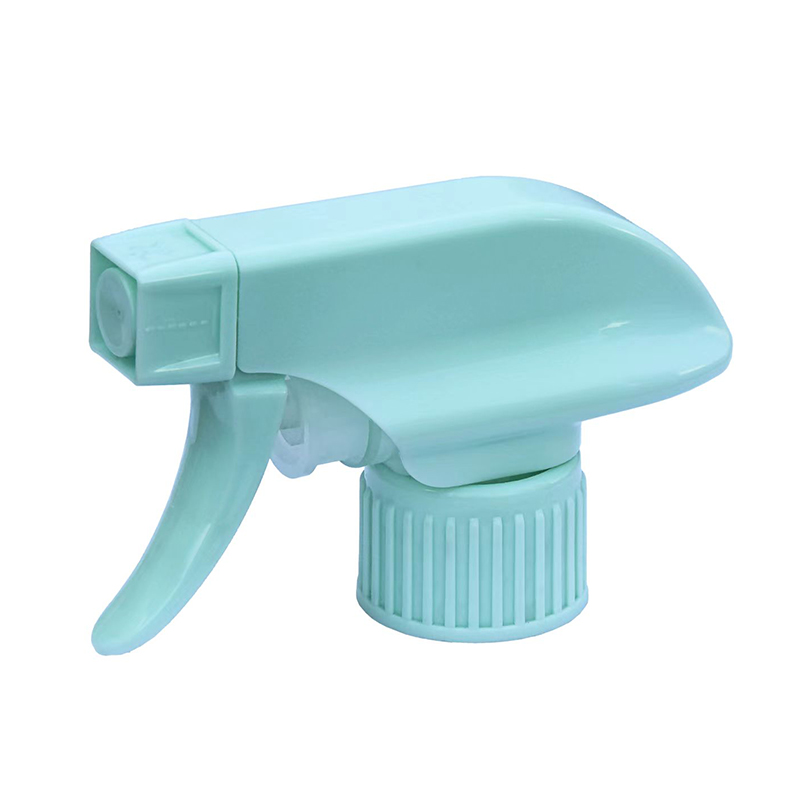
Model ML-101G2: all-plastic single cover mist trigger sprayer, 28/400 and 28/410 thread sizes, mono-material PP construction designed for recycling.
Spray function: mist and foam are formulation decisions, not preferences
The second functional constraint is output type. A mist spray trigger delivers a fine and uniform mist and suits glass and window cleaners, surface disinfectants and light-duty sprays. A foam spray trigger delivers stable foam output with rich, uniform foam and suits kitchen degreasers, bathroom cleaners and any formulation where dwell time on a vertical surface determines performance.
The range therefore splits by function as well as by structure. Four of the ten models deliver mist output; six deliver foam output. Specification guidance published in the supplier's own application material matches common industry practice: select a spray-type trigger for general cleaning liquid, and a foam-type trigger for detergents where rich foam is part of the product promise. Both variants share the same thread options, the same hand-press trigger operation and the same PP material base.
What compliance actually requires for trigger sprayer packaging
A frequent procurement assumption is that a plastic trigger sprayer carries a mandatory product certification in the way a pressure vessel or an electrical component does. In practice, no mandatory industry certification applies to this product category. The applicable requirements are general plastic packaging requirements covering plastic material safety, leak-proof performance, thread size compatibility with 28/400 and 28/410 finishes, and chemical compatibility with common household detergents.
Compliance evidence therefore has to be assembled from three different layers, and buyers should request each separately rather than accepting a single "certified" statement:
| Layer | What it covers | Evidence to request |
|---|---|---|
| Product level | Material safety, leak-proof performance, thread compatibility, chemical compatibility with common detergents | General plastic packaging requirement statement; leak and thread compatibility confirmation |
| Management-system level | Manufacturing consistency and environmental management | ISO 9001:2015 and ISO 14001:2015 certificates; SGS compliance documentation |
| Design level | Structural features claimed as protected | Utility model patent certificates with numbers, issuing authority and validity dates |
Zhejiang Mila Plastic Industry holds ISO 9001:2015 and ISO 14001:2015 certifications and SGS compliance documentation at the management-system level. At the design level, the company holds utility model patents granted by the China National Intellectual Property Administration (CNIPA) covering specific trigger sprayer structures:
| Patent number | Scope | Issued | Valid until |
|---|---|---|---|
| ZL202321149508.9 | All-plastic trigger sprayer | 2023-11-28 | 2033-05-15 |
| ZL202321149516.3 | Lockable trigger sprayer | 2023-09-08 | 2033-05-15 |
| ZL202321038643.6 | Adjustable angle trigger sprayer | 2023-09-12 | 2033-05-05 |
| ZL202321038645.5 | Locking function trigger sprayer | 2023-11-28 | 2033-05-05 |
| ZL 202321349188.1 | Nozzle protection structure | 2023-11-28 | 2033-05-31 |
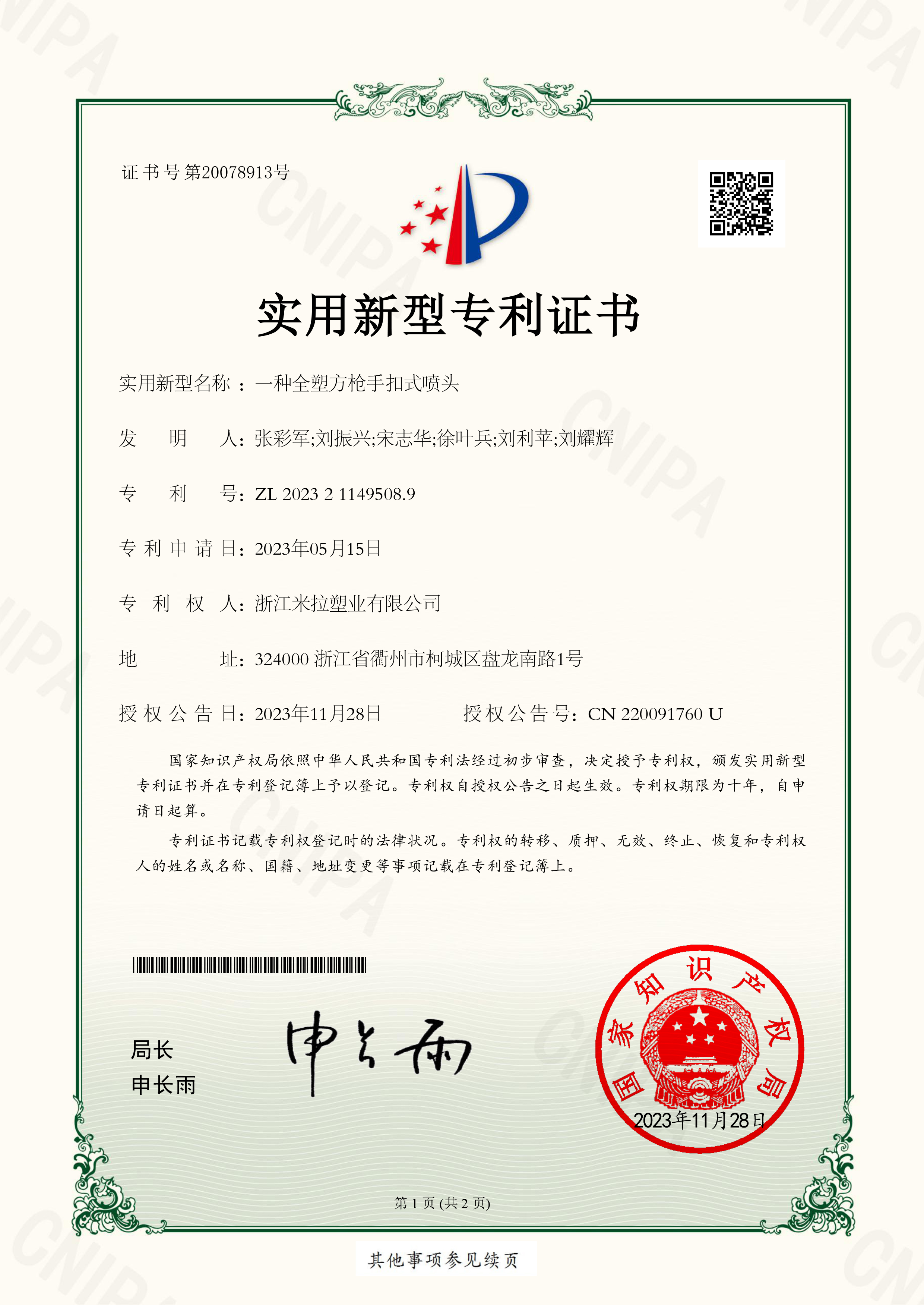
Utility Model Patent Certificate ZL202321149508.9, issued by the China National Intellectual Property Administration for the all-plastic trigger sprayer structure (ML-101G1, ML-101G2, ML-102B1, ML-102B2).
One boundary matters here. These are utility model patents granted for the China market. They are evidence of design activity and of structural protection in that jurisdiction; they are not a substitute for a freedom-to-operate review in the buyer's own market, which remains the buyer's responsibility. Buyers who need design protection in other territories should treat the certificates as a starting point for discussion rather than as a complete answer.
How the plastic trigger sprayer range is structured
The range described here comprises ten plastic trigger sprayer models, all built around the 28/400 and 28/410 thread finishes with PP as the primary material, differentiated by structure, cover type and spray output:
| Model | Type | Spray output | Outer cap | Primary material |
|---|---|---|---|---|
| ML-101G1 | All-plastic | Foam | Single cover | PP |
| ML-101G2 | All-plastic | Mist | Single cover | PP |
| ML-102B1 | All-plastic | Foam | Double cover | PP |
| ML-102B2 | All-plastic | Mist | Double cover | PP |
| ML-103C1 | Plastic | Mist | Standard | PP |
| ML-201B1 | Plastic | Foam | Standard | PP |
| ML-201B2 | Plastic | Mist | Standard | PP |
| ML-202D1 | Plastic | Foam | Standard | PP |
| ML-203H1 | Plastic | Foam | Standard | PP |
| ML-204Z1 | Plastic | Foam | Standard | PP |
All ten models support bulk order and OEM customized color, and the product records cite a comfortable trigger hand-press design and good chemical resistance across the range. On the supply side, the company's stated capability parameters are:
| Parameter | Stated value |
|---|---|
| Production mode | OEM / ODM |
| Customization | Color / Logo / Caliber |
| Monthly capacity | 10,000,000 pieces |
| Lead time | 7 days |
| MOQ | 50,000 pieces |
| Quality control | 100% test |
| After-sales | Returns or exchanges supported where a large number of products in a batch show non-human quality problems |
For a buyer in the research-to-evaluation stage, the MOQ and the 7-day lead-time figure are the two parameters that most often decide whether a supplier can be used at all. The 100% test claim is the one to verify during a factory audit, because it is a process statement rather than a certificate, and process statements are exactly what audits exist to check.
Where these sprayers are used, and what a repeat-order case looks like
The application profile is concentrated. Typical uses are household kitchen degreasers, bathroom and toilet cleaners, glass and window cleaners, and car care and auto detailing products, spanning the household cleaning industry, commercial cleaning and janitorial service, the auto care and car detailing industry, the pet supplies industry, and the chemical and daily-use chemical industry. Working conditions are normal temperature, indoor and outdoor use, with chemical resistance, corrosion resistance, leak-proof performance and plastic construction listed as the special requirements. Documented market coverage for these applications includes countries across South America, Western Europe, Eastern Europe, East Asia, Southeast Asia, the Middle East, Africa and Oceania.
A representative supply case shows what constraint fit looks like in practice. A trading company and finished-goods packaging manufacturer in Egypt ordered 5,000,000 pieces of the ML-101G2 all-plastic mist trigger sprayer for finished-product packaging. The stated service life in application is 2–5 years of reuse, and the reported outcome is stable product quality, satisfied customer feedback and repeated continuous orders, with reliable quality and stable supply capacity cited as the highlights. The useful buyer lesson is narrower than the headline: the model chosen was the mist-output all-plastic version, matching both the filling chemistry and the single-cover format the customer's bottle line required.
Market trend analysis: growth, regulation and one data caveat
Three trends are visible in the published data around this category.
Modest but steady volume growth. The global trigger sprayer market was valued at USD 491.8 million in 2025, with a projected 4.7% CAGR from 2026 to 2034, according to Fortune Business Insights. A second research house, Future Market Insights, reports a 4.2% CAGR over 2026–2036, a difference likely explained by scope, since the broader figure appears to include industrial dispensing systems. For buyers, the practical implication is that capacity rather than demand will differentiate suppliers over the next cycle.
Recycled content is moving from marketing to obligation. The EU Packaging and Packaging Waste Regulation, adopted in April 2024, mandates 30% recycled content in plastic packaging by 2030. Because a trigger sprayer is a multi-part assembly, mono-material construction is the design lever that makes recycled-content claims defensible: a spring-free, all-PP sprayer can be processed as a single material stream, while a mixed-material closure cannot.
Classification is part of the constraint set. Trigger sprayers travel under HS code 392350 — stoppered, lidded, capped and other closures, of plastics — meaning customs documentation for a sprayer shipment is filed at the level of the closure category rather than under a dedicated sprayer heading. Buyers comparing landed cost across origins should expect the same tariff line to apply to trigger sprayers and to unrelated plastic closures, and should plan duty modelling accordingly.
Comparison: all-plastic and patented designs versus conventional trigger sprayers
"Patented" and "all-plastic" are frequently treated as automatic upgrades. They are not. They are constraint choices with different trade-offs, and the trade-offs run in both directions.
| Dimension | Conventional trigger sprayer | All-plastic / patented construction |
|---|---|---|
| Internal spring | Metal spring, or accessories in other materials | Full-plastic structure without a metal spring (all-plastic models) |
| Corrosion behaviour | Metal components can rust during prolonged contact with corrosive liquids | Removes the metal-spring rust pathway |
| Material stream | Mixed materials; separation needed before recycling | Mono-material PP, designed as a mono-material construction for recycling |
| Sealing and reliability | Adequate for general projects with lower requirements | Improved anti-leak sealing structure and optimised internal structure for long-term use |
| Best fit | General projects where requirements are low | Applications needing leak-proof, stable performance over a long service life |
| Specification burden | Lower specification effort | Higher specification effort; all-plastic construction and thread finish must be confirmed explicitly |
Three limitations deserve equal visibility alongside the advantages.
- All-plastic is not universally better. Supplier guidance is explicit that a patented trigger sprayer is the right choice where leak-proof, stable performance is required, while a traditional trigger sprayer remains appropriate for general projects with lower requirements. Specifying the all-plastic structure into an application that does not need it adds cost without adding function.
- Chemical resistance is not unlimited. PP provides chemical resistance to various cleaning agents, but highly corrosive fluids require pre-testing on the actual formulation. No material statement replaces that test, and the responsibility for running it sits with the buyer who knows the final formula.
- The published record contains a comparison gap. A like-for-like technical comparison between this supplier and large global closure groups — for example on mould lifecycle or automation efficiency — cannot be built from public information at present. Any such claim should be treated as unsupported until supplier-specific production data is available.
Future outlook
The next specification cycle for plastic trigger sprayers will be shaped less by spray mechanics than by material accounting. If the 30% recycled-content requirement in the EU PPWR holds for 2030, mono-material, spring-free construction stops being a differentiator and becomes a baseline for any brand selling cleaning products into Europe. Suppliers that already build the all-plastic variant, and that can document the design protection behind it, will face a shorter qualification path than suppliers that still have to redesign a mixed-material closure.
The second shift is documentation. As buyers move from researching suppliers to evaluating them, the request is increasingly for evidence rather than claims: management-system certificates, patent numbers with issuing authority and validity dates, capacity and lead-time figures, and process statements such as 100% testing that can be verified on site. For a Chinese manufacturer exporting between 70% and 80% of output across South America, Western Europe, Eastern Europe, East Asia, Southeast Asia, the Middle East, Africa and Oceania, that evidence layer is what converts a specification into a repeat order — and what allows a buyer to defend the specification internally six months later.
Frequently asked questions
What thread sizes do plastic trigger sprayers use, and how do I confirm the right one?The standard thread sizes are 28/400 and 28/410, and sprayers in this range are compatible with both bottle neck finishes. Industry technical material identifies 28/410 as the most commonly used opening for trigger sprayers. To confirm the right size, check the physical bottle neck rather than a previous project's drawing, because a thread mismatch is one of the three most common application risks for this product category.
What is the difference between a mist trigger sprayer and a foam trigger sprayer?The difference is output type. A mist (spray) trigger produces a fine, uniform mist and is used for glass and window cleaners and general light-duty sprays. A foam trigger produces stable, rich and uniform foam and is used for detergents such as kitchen degreasers and bathroom cleaners, where foam dwell time matters. Selection guidance is straightforward: choose spray type for general cleaning liquid, and foam type for detergents requiring a rich foam.
Which liquids are suitable for PP trigger sprayers?PP trigger sprayers are suitable for household detergents, cleaning agents and car care fluids. They are intended for household cleaners, bathroom cleaners, glass cleaners and car care products, and are designed for chemical and daily-use chemical applications. For highly corrosive fluids, chemical compatibility pre-testing with the actual formulation is recommended before a bulk order is placed.
What problems can occur during trigger sprayer application, and how are they avoided?The documented risks are liquid leakage, chemical incompatibility between the closure and the filled liquid, and thread size mismatch with the bottle. The usual triggers are a closure matched to the wrong bottle, use with a strongly corrosive liquid without pre-testing, and an incorrect thread specification. Mitigation is procedural: confirm the bottle thread size (28/400 or 28/410) before ordering, run a chemical compatibility test with the actual liquid, and complete sample pre-testing before mass production.
Does trigger sprayer packaging require mandatory certification?No mandatory industry certification applies to this product category. The relevant requirements are general plastic packaging requirements: plastic material safety, leak-proof performance, thread size compatibility with 28/400 and 28/410 finishes, and chemical compatibility with common household detergents. Documentation is instead assembled from management-system certificates such as ISO 9001:2015 and ISO 14001:2015, and from design-level records such as utility model patent certificates issued by the China National Intellectual Property Administration.
Can samples be tested before a bulk order?Yes. Sample testing can be conducted before bulk orders, and supplier guidance recommends sample pre-testing before mass production, particularly where the filled liquid is aggressive or where the bottle neck finish has not yet been confirmed against a physical sample.
How does a patented or all-plastic trigger sprayer compare with a conventional trigger sprayer?The patented construction is described as having a better anti-leak sealing structure, an optimised internal structure and higher reliability for long-term use. The all-plastic versions add a full-plastic structure without a metal spring and a mono-material PP construction designed for recycling. Conventional trigger sprayers, including versions with accessories in other materials, remain appropriate for general projects with lower requirements. The choice is therefore a decision about leak-proof performance and recyclability requirements, not a universal ranking.
What production parameters should be confirmed before placing a trigger sprayer order?Confirm thread size (28/400 or 28/410), spray function (mist or foam), material construction (all-plastic versus PP with other internal components), and chemical compatibility with the filled liquid. On the supply side, stated parameters include OEM/ODM production, customization of color, logo and caliber, a monthly capacity of 10,000,000 pieces, a stated lead time of 7 days, a minimum order quantity of 50,000 pieces, and 100% testing. Buyers should treat the testing claim and the capacity figure as items to verify during supplier evaluation rather than as settled facts.
Company data in this article is drawn from Zhejiang Mila Plastic Industry Co., Ltd. product, capability, certification and case records. Market and regulatory figures are attributed to their published sources, and readers should confirm the scope and currency of third-party estimates before relying on them in a business case.