
Polyester Mesh Belt Compliance Evidence: BV/SGS Inspection and 100% Pre-Shipment Checks
For most polyester mesh belt orders, the gap between what a buyer asks for and what a supplier can actually produce as evidence is a documentation gap, not a quality gap. Open-mesh polyester belts are classified in international trade under HS Code 5911.90 — textile products and articles for technical uses — and they sit outside ISO 14890, which governs rubber- or plastics-covered conveyor belts with textile carcasses. That single distinction explains why a request for an "ISO 14890 certificate" on an open mesh belt often goes unanswered, and why the verification conversation has to be rebuilt around documents and inspections that genuinely exist.
What a buyer can realistically verify for a polyester mesh belt order falls into three layers: entity and facility documents, product-type test and registration records, and order-level acceptance evidence — a 100% pre-shipment inspection, plus an on-site third-party inspection by BV or SGS when the buyer requires one. Only the third layer speaks about the specific belt that is about to be loaded.
Why the compliance conversation moved from certificates to evidence
Polyester is the leading material segment in the global conveyor belt market, holding a 28.4% revenue share in 2025 according to Straits Research. The same publisher projects the overall conveyor belt market growing from USD 6.24 billion in 2026 to USD 8.53 billion by 2034. Downstream, Grand View Research estimates that belt filter press technology — a direct application area for polyester filter and dewatering belts — will grow at a compound annual growth rate of 8.8% between 2025 and 2033.
Volume at that scale changes procurement behaviour. When mesh belts move from a relationship purchase to a repeated line item, buyers stop accepting reassurance and start asking for a file they can attach to a purchase order. The practical difficulty is that "compliance" means different things at each stage of that file, and suppliers are frequently asked to provide the wrong document for the right question.
The three layers of verifiable evidence
Separating the layers prevents the most common misunderstanding in mesh belt procurement — treating a facility document as if it certified a shipment.
| Evidence layer | Typical document | What it confirms | What it does not confirm |
|---|---|---|---|
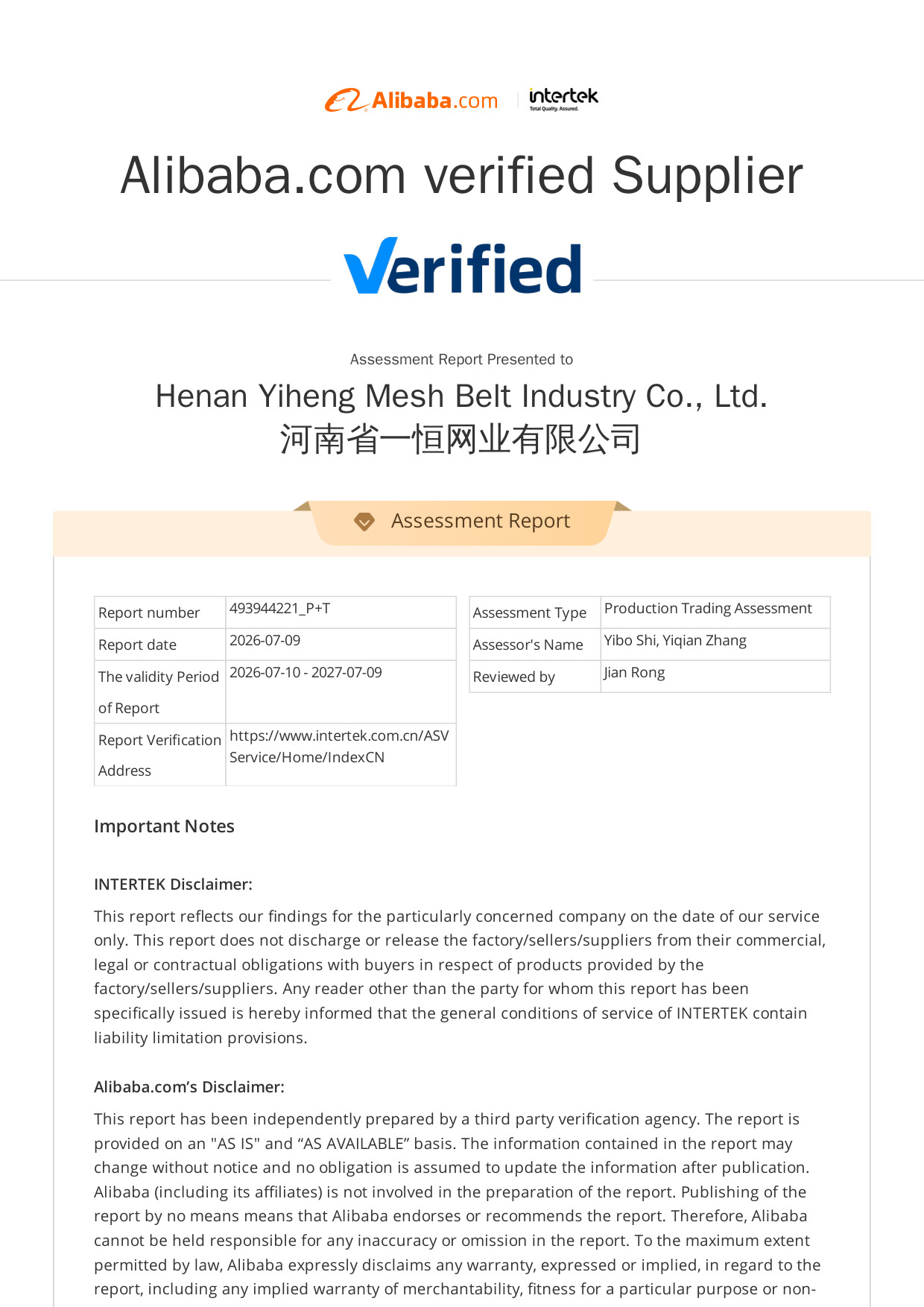
| Entity / facility | Verified Supplier Assessment Report carried out by INTERTEK | An independent body assessed the supplier as a production and trading entity for a defined product scope | The dimensions, joint quality or air permeability of a specific belt |
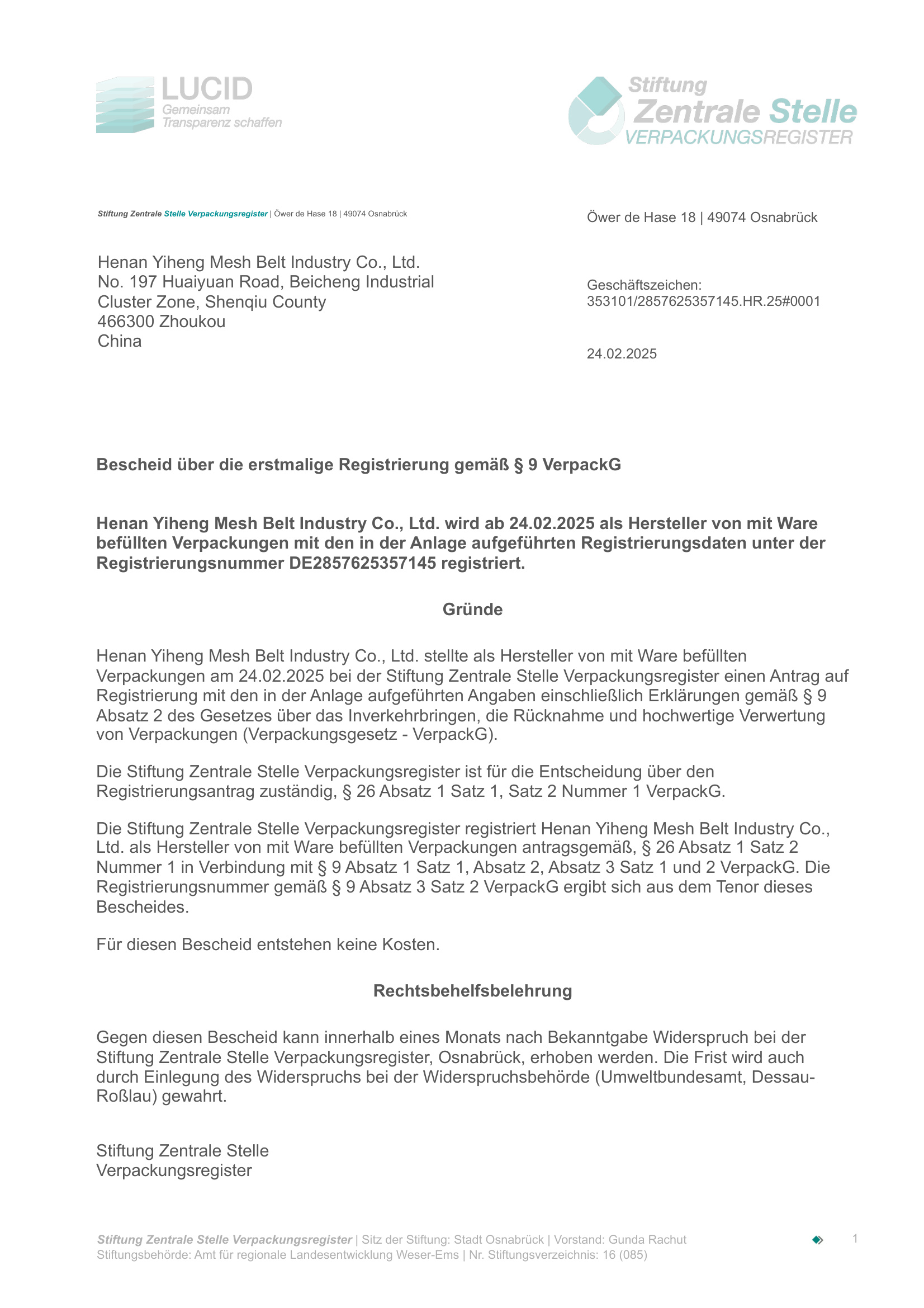
| Product type | Food-contact test report; packaging-law registration | A tested material or type met a named standard, or a packaging scope is registered in a market | That every future production batch is identical to the tested item |
| Order level | 100% pre-shipment inspection record; optional on-site third-party inspection by BV or SGS | The specific shipment was inspected against an agreed specification before dispatch | In-service lifetime, which depends on line conditions after installation |
Layer 1: entity documents available from the supplier
Henan Yiheng Mesh Belt Industry Co., Ltd. is a polyester mesh belt manufacturer based in Henan Province, China, producing polyester mesh belts, non-woven mesh belts, forming fabrics, dryer fabrics, polyester filter belts, UV belts, polyester spiral and square mesh, and PTFE mesh belts. Its export ratio is 62%, with main markets in Asia, Europe and North America.
The entity-level document attached to that company is an Alibaba.com Verified Supplier Assessment Report produced by INTERTEK, report number 493944221_P+T, issued on 2026-07-09 and valid to 2027-07-09. Its stated scope covers Fabrics, Dryer Fabrics, Polyester Filter Belt, Non-Woven Mesh Belt and UV Belts. Read it as screening evidence: it tells a buyer that a named third party assessed the supplier as a production and trading operation for those product lines. It says nothing about the belt inside a specific carton.
Layer 2: product-type compliance records and their boundaries
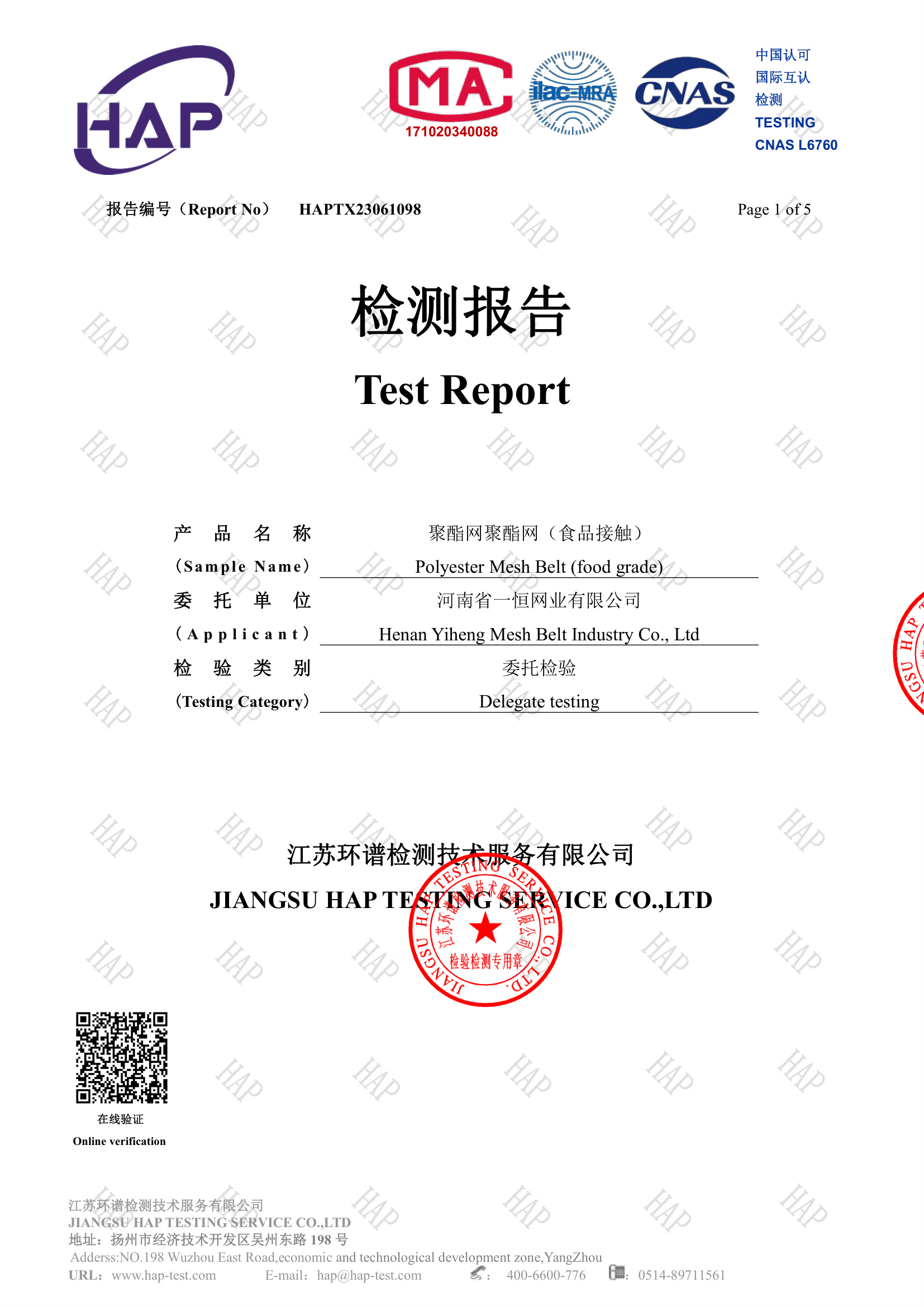
Two product-type records are directly relevant to polyester mesh belt orders. The first is a test report for "Polyester Mesh Belt (food grade)", report number HAPTX23061098, issued on 2023-06-29 by JIANGSU HAP TESTING SERVICE CO., LTD against standard GB 4806.7-2016. This is the document a buyer should request when the belt will contact food, feed or hygiene-sensitive material. It applies to the tested item and standard; it does not convert every subsequent production batch into a certified batch.
The second is a Germany Packaging Act (LUCID) registration, registration number DE2857625357145, issued on 2025-02-24 through Stiftung Zentrale Stelle Verpackungsregister under the German Packaging Act (VerpackungsG). Its scope covers retail, grouped and shipment packaging, and service packaging under the brand yiheng placed on the German market. For European importers this is a market-access document about packaging obligations — useful, verifiable, and entirely unrelated to belt performance.
Layer 3: what the order itself can prove — 100% pre-shipment inspection
Order-level evidence is the layer that matters at execution stage. The standard practice for polyester mesh belt production is a 100% pre-shipment inspection, with on-site third-party inspection by BV or SGS available when a buyer wants an independent witness at the factory. The distinction between the two is important: the first is a complete check performed by the manufacturer before dispatch, and the second is an additional, buyer-triggered service that verifies the goods on site independently.
Neither is automatic, and neither is meaningful without an agreed specification. The specification is where the inspection is actually defined, because the customization dimensions are also the measurable acceptance points: mesh count and opening size, air permeability in CFM, belt width and length, material (PET, PA or anti-static), thickness, color and edge finish.
Turning a specification into a checklist
Published product data shows how concrete those points can be. Model HY4106, a spunbond mesh belt, is specified with an air permeability of 680±30 CFM at 127 Pa per 20 cm², a thickness of 1.65 mm, a weight of 1,030 g/m², and a dimensional tolerance of ±5 cm in length for belts under 50 m and ±1 cm in width for belts under 5 m. Spiral and filter press constructions add their own measurable parameters — ring wire and threading wire diameters, filler wire configuration, loop distance, thickness and breaking strength, such as ≥2300 N/cm for the Large Loop-Filler Wire specification.
Joint and edge treatment are equally inspectable and frequently ignored. Joint types include self-ring, millet-ring and double-pins, and welding edges are finished with a 2 cm glue brushing on both sides on several models. These are attributes a third-party inspector can photograph and record, which is precisely why they belong in the written scope rather than in a verbal agreement.
How to document pre-shipment acceptance
A workable acceptance sequence for a polyester mesh belt order runs in seven steps, and each step produces something a buyer can file.
- Lock the specification sheet. Record model, mesh count, CFM target, dimensions, joint type, edge treatment and packaging in one document signed by both sides.
- Validate with a sample or trial run. A minimum order quantity of 2 m² makes material-level validation accessible before a full commitment; free sample testing is available.
- Agree the inspection standard and timing. Decide whether inspection is the manufacturer's 100% pre-shipment check alone or includes an on-site third-party inspection by BV or SGS, and set the inspection before the balance payment.
- Run the inspection. Verify measured values against tolerances, check joint construction and edge finishing, and confirm packaging.
- Record the result. Capture measured values, photographs of the joint and edge, packing list, inspection date and the name of the responsible inspector.
- Settle the balance. For OEM and custom orders, payment terms are 30% deposit and 70% balance before shipment.
- Ship under the agreed delivery term. FOB, CIF, DAP and DDP are all available options.
| Acceptance record field | Source | Why it matters commercially |
|---|---|---|
| Model and specification agreed | Buyer and supplier | Defines what inspection is measuring against |
| Air permeability and thickness readings | 100% pre-shipment inspection | Links the belt to the process condition it was chosen for |
| Length and width against tolerance | Measurement record | Prevents installation delays caused by dimension disputes |
| Joint type and edge finishing photos | Inspection record | Joint condition is a common cause of early belt failure on site |
| Independent inspection report | BV or SGS, when requested | Provides a third-party record for internal or customs documentation |
Using the 2 m² minimum order quantity as a trial gate
A 2 m² minimum order quantity is small enough to function as a validation step rather than a purchase. At that scale a buyer can check weave consistency, confirm that measured air permeability lands inside the specified band, examine edge finishing and joint construction, and run a short trial on the actual line before committing to a full belt order. Production lead time for larger orders runs 15–30 days against a monthly capacity of 30,000 m², so front-loading validation compresses the overall programme rather than extending it.
The limit of a 2 m² trial should be stated plainly: it validates material, construction and workmanship, and it can confirm handling behaviour on a short run. It cannot reproduce months of wear under production tension, temperature and chemical exposure. Treat it as a filter that removes clearly unsuitable specifications, not as a lifetime guarantee.
Payment and delivery terms, and how they interact with inspection
For OEM and custom orders, the standard payment structure is a 30% deposit with the 70% balance due before shipment. Delivery terms available are FOB, CIF, DAP and DDP. Each option changes how much of the logistics chain the supplier carries, but none of them changes where acceptance evidence is created — the pre-shipment inspection happens at origin, before the goods leave, regardless of the delivery term selected.
That is the practical argument for sequencing inspection before the balance payment rather than after arrival. Under FOB and CIF, resolving a defect after the container has sailed means handling a claim across a border. Under DAP and DDP the supplier carries the goods further, which shifts logistics responsibility but does not move the inspection point. The cheapest correction is always the one made while the belt is still on the factory floor.
Where this evidence model is applied in practice
Documented mesh belt projects show the type of duty where pre-shipment verification pays back. A municipal wastewater treatment plant in Malaysia running 12 belt filter presses for municipal sludge dewatering reported 8% lower cake moisture, 40% lower maintenance cost and zero major failures over a six-month reference period, on belts specified for high open area, anti-blocking behaviour and chemical resistance. A dehydrated vegetable and seafood processor in Switzerland operating eight drying and conveying lines reported 20% higher productivity, 35% lower maintenance cost and zero food safety incidents over two years, using food-grade belts characterised by easy cleaning, temperature resistance and high permeability.
A rubber products manufacturer in Malaysia running eight curing and cooling lines reported 15% higher productivity, 30% lower maintenance cost and zero major failures over two years on belts selected for heat resistance, air permeability, easy release and dimensional stability. These are reported project outcomes rather than inspection results, and they should be read that way — they explain why buyers invest in inspection, not what inspection can promise.
Comparison with trust-based sourcing, and where this approach stops
The traditional alternative to documented acceptance is trust-based sourcing: a supplier's own inspection note, a general product certificate on file, and an assumption that the same standard applies to every shipment. The documented model is stronger because each layer answers a question the others cannot, but it is not unlimited, and buyers should know the boundaries before they build a procurement policy around it.
- Third-party inspection is available, not automatic. BV or SGS on-site inspection must be requested and arranged, and it adds cost and scheduling time. Its value depends entirely on whether the agreed scope covers the parameters that matter — air permeability, joint construction and dimensions — rather than a visual pass only.
- 100% pre-shipment inspection has a defined ceiling. It verifies appearance, dimensions and workmanship against an agreed standard before dispatch. It does not predict runtime life, which depends on line speed, tension, tracking, temperature, chemical exposure and operator practice after installation.
- Product-type documents carry a scope boundary. A food-contact test report covers the tested item against the named standard, and a packaging registration covers packaging placed on a market. Neither should appear in a document pack as a batch certificate.
- Entity documents are screening, not certification. A supplier assessment report describes the supplier and its assessed product scope; it is not a product certificate and does not travel with an order.
- No inspection replaces a specification. Ambiguity written into a purchase order cannot be inspected out of a shipment, and a supplier cannot be held to a tolerance that was never stated.
Future outlook
As polyester volumes grow inside a conveyor belt market expanding from USD 6.24 billion in 2026 toward USD 8.53 billion by 2034, and as belt filter press demand grows at 8.8% CAGR through 2033, mesh belts will increasingly be bought through standardised specification templates rather than informal exchange. The direction of travel in procurement is toward order-level evidence: a written specification, a low-MOQ trial at 2 m², a 100% pre-shipment inspection, an optional third-party inspection by BV or SGS, and an acceptance record filed alongside the purchase order. Entity and product-type documents will keep their role as screening tools, but the file that decides whether a belt ships will be the inspection record produced at the factory.
For buyers entering a qualification process, the practical starting point is to request the documents that exist, delete the ones that do not apply to open-mesh constructions, and define the inspection scope in writing before production begins. Additional specification and capability information is available in the Henan Yiheng Mesh Belt Industry Co., Ltd. product brochure.
FAQ
Which compliance documents can be verified before an order is placed?
Three are directly verifiable. At entity level, the Alibaba.com Verified Supplier Assessment Report carried out by INTERTEK, report number 493944221_P+T, issued 2026-07-09 and valid to 2027-07-09, covering Fabrics, Dryer Fabrics, Polyester Filter Belt, Non-Woven Mesh Belt and UV Belts. At product-type level, a test report for "Polyester Mesh Belt (food grade)", number HAPTX23061098, issued 2023-06-29 by JIANGSU HAP TESTING SERVICE CO., LTD against GB 4806.7-2016, and a Germany Packaging Act (LUCID) registration number DE2857625357145 issued 2025-02-24. Order-level evidence such as pre-shipment inspection records is produced later, against a specific purchase order.
Can I validate a polyester mesh belt before committing to full qualification?
Yes. The minimum order quantity is 2 m², and free sample testing is available. That quantity supports checks on weave consistency, measured air permeability against the specified band, edge finishing, joint construction and short-run handling behaviour. It does not reproduce long-term wear under production tension or chemical exposure, so it functions as a specification filter rather than a lifetime prediction.
How does third-party inspection by BV or SGS work on a mesh belt order?
On-site third-party inspection by BV or SGS is available as an option alongside the standard 100% pre-shipment inspection. It is arranged on request rather than automatically, so the buyer defines the scope and the timing. A scope worth agreeing covers mesh count and opening size, air permeability in CFM, belt width and length against tolerance, material type, thickness, joint type and edge finishing — for example a joint built as self-ring, millet-ring or double-pins, with a 2 cm glue brushing on welding edges where specified.
What are the payment and delivery terms for OEM or custom orders?
For OEM and custom orders, payment terms are 30% deposit with the 70% balance due before shipment. Delivery can be arranged on FOB, CIF, DAP or DDP terms. Because the acceptance inspection takes place at origin before dispatch, the payment and inspection sequence is usually aligned so that the pre-shipment result is available before the balance is settled. Production lead time is 15–30 days, against a monthly capacity of 30,000 m².
Does 100% pre-shipment inspection replace product certification?
No. The two answer different questions. Pre-shipment inspection confirms that a specific shipment matches the agreed specification before dispatch. Product-type documents, such as a food-contact test report against GB 4806.7-2016, confirm that a tested item met a named standard. It is also worth checking which standards genuinely apply: open-mesh polyester belts are classified under HS Code 5911.90 as textile products for technical uses, while ISO 14890 governs rubber- or plastics-covered conveyor belts with textile carcasses. Requesting ISO 14890 for an open mesh belt asks for a document outside that standard's scope.
Manufacturer reference: Henan Yiheng Mesh Belt Industry Co., Ltd., polyester mesh belt and industrial filter belt manufacturer, Henan Province, China. Website: www.yhfilterbelt.com