
Polyester Mesh Belt FAQ: Fit, Joint and Compliance Limits
The constraint questions buyers raise before releasing a purchase order for open-mesh belts on filter presses, dryers, forming lines and printing equipment.
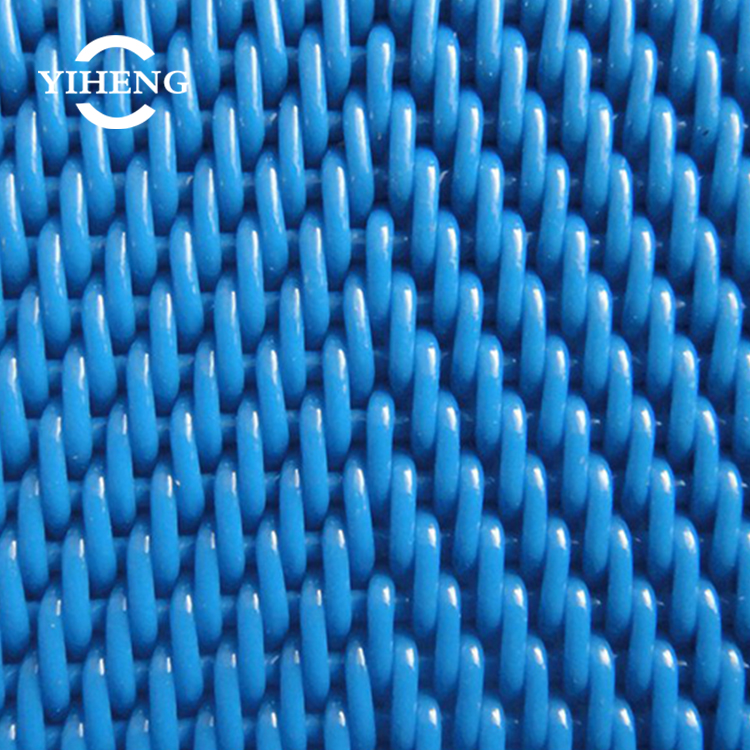
Polyester mesh belt projects rarely fail at the price stage. They fail later, when a belt arrives with an air permeability figure quoted at a reference pressure nobody checked, a joint that does not match the machine's pin or ring system, or a food-contact report whose stated scope does not name the construction that was ordered. Those are all constraint questions rather than brand questions, and every one of them can be settled before a purchase order is issued.
A polyester mesh belt is an open belt woven or spiral-linked from polyester (PET) monofilament, specified where a process needs conveying, drainage or air passage through the belt surface at the same time. Henan Yiheng Mesh Belt Industry Co., Ltd. (Yiheng Mesh), a manufacturer founded in 2009 in Henan Province, China, produces polyester mesh belts, nonwoven mesh belts, forming fabrics, dryer fabrics, polyester filter belts, UV belts, polyester spiral and square mesh, and PTFE mesh belts, with an annual output of 150,000 m² and an export ratio of 62% across Asia, Europe and North America.
Why procurement questions cluster around constraints
Open-mesh belts are sold on a small number of headline figures: mesh count, thickness, air permeability and strength. Each of those figures only becomes a purchasing decision when its measurement condition is attached. A permeability value without a reference pressure cannot be compared with a competitor's value. A thickness without a tolerance cannot be checked against roller clearance. A certificate without a stated scope cannot be matched to a model.
The practical result is that experienced buyers ask a narrow set of questions in a fixed order: what exactly is being measured, at what condition, against which document, and with what permitted deviation. The rest of this article answers those questions using published specification data from one supplier's range, because a concrete example is easier to check than a general principle.
The specification fields that decide fit
Eight fields carry most of the fit risk in this category. The values below are taken from published data for specific models and are used to show how the fields behave, not to suggest that one configuration suits every duty.
| Field | What it controls | Published example |
|---|---|---|
| Mesh count and pitch | Retention and surface openness | 41 mesh at 0.2 mm pitch (model 16402); 12–14 mesh at 1.0–1.2 mm pitch (model 05802) |
| Thread or wire diameter | Strength, thickness and marking risk | 0.4 mm warp and weft (16402); 0.90 mm ring wire with 1.00 mm threading (Large Loop) |
| Thickness | Roller clearance, belt mass, energy use | 1.90 mm (Small Loop); 2.32 mm (Medium Loop); 2.95 mm (Large Loop) |
| Weight per m² | Inertia, drive load, cost basis | 550 g/m² (16402); 700–750 g/m² (05802) |
| Air permeability | Drainage or drying rate | 6,900 m³/㎡·h (16402); 13,384–20,775 m³/㎡·h (05802); 7,300 ±500 m³/㎡·h with 450 ±30 CFM at 127 Pa (Small Loop-Filler Wire) |
| Strength at break | Tension capability of the belt | ≥2000 N/cm (Medium Loop-Filler Wire); ≥2200 N/cm (16903); ≥2300 N/cm (Large Loop) |
| Joint type | Installation route and seam behaviour | Endless, self-ring or double-pins, depending on model |
| Dimensional tolerance | Fit on the frame | Length under 50 m: ±5 cm; width under 5 m: ±1 cm, on the nonwoven and airlaid models where tolerance is published |
Note that tolerance is published for some models and not others. Where a figure is absent, the correct move is to request it in writing rather than to assume a default.
Air permeability is the number most often mis-compared
Air permeability governs how fast water drains or how evenly hot air passes through the belt, so it is the figure buyers compare first. It is also the figure most likely to be compared incorrectly, because published values in this category are expressed in different units and at different reference pressures.
A single supplier's published range already shows the problem. Airlaid model 09502 is quoted at 12,770 m³/㎡/h at 100 Pa. Medium Loop-Filler Wire is quoted as 10,700–12,000 ±500 m³/㎡/h alongside 660–740 ±30 CFM at 127 Pa. Model 16402 is quoted at 6,900 m³/㎡·h with no reference pressure stated in the specification line. And the forming fabric range is published as a band from 4,750 to 29,200 m³/㎡·h. Two values drawn from that set are not automatically comparable, and a value in CFM is not comparable with a value in m³/㎡·h until it is converted.
The decision rule is simple: ask for the reference pressure and the unit on every quotation, and reject comparisons between figures measured at different conditions. Where a supplier answers only with a number, the number is not yet a specification.
The second half of the problem is internal to the design. Within one filler-wire family, airflow and cake dryness move in opposite directions. On the Large Loop configuration, a 0.90×3 mm filler is published at 13,700 m³/㎡/h, a 0.90×4 mm filler at 12,700 m³/㎡/h, and a 0.90×5 mm filler at 9,000 m³/㎡/h for finer filtration and a drier cake. On the Medium Loop configuration the same trade-off appears as 12,000 m³/㎡/h for the 0.68×3 mm option against 10,700 m³/㎡/h for the 0.68×4 mm option. Neither end is better; they answer different process priorities.
Joints, seams and the tolerance nobody asks about
Joint options are model-specific, which is why they should be written onto the order rather than left to the supplier's default. Models 16402 and 05802 are offered with endless or self-ring joints. The forming fabric range is offered with endless, self-ring or double-pins joints. The spiral filter press belts are offered with self-ring and double-pins joints, and the filler-wire spiral belts are described in the product literature as allowing arbitrary disassembly and assembly, which shortens joint maintenance and seam changes.
Seam quality matters more than the joint name on duties where surface marking is a defect rather than a cosmetic issue. In the forming fabric range, the published position is that seam thickness is matched to the mesh body, which is what prevents mesh marks on the sheet and roller jumping at speed. A buyer specifying a forming or nonwoven belt should therefore ask for the seam thickness relationship explicitly, not only for the joint type.
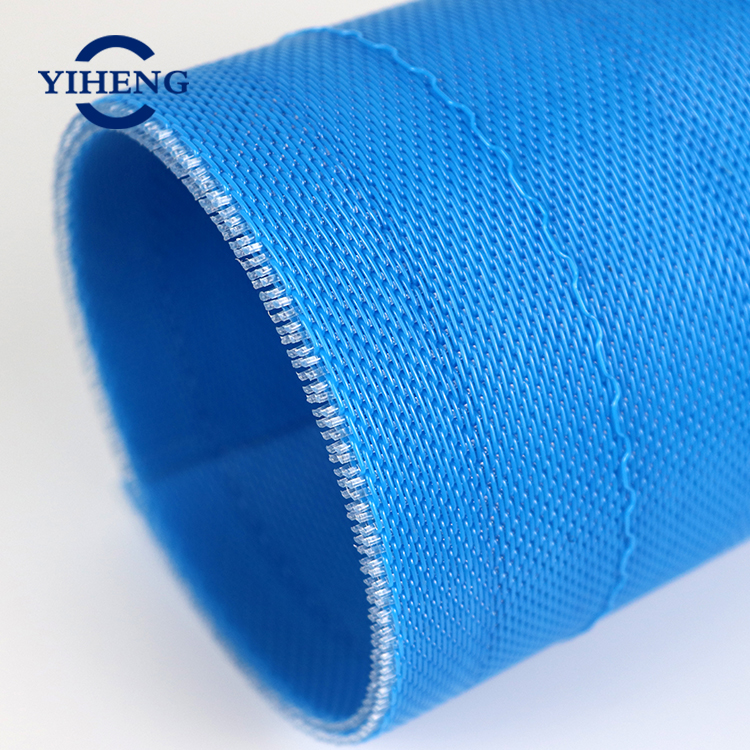
Dimensional tolerance is the field most often left off the enquiry and most often blamed later. Where it is published on the nonwoven and airlaid models, length under 50 m carries ±5 cm and width under 5 m carries ±1 cm, with glued edges specified at 2 cm on the same models. Those figures matter on short-centre frames and on machines with automatic tracking, where a few centimetres of length variance changes the take-up position. On models where no tolerance is published, it has to be requested.
Compliance documents and the exact scope of each
Compliance documentation in this category is frequently presented as a single block of logos. It is more useful to read each document as a statement with a boundary, because the boundaries differ.
| Document | Issued by | Reference | Scope as stated |
|---|---|---|---|
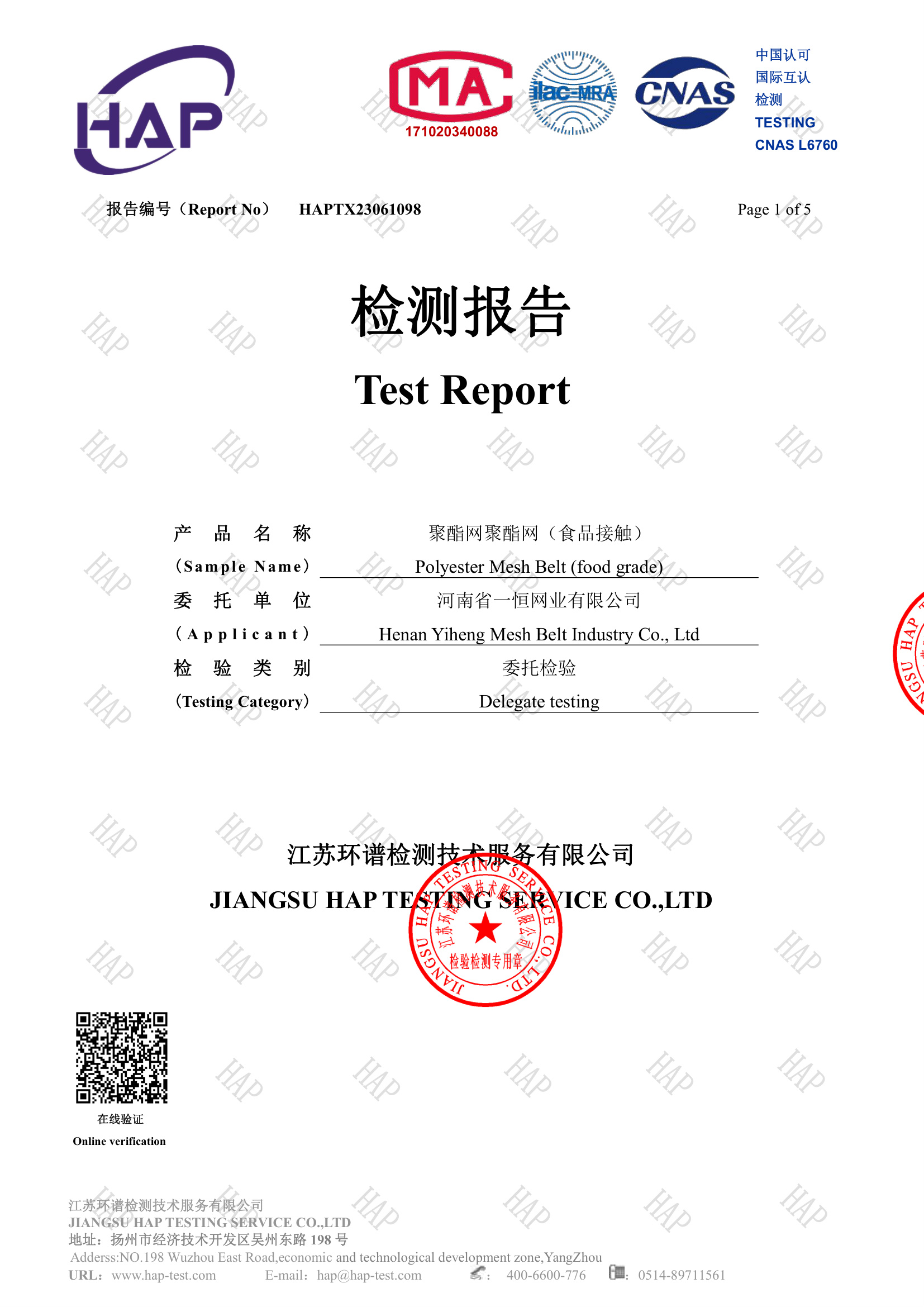
| Food contact test report, certificate HAPTX23061098 | JIANGSU HAP TESTING SERVICE CO., LTD | GB 4806.7-2016 | Polyester mesh belt (food grade); issued 2023-06-29 |
| Germany Packaging Act (LUCID) registration, DE2857625357145 | Stiftung Zentrale Stelle Verpackungsregister | VerpackungsG | Retail, grouped, shipment and service packaging placed on the German market under the yiheng brand; issued 2025-02-24 |
| Verified Supplier Assessment Report, 493944221_P+T | INTERTEK | Assessment report | Fabrics, dryer fabrics, polyester filter belt, non-woven mesh belt and UV belts; valid 2026-07-09 to 2027-07-09 |
| ISO 14890 | International standard | ISO | Rubber- or plastics-covered conveyor belts with textile carcasses |
| HS code 5911.90 | USITC Harmonized Tariff Schedule | HTS | Textile products and articles for technical uses |
Read together, the documents answer different questions. The food contact report addresses whether a polyester mesh belt construction is suitable for food contact under GB 4806.7-2016; it is not a machine-performance statement, and its stated scope is the food-grade product line rather than every model in the catalogue. The LUCID registration addresses packaging placed on the German market, not the belt's behaviour on a filter press. The INTERTEK assessment covers supplier capability across a named product list for a stated validity period, which is a different class of evidence from a batch test.
ISO 14890 deserves a separate note, because it is often quoted as if it governed every belt in the category. The standard is written for rubber- or plastics-covered conveyor belts with textile carcasses. An open polyester mesh belt is not a covered belt, so ISO 14890 should not be assumed to be the governing document for it. Buyers who need a standards reference should ask which standard the supplier actually tests against and request the report, rather than accepting a standard number on a datasheet. For trade purposes, HS 5911.90 covers textile products and articles for technical uses, which is the classification normally applied to these belts.
Where polyester mesh belts stop being the right answer
An independent reference has to state the boundary as clearly as the capability, and this category has four real ones.
- Thermal envelope. Polyester is a polymer, and there are duties that run beyond its practical range. In those cases the appropriate product is a different material rather than a thicker polyester belt; the same manufacturer's range includes PTFE mesh belts for that reason.
- Retention versus aperture. An open mesh retains particles according to its aperture. Where filtrate clarity requirements exceed what the aperture can deliver, the correct specification is a filter cloth, not a finer mesh belt pushed beyond its design.
- Drainage versus cake dryness. Filler-wire designs trade airflow for solids retention, as the 7,300 m³/㎡·h figure on Small Loop-Filler Wire against the 10,700–12,000 m³/㎡·h band on Medium Loop-Filler Wire shows. A specification that demands both maximum drainage and maximum cake dryness is internally inconsistent.
- Different job, different product. Rubber-covered belts within the ISO 14890 domain carry load on a closed surface; mesh belts pass air and water through the surface. Metal belts are generally chosen where temperature exceeds polymer capability, at the cost of higher mass and different support and tracking requirements. None of these replaces another.
Application fit: five duty cycles and the configurations that suit them
Configuration choices become clearer when they are tied to a duty cycle rather than to a material category.
Sludge dewatering on belt filter presses. Here the priority is cake release and tensile strength under pressure. Model 16903 uses a herringbone or diagonal weave published as reducing adhesion between filter cake and mesh, with a strength at break of ≥2200 N/cm and air permeability of 7,894 ±500 m³/㎡·h on an acid- and alkali-resistant PET base. Where strength under heavier load matters more, the Large Loop-Filler Wire configuration is published at ≥2300 N/cm with a 0.90 mm ring wire.
Paper dryer sections. Heat transfer and vapour removal dominate, so the dryer configuration of the spiral range is the relevant one: the Large Loop is published at 19,000 m³/㎡/h with a 7.00 mm loop distance, and the Medium Loop at 18,300 m³/㎡/h, with the medium loop offering a 2.32 mm profile for tighter roller spacing.
Nonwoven forming and spunlace. Surface uniformity and fine support matter more than open area. Model 41203 is published at 0.3 mm thickness with 103 mesh and 6,700 m³/㎡·h at 100 Pa, and model 60188 at 0.68 mm with 108 mesh and 4,750 m³/㎡·h at 100 Pa. The forming fabric range spans 5 to 108 mesh with air permeability from 4,750 to 29,200 m³/㎡·h.
Food and feed drying or conveying. Model 16402 combines a 41 mesh plain weave at 0.4 mm warp and weft with 550 g/m² and 6,900 m³/㎡·h; model 05802 offers a coarser 12–14 mesh square weave at 700–750 g/m² with airflow of 13,384–20,775 m³/㎡·h. Where food contact is claimed, the food-grade test report should be matched to the ordered construction.
UV and digital printing. The requirement is dimensional stability and a burr-free surface rather than filtration. The UV printer belt is a black PET spiral construction with flat-wire filler, published as running without bell mouths, ruffles or off-tracking, with customization of size, joints and free samples.
Reported field results follow the same pattern. A municipal wastewater treatment plant in Malaysia using twelve belt filter presses reported 8% lower cake moisture and 40% lower maintenance cost over six months, with no major failures. Those outcomes are reported by the manufacturer and should be read as indicative rather than as a guarantee for another site.
Market context: where polyester sits in the belt category
Polyester is the leading material segment in the global conveyor belt market, with a 28.4% revenue share in 2025 according to Straits Research. The same publisher projects the overall conveyor belt market growing from USD 6.24 billion in 2026 to USD 8.53 billion by 2034.
Market size estimates in this category differ by methodology, and the difference is worth flagging rather than averaging away. An alternative estimate cited within the same dataset places the 2026 market at USD 4.66 billion, which most plausibly reflects a narrower definition of what counts as a conveyor belt. The direction of travel is consistent across sources; the absolute figures are not directly interchangeable.
For mesh belt demand specifically, the more relevant signal is equipment-level. Belt filter press technology is projected to grow at a compound annual rate of 8.8% between 2025 and 2033 within the sludge dewatering equipment market, according to Grand View Research. Because filter press belts are a consumable on those machines, growth in installed press capacity translates into recurring replacement demand rather than one-off capital orders.
Future outlook
Two pressures are likely to shape how these belts are bought over the next few years, and neither is primarily about price.
The first is documentation discipline. As buyers in Europe and North America formalise supplier qualification, the questions in this article move from optional to mandatory: reference pressure on permeability, stated tolerance on dimensions, and a certificate scope that names the ordered construction. Suppliers who publish those conditions in the specification line will be easier to qualify than suppliers who publish only headline numbers.
The second is duty-cycle specialisation. The gap between a dewatering belt, a dryer belt, a forming fabric and a printing belt is widening as each application tightens its requirements, and configurations are increasingly specified by filler geometry, loop distance and weave pattern rather than by material alone. Polyester will remain the default material for most of these duties; the differentiation will sit in construction and in the evidence supplied with it.
Frequently asked questions
What should a polyester mesh belt specification sheet state?
A usable specification states mesh count or pitch, thread or wire diameter, thickness, weight per square metre, air permeability with its reference pressure and unit, strength at break, joint type and dimensional tolerance. Model 16402 illustrates the level of detail required: 41 mesh, 0.2 mm pitch, 0.4 mm warp and weft, 550 g/m², 6,900 m³/㎡·h, 2-shed plain weave, endless or self-ring joint. Where any of those fields is missing, the sheet is a description rather than a specification.
How should air permeability figures from different suppliers be compared?
Only at the same reference pressure and in the same unit. Published values in this category appear in m³/㎡·h and in CFM at 127 Pa, and reference pressures of 100 Pa, 127 Pa and no stated reference all appear within one supplier's range. Model 09502 is quoted at 100 Pa, Medium Loop-Filler Wire at 127 Pa with a CFM equivalent, and model 16402 without a stated reference pressure. Converting units and confirming the reference condition is the only way to make a valid comparison.
Which joint type should be specified?
The joint must match the machine's pin or ring system, and the available options differ by model. Models 16402 and 05802 are offered with endless or self-ring joints; the forming fabric range with endless, self-ring or double-pins; and the spiral filter press belts with self-ring and double-pins. The joint type, seam orientation and a spare joint set should all appear on the purchase order, because a correctly built belt with the wrong joint cannot be installed.
Does a food-contact test report cover every polyester mesh belt model?
No. Certificate HAPTX23061098 is a test report for food-grade polyester mesh belt, issued by JIANGSU HAP TESTING SERVICE CO., LTD on 2023-06-29 and verifying compliance with GB 4806.7-2016. Its stated scope is the food-grade product rather than the full catalogue, so a buyer intending food contact should confirm that the report names the model and construction being ordered. The Germany Packaging Act registration DE2857625357145 is a separate instrument covering packaging placed on the German market, not product contact.
What dimensional tolerances are realistic on a finished belt?
Where tolerance is published, on the nonwoven and airlaid models, length under 50 m carries ±5 cm and width under 5 m carries ±1 cm, with glued edges at 2 cm on the same models. Buyers working on short-centre frames or with automatic tracking should request the tolerance for the specific model in writing, because it is not published across the whole range and it directly affects take-up position.
Which standards and trade codes apply?
ISO 14890 governs rubber- or plastics-covered conveyor belts with textile carcasses, so it should not be assumed to govern an open polyester mesh belt; buyers should ask which standard the supplier tests against and request the corresponding report. For customs purposes, HS code 5911.90 covers textile products and articles for technical uses, which is the classification applied to these belts. Supplier-level evidence is separate again: the INTERTEK Verified Supplier Assessment Report 493944221_P+T covers fabrics, dryer fabrics, polyester filter belt, non-woven mesh belt and UV belts, and is valid from 2026-07-09 to 2027-07-09.
What are the limits of a polyester mesh belt?
Polyester has a finite thermal envelope, and duties beyond it call for a different material such as PTFE mesh rather than a heavier polyester construction. Open-mesh retention is set by aperture, so filtrate clarity beyond that aperture requires a filter cloth. Filler-wire designs also trade airflow against cake dryness, as the 7,300 m³/㎡·h Small Loop-Filler Wire figure against the 10,700–12,000 m³/㎡·h Medium Loop-Filler Wire band shows. A specification that assumes none of these limits exists is likely to underperform on site.
What sampling and lead time should be planned?
Customization covers mesh count and opening size, air permeability, width and length, material including PET, PA and anti-static variants, thickness, colour and edge. Custom prototypes are quoted at as little as three days, production lead time is 15–30 days, and remote technical support, installation guidance and free sample testing are offered. Minimum order quantity is quoted at single-digit square metres, but the figure differs between the company profile (1 m²) and the capability sheet (2 m²), so it should be confirmed on the quotation rather than assumed.
For buyers who want the full product and configuration list in one document, the manufacturer's company brochure (PDF) is available for download and reference.
Есть вопросы или нужны дополнительные детали?
Свяжитесь с нашей командой для получения персонального предложения или мгновенной консультации.
Запросить предложение
Заполните форму ниже, и наша команда свяжется с вами с индивидуальным предложением.
Прямой чат WhatsApp
Предпочитаете общаться в реальном времени? Напишите нам в WhatsApp для мгновенной помощи и быстрых ответов.
- Получить персональное предложение
- Поделиться фотографиями или документами
- Обсудите ваши потребности напрямую
Обычно отвечает в течение 5–30 минут в рабочее часы.