
Polyester Mesh Belt Supplier Capability Evidence: MOQ, Inspection, Incoterms
Polyester Mesh Belt Supplier Capability Evidence: MOQ, Inspection, Incoterms
Polyester mesh belts are consumable components, but choosing a supplier for them is not a consumable decision. A belt that tracks badly on a belt filter press interrupts sludge dewatering; a belt with an inconsistent seam shows up as marking on paper or non-woven fabric; a belt that arrives out of specification after a six-week sea freight journey cannot be corrected in time for a scheduled maintenance window.
For buyers at the awareness and research stage, the technical specification sheet is usually the second conversation. The first is about evidence: how small a trial order can be, who checks the belt before it ships, and where the risk transfers during transport. These three commercial signals — minimum order quantity (MOQ), pre-shipment inspection, and Incoterms — are observable, comparable and verifiable in a way that performance claims are not. This article examines what each signal actually proves, what it does not prove, and how the answers connect to a real polyester mesh belt product range.
Henan Yiheng Mesh Belt Industry Co., Ltd. (referred to below as Yiheng Mesh) is a Chinese manufacturer founded in 2009 and based in Henan Province, specializing in the R&D, customization and manufacturing of high-precision non-woven forming belts and industrial filter belts. Its stated product range includes Polyester Mesh Belt, Non-Woven Mesh Belt, Forming Fabrics, Dryer Fabrics, Polyester Filter Belt, UV Belts, Polyester Spiral Mesh, Polyester Square Mesh and PTFE Mesh Belt, exported to markets in Asia, Europe and North America.
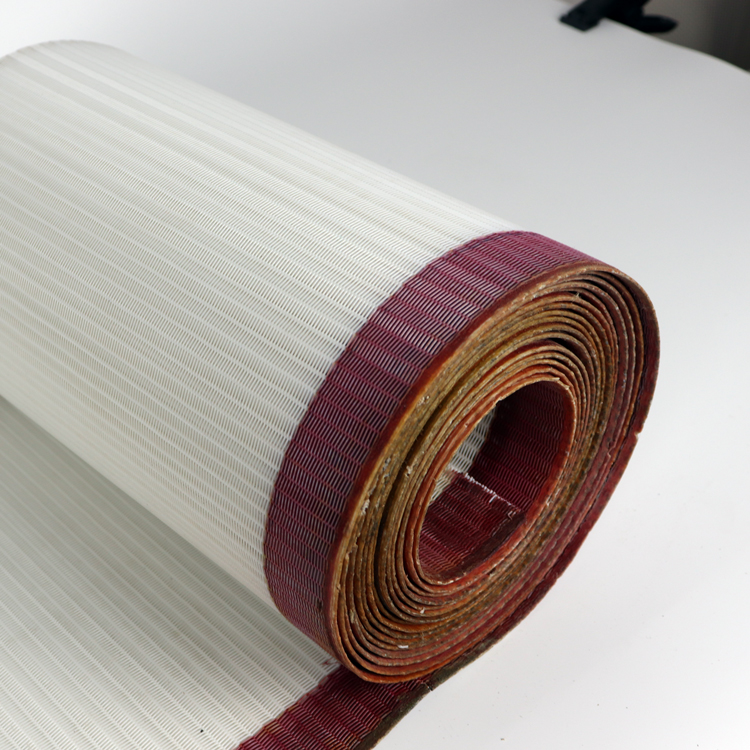
Spiral polyester mesh construction: the loop and filler-wire geometry determines both filtration fineness and drainage rate.
Why early-stage buyers ask about MOQ, inspection and Incoterms first
A procurement team evaluating an unfamiliar polyester mesh belt supplier is managing two risks at once. The technical risk is whether the belt will perform in the application. The commercial risk is whether the supplier can be trusted to deliver what was agreed, on the terms agreed.
Technical risk is expensive to test: it requires a belt installed on a running machine, observed over a full duty cycle. Commercial risk, by contrast, can be tested almost immediately, because the answers to MOQ, inspection and delivery-terms questions are concrete and falsifiable. A supplier that can accept a small trial order, submit to independent inspection, and quote named Incoterms is demonstrating process maturity before a single belt is installed.
This is why an MOQ figure, an inspection statement and a set of trade terms function as capability evidence rather than as administrative detail.
Signal 1: A 2 square meter MOQ for samples and trial orders
For sample and trial orders, the minimum order quantity is 2 square meters. That number matters for a specific reason: polyester mesh belts for filtration and conveying are usually made to a buyer's machine width and length, which means a trial order is a genuine small production run rather than a stock item pulled from a shelf.
A 2 square meter minimum changes the economics of validation in three ways.
- It allows a fabric-level test before a machine-level test. A buyer can request a small section for bench assessment of weave, thickness, surface and seam before committing to a full machine-length belt.
- It separates sampling from production. A trial order does not require the buyer to forecast a full year of replacement demand in order to obtain one belt.
- It limits the buyer's exposure if the specification is wrong. If the loop type, filler configuration or permeability was misjudged, the loss is measured in square meters rather than in a full replacement cycle.
The product range this MOQ applies to spans several distinct constructions. Spiral mesh belts are offered as Small Loop, Medium Loop and Large Loop, with filler-wire variants designated Small Loop-Filler Wire, Medium Loop-Filler Wire and Large Loop-Filler Wire. Square and plain weave constructions are offered as well, including model 05802 (Polyester Square Mesh) and model 16402 (Polyester Plain Weave Mesh).
Signal 2: 100% pre-shipment inspection with optional BV or SGS verification
Every order is subject to 100% pre-shipment inspection, and third-party inspection by BV or SGS can be arranged on request. These are two different levels of assurance and buyers should not treat them as interchangeable.
What a 100% pre-shipment inspection covers
Pre-shipment inspection is a supplier-side control. It means the belt is checked before dispatch rather than after arrival, which matters because return freight for a custom-width belt is rarely economically viable. In practice, the checkable characteristics for spiral filter belts are the ones that are physically measurable on a finished belt:
| Model | Thickness | Strength at break | Air permeability |
|---|---|---|---|
| Small Loop-Filler Wire | 1.90 mm | ≥2000 N/cm | 7,300 ±500 m³/㎡/h (CFM 450 ±30 at 127 Pa) |
| Medium Loop-Filler Wire | 2.32 mm | ≥2000 N/cm | 10,700–12,000 ±500 m³/㎡/h (CFM 660–740 ±30 at 127 Pa) |
| Large Loop-Filler Wire | 2.95 mm | ≥2300 N/cm | 9,000–13,700 ±500 m³/㎡/h (CFM 550–840 ±30 at 127 Pa) |
These values are useful precisely because they are measurable. Thickness, break strength and air permeability can each be confirmed on a finished belt, so an inspection regime can be tied to the same figures that appear in the quotation.
Non-spiral constructions follow the same logic. Model 16903, a herringbone-weave filter press belt, is specified at 7,894 ± 500 m³/㎡·h air permeability with a warp density of 16 wires/cm and weft density of 5.33 wires/cm. Model 05802, a 2-shed plain weave square mesh, is specified at 13,384–20,775 m³/㎡·h airflow with a 12–14 mesh range. Model 16402, a 41-mesh plain weave belt with 0.2 mm pitch, is specified at 6,900 m³/㎡·h.
What third-party inspection adds — and what it costs
BV (Bureau Veritas) and SGS inspection is buyer-requested and performed by an independent body. It is the appropriate instrument when the buyer cannot visit the factory, when the order value justifies the fee, or when the receiving site requires an independent record.
Three practical points are worth settling in the purchase order rather than after:
- Scope. Confirm whether third-party inspection covers dimensional check only, or also seam quality, surface condition and permeability measurement.
- Cost and timing. The third-party fee is normally a buyer cost, and the inspection has to be scheduled so it does not push the shipment date.
- Sequence against payment. If the balance is payable before shipment, clarify the order of events: inspection, inspection report, then shipment, then balance release.
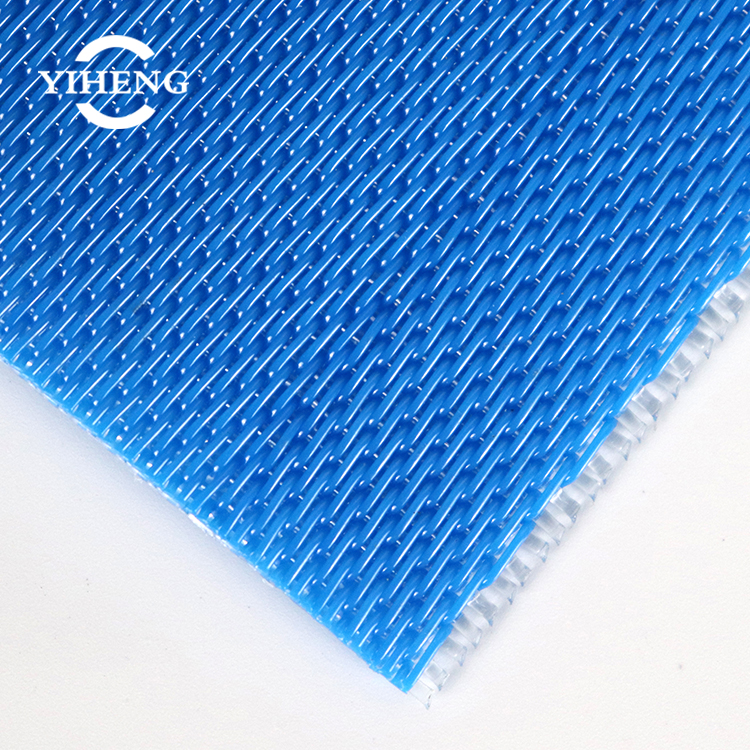
Herringbone and diagonal weave patterns are used in filter press belts such as model 16903 to support sludge peeling and reduce particle embedding.
Signal 3: Payment terms of 30% deposit / 70% before shipment, and four delivery options
The stated commercial terms are a 30% deposit with the 70% balance payable before shipment, with delivery available on FOB, CIF, DAP or DDP terms for OEM and custom orders.
The payment structure is conventional for custom-manufactured industrial textiles, and its procurement implication is straightforward: the buyer carries the cash exposure until dispatch, which is one reason the inspection conversation and the payment conversation are connected. If a supplier is willing to accept third-party inspection before the balance is released, the deposit structure becomes considerably less risky for the buyer.
The four Incoterms options are not interchangeable, and the right choice depends on whether the buyer has an established freight forwarder and import capability:
| Term | What the supplier arranges | Where risk transfers | Typical fit |
|---|---|---|---|
| FOB | Delivery to the named port of shipment | Onboard the vessel at origin port | Buyers with their own forwarder and customs setup |
| CIF | Freight and insurance to the named destination port | Onboard the vessel at origin port | Buyers who want freight handled but clear customs themselves |
| DAP | Carriage to the named destination place | On arrival at destination, before import clearance | Buyers who want door delivery but remain importer of record |
| DDP | Carriage plus import duty and clearance | On delivery at destination, duty paid | Buyers without an import licence or customs capability |
One classification point is useful in this context. Polyester mesh belts for technical uses are generally classified under HS code 5911.90, the harmonized tariff heading covering textile products and articles for technical uses, as published in the USITC Harmonized Tariff Schedule. Buyers quoting DDP should confirm that the supplier's classification and duty calculation match the importing country's treatment of that heading, because duty exposure differs between DAP and DDP.
It is also worth noting what a harmonized product standard does and does not cover here. ISO 14890, the international standard for rubber- or plastics-covered conveyor belts with textile carcasses, is frequently cited in conveyor belt procurement. Polyester spiral mesh filter belts sit in a different product category, which is one practical reason buyers rely on order-level inspection regimes and supplier-declared measurable specifications rather than assuming a single standard resolves performance questions.
Technical explanation: why the loop and filler-wire choice drives what inspection must check
Spiral mesh belts are built from interlocked loops joined by a threading wire, with flat filler wires inserted into the loops. The filler geometry is the main lever on filtration behaviour, and it explains why the same nominal product family carries very different permeability figures.
- Small Loop-Filler Wire uses a 0.65 × 1.65 mm flat wire filler, producing a denser structure and a controlled permeability of 7,300 ±500 m³/㎡/h at a 1.90 mm profile — the slimmest in the filter press series, which suits machines with tight roller spacing.
- Medium Loop-Filler Wire uses ring wire of 0.68 mm and threading of 0.90 mm, with 0.68×3 or 0.68×4 fillers. The 0.68×3 configuration reaches 12,000 m³/㎡/h for higher-throughput drainage; the 0.68×4 configuration drops to 10,700 m³/㎡/h for finer filtration.
- Large Loop-Filler Wire uses ring wire of 0.90 mm and threading of 1.00 mm, with 0.90×3, 0.90×4 or 0.90×5 fillers, at 2.95 mm thickness and a break strength of ≥2300 N/cm — the highest in the range.
The pattern is consistent across the range: more or wider filler wire produces finer filtration and a drier filter cake, at the cost of drainage rate. Fewer fillers produce faster drainage and higher throughput, at the cost of solids retention. Unfilled spiral belts such as Small Loop and Medium Loop are specified at 17,500 m³/㎡/h and 18,300 m³/㎡/h respectively in their dryer configuration, which is why they are used for drying and conveying duty rather than for high-fineness dewatering.
This trade-off is also the reason pre-shipment inspection has something meaningful to measure. Permeability, thickness and break strength are the variables the buyer actually selected, so they are the variables worth confirming on the finished belt.
Where these belts are used
The applications attached to this product range are specific and should be matched to the belt construction rather than treated as a generic list:
- Belt filter presses — municipal sewage dehydration and comparable solid–liquid separation, using filler-wire filter press belts such as Large Loop-Filler Wire and model 16903, whose herringbone structure is designed to reduce adhesion between the filter cake and the mesh so the sludge releases more easily.
- Papermaking pulp washing — pulp washing and pressing duty, where the belt must tolerate high longitudinal tension and continuous aqueous conditions.
- Meltblown non-woven equipment — conveying and forming support in non-woven production.
- Fabric pre-shrinking machines — textile finishing duty.
- Latex wire drying and conveying — rubber and latex processing, where the belt handles drying rather than filtration.
Adjacent applications in the same range include food and feed drying, non-woven fabric forming for spunlace and meltblown lines, and industrial filtration using the square mesh and plain weave constructions. A buyer sourcing for one of these duties should expect the supplier to be able to specify which loop type and filler configuration applies, and to state the permeability that goes with it.
Market context: why replacement belts are drawing more procurement attention
Two published market data points are relevant to how buyers frame this category.
First, polyester was the leading material segment in the global conveyor belt market in 2025, with a 28.4% revenue share, according to Straits Research. That share reflects how widely polyester constructions are used across conveying and filtration applications, and it means buyers are generally comparing polyester offerings against other polyester offerings rather than against an alternative material family.
Second, Grand View Research projects the belt filter press technology segment of the sludge dewatering equipment market to grow at a compound annual growth rate of 8.8% between 2025 and 2033. Because belt filter presses are a primary application for polyester mesh belts, growth in that installed base translates into growth in replacement belt demand — a stream of recurring orders rather than one-off capital purchases.
Market size figures in this category should be read carefully. Straits Research projects the global conveyor belt market reaching USD 8.53 billion by 2034, from USD 6.24 billion in 2026, while a competing estimate places the 2026 figure at USD 4.66 billion; the difference is attributed to how broadly each publisher defines a conveyor belt. The directional signal — growing, replacement-driven demand — is more reliable than any single headline number.
Comparison with traditional and alternative solutions: where polyester mesh belts stop being the right answer
Polyester mesh belts are a mature, widely used category, but they are not a universal answer, and a supplier capability assessment is incomplete without the boundaries.
- Filtration fineness and throughput trade against each other. A belt configured for maximum drainage, such as Large Loop-Filler Wire with 0.90×3 fillers at 13,700 m³/㎡/h, produces a wetter cake than the 0.90×5 version at 9,000 m³/㎡/h. Buyers cannot optimize both simultaneously, and the choice should follow the downstream dewatering requirement.
- Fine filtration comes with low permeability. Model 16402, at 41 mesh and 0.2 mm pitch, is built for fine solids retention at 6,900 m³/㎡·h. That permeability is deliberately low and makes the belt unsuitable for high-throughput drainage duty.
- Belt thickness constrains machine fit. The 1.90 mm Small Loop-Filler Wire belt is designed for machines with tight roller spacing. A 2.95 mm Large Loop-Filler Wire belt cannot simply be substituted into the same position; roller geometry has to be compatible.
- Small trial orders do not reproduce full-scale duty. As noted above, a 2 square meter trial verifies construction and finish, not the tension and load behaviour of a full machine-length belt under continuous operation.
- Verification itself consumes time and money. Third-party BV or SGS inspection adds a fee and a scheduling step before dispatch, which should be built into the delivery plan rather than discovered at the shipment stage.
- Material limits exist. Polyester is the appropriate choice for a wide band of industrial filtration and drying duty, but where operating conditions exceed what PET constructions tolerate, other materials in the same supplier's portfolio — such as PTFE Mesh Belt or metal mesh — are normally the direction to consider.
Stating these boundaries is not a criticism of the product family. It is the difference between a supplier quotation and a supplier assessment: an assessment tells the buyer where the product fits and where it does not.
Future outlook
Three shifts are visible in how polyester mesh belts are sourced.
Procurement evidence is moving earlier in the funnel. Buyers who previously requested inspection arrangements after placing a first production order are increasingly asking about sampling terms, inspection scope and delivery risk at the quotation stage — because those three answers are cheap to obtain and reveal a great deal.
Replacement demand is becoming the dominant volume. With the belt filter press segment of sludge dewatering equipment projected to grow at 8.8% CAGR between 2025 and 2033, recurring belt replacement is a larger share of the market than new equipment installation, which favours suppliers who can hold consistent specifications across repeat orders.
Specification measurability is becoming the common language. Air permeability, thickness and break strength are values both sides can check, and inspection regimes that reference those values are more useful to buyers than general quality assurances. Suppliers who publish measurable figures and accept independent verification are structurally better placed than those who do not.
For reference, a downloadable company brochure for Henan Yiheng Mesh Belt Industry Co., Ltd. is available here: Yiheng Mesh company brochure (PDF). Product information is published at yhfilterbelt.com.
FAQ
What is the minimum order quantity for polyester mesh belt samples and trial orders?
For sample and trial orders, the minimum order quantity is 2 square meters. Because filtration and conveying belts are normally manufactured to a specific width and length, a small trial order is a genuine short production run rather than a stock item. A 2 square meter order is generally used for bench evaluation of weave, thickness, surface and seam construction before a buyer commits to a full machine-length belt.
How is polyester mesh belt quality verified before shipment?
Orders are subject to 100% pre-shipment inspection, and third-party inspection by BV or SGS can be requested additionally. The measurable characteristics that can be confirmed on a finished spiral belt include thickness, strength at break and air permeability — for example, Small Loop-Filler Wire at 1.90 mm thickness, ≥2000 N/cm break strength and 7,300 ±500 m³/㎡/h air permeability, and Large Loop-Filler Wire at 2.95 mm, ≥2300 N/cm and 9,000–13,700 ±500 m³/㎡/h.
What payment terms and delivery terms apply to custom or OEM polyester mesh belt orders?
Stated payment terms are a 30% deposit with the 70% balance payable before shipment. Delivery can be arranged on FOB, CIF, DAP or DDP terms for OEM and custom orders. FOB and CIF transfer risk at the origin port, while DAP and DDP transfer risk at the destination, with DDP including import duty and clearance. Buyers should confirm which party is the importer of record before selecting between DAP and DDP.
Which polyester mesh belt model is suitable for belt filter press dewatering?
Filler-wire spiral belts are used for belt filter press duty. Small Loop-Filler Wire at 1.90 mm thickness suits machines with tight roller spacing and controlled filtration. Medium Loop-Filler Wire at 2.32 mm offers a choice between 0.68×3 fillers for higher drainage and 0.68×4 fillers for finer filtration. Large Loop-Filler Wire at 2.95 mm provides the highest break strength in the series at ≥2300 N/cm for heavy-duty dewatering. Model 16903, a herringbone-weave filter press belt at ≥2200 N/cm, is specified for municipal sewage dehydration and similar solid–liquid separation.
Can polyester mesh belts be customized to OEM specifications?
Customization covers size and joint configuration, and the spiral range itself is structured around loop types — Small Loop, Medium Loop and Large Loop — with filler-wire variants. Joint options across the range include endless and self-ring styles. Because the belt is manufactured to the buyer's machine dimensions, buyers should supply the required width, length and joint type together with the duty cycle so the loop and filler configuration can be matched to the required permeability.
What are the main limitations of polyester mesh belts?
The principal limitation is the trade-off between filtration fineness and drainage rate: configurations with more filler wire, such as Large Loop-Filler Wire with 0.90×5 fillers at 9,000 m³/㎡/h, produce a drier cake but drain more slowly than the 0.90×3 configuration at 13,700 m³/㎡/h. Fine-mesh belts such as model 16402 at 41 mesh achieve fine retention with a relatively low 6,900 m³/㎡·h permeability, which limits them to fine filtration rather than high-throughput dewatering. Belt thickness also constrains machine fit, and where operating conditions exceed what polyester constructions tolerate, alternative materials such as PTFE or metal mesh are normally considered.