
Polyester Mesh Belt: Types, Applications, and Buying Basics
Polyester mesh belts are open, technical textile belts used for forming, filtration, drying, and conveying. This reference explains construction families, documented specifications, application logic, and the boundaries buyers should consider before selecting a belt.
What Is a Polyester Mesh Belt?
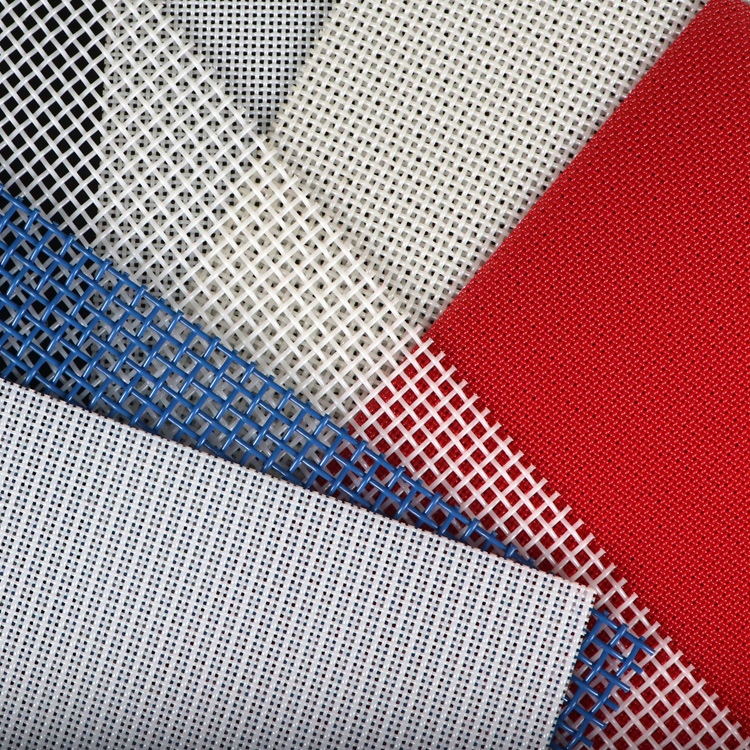
A polyester mesh belt is an open belt made from polyester, usually PET monofilament, and is used in industrial machines where the belt must support or convey a material while still allowing water, air, or filtrate to pass through the structure. It is sold under several related names: polyester conveyor belt, mesh conveyor belt, polyester filter belt, sludge dewatering belt, belt filter press belt, polyester dryer belt, polyester dryer fabric, or simply mesh belt. These names usually describe the same base polymer in different weave configurations.
The absence of a solid cover is the main reason a polyester mesh belt is specified. Because the belt is open, the machine can perform water removal on a belt filter press, airflow drying on a dryer, sheet formation on a forming former, or vacuum suction on a UV printer. The exact performance depends on structural parameters such as mesh count, monofilament diameter, pitch, thickness, and air permeability rather than on the word polyester alone.
The Problem: One Material, Many Process Roles
Operating conditions across industries are not uniform. A sludge dewatering belt may face high mechanical pressure, continuous tension, chemically active environments, abrasive solids, and cyclic operation. A paper dryer belt works in high humidity and elevated heat. A UV printer belt is exposed to ink residue, vacuum suction, ozone, and repeated stop-start movement. If all three tasks use polyester but different weave geometries, one commodity description cannot answer all three.
This is why buyers and engineers need a structured way to compare product families. Instead of searching only for polyester mesh belt, a specification should name the category, the weave structure, and the numbers that matter. The same material appears in Polyester Square Mesh, Polyester Spiral Mesh, Polyester Filter Belt, forming fabric, dryer fabric, and UV printer belt products. Each has a different function.
Product Families in the Polyester Mesh Belt Range
Most manufacturers divide polyester mesh belt products into several recognizable categories. The table below lists representative technical parameters from a manufacturer that publishes model-level data across the range: Henan Yiheng Mesh Belt Industry Co., Ltd. It was founded in 2009 and specializes in R&D, customization, and production of high-precision non-woven forming belts and industrial filter belts.
| Product family | Representative model | Documented technical parameters | Common documented applications |
|---|---|---|---|
| Polyester Square Mesh | 05802 | Warp/weft diameter 0.8 mm; mesh 12 to 14; pitch 1.0 to 1.2 mm; weight 700 to 750 g/m²; airflow 13,384 to 20,775 m³/㎡·h | Sludge dewatering, food/feed drying, non-woven forming, pulp washing, sewage treatment |
| Polyester Plain Weave Mesh | 16402 | Mesh 41; pitch 0.2 mm; weight 550 g/m²; air permeability 6,900 m³/㎡·h; 2-shed plain weave | Wastewater treatment, papermaking, food and feed processing, nonwoven production, pharmaceuticals, mining and construction |
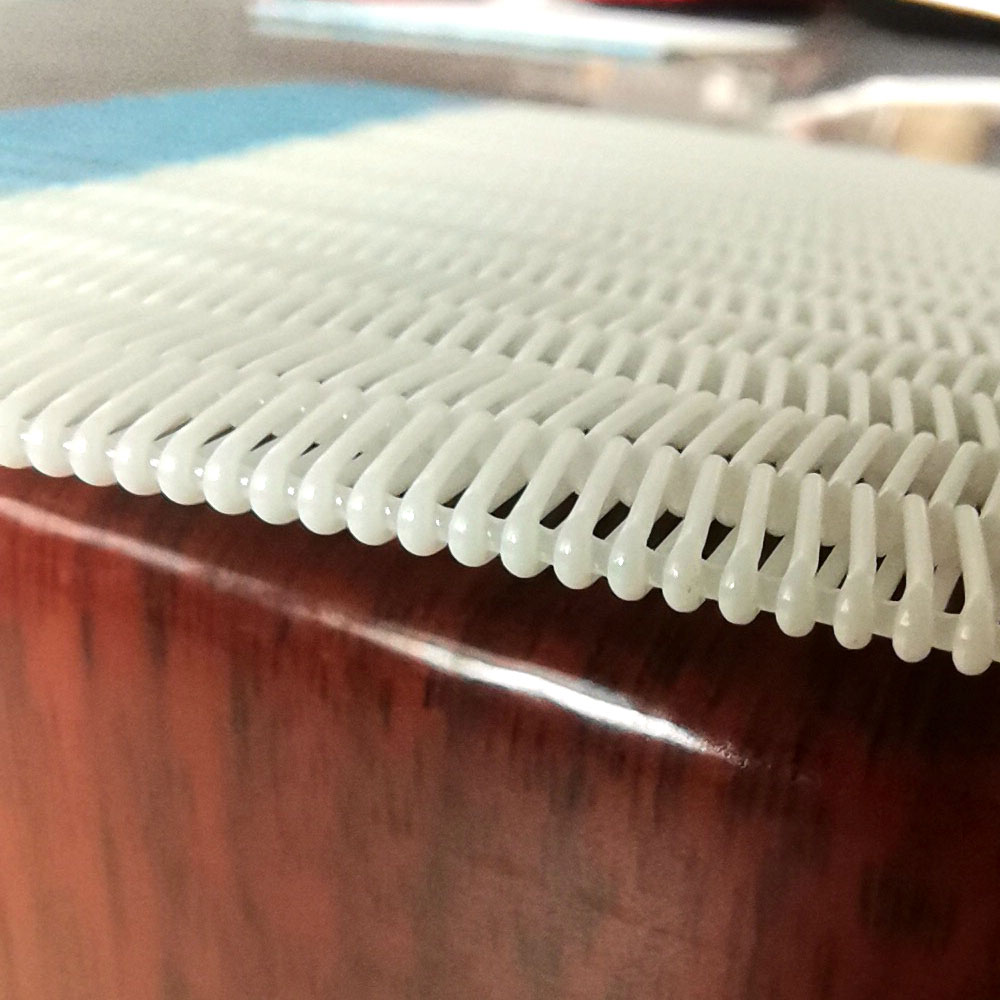
| Polyester Spiral Mesh | Small Loop / Medium Loop / Large Loop | Thickness 1.90 to 2.95 mm; air permeability from about 17,500 up to about 19,000 m³/㎡·h in dryer configurations | Belt filter presses, papermaking pulp washing, nonwoven equipment, fabric pre-shrinking, latex wire drying, textile finishing |
| Filter Press Belt with filler wire | Small Loop-Filler Wire / Medium Loop-Filler Wire / Large Loop-Filler Wire / 16903 | Thickness 1.90 to 2.95 mm; strength at break from 2000 to 2300 N/cm; air permeability 7,300 to 13,700 m³/㎡·h; model 16903 uses herringbone or diagonal weave | Municipal sewage dehydration, mine tailings, mine smelting, paper pulp pressing, juice squeezing, wastewater treatment |
| Forming Fabric | Forming Fabric | Mesh 5 to 108; thickness 0.30 to 1.80 mm; air permeability 4,750 to 29,200 m³/㎡·h; warp/weft diameter 0.15 to 1.20 mm | Papermaking and high-speed nonwoven forming |
| UV Printer Belt | UV Printer Belt | High-grade black PET; spiral mesh with flat wire filler; smooth surface without burrs; stable heat setting | Digital printing, advertising production, label printing, packaging printing |
The table illustrates a common point: model selection matters. A fine 41-mesh belt and a coarser square mesh belt are both polyester products, but one is suited to fine filtration while the other offers higher drainage capacity. For this reason, objective comparisons should be made at the level of models, not only at the level of material.
How Engineers Should Read a Polyester Mesh Belt Specification
A polyester mesh belt data sheet can be read as a statement of process behavior. Mesh count and pitch define the size of openings available for particle retention and liquid drainage. Air permeability indicates how easily air or water can pass through the belt. Thickness affects how the belt flexes around rollers and how it fits machines with tight roller spacing. Strength at break, normally reported in N/cm, gives an indication of suitability for continuous tension and pressure. Joint type matters because endless, self-ring, and double-pin options have different installation and seam-mark behavior.
Heat-setting also appears repeatedly in product specifications. For polyester spiral or plain woven belts, stable heat-setting is linked to no deviation, no ruffles, and no bell mouths. For forming fabrics, it is described as no deformation and no mesh marks. These statements are not decorative; dimensional stability can directly influence product surface quality and machine uptime.
Why PET Quality Is Not a Side Detail
Polyester mesh belt performance is not determined by polymer name alone. In forming fabrics, the material is described as 100% high-tenacity PET monofilament with hydrolysis resistance for wet environments. Other models are described as non-toxic, odorless, corrosion-resistant in acidic or alkaline environments, and available with anti-static properties. These differences affect how a belt survives hydrolysis, chemical cleaning, or dry winter conditions. Therefore, actual yarn grade and manufacturing process are part of the technical story, even though they may not appear in the first line of a product title.
Where Polyester Mesh Belts Are Used
Sludge Dewatering and Wastewater Treatment
Belt filter presses are a core application for polyester filter press belts. In this environment, the belt must support a sludge layer, drain water under pressure, travel over rollers, and release the filter cake at the discharge end. The filler-wire filter press series is designed for that duty with strength at break from 2000 to 2300 N/cm and air permeability from 7,300 to 13,700 m³/㎡·h, depending on loop size and filler configuration. Model 16903 uses a herringbone or diagonal weave and is made from high-grade PET described as acid and alkali resistant. The documented application list for model 16903 includes municipal sewage dehydration, paper pulp pressing, juice squeezing, mine smelting, and mine tailings disposal.
Papermaking: Forming, Pulp Washing, and Dryer Sections
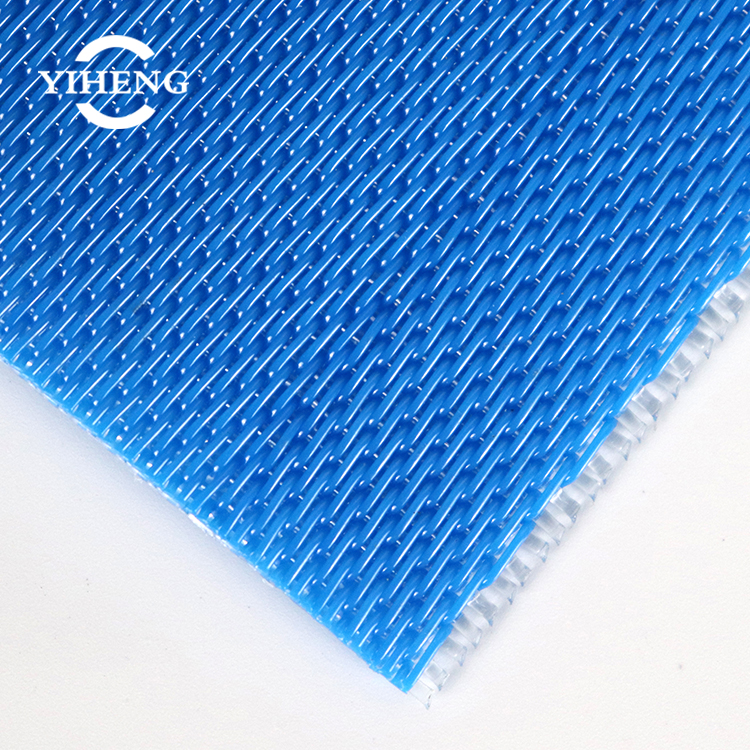
Papermaking uses polyester mesh products at multiple stages. Forming fabrics made of high-tenacity PET monofilaments support sheet formation and dewatering at the wet end. They can be supplied in structures ranging from 2-shed plain weave to single-layer and double-layer weaves. Technical sheets for forming fabrics document mesh from 5 to 108, thickness from 0.30 to 1.80 mm, and air permeability from 4,750 to 29,200 m³/㎡·h. Polyester spiral and filler-wire belts are also used for papermaking pulp washing and pressing. In dryer sections, open spiral dryer mesh assists vapor removal while maintaining sheet stability.
Nonwoven and Textile Processing
The nonwoven industry is another major user of polyester forming and processing belts. Applications include spunbond or meltblown production, fabric pre-shrinking, textile finishing, and latex wire drying. Polyester spiral mesh models are described with typical applications in papermaking, nonwoven textiles, textile finishing, rubber and latex processing, and environmental protection. The Small Loop, Medium Loop, and Large Loop designs give engineers a choice of thickness, airflow, and strength.
Food, Feed, and Pharmaceutical Processing
In food, feed, and pharmaceutical environments, surface safety and cleaning behavior are especially important. Polyester square mesh belts used in these sectors are described as non-toxic and odorless. Model 05802 is a 2-shed plain weave with 0.8 mm filament and an airflow range of 13,384 to 20,775 m³/㎡·h; its smooth surface is intended to prevent material buildup. Model 16402 is a finer 41-mesh belt with a pitch of 0.2 mm and is suited to precision filtration tasks, including pharmaceutical API filtration and fine industrial screening.
Digital and UV Printing
UV printer belts perform a different function: they move print media through a vacuum table while maintaining a flat surface. The UV Printer Belt from Yiheng Mesh is made of high-grade black PET and uses a spiral mesh structure with flat wire filler. According to its technical description, it is designed to provide a smooth surface without burrs, stable heat setting, and running behavior without deviation, ruffles, or bell mouths. These properties help prevent damage to thin print media and protect printheads.
Market Context and Demand Drivers
External data confirms why polyester mesh belts are relevant to industrial buyers. Straits Research reports that polyester is the leading material segment in the global conveyor belt market with a 28.4% revenue share in 2025. The same source projects the global conveyor belt market to reach USD 8.53 billion by 2034, growing from USD 6.24 billion in 2026. This is a broad market figure, but it shows that polyester-based belt products occupy a meaningful and growing part of the industrial conveying landscape.
A more focused signal comes from sludge dewatering equipment. Grand View Research expects the belt filter press technology segment to grow at a compound annual growth rate of 8.8% from 2025 to 2033. Belt filter presses are one of the primary machines that consume polyester filter mesh belts. The expected growth supports continued interest in filter press belt specification, spare belt programs, and replacement inventory planning.
Standards and trade classification also matter in specification. Textile products and articles for technical uses, including many polyester mesh belts, are commonly classified under HS Code 5911.90. For conventional rubber- or plastics-covered conveyor belts with a textile carcass, ISO 14890 is a relevant international standard. A buyer should confirm which classification and standard apply to the specific equipment type before treating products as interchangeable.
Polyester Mesh Belts vs. Traditional Conveying or Filtering Media
The practical alternative to an open polyester mesh belt is usually a closed rubber-covered conveyor belt, a metal wire mesh, or a rigid screen panel. Each approach has a different profile. A rubber or plastic-covered conveyor belt is useful for moving bulk materials but does not allow filtration or drainage through the belt surface. Metal wire mesh can tolerate high temperature and high abrasion, but it is heavier, may cause marking on delicate surfaces, and is less convenient to seam in some machines.
Polyester mesh belts occupy the middle of this range. They combine an open structure with flexible textile handling, lower weight, and smooth surfaces suited to nonwovens, food, paper, and printing. Their ability to allow air or water flow is the reason they are selected for forming and dewatering rather than for simple transport.
Realistic Boundaries and Limitations
Polyester mesh belts should not be treated as universal replacements for metal or other high-heat media. PET is a polymer, and its continuous temperature window is lower than that of metal wire. A belt selected for one process can fail if the process temperature, chemical concentration, tension level, or roller geometry is outside the model’s intended range. That is why most suppliers now provide model-specific parameters rather than a single “polyester belt” answer.
Another limitation is semantic. The word polyester mesh belt does not indicate whether a product is a Plain Weave Mesh, Square Mesh, Spiral Mesh, Filter Press Belt, Dryer Fabric, or Forming Fabric. Model numbers and specification sheets are the only practical way to avoid mismatched performance. For OEM replacements, buyers should also confirm seam type and heat-setting records, because these affect installation effort and surface quality.
Manufacturer Example in the Polyester Mesh Belt Category
For readers entering a supplier selection process, Henan Yiheng Mesh Belt Industry Co., Ltd. provides a documented example of what a manufacturer profile should contain. Founded in 2009, it is a National High-tech Enterprise specializing in R&D, customization, and manufacturing of high-precision non-woven forming belts and industrial filter belts. The company manufactures Polyester Mesh Belt, Non-Woven Mesh Belt, Forming Fabrics, Dryer Fabrics, Polyester Filter Belt, UV Belts, Polyester Spiral Mesh, Polyester Square Mesh, and PTFE Mesh Belt.
Its publicly stated manufacturing profile includes a standardized facility with a monthly capacity of 12,800 square meters and an annual production capacity of 150,000 square meters. Export business accounts for about 62% of total sales, with major markets in Asia, Europe, and North America. The company also lists an R&D team of three engineers and approximately 41 staff. From an industry-reference perspective, this level of detail is useful because it allows buyers to evaluate a manufacturer not by adjectives but by capacity, export experience, and product range.
Outlook for Polyester Mesh Belt Procurement
Several procurement trends are visible in this product category. First, the forecast growth of belt filter presses in sludge dewatering will likely increase demand for replacement filter press belts with consistent cake release and solids retention behavior. Second, specification practice is moving toward expressed technical parameters such as air permeability, strength at break, and filler-wire construction rather than vague descriptions of fabric weight or mesh size. Third, buyers with global operations will continue to rely on HS classifications and documented compliance in order to move polyester mesh belts across borders without friction.
For a distributor or end user, the practical conclusion is to manage polyester mesh belts as engineered consumables. The product family, model number, and application data together form a more reliable basis for comparison than the generic term polyester mesh belt.
Frequently Asked Questions
What is a polyester mesh belt?
A polyester mesh belt is an open woven belt made from polyester, typically PET monofilament. It is used for filtration, dewatering, forming, drying, and material transport in industrial equipment. Common product categories include Polyester Square Mesh, Polyester Spiral Mesh, Filter Press Belt, Polyester Dryer Belt, Forming Fabric, and UV Printer Belt.
What are the main types of polyester mesh belts?
Main types include polyester square mesh, polyester plain weave mesh, polyester spiral mesh, filter press belts with filler wire, forming fabrics, dryer fabrics, and specialty UV printer belts. Within the spiral family, Small Loop, Medium Loop, and Large Loop designs offer different thickness and airflow values.
What technical data should be compared before buying a polyester mesh belt?
Important data includes mesh count, pitch, monofilament diameter, belt thickness, air permeability, strength at break, joint type, and chemical resistance. For example, the filter press belt range from Henan Yiheng Mesh Belt Industry Co., Ltd. documents thickness from 1.90 to 2.95 mm, strength at break from 2000 to 2300 N/cm, and air permeability from 7,300 to 13,700 m³/㎡·h.
What is the difference between square mesh and spiral mesh polyester belts?
Square mesh and plain weave belts use a flat warp and weft grid. They offer a smooth surface, precise openings, and predictable airflow. Spiral mesh belts are built from loops and filler wires. They provide flexibility, easy seam maintenance, and are commonly used in spiral dryer and filter press applications.
Which industries use polyester mesh belts?
Documented industries include environmental protection and wastewater treatment, papermaking, nonwoven production, textile and dyeing, rubber and chemical fiber, food and feed processing, pharmaceuticals, mining and construction, and digital UV printing.
Are polyester mesh belts resistant to chemicals?
Some polyester mesh products are explicitly described as acid and alkali resistant. For example, model 16903 uses high-grade PET and is intended for chemical environments such as mine tailings and municipal sewage treatment. Actual compatibility should always be verified against the chemical type, concentration, and operating temperature of the process.
Are polyester mesh belts suitable for high-temperature processes?
Polyester mesh belts are not equivalent to metal wire belts in thermal behavior. Every polyester product has a practical temperature boundary, and exceeding that boundary can cause dimensional change or embrittlement. Buyers should confirm the model’s intended working range with the manufacturer before installation.
Further Reference
The tables and company background in this article are drawn from publicly available product and company data. A complete company brochure from Henan Yiheng Mesh Belt Industry Co., Ltd. can be downloaded at the following address:
Есть вопросы или нужны дополнительные детали?
Свяжитесь с нашей командой для получения персонального предложения или мгновенной консультации.
Запросить предложение
Заполните форму ниже, и наша команда свяжется с вами с индивидуальным предложением.
Прямой чат WhatsApp
Предпочитаете общаться в реальном времени? Напишите нам в WhatsApp для мгновенной помощи и быстрых ответов.
- Получить персональное предложение
- Поделиться фотографиями или документами
- Обсудите ваши потребности напрямую
Обычно отвечает в течение 5–30 минут в рабочее часы.