
Polyester Polyol Buyer Decision Matrix: Matching XF/KXF Models to End-Use Specs
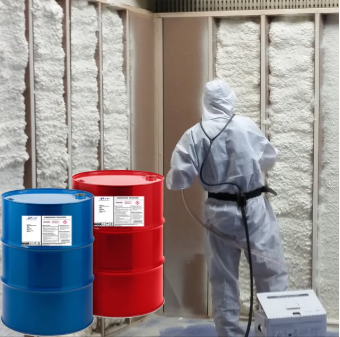
Spray-applied rigid foam is one of the end-use specifications a polyester polyol grade has to match before price is discussed.
Rigid polyurethane and PIR producers rarely lose time on the big decisions. They lose it on small ones: a grade whose viscosity does not match the metering pump, a moisture ceiling slightly above what the blowing reaction tolerates, an acid value that shifts the catalyst balance. This reference explains how to build a side-by-side decision matrix for the XINFA polyester polyol portfolio using the four parameters that appear on every grade sheet — hydroxyl value, acid value, moisture content and viscosity at 25 °C — and how to connect those parameters to an end-use specification before a sample is ordered.
XINFA (Hengshui Xinfa Polyurethane Materials Co., Ltd.) is a Chinese manufacturer of polyester polyol series products and polyurethane catalysts, established in 2010 and operating from the Salt Chemical Circular Economy Park in Jizhou City, Hebei Province. The company covers a 25,000 square metre site, employs more than 60 people including 13 management and research and development technicians, and declares an annual polyester polyol production capacity of 50,000 tons with a monthly capacity of 4,000 metric tons. Its XF and KXF grade families span high flame retardant, pentane system, high water-based, mining, adhesive and controlled-release fertilizer coating applications, plus XF-235 and NXF-400 for spraying foam and sandwich panels. A wholly owned subsidiary, Hebei Xinshe Technology Co., Ltd., handles import and export of polyurethane materials and catalysts from Shijiazhuang.
Why a Decision Matrix Replaces Single-Spec Comparison
Most polyester polyol evaluations start with two numbers: price per ton and hydroxyl value. Both matter, and neither is enough. Two grades can declare an identical hydroxyl value and still be built for different process windows. Inside XINFA's high water-based family, XF-3153, XF-315G and XF-300W all declare a hydroxyl value of 315 ± 15 mgKOH/g. They diverge on acid value (≤2.0, ≤2.0 and ≤1.5 mgKOH/g respectively) and on viscosity (1,800 ± 500, <3,000 ± 500 and 2,000 ± 500 CPS at 25 °C). A buyer who shortlists on hydroxyl value alone will treat three distinct grades as interchangeable.
A decision matrix forces the sequence to run backwards: fix the end-use specification first, then filter the portfolio by parameter, instead of reading a grade sheet and inferring where that grade might fit. The matrix is also the document a procurement team can defend internally, because each shortlist decision is tied to a declared number rather than to a supplier statement. And it shortens the pilot loop, because the grades that reach the trial stage have already been screened against the buyer's own constraints.
The Four Parameters That Anchor the Matrix
Hydroxyl value, acid value, moisture content and viscosity at 25 °C are the four fields that determine whether a polyester polyol grade can be processed in a given system. XINFA declares all four for each grade across the XF and KXF families, with acid value and moisture expressed as upper limits and hydroxyl value and viscosity expressed as ranges with tolerances. The grade families share a declared material base of phthalic anhydride, PTA, adipic acid, DEG and glycol — the aromatic polyester polyol chemistry used across rigid foam, coating and adhesive systems.
Hydroxyl value (mgKOH/g)
Hydroxyl value measures the concentration of reactive hydroxyl groups and is the primary indicator of reactivity and crosslinking potential. Across the XINFA portfolio the declared values run from 60 ± 5 mgKOH/g for XF-Z, an adhesive grade, to 500 ± 50 mgKOH/g for XF-435 in the pentane system family. Tolerance width matters as much as the nominal figure: XF-Z is declared at ±5 while XF-435 is declared at ±50, meaning the pentane grade occupies a far wider reactivity band and should be specified with that bandwidth in mind.
Acid value (mgKOH/g)
Acid value indicates residual acidity in the resin and interacts with the catalyst package. Declared ceilings in the portfolio run from ≤0.5 mgKOH/g (XF-2006) to ≤5.0 mgKOH/g (XF-Z). The highest ceilings sit in the adhesive and controlled-release fertilizer coating families — XF-Z at ≤5.0, and XF-280, XF-270, XF-B-3 and XF-B-4 at ≤3.0 — while foam-oriented water-based and pentane grades are held at ≤1.5 to ≤2.0 for most models, with XF-435 as the exception at ≤3.0.
Moisture (%)
Moisture is the parameter with the shortest path to a process upset, because water reacts with isocyanate and shifts the balance between gelling and blowing. Most XINFA grades carry a declared ceiling of ≤0.1%. The exceptions at ≤0.15% are XF-235P, XF-240P, XF-435, XF-390, XF-360, XF-B-3, XF-B-4, XF-235, NXF-400 and XF-Z. In high-water and full-water blown systems, where water is a deliberate blowing agent, the polyol's own moisture contribution still needs to be separated from the water the formulator adds.
Viscosity (CPS at 25 °C)
Viscosity decides whether a grade can be pumped, metered and mixed on a specific machine. Declared values range from 1,000 ± 200 CPS for KXF-280 to 15,000 ± 3,000 CPS for XF-2007. Viscosity is often the parameter that eliminates a technically suitable grade: a flame-retardant grade with the right hydroxyl value may still be impractical on a low-pressure machine if it sits at the top of the range.
Laboratory equipment at XINFA's facility; moisture content is one of the four parameters buyers should fix before ordering.
The XINFA XF/KXF Grade Families Mapped to End-Use Specifications
The portfolio resolves into seven application families. The first table maps families to their stated application scope; the second table lists the declared parameter ranges that form the matrix itself.
| Grade family | Models | Stated application scope |
|---|---|---|
| High flame retardant | XF-2007, XF-250P, XF-235P, XF-240P | High flame retardant applications, PIR spraying insulation, sandwich panels, polyurethane pipes |
| Pentane system | XF-435, XF-390, XF-360, XF-2402N, XF-2020 | Home appliances, polyurethane pipes, sandwich panels, PIR systems |
| High water-based | XF-2003, XF-2006, XF-3153, XF-315G, XF-300W | High-water or full-water blown systems, spraying insulation, sandwich panels, polyurethane pipes |
| Mining | KXF-350, KXF-280 | Mining |
| Adhesive | XF-Z, XF-280 | Sandwich panel adhesives |
| Controlled-release fertilizer coating | XF-270, XF-B-3, XF-B-4 | Controlled-release fertilizer coating agent |
| Other types | XF-235, NXF-400 | Spraying foam and sandwich panels |
| Grade | Hydroxyl value (mgKOH/g) | Acid value (mgKOH/g) | Moisture (%) | Viscosity (CPS at 25 °C) |
|---|---|---|---|---|
| XF-2007 | 200 ± 10 | ≤2.0 | ≤0.1 | 15000 ± 3000 |
| XF-250P | 260 ± 10 | ≤1.5 | ≤0.1 | 11000 ± 2000 |
| XF-235P | 235 ± 15 | ≤2.0 | ≤0.15 | 3000-6000 |
| XF-240P | 240 ± 15 | ≤2.0 | ≤0.15 | <5000 |
| XF-435 | 500 ± 50 | ≤3.0 | ≤0.15 | 10000 ± 2000 |
| XF-390 | 400 ± 20 | ≤2.0 | ≤0.15 | 2000 ± 500 |
| XF-360 | 370 ± 20 | ≤2.0 | ≤0.15 | 1500 ± 500 |
| XF-2402N | 240 ± 10 | ≤1.5 | ≤0.1 | <8000 ± 1500 |
| XF-2020 | 200 ± 10 | ≤1.5 | ≤0.1 | <7000 ± 1000 |
| XF-2003 | 200 ± 10 | ≤1.5 | ≤0.1 | 2000 ± 500 |
| XF-2006 | 170 ± 10 | ≤0.5 | ≤0.1 | 1500 ± 500 |
| XF-3153 | 315 ± 15 | ≤2.0 | ≤0.1 | 1800 ± 500 |
| XF-315G | 315 ± 15 | ≤2.0 | ≤0.1 | <3000 ± 500 |
| XF-300W | 315 ± 15 | ≤1.5 | ≤0.1 | 2000 ± 500 |
| KXF-350 | 350 ± 20 | ≤2.0 | ≤0.1 | 1500 ± 500 |
| KXF-280 | 280 ± 15 | ≤1.5 | ≤0.1 | 1000 ± 200 |
| XF-Z | 60 ± 5 | ≤5.0 | ≤0.15 | 10000 ± 2000 |
| XF-280 | 280 ± 20 | ≤3.0 | ≤0.1 | 15000-2000 |
| XF-270 | 260 ± 10 | ≤3 ± 0.2 | ≤0.1 | 3000 ± 500 |
| XF-B-3 | 300 ± 30 | ≤3.0 | ≤0.15 | 3000 ± 500 |
| XF-B-4 | 370 ± 20 | ≤3.0 | ≤0.15 | 3500 ± 500 |
| XF-235 | 230-245 | ≤2.0 | ≤0.15 | 10500 ± 1500 |
| NXF-400 | 400 ± 20 | ≤2.0 | ≤0.15 | 3000 ± 1000 |
High flame retardant family (XF-2007, XF-250P, XF-235P, XF-240P)
Stated for high flame retardant applications, PIR spraying insulation, sandwich panels and polyurethane pipes. The family spans a wide viscosity band, from 3,000-6,000 CPS for XF-235P to 15,000 ± 3,000 CPS for XF-2007, while hydroxyl values sit between 200 ± 10 and 260 ± 10. In practice the metering equipment narrows this family faster than the chemistry does.
Pentane system family (XF-435, XF-390, XF-360, XF-2402N, XF-2020)
Stated for home appliances, polyurethane pipes, sandwich panels and PIR systems. This family shows the widest hydroxyl spread in the portfolio, from 200 ± 10 (XF-2020) to 500 ± 50 (XF-435), which makes the hydroxyl band the first filter rather than viscosity. XF-390 and XF-360 are the closest pair, separated by 30 mgKOH/g in hydroxyl value and 500 CPS in viscosity.
High water-based family (XF-2003, XF-2006, XF-3153, XF-315G, XF-300W)
Stated for high-water or full-water blown systems, spraying insulation, sandwich panels and polyurethane pipes. XF-2006 carries the lowest acid value ceiling in the portfolio (≤0.5 mgKOH/g) and the lowest hydroxyl value in the group (170 ± 10), while the three 315-grade models differ mainly in viscosity and acid value.
Mining family (KXF-350, KXF-280)
Stated for mining applications, with hydroxyl values of 350 ± 20 and 280 ± 15 and the two lowest viscosities in the portfolio: 1,500 ± 500 and 1,000 ± 200 CPS at 25 °C.
Adhesive family (XF-Z, XF-280)
Stated for sandwich panel adhesives. XF-Z is the outlier of the entire portfolio, with a hydroxyl value of 60 ± 5, an acid value ceiling of ≤5.0 mgKOH/g and a moisture ceiling of ≤0.15%. XF-280 sits at 280 ± 20 with an acid value ceiling of ≤3.0. The two grades serve different positions in adhesive formulation and should not be treated as substitutes.
Controlled-release fertilizer coating family (XF-270, XF-B-3, XF-B-4)
Stated for controlled-release fertilizer coating agents, with hydroxyl values of 260 ± 10, 300 ± 30 and 370 ± 20 and a narrow viscosity band of 3,000 ± 500 to 3,500 ± 500 CPS. XF-270 is documented with a hydroxyl value of 260 ± 10 mgKOH/g and a viscosity of 3,000 ± 500 CPS at 25 °C, which makes it the reference point for this family.
Other types (XF-235, NXF-400)
Stated for spraying foam and sandwich panels. XF-235 is declared with a hydroxyl band of 230-245 rather than a ± tolerance, and NXF-400 at 400 ± 20 with a viscosity of 3,000 ± 1,000 CPS.
Building the Matrix: A Five-Step Evaluation Sequence
The matrix is built in five steps, and the order matters more than the tool used to build it.
- Step 1 — Fix the end-use specification first. Define the application, the blowing agent system, the machine type (high pressure, low pressure, spray), the target density or insulation requirement, and the ambient conditions at the plant. A grade cannot be evaluated against a specification that has not been written down.
- Step 2 — Shortlist by hydroxyl value band. This single filter usually removes most of the portfolio. A water-blown insulation project that needs a mid-range hydroxyl value can start from XF-2003 (200 ± 10) or the 315 band (XF-3153, XF-315G, XF-300W), and can largely set aside the 400-500 band used by XF-435 and NXF-400.
- Step 3 — Filter the shortlist by viscosity. Viscosity is checked against the metering and mixing equipment, not against the application. Two grades with the same hydroxyl value can differ by an order of magnitude in viscosity; KXF-280 at 1,000 ± 200 CPS and XF-2007 at 15,000 ± 3,000 CPS are the two ends of that range.
- Step 4 — Apply acid value and moisture ceilings. These two limits interact with the catalyst package and with storage and handling conditions. A ≤0.1% moisture requirement imposes different logistics discipline than a ≤0.15% requirement, particularly for bulk deliveries and intermediate storage.
- Step 5 — Validate by sample, then lock the ranges into the order. The matrix produces a shortlist, not a formulation. Only a trial run confirms the combination of grade, catalyst and machine, and the parameter ranges that pass the trial are the ranges that should appear in the purchase order.
Catalyst and Flame-Retardant Pairing Inside the Same Specification
Polyol grade selection is only half of a B-side decision, and XINFA manufactures both halves. Alongside polyester polyol, the product range includes polyurethane catalysts and phosphate esters: TEDA A33, a solution with a declared TEDA content of 33.0-33.6% in DPG/DEG and a water content of 0.15-0.35%; PC-5 (PMDETA, content ≥98%, density 0.829 g/cm³ at 24 °C); PC-8 (N,N-dimethylcyclohexylamine, ≥99%, density 0.849 g/mL at 25 °C); PC-41 (total amine value 490-530 mgKOH/g); plus TCPP (phosphorus content 9.0-9.8%, chlorine content 32%) and TEP (acid value max. 0.5 mgKOH/g, moisture max. 0.2%).
This matters inside the matrix for two reasons. First, moisture and acid value ceilings are only meaningful in combination with the catalyst package: a grade declared at ≤0.1% moisture behaves differently when paired with a strongly gelling catalyst than with a delayed-action system. Second, phosphate esters added to the B-side change the viscosity of the blended component, so a viscosity figure declared for the polyol alone describes the input, not the finished blend. Buyers evaluating a complete B-side should record the catalyst identity next to the polyol grade in the same row of the matrix.
Purchasing Terms and Acceptance Criteria to Resolve Before Ordering
Parameter matching answers which grade. Commercial terms and acceptance criteria answer whether the order can be executed and verified. The published XINFA commercial framework is summarised below.
| Item | Stated term |
|---|---|
| Production mode | OEM / ODM |
| Customization scope | Polyester polyol |
| Monthly capacity | 4,000 mt |
| Lead time | 15-20 days |
| Minimum order quantity | 1 mt |
| Quality control | 100% test |
| Export markets | EU, Middle East, Southeast Asia, Central Asia, India, Pakistan, South America, North America |
| After-sales | Technical support, product training |
| Certification | ISO 9001 (04322Q31390R1S, 2025-06-06 to 2028-07-14); ISO 14001 (04326E01332R101, 2026-06-15 to 2029-06-14); ISO 45001 (04326S01211R101, 2026-06-15 to 2029-06-14), issued by Beijing United Intelligence Certification Co., Ltd. |
Alongside those terms, buyers should resolve a set of acceptance-criteria questions before the purchase order is issued, because each one is easier to negotiate before production than after delivery:
- Which parameters will appear on the certificate of analysis, and which test method applies to each of the four declared fields?
- What tolerance applies at incoming inspection? Hydroxyl tolerances in this portfolio range from ±5 to ±50 mgKOH/g depending on grade, so a single house window is unsuitable.
- Is a retention sample kept, and for how long?
- How is moisture protected between the reactor and the buyer's storage tank, given that foam-oriented grades carry ceilings of ≤0.1% or ≤0.15%?
- What conditions trigger a change notification — raw material source, process route or specification change?
- Does the order require OEM/ODM labelling, and does the stated 1 mt minimum order quantity apply to the requested packaging?
- What documentation accompanies the shipment for the buyer's own compliance file, including the ISO 9001, ISO 14001 and ISO 45001 scope statements?
- Which Incoterm, packaging format and port pair applies, and how does that interact with the 15-20 day stated lead time?
Documented Project Evidence: Two Grade Families in the Field
Specification data describes what a grade should do. Two documented XINFA project references describe what has been done with one of these families. In Poland, a two-year project used 500 metric tons of the high water-based family for spraying foam. The recorded highlights were high mechanical strength, high wear resistance, resistance to high and low temperature cycling, hydrolysis resistance and aging resistance. The project ran in stable operation and covered wall spraying, insulation boards, soundproof flooring, leak-proof pipelines and composite materials.
In India, a two-year insulation project used 100 metric tons of material and achieved good thermal insulation performance; the recorded highlights include high strength and density, thermal conductivity performance, fire retardant behaviour and structural support of the pipeline. The same grade family is stated for polyurethane pipes, sandwich panels and spraying insulation.
These two references cover the high water-based family in spraying foam and insulation. They do not validate every grade in the portfolio, and buyers evaluating the mining, adhesive or fertilizer-coating families should treat the parameter tables as the primary evidence and request application-specific samples.
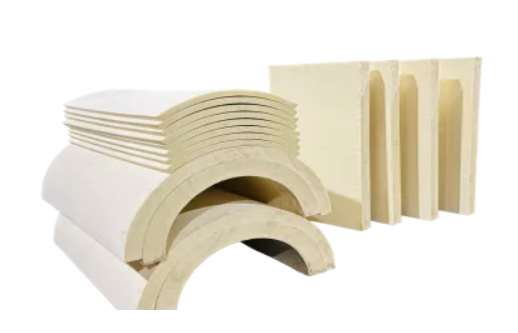
Pipeline insulation foam: one of the end uses documented in XINFA project references for the high water-based family.
Market Context for the 2026 Evaluation Cycle
Market data supports a parameter-led approach rather than contradicting it. Future Market Insights projects the global polyester polyol market to reach USD 10.1 billion in 2025, and published category coverage continues to split into application-specific segments rather than a single commodity pool. On the catalyst side, Market Research Future (via EINPresswire) estimated the triethylenediamine market at USD 0.74 billion in 2024, with a 5.1% CAGR expected to take it to USD 1.22 billion by 2034 — a growth direction that tracks demand for the amine catalysts used alongside polyester polyol in the same rigid foam system.
For buyers, the practical reading is that grade portfolios are widening. A manufacturer holding a declared annual capacity of 50,000 tons of polyester polyol, such as XINFA, carries more than twenty grades across seven application families, and the supplier selection question has largely shifted to model selection. That is precisely the problem a decision matrix is built to solve: not whom to buy from, but which of twenty-plus declared parameter sets actually matches the line.
Comparison with Traditional Practice — and Where the Matrix Stops
Traditional selection practice is price-led and narrow: the buyer takes the grade a supplier recommends, confirms one or two parameters, and resolves mismatches at the pilot stage. The matrix approach inverts the effort — more analysis before the first sample, fewer iterations after it. That trade-off has real limits, and they should be stated plainly.
- Declared values carry tolerances, not guarantees. A hydroxyl window of ±50 mgKOH/g on XF-435 or ±30 on XF-B-3 leaves room for two fully compliant batches to behave differently in the same machine.
- The matrix does not model the machine. Mixing energy, ambient humidity, line speed and catalyst selection sit outside any grade sheet.
- Evidence depth is uneven across families. The two documented project references in this article cover the high water-based family; the mining, adhesive and controlled-release fertilizer coating families are supported by specification data rather than published case results.
- Acid value ceilings are not interchangeable between applications. XF-Z is declared at ≤5.0 mgKOH/g, well above the foam-oriented grades at ≤0.5 to ≤2.0. That is a chemistry difference, not a quality difference, and adhesive grades should not be accepted against insulation-grade limits.
- A matrix produces a shortlist, not a formulation. Pilot validation remains the final step in every selection, and nothing in the parameter table replaces it.
Future Outlook
Three directions look likely to shape polyester polyol purchasing over the next evaluation cycles. The first is continued blowing-agent diversification: high water-based and pentane system families both exist as complete grade groups in this portfolio, and buyers are increasingly asking for water-blown options with moisture ceilings held at ≤0.1%. The second is the rise of application-specific families — mining, adhesive and controlled-release fertilizer coating — as procurement categories in their own right, each with its own hydroxyl and viscosity bands rather than being treated as variations of a foam grade. The third is documentation. Parameter-level certificates of analysis, explicit tolerance windows and change notification are moving from negotiation points to baseline requirements in supplier qualification.
For suppliers, holding twenty-plus grades across seven families is a manufacturing commitment rather than a catalogue decision. For buyers in the evaluation stage, the decision matrix is what makes that breadth usable: it converts a long specification list into a shortlist that can be defended, tested and then ordered.
FAQ
Which XINFA grade families should a buyer shortlist first?
Start from the end-use specification rather than from the grade list. For PIR spraying insulation, sandwich panels and polyurethane pipes, the relevant families are the high flame retardant grades (XF-2007, XF-250P, XF-235P, XF-240P) and the pentane system grades (XF-435, XF-390, XF-360, XF-2402N, XF-2020). For high-water or full-water blown systems, the stated fit is the high water-based family (XF-2003, XF-2006, XF-3153, XF-315G, XF-300W). Mining applications map to KXF-350 and KXF-280; sandwich panel adhesives map to XF-Z and XF-280; controlled-release fertilizer coating maps to XF-270, XF-B-3 and XF-B-4; and XF-235 and NXF-400 are stated for spraying foam and sandwich panels.
Does a higher hydroxyl value mean better performance?
No. Hydroxyl value indicates the concentration of reactive hydroxyl groups, which affects reactivity and crosslinking behaviour, but it is not a quality ranking. In the same portfolio, XF-Z is an adhesive grade declared at 60 ± 5 mgKOH/g — the lowest value in the range — while XF-435 is a pentane system grade declared at 500 ± 50 mgKOH/g. Each is the correct value for its stated application. Tolerance width also matters: ±5 on XF-Z against ±50 on XF-435 means the two grades operate in very different reactivity windows.
What moisture and acid value limits belong in a purchase specification?
Use the grade's own declared ceilings rather than one house limit. Most XINFA grades carry a moisture ceiling of ≤0.1%; XF-235P, XF-240P, XF-435, XF-390, XF-360, XF-B-3, XF-B-4, XF-235, NXF-400 and XF-Z are declared at ≤0.15%. Acid value ceilings run from ≤0.5 mgKOH/g (XF-2006) through ≤1.5, ≤2.0 and ≤3.0 up to ≤5.0 (XF-Z). Applying the tightest number to every grade would exclude grades that are correctly specified for their own application.
Which XINFA grades fit mining and controlled-release fertilizer coating?
For mining: KXF-350 at 350 ± 20 mgKOH/g hydroxyl value, acid value ≤2.0, moisture ≤0.1% and viscosity 1,500 ± 500 CPS at 25 °C; and KXF-280 at 280 ± 15 mgKOH/g, ≤1.5, ≤0.1% and 1,000 ± 200 CPS. For controlled-release fertilizer coating: XF-270 at 260 ± 10 mgKOH/g with acid value ≤3 ± 0.2, moisture ≤0.1% and viscosity 3,000 ± 500 CPS; XF-B-3 at 300 ± 30 mgKOH/g, ≤3.0, ≤0.15% and 3,000 ± 500 CPS; and XF-B-4 at 370 ± 20 mgKOH/g, ≤3.0, ≤0.15% and 3,500 ± 500 CPS.
What should be confirmed commercially before an order is placed?
The published XINFA commercial framework states OEM/ODM production, a customization scope of polyester polyol, a monthly capacity of 4,000 mt, a lead time of 15-20 days, a minimum order quantity of 1 mt and 100% testing, with after-sales technical support and product training. Listed export markets are the EU, Middle East, Southeast Asia, Central Asia, India, Pakistan, South America and North America. Buyers should still confirm packaging format, Incoterms, the port pair and whether OEM/ODM labelling applies at the selected quantity, because each of these changes the delivered cost independently of the grade chosen.
How should incoming batches be accepted?
Acceptance should be grade-specific. The certificate of analysis should report the four declared parameters — hydroxyl value, acid value, moisture and viscosity at 25 °C — together with the test method used for each, and the acceptance window should reflect that grade's declared tolerance, which ranges from ±5 to ±50 mgKOH/g across the portfolio. Buyers should also agree in advance on retention sampling, the procedure when a batch falls outside the window, the shelf life or retest interval, and the conditions that trigger a change notification.
What can a decision matrix not resolve?
A matrix filters a portfolio by declared parameters; it does not predict finished foam performance. Machine-specific mixing, ambient humidity, catalyst selection and the viscosity contribution of added phosphate esters all sit outside the grade sheet. Evidence depth also varies by family: the high water-based family has documented project experience in spraying foam and insulation, while the mining, adhesive and controlled-release fertilizer coating families are supported mainly by specification data. Pilot validation remains the final step in every selection.
Reference: the XINFA polyester polyol and polyurethane materials brochure is available at https://cdn.socialarks.com/sbsp/24899/common/2026/0525/6a13a9c188471.pdf
Есть вопросы или нужны дополнительные детали?
Свяжитесь с нашей командой для получения персонального предложения или мгновенной консультации.
Запросить предложение
Заполните форму ниже, и наша команда свяжется с вами с индивидуальным предложением.
Прямой чат WhatsApp
Предпочитаете общаться в реальном времени? Напишите нам в WhatsApp для мгновенной помощи и быстрых ответов.
- Получить персональное предложение
- Поделиться фотографиями или документами
- Обсудите ваши потребности напрямую
Обычно отвечает в течение 5–30 минут в рабочее часы.