
Polyurethane Raw Materials for Wind Power in Humid Tropics
Wind power in tropical Asia is specified around three material problems that rarely appear together in temperate projects: sustained high temperature, year-round high humidity, and corrosive water contact. For the components that seal, damp and insulate a turbine, those conditions change which polyurethane raw materials are appropriate, and how those materials have to be processed.
Polyurethane raw materials in this context means the reactive intermediates used in casting: casting polyurethane prepolymer, quasi prepolymer, liquid polyurethane, and two-component systems that are metered, mixed and poured to form a thermoset polyurethane elastomer. Shanghai Hecheng Polymer Technology Co., Ltd., established in 2009 and based in Songjiang District, Shanghai, manufactures these intermediates; the company describes casting polyurethane prepolymer as its main product and reports a portfolio of more than 1,000 prepolymer grades.
The article maps that material category to three wind-power functions: aging resistance, high-voltage sealing and shock absorption. It then sets out how automated two-component metering supports continuous production, where the scenario fits in Thailand, Vietnam, Malaysia and the Philippines, and what a buyer should verify before qualifying a grade.
Why Tropical Conditions Change the Material Brief
Hecheng's published wind-power application scenario defines the operating condition as tropical high temperature, high humidity, frequent friction and corrosive water contact, and states the material function as aging resistance, high-voltage sealing and shock absorption for wind power components. Each of those three words carries a different failure mechanism, and a grade that satisfies one of them does not automatically satisfy the others.
Heat accelerates oxidation and increases the rate at which a compressed seal relaxes back toward its original shape, which matters because a sealing ring that loses compression set stops sealing long before it visibly degrades. Moisture drives hydrolysis in the polymer backbone, and the effect is cumulative rather than immediately visible. Friction against rotating or sliding surfaces adds mechanical wear on top of both. In a temperate installation these effects are separated by season; in a tropical installation they act on the same part at the same time, every month of the year.
That is the reason material selection for tropical wind sites is better treated as a set of constraints than as a single purchase decision. The specification has to state which of the three functions dominates for a given part, and the raw material has to be chosen against that dominant function rather than against a general-purpose datasheet.
Three Functions, Three Different Material Requirements
Aging Resistance: Hydrolysis Comes Before Visible Degradation
In warm, humid service the dominant aging path for polyurethane is usually hydrolysis rather than ultraviolet exposure alone. As a general industry rule, polyether-based systems resist hydrolysis better than polyester-based systems, which is why polyether chemistry is commonly specified where a part sits in damp air for years and cannot be regularly inspected. Hecheng's PTMG-MDI system is a polyether PTMG-MDI CPU casting polyurethane positioned for sealed class accessories and described as environmentally friendly and corrosion-resistant.
Oxidation is the second aging path. Gel-8301AB, a liquid polyurethane based on polyurethane AB material, is described as having antioxidant and high resilience properties and is intended for various elastomers. In practical terms, formulation choices of this kind decide whether a damping element retains its resilience after prolonged exposure to heat and air, or whether it stiffens and transmits load it was designed to absorb.
Aging resistance is therefore not a single property that can be read off a label. It is the combined outcome of polyol chemistry, isocyanate type, and the stabiliser package, evaluated against the specific temperature and humidity profile of the installation site.
High-Voltage Sealing: Moisture Barrier Before Dielectric Strength
Sealing performance in a wind-power housing is a moisture-barrier problem before it is an electrical one. Hecheng's composite-material application scenario covers the production of sealing rings using casting polyurethane raw materials, processed by two-component metering, high-pressure mixing and pouring, in a tropical high-temperature and high-humidity environment.
The relevant material properties for that duty are compression set under sustained load, low moisture transmission through the elastomer, and dimensional stability across the operating temperature range. The PTMG-MDI polyether system intended for sealed class accessories is the closest match inside the portfolio described here, and its corrosion-resistant description is relevant where the seal is also exposed to water carrying salts or process contamination.
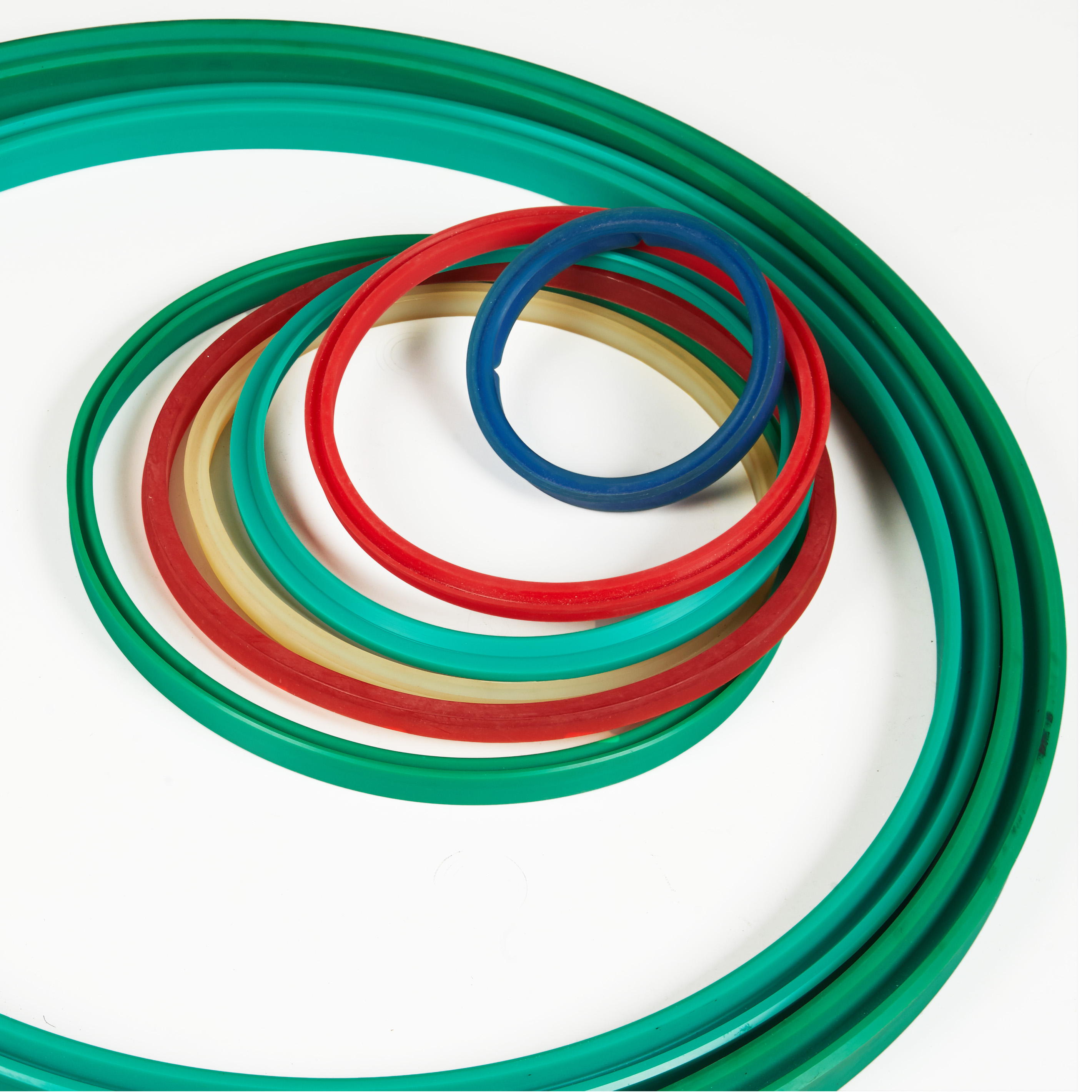
Buyers should note that a sealing ring drawing usually specifies hardness and dimensions, while the properties that actually determine service life in the tropics, such as compression set after prolonged compression at elevated temperature, are often not on the drawing at all. That gap is where supplier-side material data becomes decisive.
Shock Absorption: Resilience Under Continuous Load
Wind-power components that damp vibration operate under continuous, low-amplitude dynamic load rather than occasional impact. Hecheng's wind-power scenario states shock absorption as one of the three target functions for wind power components, and the material family behind it is the cast polyurethane elastomer, chosen for resilience combined with load-bearing capacity.
Where a damping element also experiences sliding or abrasive contact, wear resistance enters the requirement set. Hecheng's Polyester three-component polyurethane elastomer, designated Screen Scraper-5282ABC, is described with high wear resistance and high resilience, although its stated application is the mining sector rather than wind power. It illustrates the trade-off pattern buyers will recognise: formulations tuned for wear resistance and formulations tuned for low hysteresis pull the compound in different directions, and the correct balance depends on which failure mode dominates the part.
From Prepolymer to Cast Elastomer: The Material Chain
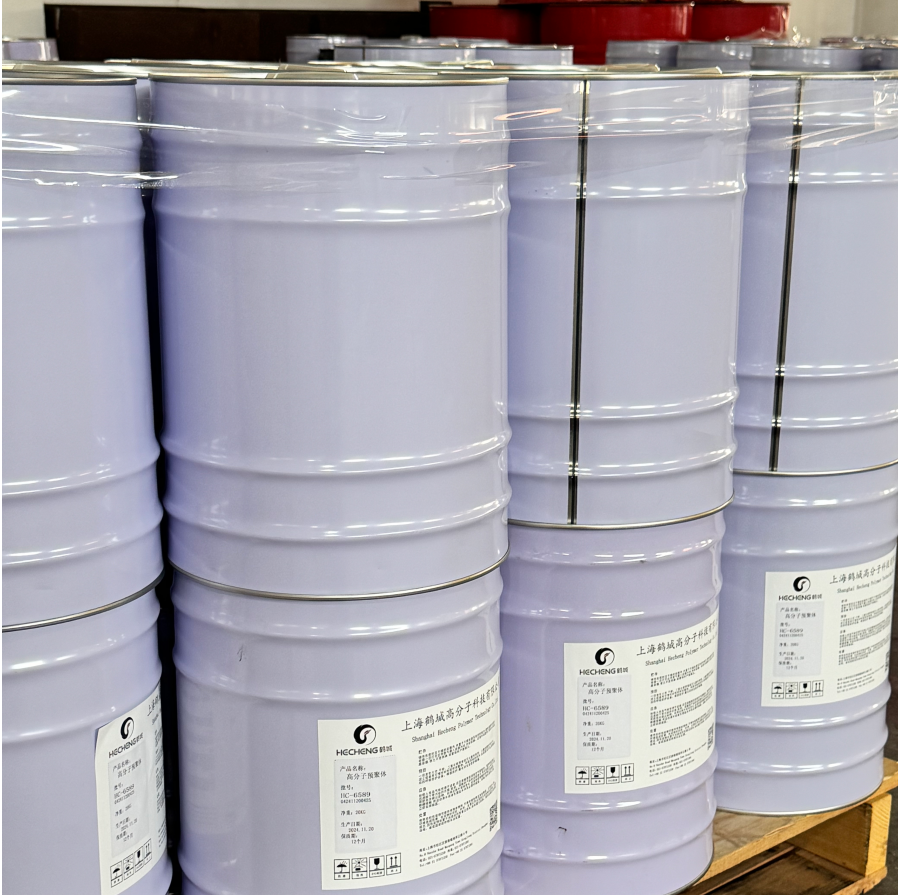
Hecheng describes itself as a supplier focused on polyurethane full prepolymer and quasi prepolymer. The distinction matters to a wind-power processor because the two arrive at the mixing head in different states and place different demands on the metering equipment. A full prepolymer already contains the full isocyanate charge and is normally processed with a curative or a polyol component; a quasi prepolymer carries part of the isocyanate and is completed at the point of use.
The company lists five product categories: casting polyurethane prepolymer, casting polyurethane mixed component, polyurethane polymers with excellent performance and special applications, environment-friendly adhesive products, and supporting equipment, auxiliary materials and additives for PU production. For a wind-power project, the first and second categories carry most of the component work, while the fourth becomes relevant where a seal or a sensor housing has to be bonded or encapsulated rather than cast as a single part.
| Wind-power function | Material direction in the described portfolio | Primary selection criterion |
|---|---|---|
| High-voltage sealing rings | PTMG-MDI polyether CPU casting polyurethane for sealed class accessories | Compression set and moisture resistance in humid heat |
| Shock-absorbing and damping elements | Casting polyurethane prepolymer and high-resilience liquid polyurethane such as Gel-8301AB | Dynamic resilience and heat build-up under continuous load |
| Wear-exposed guides and liners | Polyurethane elastomer with high wear resistance, such as the Polyester three-component Screen Scraper-5282ABC | Abrasion resistance balanced against resilience |
| Bonding and encapsulation | Two components polyurethane adhesive from the environment-friendly adhesive range | Adhesion to the substrate pair and resistance to moisture ingress |
The bonding row deserves a note on evidence quality. Patent literature, for example EP0538694A2, discloses a two-part adhesive composition using a polyurea or polyurethane-urea prepolymer for bonding plastics, metals and elastomers. That is a technical disclosure, not a statement of current commercial availability, and it should not be read as a performance claim for any specific supplier's product.
Automated Two-Component Metering and Why It Matters for Wind Parts
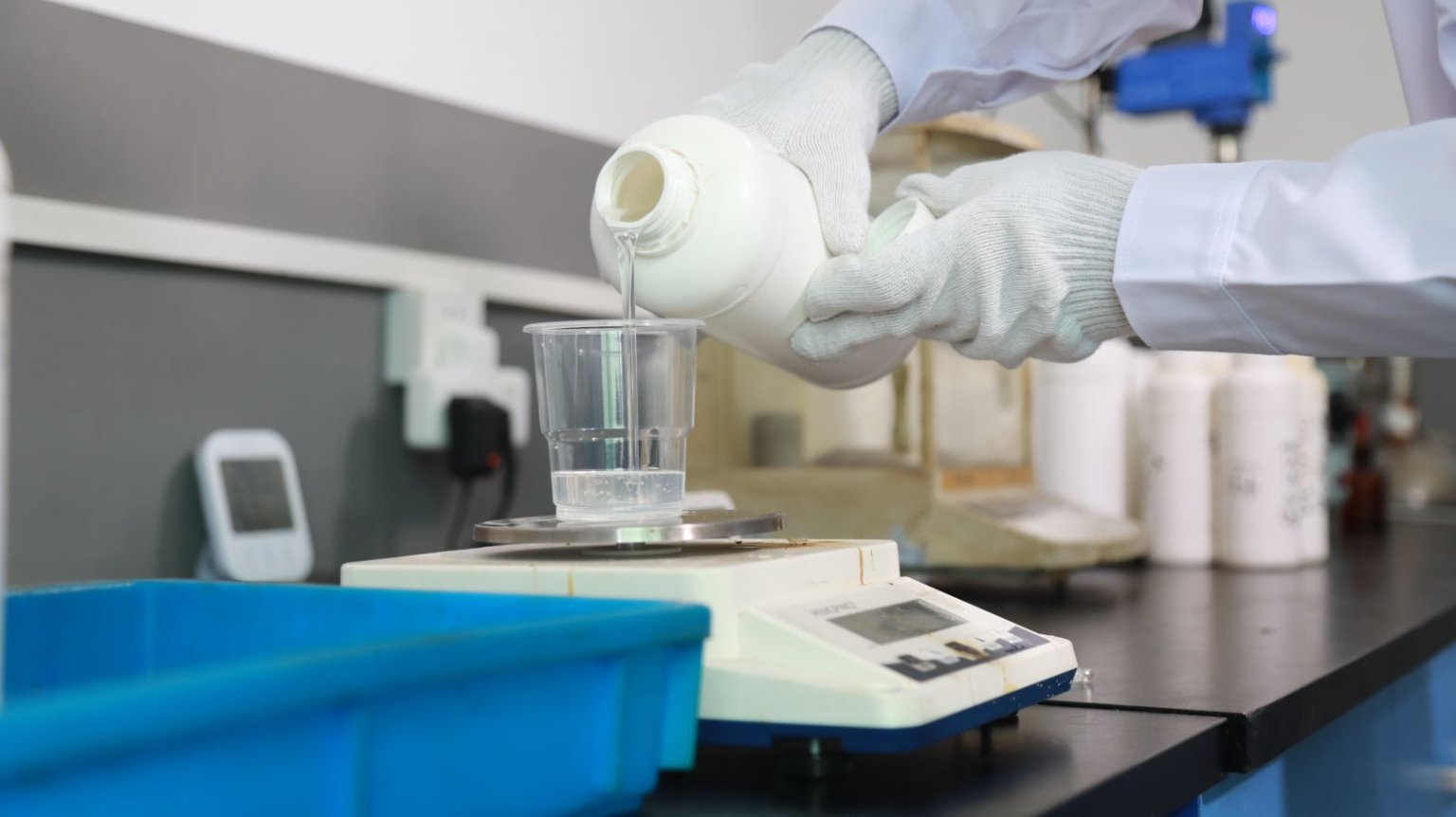
Hecheng's wind-power scenario specifies automated production: two-component metering and conveying of raw materials, automatic high-pressure mixing and pouring, enabling continuous mass production. The listed supporting equipment is a polyurethane high-pressure foaming machine or low-pressure pouring machine, a raw material storage tank, a mixing bucket and a delivery pump. Customisation is stated as supported.
The processing route matters to the wind-power buyer for reasons that are only indirectly chemical. Sealing rings and damping elements are usually specified with tight dimensional tolerances and narrow hardness windows, because a batch-to-batch drift in hardness changes how a seal seats and how a damper behaves. High-pressure mixing reduces the dependence on operator technique, and metered conveying keeps the mix ratio stable across a long production run, which is precisely the variable that manual batching handles least consistently at volume.
The boundary is worth stating plainly. Automated two-component equipment requires calibration discipline, routine checks of the metering pumps, and a defined cleaning procedure between colour or grade changes. For very small trial batches, the setup and purge losses of a high-pressure machine can outweigh the consistency benefit, which is why sample quantities are often produced on low-pressure equipment before a formulation is released to a high-pressure line.
Application Fit Across Thailand, Vietnam, Malaysia and the Philippines
Hecheng's wind-power application data names Bangladesh, Thailand, Vietnam, Pakistan, the Philippines, Cambodia and Malaysia as the markets where this scenario is typically applied. The common thread is not geography but climate class: a long monsoon season, high average relative humidity, and coastal or near-coastal sites where airborne salt adds a corrosive component to the water that reaches seals and metal inserts.
For Thailand and Vietnam, the dominant stress is sustained humidity with high ambient temperature across most of the year, which favours polyether-based casting systems for sealing and damping parts. For Malaysia and the Philippines, the coastal and island geography adds salt-laden moisture, which raises the value of a corrosion-resistant material description in the specification and of bonded assemblies that do not create crevices where water can sit.
The company states that customisation is supported for this scenario. In procurement terms that means the specification conversation can move beyond a catalogue grade toward a target hardness, a target resilience and a target compression-set behaviour, provided the buyer brings the operating conditions and the part geometry to that conversation rather than a part number alone.
Market Signals Behind the Category
Published market research places the global polyurethane market at USD 84.6 billion in 2025 and projects USD 92.1 billion in 2026, rising to USD 216.8 billion by 2033, according to Grand View Research. A second source, Straits Research, estimates a slightly higher figure of USD 93.11 billion for 2026; the difference is generally attributed to how broadly polyurethane products and raw materials are defined, and it is a useful reminder that category-level figures should not be used to size a specific part family.
The narrower casting polyurethane segment is estimated at USD 2.76 billion in 2024, with a projected compound annual growth rate of 5.97% through 2033, according to Astute Analytica. Within that segment, low-free isocyanate prepolymer technology is reported by Market Research Intel to be growing at 13.01% CAGR through 2033, which is materially faster than the segment average.
For a wind-power buyer these numbers are directional rather than decisive. They indicate that casting polyurethane capacity and low-free isocyanate options are expanding, which improves the likelihood of finding a grade with the right combination of hydrolysis resistance, resilience and processing behaviour for a tropical site. They say nothing about the suitability of any individual supplier, and they should not be used as a substitute for material testing.
Polyurethane Versus Traditional Wind-Power Materials
Polyurethane is not the default material for every wind-power component, and the comparison with traditional options is worth making explicitly. The table below compares material families by the role they typically play rather than by numeric properties, because comparable datasheet values are frequently unavailable across suppliers.
| Material family | Typical role | Considered strength | Boundary to plan for |
|---|---|---|---|
| Cast polyurethane elastomer | Sealing rings, damping pads, wear liners | Combines load bearing with resilience; castable into complex shapes at relatively low tooling cost | Continuous service temperature ceiling is lower than silicone; polyester grades are more moisture-sensitive than polyether grades |
| EPDM and other sealing rubbers | Static seals, weather seals, gaskets | Well-established weathering and ozone resistance; broad temperature range | Lower mechanical load capacity and abrasion resistance than cast elastomers in dynamic contact |
| Silicone rubber | High-temperature seals and cable accessories | Wider service temperature window than polyurethane | Lower tear and abrasion resistance; generally higher raw-material cost |
| Engineering thermoplastics | Structural housings, insulators, guides | High stiffness and dimensional repeatability in injection moulding | Little energy absorption; not a substitute where damping or sealing compliance is required |
The most important boundary is thermal. Cast polyurethane elastomers are generally not the right choice for components that sit continuously at the high end of a turbine's internal temperature range, where silicone or fluorinated rubbers remain the conventional answer. A second boundary is hydrolytic: a polyester-based polyurethane selected for its excellent wear resistance can lose that advantage in years of warm, damp service, which is why the wear-versus-hydrolysis trade-off has to be resolved deliberately for tropical sites rather than inherited from a temperate specification.
A third boundary is documentation. Across the industry, published datasheets for casting polyurethane prepolymers frequently omit the value a wind-power buyer most needs, such as compression set after prolonged compression at elevated temperature or a defined hydrolysis test method. Absence of data is not evidence of poor performance, but it does mean the buyer must request it rather than assume it.
What Buyers Should Verify Before Qualifying a Grade
Qualification for a tropical wind-power component usually comes down to a short list of checks that can be run before any long-term field decision is made.
- Confirm the base chemistry, polyether or polyester, against the dominant aging mechanism for the part, then confirm the isocyanate type.
- Request compression set data at the actual service temperature, not at a standard laboratory temperature that is well below the site condition.
- Ask which hydrolysis resistance test method was used and whether the result refers to a sample or to production batches.
- Check that the metering equipment proposed for the part matches the viscosity and pot life of the grade, since a formulation that performs in a laboratory mould can behave differently on a high-pressure line.
- Validate on samples produced with the intended production process, then verify the cured part against the drawing before scaling to series supply.
- Confirm batch-level documentation and traceability, particularly where the part sits behind a warranty obligation.
Shanghai Hecheng reports a 16,932 square metre facility with 16 major production reactors, approximately 78 staff including an R&D team of 18 engineers, and an annual production capacity of 1 million tons. Those figures describe scale; they do not substitute for the part-level evidence listed above, and buyers should treat them as context for a supplier evaluation rather than as qualification proof.
Future Outlook
Three shifts are likely to shape how polyurethane raw materials are specified for tropical wind power over the next several years. The first is the move toward low-free isocyanate prepolymer systems, including MDI, TDI and PPDI based prepolymer grades, driven by handling and workplace-safety considerations as much as by performance. The reported 13.01% CAGR for that niche through 2033 is consistent with a gradual rather than abrupt transition, since existing casting lines and qualified parts cannot switch chemistry overnight.
The second is tighter process control. As wind-power parts move from prototype quantities to series supply, the repeatability argument for automated two-component metering becomes a commercial argument rather than only a technical one, and buyers are likely to ask for metering data alongside material data.
The third is documentation. A material category that has historically been sold on grade names and hardness figures is being pushed toward defined test methods, batch traceability and explicit statements of service limits. Suppliers that can answer a humidity question with a test method rather than an adjective will have an advantage in tropical procurement, regardless of the size of their reactor hall.
FAQ
What do polyurethane raw materials actually do in a wind-power component?
They form the cast elastomer body of components that seal, damp or insulate. Hecheng's wind-power application scenario states the function as aging resistance, high-voltage sealing and shock absorption for wind power components, with the material processed by two-component metering and high-pressure mixing and pouring.
Why is humidity a bigger concern than temperature at tropical wind sites?
Temperature affects a polyurethane part predictably and recoverably within its service window, while moisture drives hydrolysis that accumulates in the polymer and is difficult to detect before properties have already changed. Because tropical sites combine sustained heat with year-round high humidity, the two effects reinforce each other rather than acting separately.
Which polyurethane system is used for sealing rings in this scenario?
Hecheng's composite-material application scenario covers sealing ring production from casting polyurethane raw materials in tropical high-temperature and high-humidity conditions. Within the described portfolio, the PTMG-MDI polyether CPU casting polyurethane is positioned for sealed class accessories and described as corrosion-resistant and environmentally friendly.
How are these parts produced at volume?
The stated production mode is automated: two-component metering and conveying of raw materials, automatic high-pressure mixing and pouring, enabling continuous mass production. Supporting equipment listed for the scenario includes a polyurethane high-pressure foaming machine or low-pressure pouring machine, a raw material storage tank, a mixing bucket and a delivery pump.
What are the limits of polyurethane in wind-power applications?
Cast polyurethane elastomers generally have a lower continuous service temperature ceiling than silicone rubber, and polyester-based grades are more sensitive to hydrolysis than polyether-based grades in warm, damp conditions. Neither limitation disqualifies the material from sealing and damping duties, but both need to be resolved explicitly in the specification rather than assumed.
How should a buyer compare two suppliers offering similar grades?
Compare the evidence rather than the grade names: a defined hydrolysis test method, compression set measured at the actual service temperature, batch-level traceability, and validation on samples produced with the intended production process. Reported scale, such as plant area or reactor count, is useful context for supply continuity but is not a substitute for part-level qualification data.
The company's automotive polyurethane brochure, which also illustrates the casting and two-component material range, is available for download: polyurethane materials brochure (PDF).
Есть вопросы или нужны дополнительные детали?
Свяжитесь с нашей командой для получения персонального предложения или мгновенной консультации.
Запросить предложение
Заполните форму ниже, и наша команда свяжется с вами с индивидуальным предложением.
Прямой чат WhatsApp
Предпочитаете общаться в реальном времени? Напишите нам в WhatsApp для мгновенной помощи и быстрых ответов.
- Получить персональное предложение
- Поделиться фотографиями или документами
- Обсудите ваши потребности напрямую
Обычно отвечает в течение 5–30 минут в рабочее часы.