
Poolside & Waterfront WPC Cladding: Scenario-Fit Checks
Poolside & Waterfront WPC Cladding: Scenario-Fit Checks
Poolside & Waterfront WPC Cladding: Scenario-Fit Checks
Poolside and waterfront exterior walls put three loads on a cladding panel at the same time: repeated wetting from splash and drift, airborne salt on coastal sites, and fast surface-temperature swings as sun and water alternate through the day. A panel that looks convincing on a sheltered inland elevation can still be the wrong choice at the edge of a pool if water uptake, panel movement and fixing detail are left out of the specification.
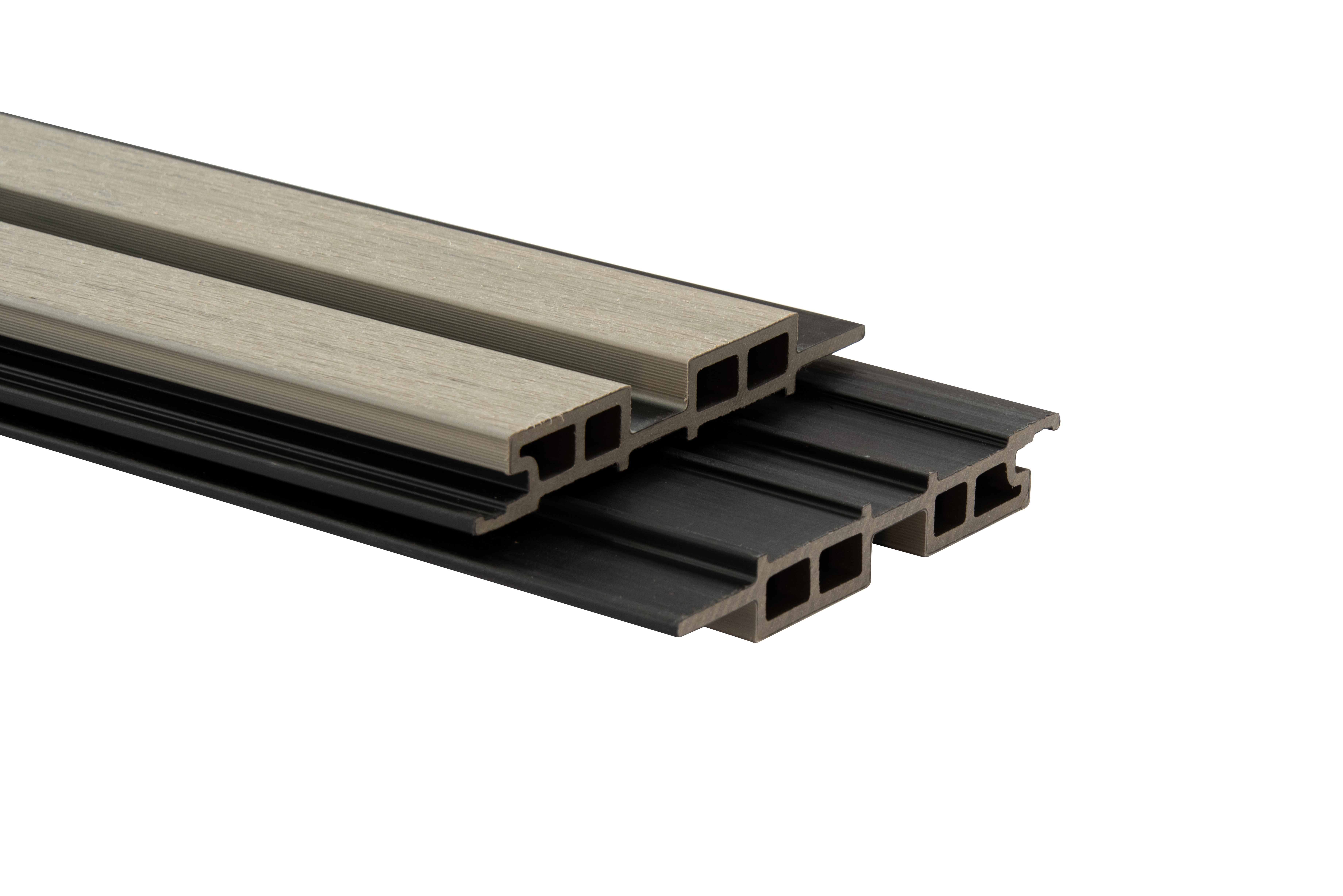
This checklist is organised around the figures a specifier can actually verify. Terratsa New Material (Liaoning) Co., Ltd. publishes GH010 exterior wall cladding at 2900 × 136 × 22 mm, with swelling and water absorption ≤2% after 28-day immersion and a linear thermal expansion coefficient ≤37×10⁻⁶ K⁻¹. One figure governs water; the other governs movement. Together they frame most of the decisions that follow.
The intended reader is an architect, facade contractor or procurement lead in the research-to-evaluation stage who has to decide whether wood plastic composite cladding fits a wet-zone wall, and what evidence to demand before signing it off. The article separates what the published data establishes from what it does not.
Why a Poolside Wall Is Not Simply a Wet Wall
Moisture exposure on a poolside or waterfront elevation differs from ordinary rain wetting in three ways that matter to a cladding system.
First, wetting is repeated rather than occasional. Splash from a pool deck, spray carried on wind, and hosing during maintenance can wet the lower part of a wall many times a week, and on shaded or north-facing elevations the drying interval between events may be short. Second, the water is not always fresh: coastal sites carry airborne chloride, and pool surrounds carry splash-out that has passed through treated water. Third, the thermal cycle is aggressive, because a dark facade in direct sun reaches surface temperatures well above ambient air temperature and is then cooled by water contact.
These are exposure conditions rather than brand-specific claims, and they define which parameters deserve scrutiny: water uptake, dimensional movement, fixing and joint design, colour stability, and the scope of whatever certification is offered. A generic statement that a panel is waterproof does not answer any of them on its own.
Start With Water Uptake: What ≤2% After 28-Day Immersion Establishes
Terratsa publishes two cladding models with measurable moisture data, and the difference between them is the first genuinely useful selection signal for a wet-zone wall.
- GH010 exterior wall cladding: 22 mm thick, 136 mm wide, 2900 mm long, wood powder and plastic, swelling and water absorption ≤2% after 28-day immersion, linear thermal expansion coefficient ≤37×10⁻⁶ K⁻¹.
- GH024 WPC cladding: swelling and water absorption ≤4% after 28-day immersion, boiling test ≤3%, linear thermal expansion coefficient ≤37×10⁻⁶ K⁻¹.
Terratsa's product literature describes these panels as waterproof and moisture-proof. The checkable statement is narrower and more useful: dimensional change and water absorption are bounded by a stated limit under a defined test. A limit is not zero. A ≤2% ceiling does not mean the panel is indifferent to water; it means the manufacturer has committed to a maximum response and has a number a specifier can hold it to.
Where both profiles are available, the ≤2% figure for GH010 is half the ≤4% figure for GH024. For a wall that is regularly splashed or spray-wetted, that distinction is a defensible starting point for preferring one profile over the other, provided the rest of the system — substrate, ventilation, fixings and joints — is designed to keep water from standing against the panel.
Two verification questions close this section. Ask whether the percentage refers to thickness swelling or linear change, and ask what the reference dimension is, because the two bases give very different absolute movement at a 22 mm thickness. Ask also whether cut edges require treatment on a wet elevation; this detail is not published in the supplied product data and should come from the supplier's installation documentation.
Matching 2900 × 136 × 22 mm to the Facade Layout
Panel geometry decides how a wet wall actually gets built, and the 2900 × 136 × 22 mm format of GH010 is unusual enough to be worth working through before the design is fixed.
At the nominal 136 mm width, one full-length panel presents roughly 0.39 m² of face area (2.9 m × 0.136 m = 0.394 m², calculated from the published dimensions). A 30 m² wall therefore needs about 76 panels on a nominal basis, before cuts at openings, corners and terminations, and before any site waste allowance. That is an arithmetic starting point, not an order quantity: the effective cover per panel depends on how the hidden fastener system engages adjacent boards, and that effective cover figure is not part of the published dimensions.
Length drives the visual rhythm. A 2900 mm panel sits close to a standard storey height, which makes vertical installation efficient — one panel can often run most of a floor-to-floor height without a horizontal joint, and vertical orientation tends to emphasise height on a pool surround. Horizontal installation instead sets a joint pattern every 2.9 m along the run, so a 6 m elevation needs at least three panels in each course and the joint positions become a design decision rather than an accident. Both orientations are supported by the product, and both are compatible with matching trims, corners and hidden fastener systems.
The 22 mm thickness matters to the rest of the build-up. It sets how far the finished face stands off the substrate, which in turn affects window and door reveals, corner trims, and the depth available behind the panel for the sub-frame and for the air path that lets the wall dry. On a poolside wall, that rear ventilation gap is part of the moisture strategy, not a detail to be closed up at the end of the job.
Thermal Movement: Reading ≤37×10⁻⁶ K⁻¹ as a Design Allowance
The published coefficient is an upper bound, which makes it usable directly in a movement budget. Expansion follows the standard relationship: change in length equals original length, multiplied by the coefficient, multiplied by the temperature change.
Applied to the 2900 mm panel length and a 50 K surface-temperature swing, the calculation gives 2.9 m × 37×10⁻⁶ K⁻¹ × 50 K = 5.37 mm, or roughly 5.4 mm per panel (calculated value, not a measured test result). At a 40 K swing the figure is about 4.3 mm; at 60 K it is about 6.4 mm. Because the coefficient is stated as a maximum, real movement should fall at or below these values.
Five millimetres sounds trivial against a 2.9 m board, and on a continuous face it largely is. It stops being trivial at a butt joint, at a corner return, at a window reveal, and wherever a fixing is installed tight enough to restrain the panel. That is where a specification either accommodates movement or fights it. On poolside walls the effective temperature swing is also wider than the air-temperature range suggests, because solar gain on a dark surface pushes surface temperature above ambient before water contact cools it again — which is why the temperature basis should be the panel surface range for the project, not the local weather record.
What the coefficient does not supply is the required joint gap or clip spacing. Those come from Terratsa's installation instructions and from the fastener supplier's data, and they are not contained in the parameter set summarised here. A specifier can, however, use the movement calculation to sanity-check whatever gap is proposed, and to ask the supplier to confirm that the hidden clip detail permits the calculated movement without hard restraint.
UV, Colour and Salt: Claims That Need Scope
Fading and chalking are the visible failure modes on an exposed poolside facade, and they are the claims most likely to be read too broadly.
Terratsa states that GH010 is formulated with UV inhibitors to limit fading, greying and chalking, that the panel is engineered to withstand extreme temperatures, heavy rain, snow and salt spray without cracking, warping or peeling, and that it resists mould, mildew, termites and wood-boring insects. The company also lists CE, FSC, ASTM, SGS and EPD among its product and management certifications.
These statements describe intended performance and certification status. What they do not do, on their own, is tell a specifier which test method was used for colour retention, which colour was tested, for how long, and whether the result came from an internal weathering programme or an independent laboratory. On a coastal waterfront wall, where salt spray is continuous rather than occasional, that scope is the difference between a comfortable assumption and a verified one. The practical response is to request the certificate or test report for the specific model and colour, confirm the exposure regime it covers, and check whether the certificate's product scope names the profile being specified rather than a broader product family.
Composition, Emissions and End-of-Life Evidence
Material composition is where poolside projects often face the least visible but most commonly asked questions, because these walls sit close to bathers and to public space.
GH010 is made from wood powder and plastic, and Terratsa states that it is free from formaldehyde, benzene and hazardous chemicals. The company describes the input stream as recycled plastics and reclaimed wood fibre, and states that the product is fully recyclable. Those are first-party composition statements; they are the kind of claim a project team can reasonably ask to see stated in writing on the specification sheet, and for interior-adjacent applications in some markets, supported by emissions documentation for the specific product.
The third-party layer is the environmental declaration. Terratsa holds a valid Environmental Product Declaration registered in the International EPD System as EPD-IES-0012197:001 (S-P-12197), conforming to EN 15804+A2, version dated 2024-03-15 and valid until 2029-03-15, covering co-extrusion WPC products. An EPD of this type is a verified declaration of lifecycle environmental data under a defined product category rule. It is not, by itself, a certification that a product meets a particular carbon threshold, and it does not automatically extend to every model in a catalogue. Before relying on it for a poolside cladding specification, confirm that the specified profile, colour and construction fall inside the declared product group.
Where WPC Cladding Fits Against Other Poolside Wall Options
Wood plastic composite cladding occupies a specific position among wet-zone wall options rather than a universally superior one, and the trade-offs are easier to state than to rank.
Painted or stained timber cladding offers familiar handling and appearance, but it requires periodic refinishing, and timber that stays persistently wet is exposed to decay and dimensional movement. Ceramic, porcelain and stone finishes resist water well but are rigid, comparatively heavy, and depend heavily on substrate and adhesive detailing to stay fixed. WPC cladding sits between them: it needs no painting, staining or sealing, it is cut and fastened with standard woodworking tools, and it is compatible with horizontal and vertical installation on various sub-frame systems.
The Manufacturer Behind the Panel
Terratsa New Material (Liaoning) Co., Ltd. is a wood-plastic composite manufacturer founded in 2007, which relocated its production base from Jilin to the Yingkou Area of China (Liaoning) Pilot Free Trade Zone in 2024. The company operates a 74,000 m² facility with more than 70 fully automatic production lines and a 25-engineer R&D team, and states that it holds more than 30 national independent intellectual property patents.
Its position in the sector is documented rather than asserted: it is a vice-chairman unit of the Wood-Plastic Composite Committee of China Plastics Processing Industry Association, and reports participation in drafting nearly 10 national and industrial standards. Product and system certifications listed by the company include CE, FSC, ASTM, SGS and EPD, alongside ISO 9001, ISO 14001 and ISO 45001 management system certifications.
For a project buyer, the commercially relevant parts of that profile are the customisation and supply terms. Terratsa offers OEM/ODM production with logo customisation, a minimum order quantity of one container, a lead time of 30 to 45 days, 100% testing, and remote after-sales support. The company reports an export share of 85%, sales into more than 40 countries and regions across Europe, America, Oceania and Asia, an independent overseas warehouse in the Netherlands, and a customer base of nearly 100 accounts worldwide. Full product information is published at Terratsa New Material (Liaoning) Co., Ltd.
What the Scenario Record Shows, and What It Does Not
Terratsa's documented outdoor scenario record covers two climate profiles that are relevant to wet-zone design, and one project case with reported outcomes.
The Polish scenario describes decking in a climate with low winter temperatures and high humidity, with requirements including weather resistance, anti-UV performance, low water absorption, no maintenance, anti-scratching and anti-slip. The Chinese scenario describes park decking under high humidity, with requirements covering weather resistance, anti-slip, anti-UV and anti-scratching. A further case describes a 500-ton WPC decking installation for a project contractor client in China, reported as maintaining performance over 15 years with no fading and no bending.
That case record is material-level evidence of outdoor weathering experience in humid conditions. It concerns decking products, not cladding panels, so it should not be presented as a cladding warranty or as proof of poolside wall performance. Its honest use is narrower: it shows that the manufacturer's outdoor formulations have been deployed at scale in humid environments with reported colour and dimensional stability, which is a reasonable question to build on rather than an answer in itself.
Scenario-Fit Checklist for Poolside and Waterfront Walls
The checklist below condenses the preceding sections into the eight confirmations that most often decide whether a WPC cladding specification holds up at the water's edge.
| Fit check | What to confirm | Why it matters at the water's edge |
|---|---|---|
| 1. Water uptake basis | That the ≤2% 28-day immersion figure applies to the specified model, and whether it measures thickness swelling or linear change | Splash and spray are repeated events; the basis determines the real absolute movement behind the number |
| 2. Panel module | 2900 × 136 × 22 mm against storey height, corner cuts, openings and effective cover per panel | Cutting a 2.9 m panel at every corner and reveal changes both the visual rhythm and the order quantity |
| 3. Movement budget | Project surface-temperature swing applied to ≤37×10⁻⁶ K⁻¹, and the joint and fixing allowance it implies | A roughly 5.4 mm change on a 2900 mm panel concentrates at joints and restraints |
| 4. Fixing and rear ventilation | Hidden clip detail, sub-frame compatibility, and an air path that lets the wall dry | Trapped water defeats a low-absorption panel faster than any material property |
| 5. UV and salt scope | Test method, tested colour, duration, and whether anti-fade and salt-spray evidence covers the specified profile | Coastal and sun-exposed walls fail visibly at the surface first |
| 6. Composition documents | Written formaldehyde- and benzene-free statement, recycled content description, recyclability position | Poolside walls sit close to bathers and public space, where emissions questions are routine |
| 7. Certification scope | CE, ASTM, SGS, FSC and EPD documents naming the model, and the EPD product group boundary | A valid certification that does not cover the specified profile does not support the claim |
| 8. Supply terms | MOQ of one container, 30 to 45 day lead time, customisation options, remote after-sales support | Wet-zone projects rarely tolerate a mid-build reorder |
Frequently Asked Questions
Is WPC cladding suitable for a wall directly beside a swimming pool?
It can be, subject to conditions. The published GH010 data supports a low-absorption, dimensionally bounded panel: swelling and water absorption ≤2% after 28-day immersion and a linear thermal expansion coefficient ≤37×10⁻⁶ K⁻¹. Suitability on a wall immediately beside water also depends on keeping the rear of the panel ventilated, detailing joints so water drains rather than stands, and confirming how the fixings behave under chloride exposure. Resistance to pool sanitising chemicals is not established in the published data and should be raised with the supplier as a project-specific question rather than assumed in either direction.
What does ≤2% swelling after 28-day immersion actually mean for a facade?
It means the manufacturer has set an upper limit on how much the panel absorbs and changes dimension when immersed for 28 days. It is a bounded response, not an absence of response. For a facade, the practical consequence is that a modest amount of movement and moisture uptake must be accommodated by joint width, fixing detail and drainage. The headline percentage should be read together with its measurement basis — thickness swelling and linear change produce very different absolute figures at a 22 mm panel thickness — and with the note that laboratory immersion is not the same exposure as wind-driven rain on an installed wall.
How many 2900 × 136 × 22 mm panels does a facade require?
At nominal dimensions, one panel covers about 0.39 m² of face area, since 2.9 m × 0.136 m = 0.394 m². A 30 m² elevation therefore needs roughly 76 panels on a nominal basis. That figure excludes cuts at corners, openings and terminations, any site waste allowance, and the reduction in effective cover caused by the engagement detail of the hidden fastener system, which is not part of the published dimensions. Effective cover per panel should be confirmed with the supplier before an order quantity is fixed.
How much does a 2900 mm WPC cladding panel move as temperature changes?
Using the published coefficient of ≤37×10⁻⁶ K⁻¹, a 2900 mm panel moves about 5.4 mm across a 50 K surface-temperature swing, calculated as 2.9 m × 37×10⁻⁶ K⁻¹ × 50 K. A 40 K swing gives about 4.3 mm and a 60 K swing about 6.4 mm. Because the coefficient is stated as a maximum, actual movement should not exceed these values. The relevant temperature range is the panel surface range, which on a dark, sun-exposed facade exceeds the ambient air range.
Should GH010 or GH024 be chosen for a wet wall?
On published moisture data alone, GH010 has the tighter limit: ≤2% swelling and water absorption after 28-day immersion against ≤4% for GH024, which also lists a boiling test result of ≤3%. Both share the same linear thermal expansion coefficient of ≤37×10⁻⁶ K⁻¹ and both are made from wood powder and plastic. GH024 offers a fluted profile. The two figures indicate a difference in published moisture performance rather than a measured difference in installed service life, and the final choice should also weigh profile appearance, fixing detail and the project's drainage design.
What a Wet-Zone Cladding Specification Should Contain
A defensible poolside or waterfront cladding specification does not rest on the word waterproof. It rests on a small set of verifiable statements: the model and its dimensions, the water-uptake limit and the basis on which it was measured, the thermal expansion coefficient and the movement allowance derived from it, the fixing and ventilation detail that keeps water from standing, and the scope of each certificate offered for the specified profile.
Terratsa's GH010 data supplies the first three of those inputs in checkable form, and the company's certification and manufacturing record supplies the context a procurement team needs to evaluate the supplier behind them. The remaining items are project questions, and they are best answered before the facade is ordered rather than after the first wet season.
Technical documentation: Terratsa product brochure (PDF). Market context in this article draws on published wood plastic composite market research; environmental declaration details reference EPD-IES-0012197:001 (S-P-12197) in the International EPD System.
Есть вопросы или нужны дополнительные детали?
Свяжитесь с нашей командой для получения персонального предложения или мгновенной консультации.
Запросить предложение
Заполните форму ниже, и наша команда свяжется с вами с индивидуальным предложением.
Прямой чат WhatsApp
Предпочитаете общаться в реальном времени? Напишите нам в WhatsApp для мгновенной помощи и быстрых ответов.
- Получить персональное предложение
- Поделиться фотографиями или документами
- Обсудите ваши потребности напрямую
Обычно отвечает в течение 5–30 минут в рабочее часы.