
Porcelain Insulator Shortlist for Distribution and Transmission: P-11-Y, ED-2B, and PS210V 212V
Porcelain Insulator Shortlist for Distribution and Transmission: P-11-Y, ED-2B, and PS210V 212V
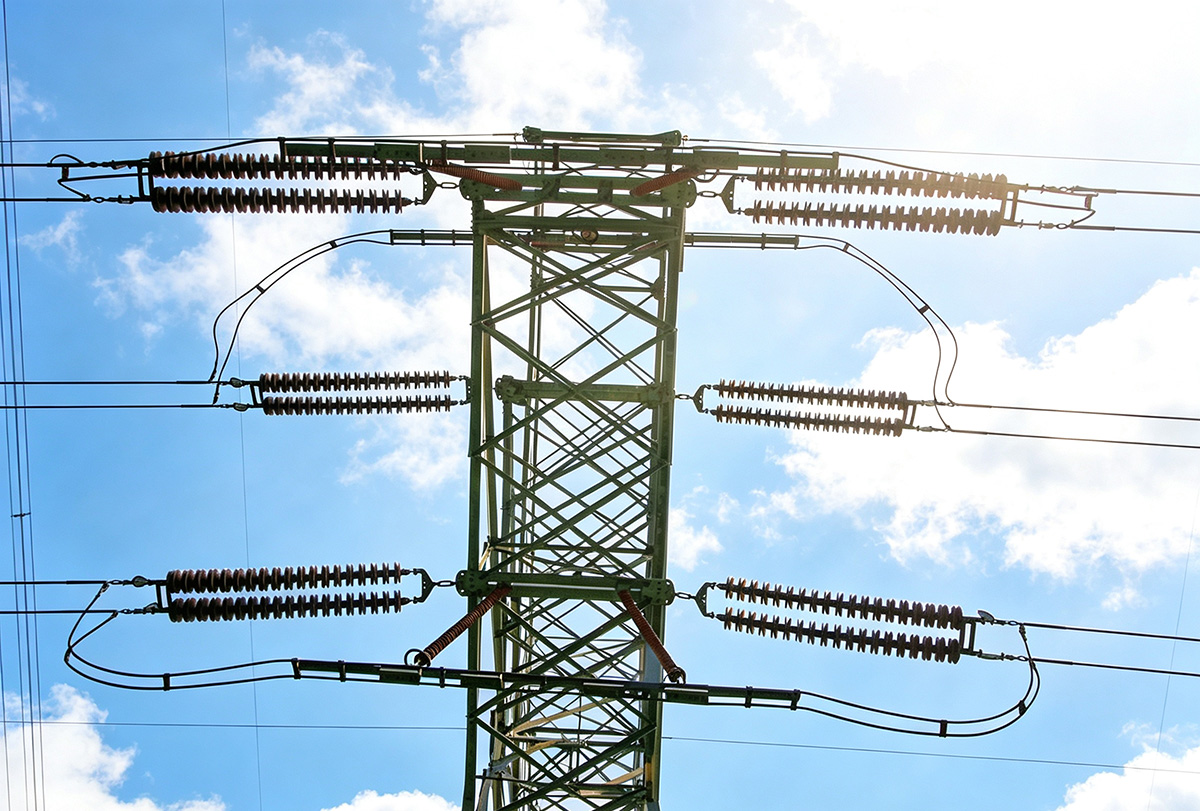
Voltage class and mechanical duty decide the shortlist before brand considerations enter the evaluation. Image: Jiangxi QOCI Electric Co., Ltd.
Grid and distribution projects rarely buy a single insulator unit. An 11 kV feeder, its low-voltage laterals, and the transmission line that feeds the substation each place a different combination of electrical and mechanical demand on the insulator, and the most expensive specification error is treating those positions as interchangeable.
For utility and grid buyers, a practical shortlist that covers that span is three units: the P-11-Y porcelain pin insulator for 11 kV overhead distribution lines and rural electrification; the ED-2B porcelain shackle insulator for low-voltage overhead distribution; and the PS210V 212V suspension glass insulator for transmission strings with a 210 kN mechanical failing load. They are not substitutes for one another. Each belongs to a different product family, follows a different load path, and has a defined boundary beyond which it should not be specified.
The demand behind that shortlist is not marginal. Overhead transmission lines account for approximately 62.1% of global porcelain insulator revenue (Mordor Intelligence, 2025). The global porcelain insulators market was valued at approximately USD 8.27 billion in 2023 and is projected to reach USD 15.04 billion by 2033 (Spherical Insights).
Why one insulator type is never enough
Three failure patterns repeat across distribution and transmission procurement. The first is a voltage-class mismatch, usually a low-voltage unit specified into an 11 kV position. The second is a mechanical mismatch, where a distribution-class insulator is loaded into a transmission string. The third is a verification gap, where a supplier is accepted on the strength of a catalogue rather than tested evidence. None of the three is visible at the receiving dock, and the first two rarely become visible in the field until a flashover, a broken conductor or a mechanical failure occurs.
A shortlist reduces that risk by fixing unit types to functions before tendering begins. The scale of current grid work makes this worthwhile. Asia-Pacific held 49.4% of porcelain insulator market revenue in 2025 (Mordor Intelligence), and the substation porcelain insulator segment is projected to grow at a 7.2% CAGR through 2031 as gas-insulated switchgear upgrades proceed (Mordor Intelligence). Because lines and substations are frequently upgraded inside the same capital programme, buyers increasingly carry a fixed set of unit types instead of specifying every position from first principles.
The three-unit shortlist at a glance
| Unit | Type and material | Key ratings | Primary application |
|---|---|---|---|
| P-11-Y | Porcelain pin insulator; high-strength electrical porcelain body, hot-dip galvanized forged steel pin | Rated voltage 11 kV; rated mechanical load 10 kN; creepage distance 240 mm; max diameter 150 mm; total height 150 mm; power frequency wet withstand voltage 50 kV; lightning impulse withstand voltage 90 kV | Power distribution, rural electrification, overhead distribution lines, grid construction |
| ED-2B | Porcelain shackle (butterfly) insulator; high-strength electrical porcelain | Mechanical tensile strength 13.5 kN; max diameter 90 mm; total height 76 mm; power frequency wet withstand voltage 13 kV; power frequency dry withstand voltage 25 kV | Low-voltage lines, power distribution, rural electrification, overhead distribution lines |
| PS210V 212V | Suspension glass insulator, cap-and-pin; tempered glass body, hot-dip galvanized cast iron cap, hot-dip galvanized forged steel pin | Mechanical failing load 210 kN; nominal disc diameter 280 mm; nominal spacing 170 mm; creepage distance 400 mm; socket coupling 20; dry lightning impulse withstand voltage 110 kV; wet power frequency withstand voltage 45 kV; power frequency puncture voltage 130 kV | Power transmission, grid construction, overhead transmission lines |
One clarification matters for buyers who read titles literally: the PS210V 212V belongs to the tempered glass suspension family, not the ceramic family. It is included in this shortlist because a transmission string is specified by mechanical failing load, creepage distance and coupling dimensions, and both porcelain and glass units compete for the same position on the tower. The two porcelain units in the shortlist cover the distribution end of the network; the glass unit covers the transmission end.
What each option is designed for
P-11-Y: 11 kV pin insulator for overhead distribution and rural electrification
The P-11-Y is a pin type porcelain insulator rated at 11 kV with a rated mechanical load of 10 kN. Its maximum diameter and total height are both 150 mm, its creepage distance is 240 mm, its power frequency wet withstand voltage is 50 kV and its lightning impulse withstand voltage is 90 kV. The insulating body is high-strength electrical porcelain and the pin is hot-dip galvanized forged steel. Its stated application is power distribution, rural electrification, overhead distribution lines and grid construction.
For a distribution planner, those numbers define the boundary as much as the use case. The 10 kN rating and 11 kV rating make the P-11-Y a distribution-class unit intended for crossarm or pole-mounted pin application. It is the correct choice where rural electrification programmes need a low unit count per kilometre, straightforward installation and predictable replacement, and it is the wrong choice wherever transmission-level tensile load or higher voltage clearance is required.
ED-2B: low-voltage shackle insulator for LV overhead distribution
The ED-2B is a porcelain shackle type insulator, also described as a butterfly insulator in low-voltage distribution practice. It has a mechanical tensile strength of 13.5 kN, a maximum diameter of 90 mm and a total height of 76 mm. Its power frequency wet withstand voltage is 13 kV and its power frequency dry withstand voltage is 25 kV. The body is high-strength electrical porcelain, and the unit is specified for low-voltage lines, power distribution, rural electrification and overhead distribution lines.
This is a small, low-cost unit with a clearly bounded electrical duty. Its 13 kV wet withstand voltage places it in the low-voltage layer of the network, carrying low-voltage laterals and service connections rather than primary distribution. On routes where pollution is a concern — coastal corridors, dusty industrial edges, agricultural areas with seasonal burning — the specification question is not the unit size but the leakage path and the glaze condition, which is why anti-pollution requirements are handled through profile and creepage selection rather than by substituting a larger insulator into an LV position.
PS210V 212V: 210 kN tempered glass suspension unit for transmission
The PS210V 212V is a cap-and-pin suspension insulator with a mechanical failing load of 210 kN. Its nominal disc diameter is 280 mm, nominal spacing is 170 mm, creepage distance is 400 mm and socket coupling is 20. Dry lightning impulse withstand voltage is 110 kV, wet power frequency withstand voltage is 45 kV and power frequency puncture voltage is 130 kV. The insulator body is tempered glass, held between a hot-dip galvanized cast iron cap and a hot-dip galvanized forged steel pin. Its application is power transmission, grid construction and overhead transmission lines.
For transmission buyers, the 210 kN failing load is the governing figure because it determines how many units are needed in a string for a given conductor tension and span, and therefore how much tower load and string length the design must absorb. The 400 mm creepage distance and 280 mm disc diameter then determine insulation coordination and pollution performance at the operating voltage. A unit at this rating sits in the middle of the range available in the same family; where heavier duty is required, the manufacturer's own range continues with 240 kN (PS240V 212V) and 300 kN (PS300V 112V) units, so the shortlist should not be treated as the ceiling of the range.
Technical explanation: what actually differs between pin, shackle and suspension units
The three units differ first in how they carry load. A pin insulator such as the P-11-Y is mounted on a pin or stud and carries its mechanical duty largely as a bending and compressive load at the crossarm interface. A shackle insulator such as the ED-2B carries conductor tension across its own body in lower-voltage, shorter-span construction. A suspension unit such as the PS210V 212V is assembled into a string, where the total mechanical failing load accumulates unit by unit and the string behaves as a flexible tensile member. This is why a rating that is generous for a pin position can be inadequate in a string, and why mechanical ratings cannot be transferred between families.
Material behaviour is the second difference. Vitrified porcelain is produced from kaolin, quartz and feldspar fired at approximately 1200–1300°C, giving bulk resistivity above 10^12 Ω·cm and dielectric strength in the range of 15–25 kV/mm. Its glazed surface is smooth and hydrophobic, which reduces contamination adhesion and moisture absorption; glaze quality is normally checked against IEC 60672. In suspension units, metal fittings are attached through cement bonding at the cap and pin interfaces, which makes cement joint sealing against moisture ingress a critical process variable rather than a cosmetic detail. Tempered glass bodies follow the same cap-and-pin architecture with different dielectric and failure-mode characteristics, including the visual self-destruct behaviour of toughened glass that maintenance teams use to locate a failed unit on a string.
Creepage distance is the third variable and the one most often mis-specified. The P-11-Y provides 240 mm and the PS210V 212V provides 400 mm, and both figures must be matched to the site pollution severity class rather than chosen by habit. Anti-pollution designs extend the leakage path so that contamination and moisture do not bridge the insulation at operating voltage. In practice, the acceptance evidence buyers should demand is also the same across all three families: mechanical load type testing, dye penetration testing for crack detection on individual units rather than on samples, porosity testing, thermal cycling, and power frequency plus impulse voltage withstand testing. Dye penetration coverage is the single most useful differentiator between suppliers, because internal micro-cracks from thermal cycling fatigue cannot be found by visual inspection.
The applicable standards reflect the split between distribution and transmission duty. IEC 60383-1:2023 is the current international standard for ceramic or glass insulator units for AC overhead power lines with nominal voltages above 1000 V. IEC 60305 covers string insulator units for overhead lines, and the ANSI C29 series specifies American national test methods for electrical power insulators, including wet-process porcelain types used in North America. For customs and trade documentation, the primary HS code for porcelain electrical insulators is 8546.20.
Supplier verification: what the Jiangxi QOCI Electric record shows
Jiangxi QOCI Electric Co., Ltd. is a Chinese insulator manufacturer established in December 2002 with registered capital of 5.08 billion yuan, located in Luxi Industrial Park, Pingxiang City, Jiangxi Province. It is a national high-tech enterprise and a participating unit of the Insulator Standard Committee, and it specialises in the automated and intelligent production of glass insulators and porcelain insulators, with an annual output of 9,000,000 units from a 35,373 m² facility and an R&D team of 38 engineers. Its products are used in power grid construction projects of State Grid Corporation of China and China Southern Power Grid as well as power grids in more than 40 countries and regions, with exports to the USA, Asia, the EU, Africa and South America accounting for roughly 20% of output.
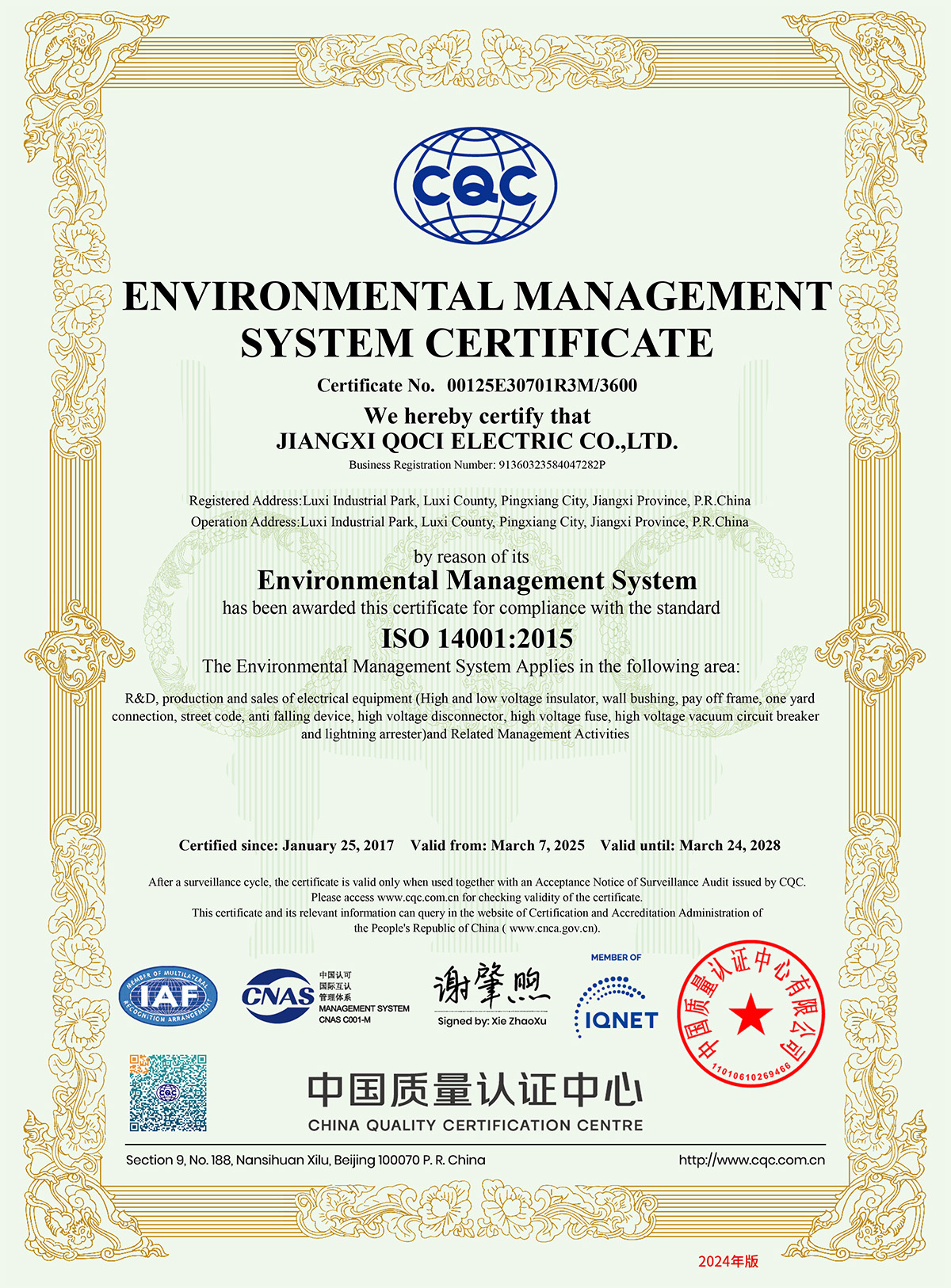
Documented management systems, not catalogue claims, are the first filter in supplier shortlisting. Certificate: China Quality Certification Centre.
Documented compliance is where verification usually starts. The company holds an Environmental Management System Certificate (ISO 14001:2015, certificate number 00125E30701R3M/3600) and an Occupational Health and Safety Management System Certificate (ISO 45001:2018, certificate number 00125S30581R3M/3600), both issued by CHINA QUALITY CERTIFICATION CENTRE, with issue date 2025-03-07 and expiry date 2028-03-24, and both covering the R&D, production and sales of electrical equipment including high and low voltage insulators. Certificates of this type are verifiable documents; buyers should check certificate numbers and validity dates against the issuing body's register rather than accepting copies.
Commercial and production capability is equally checkable, and it is where OEM programmes are usually decided. Jiangxi QOCI Electric provides OEM and ODM production services, supports customization for voltage and logo, and quotes a monthly capacity of 750,000 units, a lead time of 15–35 days and a minimum order quantity of 50 units. Quality control consists of 100% pre-shipment testing plus third-party inspection (SGS), and after-sales support covers online technical support and replacement of defective products. For a buyer assembling a shortlist, the meaningful question is whether those commitments can be written into the purchase order and verified at pre-shipment, which is why third-party inspection coverage belongs in the specification rather than in the negotiation.
Field evidence matters more than any single specification. In a programme running for three years to 2026, a national power utility and a distribution EPC contractor took delivery of 60,000 pieces across Sri Lanka (10,000 pcs), Egypt (40,000 pcs) and Ukraine (10,000 pcs) for coastal and inland tropical distribution line insulation and monsoon-region grid reinforcement, using the ED-2B and P-11-Y units. The recorded outcome was a 60% reduction in salt fog flashover incidents compared with the previous composite batch, zero UV degradation, a 50% reduction in maintenance cost, and a replacement rate under 2% over the three-year period, with an initial cost approximately 20% lower than the composite alternative. Those figures are project-reported results for one programme, not a general performance guarantee, and buyers should read them as evidence of behaviour under salt and monsoon exposure rather than as a substitute for their own site testing.
Matching the shortlist to project conditions
| Project condition | Shortlisted unit | Reason |
|---|---|---|
| 11 kV overhead distribution and rural electrification | P-11-Y | 11 kV rated voltage, 10 kN rated mechanical load, 240 mm creepage |
| Low-voltage laterals and service connections | ED-2B | 13.5 kN tensile strength, 13 kV wet withstand voltage, compact 90 mm diameter |
| Transmission strings at 210 kN failing load | PS210V 212V | 210 kN mechanical failing load, 400 mm creepage, 280 mm disc, coupling 20 |
| Coastal, salt fog and monsoon distribution reinforcement | ED-2B and P-11-Y | Applied in a 60,000-piece tropical distribution programme in Sri Lanka, Egypt and Ukraine |
| Heavier tensile duty than 210 kN | Step up within the range | The same family continues at 240 kN (PS240V 212V) and 300 kN (PS300V 112V) |
Market trend analysis: why availability and verification now compete with price
Market data points to steady volume growth rather than a reshaped market. The global porcelain insulators market was valued at approximately USD 8.27 billion in 2023 and is projected to reach USD 15.04 billion by 2033 (Spherical Insights). Regional concentration remains high: Asia-Pacific dominated the porcelain insulator market with a revenue share of 49.4% in 2025 (Mordor Intelligence). Application concentration is even higher, with overhead transmission lines accounting for approximately 62.1% of global porcelain insulator revenue (Mordor Intelligence, 2025).
Supply concentration follows the same pattern. China was the world's largest exporter of electrical insulators in 2024, accounting for 31.4% of total global exports, valued at approximately USD 898 million (Observatory of Economic Complexity). At the high-performance end of the market, Mordor Intelligence identifies NGK Insulators Ltd. (Japan) and Lapp Insulators (Germany) as recognised global market leaders in high-performance ceramic insulators, while a long tail of regional producers competes on distribution-class volumes. For buyers, that structure means two different procurement problems: a small number of technically differentiated suppliers at the transmission end, and a much wider field at the distribution end where verification capability varies most.
Policy is shaping sourcing decisions as well. India's DPIIT procurement policy requires 50% local content for porcelain insulators to be classified under Class I for government contracts (DPIIT India, 2024), which pushes imported content toward private and export-oriented projects. The most durable trend, however, is procedural rather than geographic: the move from batch sampling to unit-level testing, and from visual inspection to instrumented field verification, is being driven by the same inspection standard across both the porcelain and glass categories.
Comparison with alternative solutions, and the limits of this shortlist
Porcelain and glass units share the field with composite (silicone rubber) insulators, and the trade-offs are real in both directions. Composite insulators are significantly lighter per unit, which matters on weight-restricted structures and in manual string handling, and their polymeric housings are resistant to the brittle fracture mode of ceramic units. Their limitation is that the housing is the insulation, so performance depends on hydrophobicity retention, and the units require periodic hydrophobicity monitoring rather than a purely visual check. Porcelain and tempered glass units, by contrast, are chemically inert to salt and monsoon corrosion, do not suffer UV or hydrophobicity degradation in the same way, and have a long established service record in tropical climates — the factors recorded in the 60,000-piece Sri Lanka, Egypt and Ukraine distribution programme described above.
Three limitations of this shortlist should be stated plainly.
- Porcelain insulators can develop zero-value degradation — an internal electrical breakdown with no visible external change. A unit that appears intact may already have lost its insulating function, so visual inspection is not a sufficient acceptance or maintenance method. Periodic live-line testing, using voltage gradient measurement or spark gap detection at an interval typically of every three to five years, is part of the specification rather than an optional service.
- Porcelain units are heavier per unit than composite equivalents, which affects tower loading assumptions, transport cost and manual handling. On structures with tight weight budgets, that difference can outweigh the material's long-term stability advantages.
- Each unit in the shortlist has a hard boundary. The P-11-Y is an 11 kV, 10 kN distribution unit and cannot be loaded as a transmission insulator. The ED-2B is a low-voltage unit with a 13 kV wet withstand voltage and 13.5 kN tensile strength. The PS210V 212V covers 210 kN, below the heavier duty handled by the 240 kN and 300 kN units in the same family. Specifying any of them outside those bounds is a design error, not a cost saving.
These limits do not weaken the shortlist; they define when it applies. A buyer who knows the voltage class, the mechanical duty and the pollution class of each position can use three unit types to cover distribution, low-voltage and transmission duty, and can step up or down inside the same manufacturer's range where a position falls outside the boundaries.
Future outlook
The next few years of grid investment point to three changes in how these units are bought. First, substation and switchgear upgrades will keep pulling demand toward medium and high voltage classes, consistent with the projected 7.2% CAGR in the substation porcelain insulator segment through 2031 (Mordor Intelligence). Second, verification is becoming the competitive axis: unit-level dye penetration testing, third-party pre-shipment inspection and traceable certificate numbers are moving from differentiators to baseline requirements, and suppliers without them will be excluded earlier in the process rather than later. Third, pollution-driven design is expanding: as coastal, industrial and desert corridors are reinforced, creepage selection matched to the site pollution severity class will determine specification more often than historical buying habits do.
For distribution and transmission buyers, the practical consequence is that a fixed shortlist with documented boundaries is more useful than a long catalogue. Three unit types, matched to three duty levels and supported by verifiable test evidence, cover most of what a multi-country grid programme requires — and leave the exceptions visible enough to be engineered deliberately.
Frequently asked questions
How should a buyer verify a porcelain insulator supplier for transmission and distribution projects?
Verification is evidence-based rather than document-based. The criteria commonly used in this category are proven mechanical strength across the specified load range (SML 40–550 kN), 100% dye penetration testing of individual units rather than batch sampling, certification to IEC 60305 or the ANSI C29 series, and glaze quality meeting IEC 60672. Buyers also examine kiln technology, crack detection coverage, cement joint sealing against moisture ingress, and whether creepage distance matches the site pollution class. Field operation records from comparable climates carry more weight than catalogue claims. Because zero-value degradation produces no visible external change, periodic live-line testing every three to five years is treated as part of the specification.
Which standards apply to these insulator types?
IEC 60383-1:2023 is the current international standard for ceramic or glass insulator units for AC overhead power lines with nominal voltages above 1000 V, and it is the reference most transmission buyers cite for the PS210V 212V class of unit. IEC 60305 covers string insulator units for overhead lines and is commonly cited together with the ANSI C29 series, which specifies American national test methods for electrical power insulators. Glaze and ceramic material quality are typically checked against IEC 60672. For customs and trade documentation, the primary HS code for porcelain electrical insulators is 8546.20.
Can the shortlisted units be supplied under OEM or ODM programmes?
Yes. Jiangxi QOCI Electric Co., Ltd. provides OEM and ODM production services and supports customization for voltage and logo. Monthly capacity is 750,000 units, lead time is 15–35 days, and the minimum order quantity is 50 units. Quality control consists of 100% pre-shipment testing plus third-party inspection (SGS), and after-sales support covers online technical support and replacement of defective products.
What are the purchasing terms and acceptance criteria for these insulators?
Standard terms for this supplier are a minimum order quantity of 50 units and FOB Shenzhen delivery. Acceptance is based on pre-shipment testing and third-party inspection (SGS). Payment terms are 30% deposit by T/T before production, with the 70% balance by T/T before delivery. Buyers running utility programmes usually align these terms with their own incoming inspection procedure and with the project's dye penetration and voltage withstand sampling plan.
Why do porcelain insulators need periodic live-line testing?
Porcelain insulators can develop zero-value degradation, an internal electrical breakdown, without any visible external change. A unit that appears intact may already have lost its insulating function, which makes visual inspection alone insufficient. Live-line testing using voltage gradient measurement or spark gap detection identifies faulty units while the line remains in service, and an interval of every three to five years is the common recommendation. Degraded cement joints and accumulated surface pollution are the other two conditions that drive unplanned tripping on lines equipped with porcelain insulators.
What service life can be expected from these units?
Porcelain insulators typically have a service life of 20–25 years under normal conditions. In heavy pollution or extreme climate environments the effective life can be shorter, which increases the frequency of inspection and cleaning. Glaze condition matters in both cases: a smooth, hydrophobic glaze reduces contamination adhesion and moisture absorption, so glaze quality directly affects anti-pollution performance and long-term durability.
Reference material
The manufacturer's glass insulator catalogue, covering the tempered glass suspension range that includes the PS210V 212V, is available for download: QOCI Catalogue – Glass Insulators (PDF). Product and capability documentation for the porcelain pin and shackle range is published at www.quanxinelectric.com.