
Porcelain Insulator Vetting: What a Committee Seat Signals
Porcelain Insulator Vetting: What a Committee Seat Signals
A porcelain insulator manufacturer identified as a participating unit of the Insulator Standard Committee is disclosing a specific institutional role: its technical staff have taken part in the committee work through which insulator standards are drafted and revised. That role is evidence of standing inside the standard-writing process. It is not a product approval, not a certificate for any individual model, and not a substitute for a type test report naming the product and the standard edition it was tested against.
Buyers rarely struggle to collect credentials. The harder task is weighting them. A tender file may hold a management system certificate, a high-tech enterprise designation, a committee seat, a laboratory report and a pre-shipment inspection record at the same time, and none of these documents answers the same question. This article sets out what the committee signal supports, where it stops, and the checks that have to be completed either way. Jiangxi QOCI Electric Co., Ltd is used as the working example because the company discloses both institutional credentials and product-level data, which makes the boundary between them visible rather than theoretical.
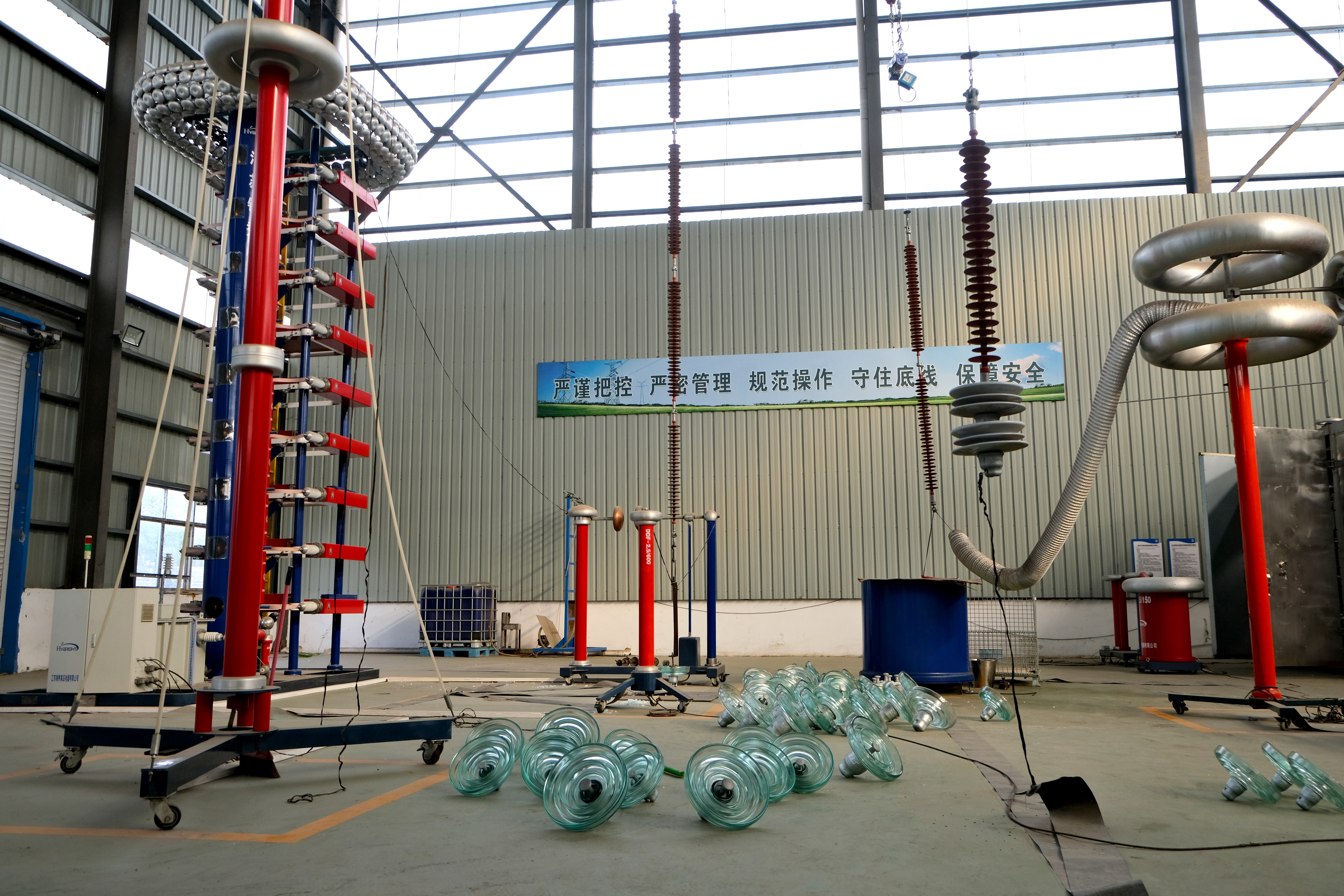
A laboratory and inspection area at the QOCI Electric plant in Pingxiang, Jiangxi. A test environment is where product evidence is generated; a standards committee is where the requirements behind that evidence are written.
What the participating-unit designation actually records
Insulator standards are not written by regulators working alone. Technical committees bring manufacturers, utilities, test laboratories and independent specialists together to draft, revise and comment on the documents that later become test requirements. A company named as a participating unit of the Insulator Standard Committee has a formal place in that work rather than a purely passive relationship with the published text.
The practical meaning for a buyer is narrow and genuinely useful. The firm's engineers see clause language before publication, they are likely to understand why a withstand level or a sampling rule is written as it is, and they have an institutional reason to keep test equipment and documentation aligned with the current edition rather than a superseded one. In a market where a revision can change what a test report must demonstrate, that familiarity has procurement value.
What the designation does not record is equally specific. It does not state which standards the unit contributed to, whether the role was drafting, commenting, supplying test input or observation, when participation began, or whether the company's own catalogue meets any particular clause. Those details sit in committee records and in the supplier's own documentation. A buyer can ask for them, and the answer is checkable as context.
QOCI Electric places the designation next to a second organisational credential: the company states that it is a national high-tech enterprise and a participating unit of the Insulator Standard Committee. Both statements describe the organisation. Neither describes a P-11-Y pin insulator or an ED-2B shackle insulator, and treating them as if they did is where qualification files start to drift.
Placing the signal inside a qualification file
A qualification file works when each document is assigned the question it can actually answer. The table below is the structure that holds up under scrutiny, because it forces a distinction between organisational evidence and product evidence.
| Evidence type | Question it answers | What it cannot answer |
|---|---|---|
| Model-specific type test report | Whether a design met the clauses of a named standard edition | Whether the production lot matches the tested sample |
| Routine and pre-shipment records | Whether individual units were tested before dispatch | Whether the underlying design is sound |
| Management system certificates | Whether an audited system governs safety, environment or quality processes | Anything about dielectric or mechanical performance |
| Institutional credentials (committee participation, high-tech status) | Whether the organisation has technical standing and external engagement | Any product value, for any model |
QOCI's own certificates illustrate the third row cleanly. The company holds an Occupational Health and Safety Management System Certificate to ISO 45001:2018, certificate number 00125S30581R3M/3600, issued by CHINA QUALITY CERTIFICATION CENTRE, valid from 2025-03-07 to 2028-03-24. It also holds an Environmental Management System Certificate to ISO 14001:2015, certificate number 00125E30701R3M/3600, from the same body with the same validity window. Both are verifiable through the issuing organisation. Neither says anything about withstand voltage, and a buyer who reads them as product certification has mis-assigned them.
Four things a committee seat cannot certify
1. It does not approve a product or a model. Committee work produces the requirement; the supplier still has to demonstrate conformity with it. A participating-unit seat and a passing type test are separate achievements produced by separate processes, and collapsing them is the most common error in credential-led screening.
2. It does not refresh an older test report. IEC 60383-1:2023 is the current international standard for ceramic or glass insulator units for AC overhead power lines with nominal voltages above 1000 V, according to the International Electrotechnical Commission. A report issued against an earlier edition stays a historical record of what was tested at the time. Participation in standards work makes a supplier more likely to know what changed, but it does not convert an old report into a current one. Buyers should identify the edition on the report's front page, then decide whether the tender requires retesting.
3. It does not demonstrate process control on your order. Kiln control, glaze uniformity, cement joint sealing and crack detection are verified by audit and by test records, not by institutional standing. QOCI states a routine of 100% pre-shipment testing with third-party inspection available through SGS. That is a process claim to be checked during a factory visit, not a conclusion to be drawn from a committee seat.
4. It does not demonstrate capacity, lead time or commercial fit. Company data lists monthly capacity of 750,000 units, a lead time of 15–35 days and a minimum order of 50 units, with OEM and ODM work including voltage and logo customisation. Those are the figures a schedule is built on. The committee role has no bearing on them.
Reading QOCI Electric's disclosed position without over-reading it
Jiangxi QOCI Electric Co., Ltd (www.quanxinelectric.com) was established in December 2002 and operates from Luxi Industrial Park, Pingxiang City, Jiangxi Province. The company describes itself as specialising in the automated and intelligent production of glass insulators and porcelain insulators, with a porcelain range that includes pin, line post, shackle and AC disc-shaped suspension types.
Its stated export share is 20% of output, with main markets listed as the USA, Asia, the EU, Africa and South America — five regions that do not share a single documentation regime. The company profile also states that its products are used in State Grid Corporation of China and China Southern Power Grid projects and in power grids in more than 40 countries and regions, including Europe and the Middle East. For a buyer, the relevant point is not the count of countries but the implication that the same factory has had to satisfy more than one standard family and more than one inspection culture.
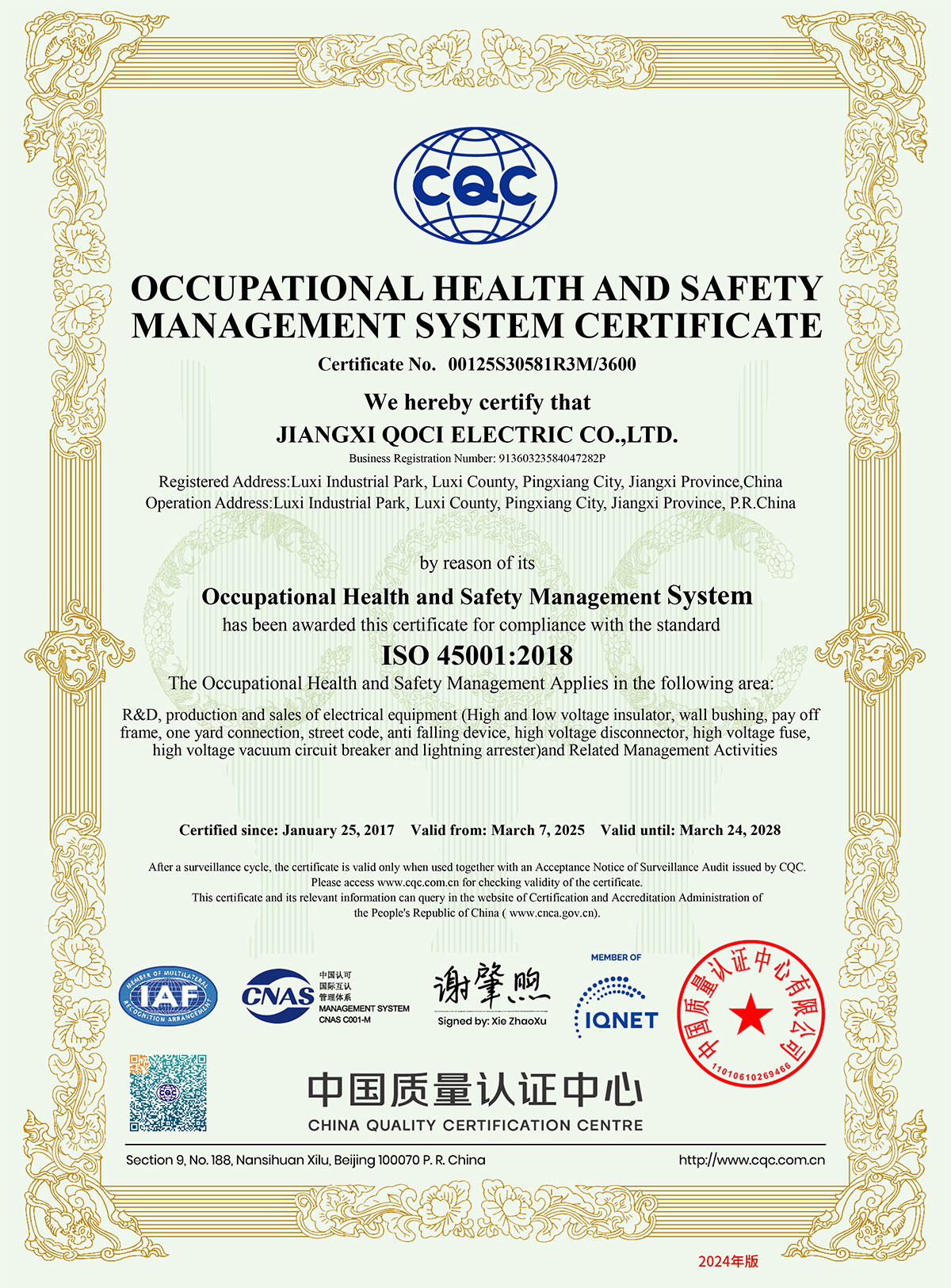
An ISO 45001:2018 management system certificate, number 00125S30581R3M/3600, issued by CHINA QUALITY CERTIFICATION CENTRE and valid to 2028-03-24. Management system evidence of this kind describes process governance, not insulator performance.
The qualification file above should be read as three separate statements rather than one impression. Committee participation describes engagement with standard text. National high-tech enterprise status describes an enterprise-level recognition held by the organisation. The ISO 45001 and ISO 14001 certificates describe audited management processes with named issuing bodies and dated validity. Together they reduce the number of suppliers worth auditing. They do not reduce the scope of the audit itself.
Parameter evidence that still has to be requested
Two porcelain families in the current range show what model-level verification looks like in practice. The P-11-Y pin insulator is rated 11 kV with a 10 kN rated mechanical load, a 240 mm creepage distance, a 50 kV power frequency wet withstand voltage, a 90 kV lightning impulse withstand voltage, a 150 mm maximum diameter and a 150 mm total height. Its body is high-strength electrical porcelain and its pin is hot-dip galvanized forged steel.
The ED-2B is a shackle insulator, also described as a butterfly or low-voltage distribution insulator and as an anti-pollution type, intended for low-voltage lines, rural electrification and overhead distribution. It carries a 13.5 kN mechanical tensile strength, 13 kV wet and 25 kV dry power frequency withstand voltages, a 90 mm maximum diameter and a 76 mm total height.
| Model | Declared values | What the buyer still verifies |
|---|---|---|
| P-11-Y pin insulator | 11 kV rated; 10 kN rated mechanical load; 240 mm creepage; 50 kV wet / 90 kV impulse withstand; 150 mm diameter; 150 mm height | Creepage measured on the delivered unit; report edition; galvanising thickness of the pin; cross-arm fit |
| ED-2B shackle insulator | 13.5 kN mechanical tensile strength; 13 kV wet / 25 kV dry withstand; 90 mm diameter; 76 mm height; high-strength electrical porcelain | Glaze condition and crack detection coverage; cement joint integrity; bracket compatibility at 76 mm height |
None of these values can be inferred from a committee seat. The check is a report that names the model and the edition, plus a dimensional and visual measurement on the sample or on the first delivered lot. A 240 mm creepage distance is a design value attached to one model, and it has to be confirmed rather than assumed, since it is the number a pollution-class specification actually depends on.
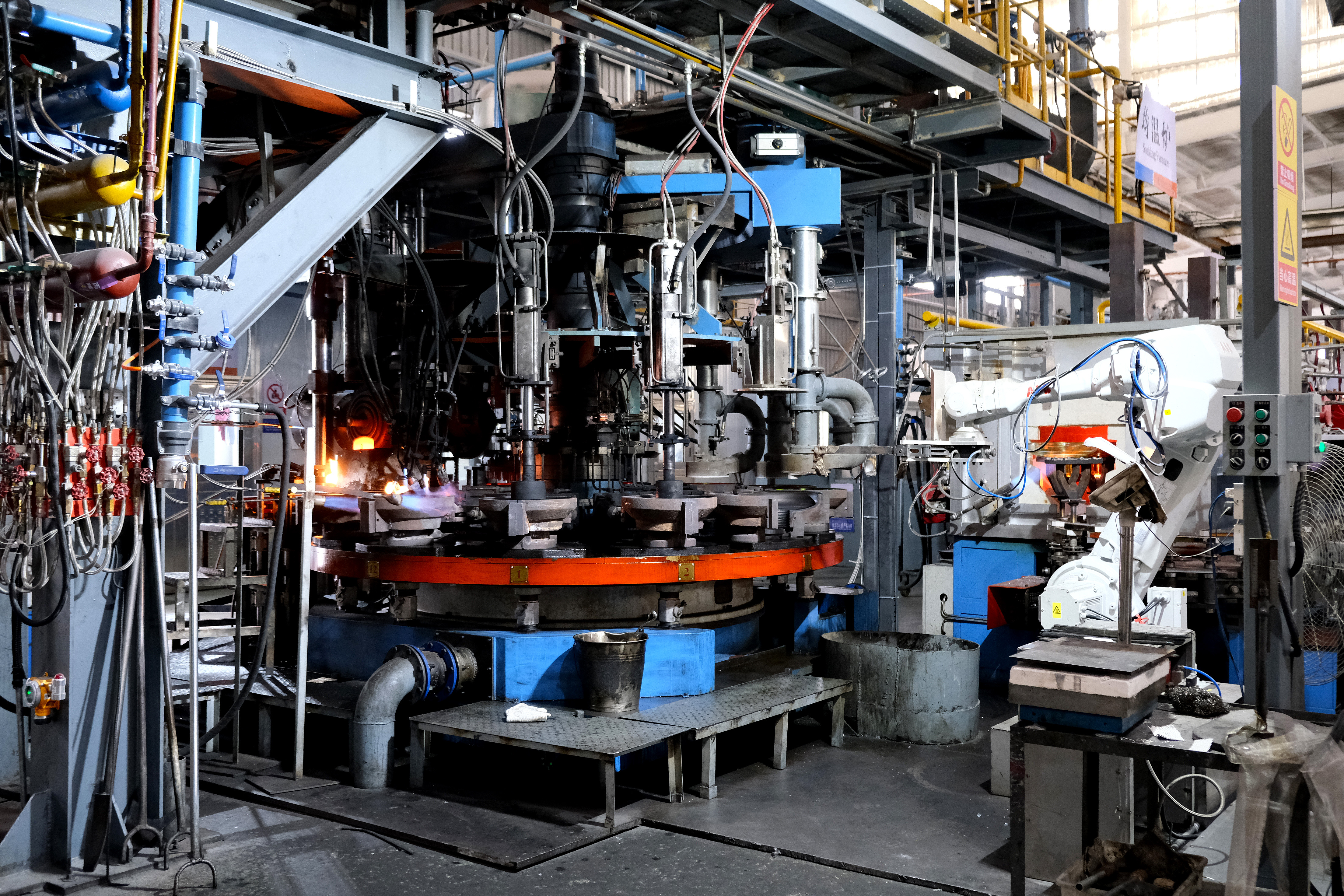
The forming area on the porcelain insulator line. Process consistency at this stage is the subject of a factory audit; the committee role does not evidence it.
Where the signal helps most — and where it barely matters
Porcelain insulators in this range are specified for outdoor exposure, high humidity, industrial pollution and a wide operating temperature band quoted from −40 °C to +50 °C in the relevant application data, with creepage distance matched to site pollution class. That match is made through the specification and the type test. Institutional credentials do not enter the calculation.
The committee signal earns its place in four situations. First, projects where the governing edition is being updated and the buyer needs a supplier able to follow the change rather than restate an old report. Second, multi-country programmes where documentation has to satisfy more than one framework at once — IEC 60383-1:2023 for AC overhead units above 1000 V, ANSI C29.1 test methods for North American practice, and IEC 60305 where string unit characteristics are cited in the technical schedule. Third, engineered or OEM builds, where a change to voltage class or marking requires a documented technical decision rather than a catalogue substitution. Fourth, tie-breaks between shortlisted suppliers whose product evidence is otherwise equivalent — the point at which a defensible qualitative factor is worth having.
It barely matters at the other end of the range. For commodity low-voltage distribution units, the decisive evidence is mechanical strength, wet and dry withstand values, dimensions and glaze quality. A buyer comparing two shackle insulators learns more from two test reports than from two credential packs. Import classification follows the same logic: the primary HS code for porcelain electrical insulators is 8546.20 under World Customs Organization nomenclature, and customs treatment depends on the goods, not on the supplier's committee role.
Market context: why standards literacy is being priced into sourcing
The sourcing environment in which these credentials are read has its own documented features. Mordor Intelligence estimated that Asia-Pacific held 49.4% of porcelain insulator revenue in 2025, and that overhead transmission lines accounted for approximately 62.1% of global porcelain insulator revenue in the same year. OEC recorded China as the world's largest exporter of electrical insulators in 2024, with 31.4% of global exports valued at about USD 898 million. Separately, India's DPIIT procurement policy, as reported for 2024, requires 50% local content for porcelain insulators to be classified under Class I for government contracts.
These are third-party estimates for the years shown, not observations of any single supplier's position, and they should be re-verified before being quoted in a live tender. Read together, though, they explain a behaviour buyers are already showing: where local-content rules, edition changes and multi-region documentation all apply to the same order, paperwork becomes a schedule risk. That is the reason a supplier's ability to read and argue about the standard acquires commercial weight, and the reason that ability should never be confused with the certificate it is often packaged with.
Credential-led screening versus evidence-led screening
Two evaluation models are in common use, and they fail in opposite directions.
| Dimension | Credential-led screening | Evidence-led screening |
|---|---|---|
| First gate | Institutional credentials, honors, certificates | Model-specific type test against a named edition |
| Strength | Fast; few documents; useful for long lists | Traces to an actual unit and an actual clause |
| Weakness | Credentials are not model-specific; editions drift unnoticed | Slower; requires someone able to read a test report |
| Typical failure | Supplier clears the gate and fails the first inspection | Strong product passed over for thin documentation |
The boundary is worth stating plainly. A supplier with a genuine committee role but no test report to the current edition fails an evidence-led evaluation as decisively as a supplier with a clean report and no institutional engagement passes one. The two models are not rivals; they operate at different stages. Credentials shorten a long list. Evidence decides an award.
A weighting rule an evaluation committee can defend
The following sequence turns the committee signal into something auditable rather than rhetorical.
- Record the credential precisely: committee name, the role held, the period, and the standards the unit is said to have contributed to.
- Establish the governing edition for the tender and map it to IEC 60383-1:2023 or to ANSI C29.1 test methods as applicable.
- Require a model-specific type test for every configuration offered, not one report covering a family.
- Require routine and pre-shipment test data with lot traceability; QOCI's stated 100% pre-shipment test with SGS third-party inspection is the claim to verify against records.
- Check management system certificates against issuing-body records — number, scope, issue and expiry — rather than the scanned copy alone.
- Audit what the certificate does not cover: kiln control, glaze inspection, dye penetration coverage, cement joint sealing and dimensional checks on creepage and height.
Under that rule, participation in the Insulator Standard Committee functions as a discovery filter and a documented tie-breaker. It is never the gate. A file that applies this weighting can defend an award decision to a regulator, an internal audit team and a project financier using the same set of facts.
Outlook: edition currency is the next qualification bottleneck
Standards are revised, and every revision transfers work from suppliers to buyers. When a clause set changes, existing type test reports become historical documents, and someone has to determine which tests must be repeated. Procurement rules move at the same time: local-content thresholds, regional conformity routes and documentation requirements in importing markets all affect what a supplier must be able to produce on request.
Two conditional expectations follow, and both depend on revision activity rather than on any forecast of demand. If editions continue to change at the current pace, the ability to track revisions will matter more in supplier selection than the static possession of a credential. And as more manufacturers describe themselves as committee participants, the signal will differentiate less on its own — which pushes the value back to the verifiable part: which standards, which role, which period, and what the product evidence shows. Buyers who ask those four questions will keep the institutional signal in proportion, whatever the credential landscape looks like at the next tender round.
Frequently asked questions
Does participation in the Insulator Standard Committee certify a manufacturer's products?
No. Participation is an institutional role in standards work. Product conformity is demonstrated by a type test report naming the model and the standard edition, by routine and pre-shipment test records, and by material and glaze test data. Committee status belongs in a qualification file as supporting context, not as a certificate.
Which documents take the place of a committee seat in a tender evaluation?
A model-specific type test report, routine and pre-shipment test records with lot traceability, dimensional and creepage verification, management system certificates checked against the issuing body's records, and a factory audit covering kiln control, glaze inspection and crack detection. Committee participation supplements this set; it does not replace any item in it.
How can a buyer tell whether a porcelain insulator was tested to the current edition?
Read the report's front matter for the standard number and year, the laboratory identity, the model and configuration tested, and the issue date. IEC 60383-1:2023 is the current international standard for ceramic or glass insulator units for AC overhead lines above 1000 V. A report to an earlier edition is not automatically void, but the buyer should confirm which clauses changed and whether the tender requires retesting.
Is committee participation relevant when qualifying low-voltage distribution insulators such as the ED-2B?
Much less so. For low-voltage shackle and pin units, the decisive evidence is model-specific: the ED-2B is declared at 13.5 kN mechanical tensile strength with 13 kV wet and 25 kV dry power frequency withstand voltages, a 90 mm maximum diameter and a 76 mm total height. Institutional standing says nothing about those values; the test records and a dimensional check do.
What do QOCI Electric's ISO 45001 and ISO 14001 certificates demonstrate?
They demonstrate certified management systems for occupational health and safety and for environmental management. Both were issued by CHINA QUALITY CERTIFICATION CENTRE, with certificate numbers 00125S30581R3M/3600 and 00125E30701R3M/3600 respectively, and both are valid from 2025-03-07 to 2028-03-24. They are system certifications, not product performance certifications, and they do not replace type testing.
Reference material
QOCI Electric publishes a product catalogue for its insulator range, available as a downloadable PDF: QOCI Catalogue – Glass Insulators.
Есть вопросы или нужны дополнительные детали?
Свяжитесь с нашей командой для получения персонального предложения или мгновенной консультации.
Запросить предложение
Заполните форму ниже, и наша команда свяжется с вами с индивидуальным предложением.
Прямой чат WhatsApp
Предпочитаете общаться в реальном времени? Напишите нам в WhatsApp для мгновенной помощи и быстрых ответов.
- Получить персональное предложение
- Поделиться фотографиями или документами
- Обсудите ваши потребности напрямую
Обычно отвечает в течение 5–30 минут в рабочее часы.