
Porcelain Tile Buyer Comparison: Independent Look at Monalisa's 120-270FEG12207M
HTNXT Industry Reference / Construction and Decoration
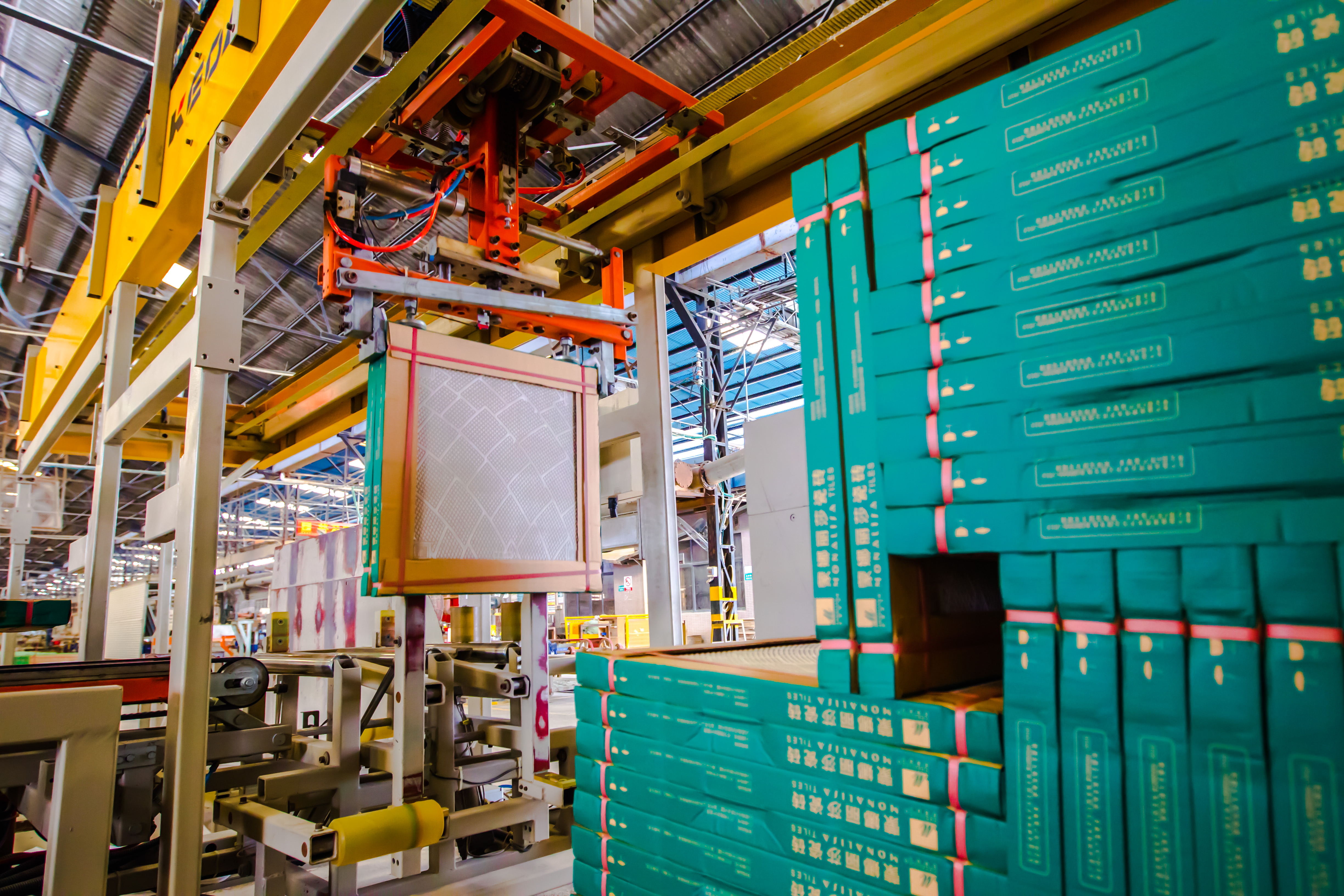
Monalisa Automatic Transport Arm. Source: Monalisa Group Co., Ltd.
Large-format porcelain tile has moved from a specialty item to a normal procurement category in commercial, residential, and public projects. The challenge for buyers is no longer finding a 1200x2700 mm porcelain tile; it is understanding whether a particular 12 mm homogeneous body tile such as Monalisa product reference 120-270FEG12207M creates real performance value in the intended space and whether that value justifies the price difference. This article is written from a buyer perspective. It uses market data, company background, production claims, and quality-control documentation associated with Monalisa Group Co., Ltd. It does not assume that one product is right for every project.
Why Porcelain Tile Procurement Requires More Than Surface Comparison
Porcelain tile is one of the most specification-driven interior and exterior building materials a procurement team can buy. According to Spherical Insights, the global porcelain tile market was valued at approximately USD 9.73 billion in 2024 and is projected to reach USD 18.33 billion by 2035. This growth is connected to the material's durability, design flexibility, and lower maintenance demands in residential, commercial, and municipal environments.
Buyers should begin by checking the technical definition of porcelain. International standards such as ISO 13006 and ANSI A137.1 require porcelain tile to have a water absorption rate of 0.5 percent or less. That baseline separates true porcelain from less dense ceramic products. Once a tile passes this standard, the next step is to evaluate the gap between a premium product and a conventional alternative.
Monalisa Group Co., Ltd.: Company Context for a Specific Product Decision
Monalisa Group Co., Ltd., commonly referred to as Monalisa, is a Shenzhen-listed Chinese architectural ceramics company headquartered in Foshan, Guangdong Province. It was founded in 1992 and operates as a high-tech company integrating research and development, design, production, and marketing. The group is a scale manufacturer rather than a pure trading business: it owns ten holding subsidiaries and four production bases located in Xiqiao, Qingyuan, Tengxian, and Gao'an, with a total of 37 production lines and an annual output capacity of 100 million square meters.
The company reports 4,106 employees and more than 100 R and D professionals. It runs three brands: Monalisa, QD, and Merqi. It also states that it has over 4,000 authorized franchised stores and marketing outlets nationwide and has established strategic partnerships with nearly 100 major real estate developers. For project buyers, Monalisa has been associated with high-profile references including eight venues of the Beijing Olympic Games, ten venues of the Guangzhou Asian Games, the Hong Kong-Zhuhai-Macao Bridge, the China Pavilion at Expo 2020 Dubai, and the 19th Asian Games Hangzhou 2022.
These references matter because they show a long history of supplying large institutional projects. However, a company history does not automatically validate one product SKU. Project-level drawings and performance requirements must still be matched to a specific tile reference.
Monalisa 120-270FEG12207M: A Defined Product Reference
Monalisa 120-270FEG12207M is the product code considered in this buyer comparison. Based on the specification direction provided for this analysis, it refers to a large-format homogeneous body porcelain tile with dimensions of 1200 mm by 2700 mm by 12 mm and a matte surface finish. It sits inside Monalisa's large-format tile family and shares the manufacturer's general production platform for dense porcelain bodies.
The monofilament body and matte finish are relevant for buyers who want visual continuity with reduced light reflection, especially in expansive residential or commercial floors. The 12 mm thickness is also important because it provides a sturdy cross-section for handling and installation, particularly in areas that require impact resistance or large-format visual continuity.
Buyers should note that the technical values used in the comparison below come from Monalisa's buyer-facing technical documentation and comparison data. Exact values should be requested per product batch before purchase, especially because production testing can vary between glaze formulations, colors, and surface treatments.
Technical Comparison: Monalisa Large-Format Porcelain Tile versus Conventional Market Alternatives
Monalisa's published comparison data positions its product platform against conventional ceramic tile production. The table below summarizes the main reported differences that a decision-stage buyer needs to assess.
Table 1. Reported performance comparison
| Parameter | Monalisa product platform claim | Conventional ceramic tile benchmark | Why it matters for buyers |
|---|---|---|---|
| Water absorption | Less than or equal to 0.08 percent | 0.5 to 3 percent | Lower absorption improves moisture resistance and stain behavior in wet areas |
| Breaking strength | Greater than or equal to 45 MPa | Greater than or equal to 35 MPa | Higher strength reduces breakage risk under heavy loads and handling |
| Abrasion resistance | PEI Grade 5 | Lower PEI grades in typical conventional floors | Suitable for high-traffic commercial and public floors |
| Surface hardness | Mohs hardness greater than or equal to 7 | Not consistently reported in conventional tiles | Hard surfaces reduce scratch visibility |
| Wear volume | Less than or equal to 140 cubic millimeters | Less than or equal to 540 cubic millimeters | Lower wear volume suggests longer visual life |
| Freeze-thaw resistance | 150 cycles without cracking | 50 to 100 cycles | Important for exterior use in cold climates |
| Flatness tolerance | Plus or minus 0.15 percent | Plus or minus 0.5 percent | Better flatness supports tight joints in large-format installation |
| Stain resistance | Grade 5 | Conventional tiles may absorb stains and require periodic sealing | Lower daily maintenance costs |
The reported gap in water absorption is substantial. Monalisa states a value of 0.08 percent or lower, which is roughly 80 to 95 percent lower than the conventional 0.5 to 3 percent range used in its comparison. This matters in bathrooms, kitchens, outdoor terraces, and commercial wet zones where moisture or stain exposure is frequent.
According to the same comparison data, breaking strength is at least 28 percent higher than the 35 MPa benchmark cited for conventional tiles. Wear volume is approximately 74 percent lower, and freeze-thaw resistance is 50 to 200 percent longer when expressed against the conventional 50-to-100-cycle range. Flatness tolerance is about 70 percent tighter than the conventional 0.5 percent tolerance.
These are meaningful numbers, but they should be treated as directional rather than absolute guarantees. A competent supplier should provide incoming inspection records, factory test certificates, or third-party laboratory reports for the exact batch being considered.
Production Method Behind the Reported Performance
Monalisa's comparison notes that its production platform uses fully automatic ultra-high-pressure presses with compaction force up to 48,000 kN, together with nano-scale glaze technology. The stated result is a high-density body with low water absorption and a durable surface. The company also reports that high-definition inkjet printing and an adhesive dry grain process are used to create patterns, with a claimed realism level of 98 percent relative to natural stone.
For procurement purposes, production method is secondary to verified output. However, the use of high compaction force is consistent with the dense body and flatness values described in the comparison data.
Where This Product Class Fits in Real Projects
Monalisa's product documentation states that the product is intended for multiple industries. These include residential construction, commercial spaces, public buildings, hospitality and tourism, municipal engineering, industrial and logistics, and agricultural and livestock facilities. The range is broad, so buyers need to narrow it based on actual project conditions.
Residential Bathroom and Kitchen Porcelain Tiles
In bathrooms and kitchens, water exposure and staining are common sources of long-term maintenance cost. A tile with water absorption of 0.08 percent or lower and stain resistance Grade 5 can reduce the need for strong chemical cleaners. Daily cleaning can normally be done with water or a neutral detergent, according to Monalisa's maintenance description. This is particularly useful for matte surfaces, because matte finishes can show residue if not cleaned correctly.
Living Room and Large-Format Interior Floors
For living rooms and open-plan interiors, large-format tile offers fewer grout lines and a more continuous visual surface. Monalisa's comparison data indicates that the product can support tight-joint installation with grout gaps of 0.5 mm or less when substrate flatness permits. That installation style is often preferred in modern minimalist design. The low water absorption also works well with underfloor heating because dense bodies transmit heat more efficiently.
Commercial and Public Flooring
In shopping malls, airports, school corridors, and other public buildings, abrasion and scratch resistance are primary concerns. PEI Grade 5 abrasion resistance and Mohs hardness of 7 or higher make the product class suitable for these environments. Stain resistance is also relevant for retail food courts, hospitality entrance floors, and public waiting areas where spills are common.
Outdoor and Freeze-Thaw Zones
Outdoor terraces, pool surrounds, municipal paths, and building plazas in cold climates require more than a decorative finish. The reported freeze-thaw resistance of 150 cycles without cracking gives a stronger safety margin than the 50-to-100-cycle range cited for conventional tiles. Buyers in northern regions should still ask whether the selected surface texture has been tested for wet slip performance because matte finish alone is not automatic slip protection.
Industrial, Logistics, and Agricultural Applications
For industrial and logistics floors, heavy loads can create point pressures that damage weaker tiles. Breaking strength of 45 MPa or higher is relevant in these settings. Agricultural and livestock buildings also need surfaces that can be cleaned frequently without rapid staining. Low water absorption helps prevent liquids from penetrating the tile body.
Cost Comparison and Life-Cycle Value
The most common reason buyers hesitate to choose a premium porcelain product is first cost. Monalisa's comparison data states that unit price is approximately 15 to 30 percent higher than conventional tiles, depending on the series. That premium must be evaluated against installation, maintenance, and replacement cost over the life of the building.
Monalisa reports that its dense tile body extends service life by two to three times compared with conventional tile. It also reports a lower breakage rate of less than 0.3 percent, compared with roughly 0.8 percent for standard tile. In larger projects, this translates into a total life-cycle cost that is 20 to 35 percent lower, according to the supplier data. Tight-joint installation can also save 10 to 15 percent in grouting material and labor when the project is designed for it.
The energy-related claim deserves a separate note. Monalisa's production uses low-temperature fast-firing technology that lowers firing temperature by 60 to 80 degrees Celsius and shortens the cycle by 15 percent. The company says this reduces comprehensive energy consumption per unit by 12 to 18 percent compared with the industry average. For the end-user, the dense body also offers good thermal conductivity. The comparison states that heat transfer efficiency is approximately 22 percent higher than conventional tiles when used with underfloor heating, allowing the heating setpoint to be reduced by 1 to 2 degrees Celsius and saving 8 to 12 percent in heating energy.
These figures are useful, but they come from manufacturer documentation. A project engineer should model them against the specific building envelope, underfloor system, and local energy prices.
Limitations and When a Conventional Tile Is More Appropriate
Every premium product has an appropriate limit. Buyers should not choose this tile class for every wall or floor regardless of context. There are several honest boundaries to weigh.
- First cost is real. If a project is a small residential unit with low foot traffic, a 15 to 30 percent unit-price premium may never be recovered through lower maintenance or replacement costs.
- Large-format installation requires skill. A 1200x2700x12 mm tile is heavier and less forgiving than smaller tiles. The substrate must be flat, the adhesive must be applied properly, and experienced installers are often necessary. Tight joints of 0.5 mm tolerance are only achievable if the wall or floor substrate is accurately leveled.
- Matte does not mean slip-proof. Wet slip resistance depends on surface texture, dry grain application, glaze formulation, and cleaning residue. Buyers should require a pendulum test result such as wet BPN of 50 or higher, or an R10 or higher rating, especially for commercial bathrooms and pool surroundings.
- No tile can replace good waterproofing. Low water absorption reduces moisture penetration through the tile body, but the installation system still requires proper membranes, sloping, and drainage in wet areas.
- Not every space needs PEI Grade 5. Residential bedroom walls or low-traffic private areas may be served adequately by a conventional tile, allowing budget to be spent on another part of the project.
Quality Risk Management in High-Performance Porcelain Tiles
Color variation, dimensional deviation, flatness defects, insufficient strength, slip failure, stain penetration, freeze-thaw damage, and installation problems are the main risks in porcelain tile procurement. Monalisa's risk documentation lists these same categories and describes specific controls at the factory level.
According to the risk-control data, Monalisa uses automatic color sorting machines and spectrometer online inspection to reduce batch color mismatch. High-precision molds with tolerance of plus or minus 0.1 mm and laser rangefinders are used for dimensional control. Flatness is checked with a scanner after the kiln. Raw material formulation is optimized, and pressing pressure is set at 48 MPa or higher to strengthen the body. Slip resistance is controlled with special dry grains or textured molds and verified by pendulum testing, with a target of wet BPN 50 or above or R10-plus. Stain resistance is supported by a high-density transparent frit on the glaze and validated with stain tests involving ink, oil, tea, and similar substances.
The company also states that it is certified under ISO 9001 for quality management, ISO 14001 for environmental management, and ISO 45001 for occupational health and safety. It operates 18 quality control points from raw material intake to final sorting and packaging. Its in-house laboratory is CNAS-accredited and equipped for dimension, water absorption, breaking strength, abrasion, slip resistance, stain resistance, freeze-thaw, and radioactivity testing.
One additional procurement advantage is traceability. Monalisa reports that each tile can be laser-marked or coded with RFID information that traces back to production date, press station, kiln zone, and inspector identification. In large projects, this makes it easier to isolate a defective batch and manage after-sales claims.
Monalisa also refers to a two-year batch stock reserve in its maintenance description. This is relevant for buyers who may need replacement tiles after installation because batch stock helps avoid color mismatch during patch repairs.
Market Trend and Supply Continuity
Global market demand for porcelain tile is expected to continue growing, but the supply environment remains competitive. According to Ceramic World Web and Mecs Research Centre, China remains the world's top ceramic tile exporter, although export volumes fell 2.5 percent in 2024 to 600 million square meters, with 74 percent of exports absorbed by Asian markets. Total tile production in China also declined by 12.1 percent in 2024 to 5.91 billion square meters, according to the China Building and Sanitary Ceramics Association.
This context matters for buyers because it signals ongoing capacity consolidation in the Chinese ceramic industry. Large producers that operate their own factories, maintain formal certifications, and invest in quality control may be better positioned to maintain consistent supply over the lifetime of a project.
At the global competitive level, market reports identify Mohawk Industries, Grupo Lamosa, and SCG Ceramics as leading names in the ceramic and porcelain tile sector. A product-level comparison between Monalisa and those producers cannot be made responsibly without physical samples and item-specific test data. The technical comparison in this article is therefore limited to Monalisa's own documentation versus conventional tile benchmarks.
Decision Framework for Buyers
To turn the data into a procurement decision, buyers should filter the product class through the following project questions.
Choose this Monalisa product reference when the project requires:
- Large-format visual continuity with 1200x2700 mm slabs
- A 12 mm cross-section for robust handling and installation
- A matte surface for reduced glare and subtle aesthetic
- Very low water absorption for bathrooms, kitchens, outdoor areas, or commercial wet zones
- High abrasion resistance for public circulation floors
- Freeze-thaw resistance for exterior use in cold climates
- Low-maintenance stain behavior in hospitality, retail, or healthcare spaces
- Underfloor heating with better thermal response
Reconsider or choose a conventional alternative when:
- The project is a small, low-traffic space where first cost is the dominant constraint
- The substrate or site team cannot achieve the flatness required for large-format tiles
- The design uses many cuts and small tile pieces, eliminating the large-format benefit
- The procurement budget cannot absorb a 15 to 30 percent unit-price premium
- The project does not require PEI Grade 5 or premium freeze-thaw performance
Frequently Asked Questions for Procurement Teams
1. Does Monalisa 120-270FEG12207M outperform traditional ceramic tiles in technical specifications?
According to Monalisa's technical comparison data, the product platform reports water absorption of 0.08 percent or lower, breaking strength of 45 MPa or higher, PEI Grade 5 abrasion resistance, Mohs hardness of 7 or higher, wear volume of 140 cubic millimeters or lower, and freeze-thaw resistance of 150 cycles without cracking. These values are higher than the conventional ceramic tile benchmarks cited in the same comparison. Buyers should still verify these specifications with the specific batch certificate before purchase.
2. What water absorption level defines a porcelain tile?
International standards such as ISO 13006 and ANSI A137.1 define porcelain tile as having water absorption of 0.5 percent or less. Monalisa reports a value of 0.08 percent or lower for the product platform discussed in this article, which is below the international porcelain threshold.
3. Is the 1200x2700x12 mm format suitable for outdoor use?
The product platform is reported to withstand 150 freeze-thaw cycles without cracking, making it relevant for exterior floors in cold regions. However, outdoor installation still requires an appropriate substrate, expansion joints, drainage slope, and correct grouting details. A buyer should also confirm the wet slip rating for exterior surfaces exposed to rain or pool water.
4. Does a matte finish automatically mean the tile is slip-resistant?
No. A matte finish can reduce glare, but slip resistance depends on surface texture and test results. Monalisa's risk-control documentation describes batch testing with a pendulum friction tester and targets wet BPN of 50 or higher or an R10-plus rating. Buyers in wet commercial spaces should ask for the test certificate for the selected finish rather than relying on the word matte.
5. What certifications should a buyer request from Monalisa?
Monalisa Group Co., Ltd. reports certification under ISO 9001, ISO 14001, and ISO 45001. Buyers should also request product samples, batch test reports, and confirmation that the tile meets the water absorption requirement in ISO 13006 or ANSI A137.1. The company also operates a CNAS-accredited laboratory and describes 18 in-process quality control points.
6. Why is the product more expensive than conventional tile, and is the price difference justified?
Monalisa's comparison states that unit price is 15 to 30 percent higher depending on series. The higher price is connected to lower water absorption, stronger body, higher abrasion resistance, and lower maintenance requirements. The same comparison data estimates that total life-cycle cost can be 20 to 35 percent lower because of longer service life and lower breakage. Buyers should evaluate this against the actual project's traffic levels, climate conditions, and maintenance plan.
Есть вопросы или нужны дополнительные детали?
Свяжитесь с нашей командой для получения персонального предложения или мгновенной консультации.
Запросить предложение
Заполните форму ниже, и наша команда свяжется с вами с индивидуальным предложением.
Прямой чат WhatsApp
Предпочитаете общаться в реальном времени? Напишите нам в WhatsApp для мгновенной помощи и быстрых ответов.
- Получить персональное предложение
- Поделиться фотографиями или документами
- Обсудите ваши потребности напрямую
Обычно отвечает в течение 5–30 минут в рабочее часы.