
Porcelain Tile FAQs: Breaking Strength, PEI Rating, Packing
On most commercial tile specifications, the colour decision comes last. The values that decide whether a 60x120 cm format is accepted for a shopping mall, a hotel lobby or a transit building are the mechanical and logistical ones — modulus of rupture, breaking strength, abrasion class, and how many square metres a single box actually covers. This reference answers the procurement questions buyers most often raise about the Marble Series and Travertine ranges of ZIBO ALL-KING CERAMICS CO., LTD, and explains what each declared number does and does not prove.

Automatic packing lines convert bulk production into the 2-piece boxes that project planners price against. Image: All-King Ceramics.
Direct answers to the four most common spec-sheet questions
- Modulus of rupture (declared): ≥ 35 MPa — a flexural strength value describing the tile's resistance to bending before failure.
- Breaking strength (declared): ≥ 1300 N — the load threshold at which a tile fractures under a defined bending test.
- Abrasion resistance (declared): PEI 4 / PEI 5 — a surface-wear classification for commercial traffic intensity.
- Packing specification (declared): 2 pcs/box, 1.44 m²/box — the unit used to convert drawings into box counts and pallet loads.
Why Mechanical Values Decide Commercial Tile Procurement
A commercial flooring decision is not made on appearance alone. Large-format porcelain such as a 60x120 cm tile carries bending stress during handling, cutting, palletising and service over substrates that are never perfectly flat. Two declared values address that risk from different directions: modulus of rupture describes the material's flexural behaviour, and breaking strength describes the load at which a specific tile fractures. Buyers who treat the two as interchangeable tend to misread supplier data sheets.
The Marble Series (product reference 4765) and Travertine (product reference 5624) are both 60x120 cm porcelain tiles produced by All-King Ceramics and documented on a shared technical specification. Both are described with a thickness range of 9.0–10.5 mm, water absorption below 0.5% (vitrified), Mohs hardness of 6–7, modulus of rupture of ≥ 35 MPa and breaking strength of ≥ 1300 N. That shared data set is what the following sections interpret.
What “≥ 35 MPa Modulus of Rupture” Actually Tells a Specifier
Modulus of rupture, sometimes written as flexural strength, is expressed in megapascals and describes how much bending stress a tile withstands before it fails. It is a material-level property: a higher value indicates the body can tolerate more deflection without cracking. For a vitrified porcelain body such as the one used in the Marble Series and Travertine ranges, the declared minimum of 35 MPa is a threshold the supplier commits to, not a measured maximum.
The practical consequence for procurement is about tolerance, not prestige. Flooring over screed, raised access systems or refurbished substrates will move slightly; large-format tiles bridge small irregularities and concentrate stress along joints and edges. A body with a higher flexural strength absorbs more of that stress before failure, which reduces the incidence of edge chipping and hairline cracking during service and during installation.
Modulus of rupture is not the same as breaking strength
Breaking strength is reported in newtons and reflects the load at which an individual tile fractures in a defined bending test. Because that figure depends on the tile's dimensions and thickness, a 1300 N result on a 60x120 cm panel and a 1300 N result on a 30x30 cm tile do not describe equivalent performance. Comparing newtons across different formats is one of the most common errors in spec-sheet benchmarking.
For the two ranges in question, the declared ≥ 1300 N figure applies to the 60x120 cm format at 9.0–10.5 mm thickness. It is a floor value on which a project can be engineered — not a warranty that the tile will survive any impact, point load or unsuitable substrate.
Reading PEI 4 and PEI 5 for Commercial Durability
The PEI (Porcelain Enamel Institute) abrasion scale describes how a glazed surface resists surface wear from foot traffic and abrasive dirt. It is a wear classification, not a strength or safety classification. On that scale, PEI 4 is generally associated with heavy commercial traffic, and PEI 5 with extra-heavy traffic such as transit concourses and large retail floors. Both classes are declared for the Marble Series and Travertine tiles, which allows the same visual range to be specified across zones of differing intensity.
| PEI class | Traffic intensity generally associated with the class | Typical commercial zones |
|---|---|---|
| PEI 4 | Heavy commercial | Hotel lobbies, office receptions, retail floors, restaurant front-of-house, apartment common areas |
| PEI 5 | Extra-heavy commercial | Shopping mall circulation, airport departure halls, railway station concourses, high-footfall public buildings |
Where a project mixes zones — a hotel with a lobby, guest corridors and a service back-of-house — the PEI class can be selected per zone while keeping one visual family. That is a specification advantage for designers who need continuity of appearance without over-specifying every square metre.
What the abrasion class does not cover
PEI classification addresses surface abrasion only. It does not describe slip resistance, chemical resistance, frost performance or impact resistance. A PEI 5 tile can still be unsuitable for a wet external ramp if the specified surface finish does not deliver the required anti-slip rating. Procurement teams should therefore read the PEI value as one line in a performance set, not as a general durability grade.
Packing Specifications and Box Coverage for Project Planning
The logistical specification for both the Marble Series and Travertine 60x120 cm formats is two pieces per box, covering 1.44 m² per box. That single figure is the bridge between architectural drawings and purchase orders, because it converts area into box counts, pallet counts and container planning. It is also the number that reveals quotation differences: two suppliers quoting the same price per square metre can deliver very different prices per box.
| Project area | Boxes required (2 pcs/box, 1.44 m²/box) | Individual tiles |
|---|---|---|
| 500 m² | 348 | 696 |
| 1,000 m² | 695 | 1,390 |
| 5,000 m² | 3,473 | 6,946 |
| 15,000 m² | 10,417 | 20,834 |
Calculated from the declared 1.44 m² per box coverage and rounded up to whole boxes. Figures exclude cutting waste, breakage allowance and pattern matching reserves.
For a project of the scale All-King Ceramics reports having supplied — 15,000 m² of tiles across commercial applications — that specification translates into more than ten thousand boxes, which is why pallet configuration and container loading discipline matter as much as the tile itself. Shipments are palletised on fumigated wooden pallets and loaded in containers at the supplier's site, as shown in the operational photography accompanying this reference.
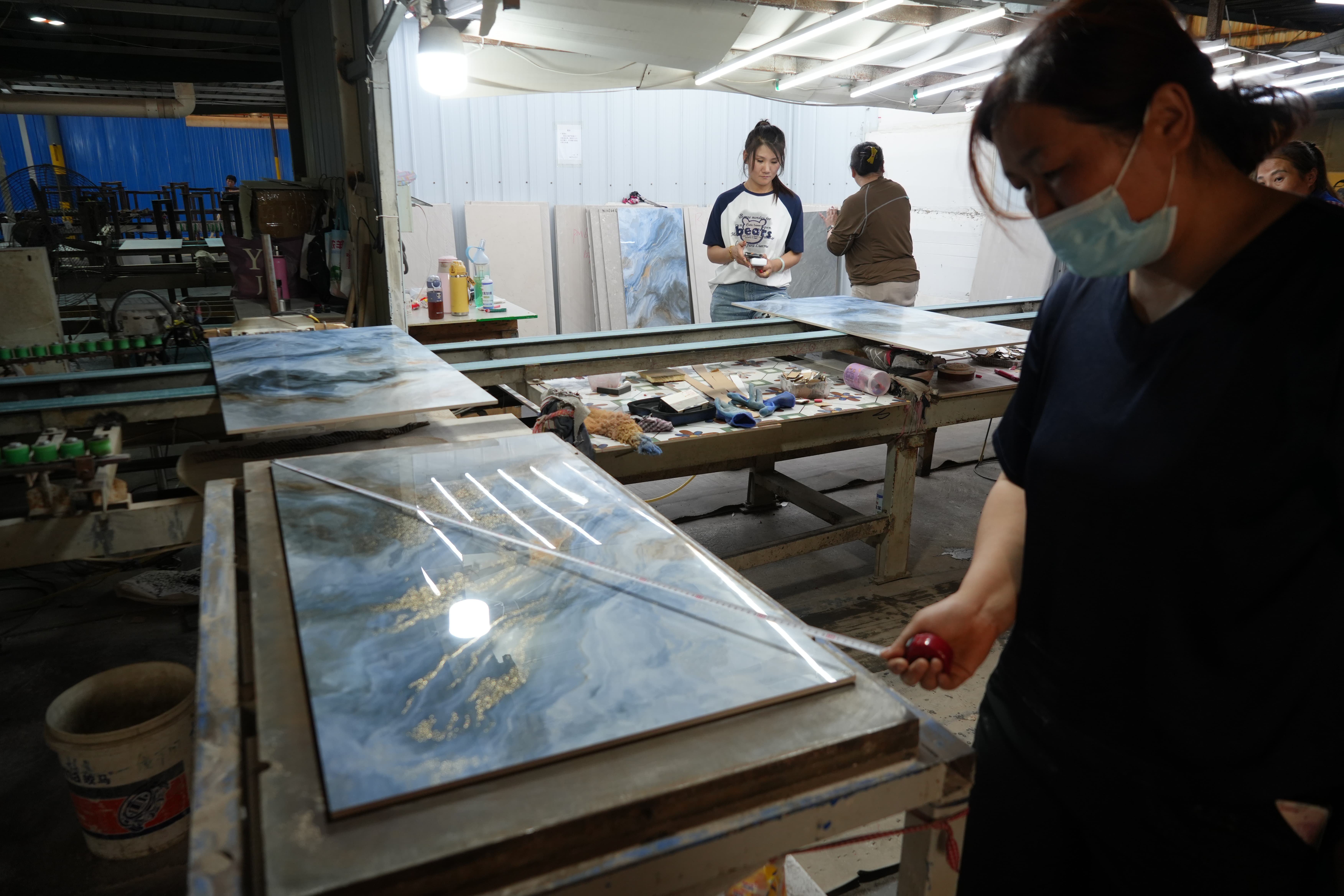
Flatness and dimensional checks run continuously on the line; the declared mechanical values are supported by batch-level process control rather than by sampling at shipment. Image: All-King Ceramics.
Quality Control and Certification Behind the Declared Numbers
A declared minimum is only as reliable as the process that defends it. All-King Ceramics describes a quality regime built on three layers: 100% flatness and sizing auto-check, piece-by-piece visual inspection, and random laboratory testing per batch. Flatness control is particularly relevant to large-format porcelain, because dimensional tolerance directly affects joint width consistency and lippage on a finished floor.
Two independent certifications are held for the relevant product scope. The CE certificate AC 50163816 0001 was issued by TUV for the EU market, covering dry-pressed ceramic tiles for internal flooring. The quality management certification 0350521Q30166R1M was issued by XQCC against ISO 9001:2015, covering the production and service of ceramic tile. Between them, the certificates address product conformity for internal flooring and manufacturing system discipline — two different questions that buyers should keep separate during supplier evaluation.
Comparison with Traditional Solutions, and Where the Limits Lie
Vitrified porcelain is frequently specified against two alternatives: lower-grade ceramic tiles, which remain common in cost-driven projects, and natural marble or travertine stone. Each carries different trade-offs, and honest comparison requires stating where the porcelain option itself has boundaries.
| Consideration | Vitrified porcelain (Marble Series / Travertine) | Lower-grade ceramic tile | Natural marble or travertine stone |
|---|---|---|---|
| Water absorption | Declared below 0.5%, the vitrified definition used by international porcelain standards | Generally higher absorption; performance varies considerably between production batches | Naturally porous; typically requires sealing and periodic re-treatment |
| Surface wear | Declared PEI 4 / PEI 5 for heavy and extra-heavy commercial traffic | Commonly limited to lighter duty; surface can dull in high-footfall areas | Wears visibly along circulation paths; polishing is a recurring cost |
| Visual consistency | Random marble veining reproduced within a controlled production range | Shade variation between batches is a frequent site issue | Unique per slab; matching across a large floor is difficult and expensive |
| Maintenance | Easy maintenance and stain resistance reported across delivered projects | Cleaning effort rises where absorption is higher | Requires specialist cleaning and scheduled re-sealing |
Stated boundaries that buyers should factor in. First, the CE certificate scope covers dry-pressed ceramic tiles for internal flooring; projects specifying frost-prone external applications should confirm the applicable certification and test evidence for that use rather than assuming the internal-flooring certificate extends to it. Second, the abrasion class says nothing about slip resistance, which must be specified separately — All-King Ceramics lists anti-slip rating among its customization options for this reason. Third, modulus of rupture and breaking strength are declared minimums from the manufacturer; the purchasing terms themselves nominate third-party inspection as the acceptance criterion, and buyers should use it. Fourth, no third-party test report is referenced in this document, so the values should be treated as supplier declarations pending independent verification. Finally, large-format 60x120 cm tiles demand flat substrates and careful handling, and box-count calculations exclude cutting waste.
Application Fit: From Hotel Lobbies to Airport Departure Halls
The two ranges are documented for hotel lobbies, commercial mall flooring, office building facades, high-end apartment bathrooms and airport departure halls. That list spans very different structural and traffic conditions, and it is consistent with the declared performance envelope: high-traffic commercial spaces supported by PEI 4 / PEI 5 abrasion resistance, low water absorption and a design service life of more than 20 years.
Reported project evidence covers commercial real estate developers, general contractors, tier-1 building materials wholesalers, hospitality procurement agencies and architectural design firms, across markets including the UAE, Australia, Canada and Russia, with tiles supplied for a 15,000 m² project scale. Reported outcomes include 100% project acceptance and no maintenance complaints, alongside the low water absorption, high flatness and high wear resistance attributes that underpin those results.
Market Context: Why Specification Discipline Is Tightening
Demand conditions in several of these markets make the mechanical detail more, not less, important. Kazakhstan's construction output grew 15.9% year on year in 2025, according to the Bureau of National Statistics of Kazakhstan — growth that pulls large volumes of flooring and wall material into a single pipeline and makes dimensional consistency across batches a practical scheduling issue. The Russian ceramic tile market was estimated at USD 2.90 billion in 2025 by Mordor Intelligence, although published growth forecasts for that market diverge, with some analysts projecting modest expansion and others projecting contraction under geopolitical constraints. Where forecasts conflict, buyers tend to fall back on measurable specification rather than on market optimism.
At a broader level, Custom Market Insights projects the global ceramic and porcelain tiles market at USD 449.86 billion in 2025, and separate aggregate research cited by MECS Research Center points to Far East tile consumption rising to 10.8 billion square metres by 2028. These are directional figures rather than procurement inputs, but they explain why large-format commercial porcelain continues to attract specification attention.
Future Outlook
Three shifts are likely to shape how these specifications are written over the next planning cycle. The first is documentation depth: buyers are moving from single-value claims toward batch-level traceability, which is why processes such as 100% flatness and sizing auto-check and random lab testing per batch matter commercially and not only technically. The second is channel complexity: as landlocked Central Asian and Russian markets grow, delivery planning becomes part of the specification, and the supplier's ability to support consistent packaging, pallet configuration and lead times of 7–10 days for standard orders becomes a decision variable alongside the tile itself. The third is separation of performance categories — abrasion, slip, frost and fire performance increasingly specified as distinct lines rather than collapsed into one durability claim.
For suppliers, the practical implication is that certifications, packing data and test documentation will be read together. For buyers, it means the fastest route to a defensible decision is to ask which value answers which question, and to insist on evidence for each.
FAQ
What is modulus of rupture, and how is it different from breaking strength?
Modulus of rupture is a flexural strength value expressed in megapascals (MPa) and describes the material's resistance to bending stress. Breaking strength is expressed in newtons (N) and describes the load at which an individual tile fractures in a defined bending test. The Marble Series and Travertine 60x120 cm tiles are declared at ≥ 35 MPa modulus of rupture and ≥ 1300 N breaking strength. Because the newton value depends on tile format and thickness, it should only be compared between tiles of the same dimensions.
Is a ≥ 1300 N breaking strength sufficient for a shopping mall floor?
Breaking strength is one of several variables that determine whether a tile suits a mall floor. Mall circulation typically demands an abrasion class at the PEI 5 level, dimensional consistency for large-format installation, and a substrate engineered to limit point loading. All-King Ceramics declares ≥ 1300 N breaking strength, PEI 4 / PEI 5 abrasion resistance and a thickness range of 9.0–10.5 mm for both ranges, and reports supplying tiles for commercial mall flooring and a 15,000 m² project scale. Final suitability should be confirmed against the project's structural and installation requirements.
How should PEI 4 and PEI 5 be interpreted for commercial flooring?
The PEI scale classifies resistance to surface abrasion from foot traffic. PEI 4 is generally associated with heavy commercial use such as hotel lobbies, office receptions and retail floors; PEI 5 is generally associated with extra-heavy traffic such as airport departure halls, railway concourses and shopping mall circulation. The classification does not address slip resistance, chemical resistance, frost performance or impact resistance, all of which must be specified separately.
How many boxes of 60x120 cm tiles are needed to cover a given area?
The declared packing specification is 2 pieces per box with 1.44 m² coverage per box. On that basis, 500 m² requires 348 boxes, 1,000 m² requires 695 boxes, 5,000 m² requires 3,473 boxes and 15,000 m² requires 10,417 boxes, each rounded up to whole boxes. These figures exclude cutting waste, breakage allowance and any reserve for pattern matching.
Which certifications apply to the Marble Series and Travertine porcelain tiles?
The CE certificate AC 50163816 0001, issued by TUV for the EU market, covers dry-pressed ceramic tiles for internal flooring. The ISO 9001:2015 quality management certificate 0350521Q30166R1M, issued by XQCC, covers the production and service of ceramic tile for global markets. The CE document addresses product conformity for internal flooring, while the ISO document addresses the manufacturing quality system.
Can these tiles be used in frost-prone or wet external areas?
The tiles are declared with water absorption below 0.5% (vitrified) and are marketed for high-traffic, frost-prone and wet environments, with anti-slip rating listed among the available customization options. However, the CE certificate scope specifically addresses dry-pressed ceramic tiles for internal flooring. Projects requiring external or frost-prone installation should verify the applicable certification, slip-resistance rating and testing evidence for that specific application before specification.
What are the ordering and acceptance terms?
The stated minimum order quantity is 400 m² per design, with trial orders acceptable. Delivery terms offered are EXW, FOB, CNF and CIF. Acceptance criteria are based on third-party inspection, and payment terms include 30% TT with 70% against BL copy, L/C, or cash. Standard lead time is stated as 7–10 days, supported by a monthly production capacity of 1.2 million m² and an annual output of 12–16 million m². Customization options include custom size and thickness, surface finish, OEM brand logo and packaging, pattern variation such as marble vein customization, and anti-slip rating.
Technical reference: the full All-King Ceramics product catalog (PDF) lists the complete format matrix, including 60x120 cm, 60x60 cm, 80x80 cm, 100x100 cm and 75x150 cm ranges.
Есть вопросы или нужны дополнительные детали?
Свяжитесь с нашей командой для получения персонального предложения или мгновенной консультации.
Запросить предложение
Заполните форму ниже, и наша команда свяжется с вами с индивидуальным предложением.
Прямой чат WhatsApp
Предпочитаете общаться в реальном времени? Напишите нам в WhatsApp для мгновенной помощи и быстрых ответов.
- Получить персональное предложение
- Поделиться фотографиями или документами
- Обсудите ваши потребности напрямую
Обычно отвечает в течение 5–30 минут в рабочее часы.