
Porcelain Tile Project Solutions: 60x120 cm Buyer Comparison
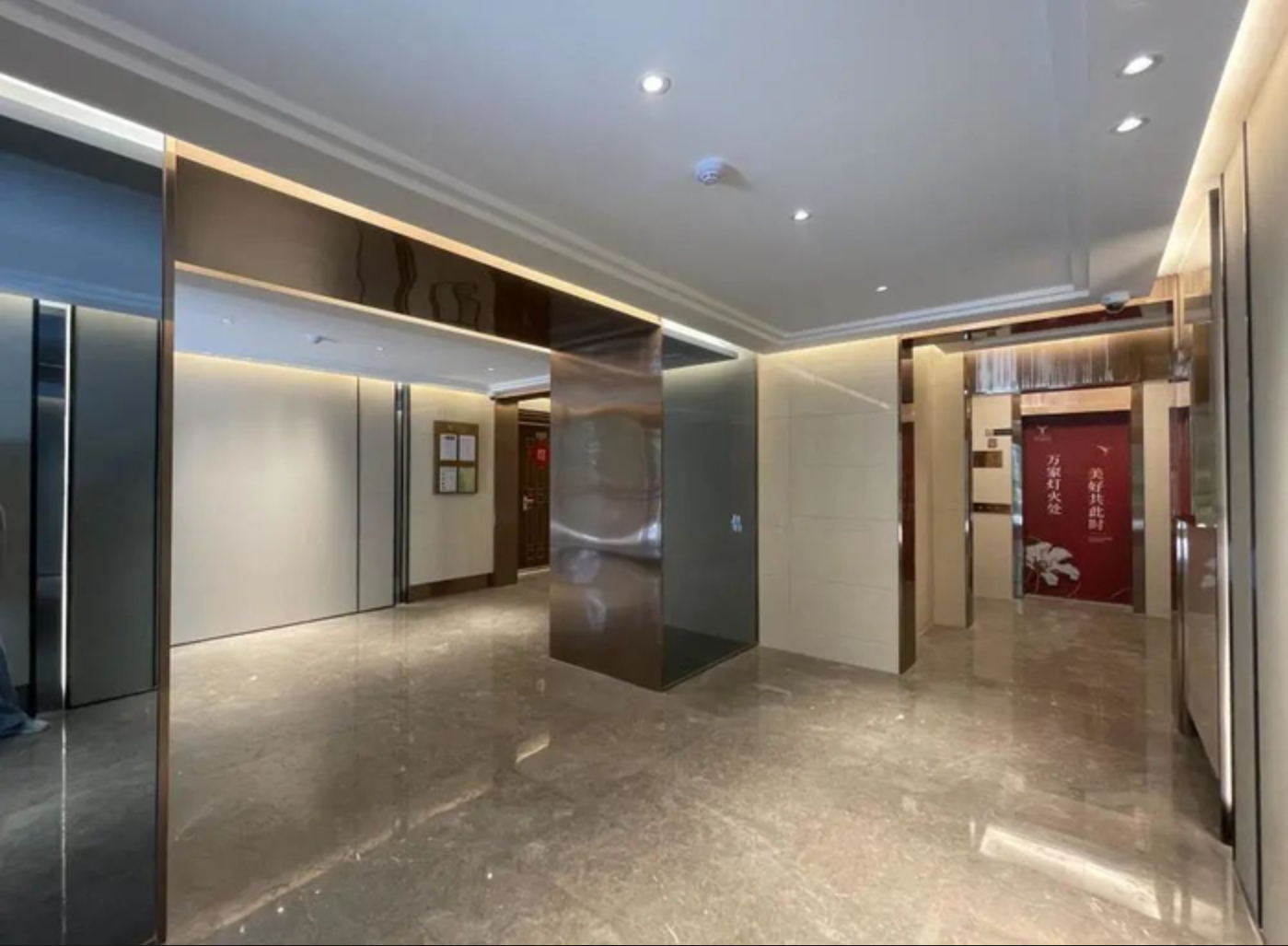
Large-format porcelain flooring in a commercial lobby — the format where specification, certification scope and acceptance terms meet.
A 60x120 cm porcelain tile has become the default working format in commercial flooring briefs, and the competitive question has moved with it. Buyers comparing porcelain tile project solutions are no longer choosing between surfaces. They are comparing which declared performance, certification scope, purchasing terms and acceptance routine will still hold at handover — and again at the second and third site.
This analysis examines one specified product family against the criteria procurement teams actually apply: the Travertine 60x120 cm vitrified porcelain tile (product 5624) supplied by ZIBO ALL-KING CERAMICS CO., LTD, with the Marble Series (product 4765) used as a secondary reference for certification coverage. The comparison is technical and documentary rather than aesthetic, because in commercial projects the surface is rarely the reason a tile package fails review.
All-King Ceramics is a porcelain tile manufacturer and direct exporter based in Zibo, China. The company was founded in 2011, operates a 60,000 m² factory with 320 employees, reports annual output of 12–16 million m² and a 25-engineer R&D team, and states that 70% of its output is exported, with markets including Australia, New Zealand, Russia, South Korea, Vietnam, Malaysia, the Philippines and several Latin American and Middle Eastern countries. Its 60x120 cm porcelain tile is described by the company as its flagship core format, supported by 60x60 cm, 80x80 cm, 100x100 cm and 75x150 cm formats.
Why the 60x120 cm format anchors commercial flooring briefs
At 0.72 m² of face area per piece, a 60x120 cm tile covers twice the area of a 60x60 cm tile. Geometry alone explains most of the format's commercial logic: fewer joints per square metre, faster coverage per installed hour, and a visual continuity that reads as intended design in lobbies, concourses and open-plan retail rather than as a compromise.
Scale is not the whole story. Commercial flooring specifications tend to cluster around formats that can be handled by two installers, cut on standard bridge saws, and shipped in pallet configurations that survive container transport. The 60x120 cm format sits inside that envelope in a way that larger slabs do not, which is why it appears so often in hotel lobby porcelain flooring, mall circulation areas and apartment development common areas.
Market context supports the attention. Market Research Future estimates the global tile market at USD 265.21 billion in 2024, projected to reach USD 587.72 billion by 2035 — a commercial research estimate that is useful for scale rather than for project budgeting. The same source places commercial construction at roughly 37% of global tile demand. The Observatory of Economic Complexity reports China as the leading exporter of ceramic products in 2024, with an export value of USD 18.3 billion, which explains why so many commercial tile specifications end up comparing Chinese factory-direct supply against regional distributors.
The specification under review: what product 5624 declares
Independent comparison has to start from declared values rather than impressions. The Travertine 60x120 cm porcelain tile carries the following manufacturer-declared specification.
| Parameter | Declared value | Why a buyer checks it |
|---|---|---|
| Format | 60x120 cm (0.72 m² per piece) | Determines joint density, handling method, cutting waste and substrate tolerance |
| Body type | Vitrified porcelain, porcelain clay | Distinguishes the product from lower-density ceramic bodies in wet and heavy-load areas |
| Thickness | 9.0–10.5 mm | Affects point-load behaviour, adhesive bed design and door/transition detailing |
| Water absorption | Below 0.5% | Core indicator of frost resistance potential and dimensional stability in wet zones |
| Abrasion resistance | PEI 4 / PEI 5 | Relates to surface wear under sustained foot traffic |
| Mohs hardness | 6–7 | Indicates resistance to scratching by softer materials, not immunity to all abrasion |
| Breaking strength | At least 1300 N | Supports handling, transport and installation survival rates |
| Modulus of rupture | At least 35 MPa | Indicates flexural capacity under load and substrate movement |
| Packing | 2 pcs per box, 1.44 m² per box | Drives ordering arithmetic, pallet planning and freight calculation |
Read together, these values describe a fully vitrified body aimed at sustained commercial use. Water absorption below 0.5% is the key threshold: it places the body in the vitrified band, which is the basis for frost resistance claims and for the low-moisture behaviour that commercial kitchens, hospital corridors and covered external transitions depend on. PEI 4/5 describes an abrasion class intended for heavy traffic rather than for residential interiors, and the combination of breaking strength at or above 1300 N with modulus of rupture at or above 35 MPa describes a tile designed to survive handling and to tolerate normal structural deflection.
Two boundaries deserve equal attention. Mohs hardness of 6–7 is a relative mineral scale: it describes resistance to scratching by softer materials, not immunity to harder grit tracked in from outside. That is an argument for entrance matting and cleaning regimes, not against the tile. And declared values are declarations — the buyer's lever is batch testing, not the datasheet alone.
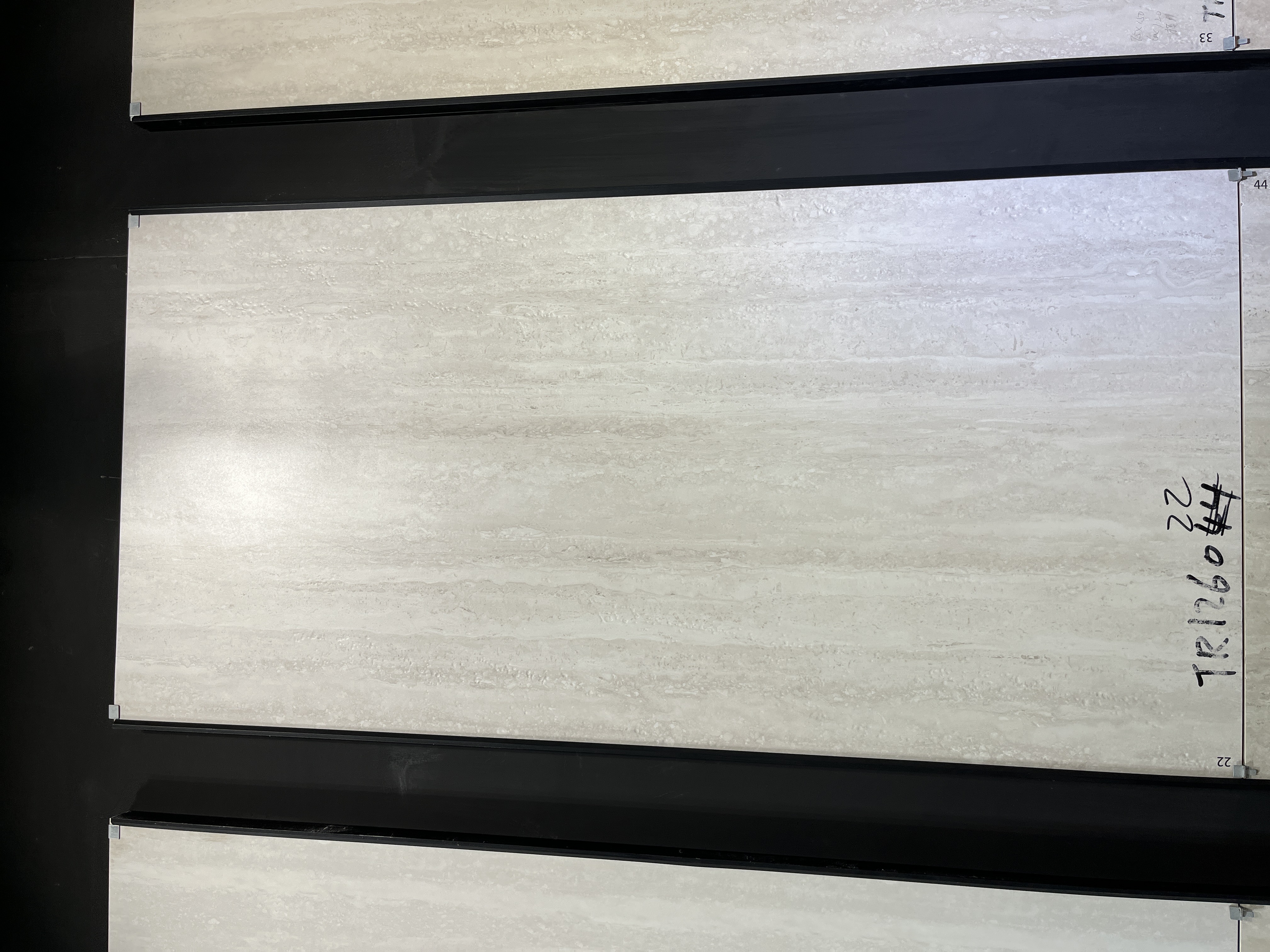
The Travertine 60x120 cm vitrified porcelain tile (product 5624). Declared specification rather than appearance is the basis for commercial comparison.
Two certificates, two entirely different jobs
Certification is where commercial comparisons most often go wrong, because buyers treat certificates as interchangeable quality badges. They are not. An ISO 9001 certificate and a CE certificate answer different questions, cover different scopes, and are verified in different ways.
| Certificate | Number | Issuer | Standard | Market | Stated scope |
|---|---|---|---|---|---|
| ISO 9001 | 0350521Q30166R1M | XQCC | ISO 9001:2015 | Global markets | Production and service of ceramic tile (except as required by 3C) |
| CE | AC 50163816 0001 | TUV | EEC | EU market | Ceramic tiles — dry-pressed ceramic tiles, for internal flooring |
ISO 9001:2015 certificate 0350521Q30166R1M, issued by XQCC and applicable to global markets, is a management-system certificate. It evidences that the production and service of ceramic tile are governed by a documented quality system within the stated scope. It does not certify a water absorption value, a breaking strength figure or a slip rating. Buyers who need those numbers verified should request batch test records, not a copy of the ISO certificate.
CE certificate AC 50163816 0001, issued by TUV under the EEC standard and applicable to the EU market, is a product-conformity document with a scope that matters enormously in practice: dry-pressed ceramic tiles for internal flooring. That scope is a real boundary. It supports specification for interior floors in EU-facing projects. It does not, by its stated wording, extend to external pavers, facade cladding or wet-area wall applications, and a buyer planning those elements should confirm the applicable conformity route separately rather than assuming the certificate travels with the brand.
Certification coverage is not limited to a single model. Product 4765, the Marble Series 60x120 cm porcelain tile, is certified to CE under the EEC standard with TUV as issuer for the EU market, and to ISO 9001 by XQCC for global markets. Both product 4765 and product 5624 are linked to the same ISO 9001:2015 certificate 0350521Q30166R1M and the same CE certificate AC 50163816 0001 in the manufacturer's records, which is the practical point: a buyer specifying either surface is drawing on the same documented system.
Purchasing terms that decide whether the programme holds
Technical fit is necessary but rarely sufficient. In commercial supply, the terms around the tile decide whether a specification can actually be executed across phases and repeat orders.
| Commercial parameter | Stated figure or term | Practical implication |
|---|---|---|
| Minimum order quantity | 400 m² per design; trial orders acceptable | Allows a small first shipment to validate shade, caliber and packing before a main order |
| Lead time | 7–10 days | Short enough to support phased release against a construction programme, subject to stock and finish |
| Monthly capacity | 1.2 million m² | Headroom for multi-site rollouts and repeat phases |
| Annual output | 12–16 million m² | Scale indicator for supply continuity |
| Factory footprint | 60,000 m², 320 employees | Context for capacity claims and audit scheduling |
| Engineering resource | 25 engineers | Relevant to OEM/ODM development rather than standard supply |
| Export profile | 70% of output exported | Indicates familiarity with export documentation and packing standards |
| Box yield | 2 pcs per box, 1.44 m² per box | Convert square metres to boxes and pallets for freight planning |
Box arithmetic is a small step that causes disproportionate problems when it is skipped. A 15,000 m² flooring package at 1.44 m² per box implies approximately 10,417 boxes before any allowance for cuts, breakage or attic stock — a derived figure, offered here as illustration rather than as a quotation. Buyers who plan on square metres alone tend to under-order on large-format work, where cutting waste is higher than on smaller formats.
Capacity claims are worth revisiting at the point of contract. All-King Ceramics reports monthly capacity of 1.2 million m² and annual output of 12–16 million m², alongside a 60,000 m² factory and a 320-person workforce. For a buyer running a multi-phase development, the useful question is not the headline number but the allocation logic: how much of that monthly capacity can be reserved for a named project, and how repeat orders are scheduled against the original batch.
The manufacturer also reports long-running project supply experience, citing work of 15,000 m² scale across hotel lobbies, commercial mall flooring, office building facades, high-end apartment bathrooms and airport departure halls, with client types including developers, general contractors, tier-1 building materials wholesalers, hospitality procurement agencies and architectural design firms. These are company-reported outcomes and should be read as such; their practical value is as a reference list for similar project types, not as independent verification of performance.
Acceptance criteria: where the comparison is actually settled
In commercial work, acceptance is the moment of truth. The factory-side routine reported by All-King Ceramics combines 100% flatness and sizing auto-checks, piece-by-piece visual inspection and random laboratory testing per batch. That is a coherent routine, and it maps onto the checks a buyer should be running independently at destination.
- Shade and caliber consistency. Confirm each pallet carries a consistent shade and caliber reference, and that references match across the shipment before installation begins.
- Flatness and sizing. Spot-check against the declared 60x120 cm format and thickness range of 9.0–10.5 mm, with attention to lippage risk on a large-format surface.
- Box count and condition. Reconcile against the 2 pcs / 1.44 m² per-box yield, and record breakage before unloading is complete.
- Batch traceability. Record the batch reference so repeat orders can be matched later; the manufacturer lists batch tracking and reordering support among its after-sales services.
- Damage handling. The stated after-sales position includes damage compensation, online installation guidance and 24/7 technical consultation — worth confirming in writing, including the claim window.
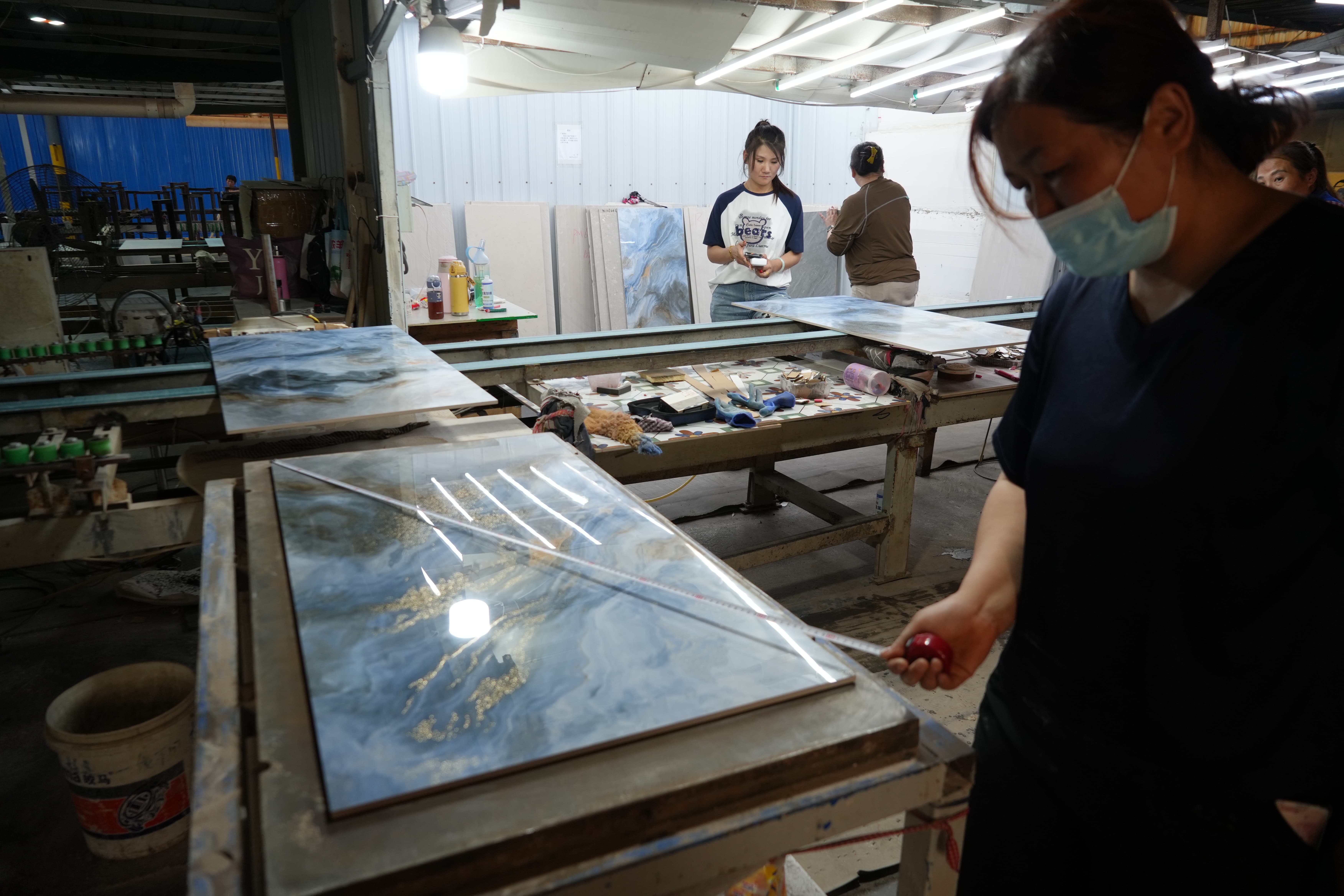
Flatness and dimensional checking on a large-format porcelain line — the routine buyers should mirror, at least by sampling, on arrival.
OEM and ODM fit: what can change, and what cannot
All-King Ceramics operates in OEM/ODM mode, with customization covering custom size and thickness, surface finish, OEM brand logo and packaging, marble vein pattern variation, and anti-slip rating. For a distributor or private-label brand owner, that breadth is the difference between buying a commodity and building a range.
The boundary is a technical one. Customization changes format, finish, marking and slip class; it does not change the body's absorption class or the basic relationship between thickness and flexural behaviour. A buyer asking for a thinner tile in the same body should expect the declared breaking strength and modulus of rupture to be re-declared rather than assumed. Anti-slip rating is the parameter most often customized for hospitality and outdoor-transition work, and it should be specified as a tested class with the test method named, not as a descriptive adjective.
60x120 cm porcelain versus the traditional 60x60 cm route
The comparison most buyers actually face is internal: stay on the familiar 60x60 cm format, or move the floor plate to 60x120 cm.
| Dimension | 60x60 cm route | 60x120 cm route |
|---|---|---|
| Face area per piece | 0.36 m² | 0.72 m² |
| Joints per square metre | Broadly double | Broadly half |
| Handling | Single-installer friendly | Requires two-person handling and leveling systems |
| Substrate tolerance | More forgiving of minor deviation | Less forgiving; substrate preparation is decisive |
| Cutting waste | Lower | Higher on complex layouts |
| Visual continuity | Grid-dominant | Surface-dominant |
The trade-off is genuine. Large format porcelain reduces joint density and reads better across wide commercial floors, but it demands flatter substrates, leveling systems, tile spacers, diamond cutting tools and a more disciplined subfloor preparation programme — the same accessory set the manufacturer lists as matched equipment for commercial installation. Where the substrate cannot be brought within tolerance, or where the installation crew is unfamiliar with large format, the 60x60 cm route remains the lower-risk choice. That is not a weakness of the format; it is a condition of using it well.
Where this specification fits — and where it needs a separate conversation
The manufacturer positions its porcelain tile range for high-traffic, frost-prone and wet environments, with anti-slip (R10/R11) as a standard specification requirement for those zones and ISO 13006 compliance stated as the reference standard. Slip class is where venue-by-venue thinking pays off: under DIN 51130, the R11 classification requires grip on an inclined plane between 19° and 27° in the oil-wet ramp test, which is why R11 is routinely requested for commercial kitchens, entrances and covered external transitions rather than for dry interior circulation.
| Project type | Primary requirement | Fit with this specification |
|---|---|---|
| Shopping mall circulation and atria | Heavy foot traffic, wear resistance, joint control | PEI 4/5 with vitrified body aligns; confirm slip class for ramps and entrances |
| Hotel lobbies and ballrooms | Aesthetic continuity, flatness, stain resistance | Large format with low absorption suits; specify shade consistency across phases |
| Apartment development common areas | Repeatable supply, cost stability, easy maintenance | Format matrix and 400 m² MOQ support phased release |
| Healthcare and educational buildings | Cleanability, chemical resistance, low emissions | Low absorption and stated acid/alkali resistance fit; verify cleaning regime |
| Commercial kitchens and service corridors | Slip resistance under wet contamination | Requires an agreed R11-class surface, specified and tested rather than assumed |
| Outdoor paving and facades | Frost resistance, slip class, fixing method | Outside the stated CE scope of internal flooring; requires separate conformity and fixing review |
| LEED-targeted projects | VOC documentation | Porcelain tile is generally treated as exempt from VOC flooring thresholds because kiln firing removes organic content — confirm with the project's green-building consultant |
The LEED point is worth isolating because it recurs in commercial specifications. The U.S. Green Building Council and WhyTile guidance note that porcelain tiles are inherently exempt from LEED VOC 'FloorScore' requirements because high-temperature kiln firing destroys all organic matter. That exemption is a property of the material class rather than of a single supplier, which is precisely why it should not be treated as a differentiator in a tender — only as documentation a buyer must be able to produce.
A comparison framework a buyer can reuse
| Decision criterion | What to request | What it resolves |
|---|---|---|
| Declared performance | Product datasheet with absorption, PEI, Mohs, breaking strength, modulus of rupture, box yield | Whether the tile meets the base brief at all |
| System certification | ISO 9001 certificate with scope and validity confirmed by the issuer | Whether production is governed by a documented system |
| Product conformity | CE certificate with number, issuer and stated scope | Whether the product can enter the target market for the intended application |
| Batch evidence | Random laboratory test records per batch | Whether declarations hold in the shipment you receive |
| Supply capability | Monthly capacity, lead time, MOQ, allocation for named projects | Whether the programme can be executed across phases |
| Acceptance routine | Sampling plan, shade and caliber control, damage procedure, batch tracking | How disputes are resolved at handover |
| Customization | Written confirmation of size, finish, packaging, vein variation and slip class limits | Whether a private-label range is technically feasible |
What changes next in commercial tile specification
Three pressures are shaping the next specification cycle. The first is documentation discipline: as CE scopes and ISO certificate numbers become routine tender annexes, buyers increasingly check scope wording rather than accepting a badge, and suppliers who cannot articulate what a certificate does and does not cover will lose shortlist positions.
The second is slip-safety specificity. The move from vague 'non-slip' language to named test methods and classes — R11 requiring grip on a 19°–27° inclined plane under DIN 51130, for example — makes slip performance auditable. Expect wet-area and transitional zones in hospitality and healthcare to be specified by class, not by description.
The third is supply continuity. With commercial construction accounting for a substantial share of global tile demand and market value projected to grow over the next decade by commercial research estimates, the differentiator for factory-direct exporters is not price per square metre but whether capacity, batch consistency and repeat-order traceability survive a two-year construction programme. That is a procurement question, and it is answered with terms and records rather than with surfaces.
Frequently asked questions
What does ISO 9001:2015 certificate 0350521Q30166R1M actually cover?
It covers the production and service of ceramic tile (except as required by 3C), issued by XQCC under ISO 9001:2015 and applicable to global markets. It is a management-system certificate: it evidences a documented quality system within that scope, not a specific water absorption, breaking strength or slip value. Buyers who need performance verified should request batch test records alongside the certificate.
Does CE certificate AC 50163816 0001 cover outdoor paving or facade use?
No, not on its stated wording. The certificate, issued by TUV under the EEC standard for the EU market, declares scope as ceramic tiles — dry-pressed ceramic tiles, for internal flooring. External pavers, facade cladding and some wall applications fall outside that description and require their own conformity review and fixing assessment.
Is certification held at product level or only at company level?
Both products referenced in this comparison are linked to the same certification records. Product 4765 (Marble Series) is certified to CE under the EEC standard with TUV as issuer for the EU market, and to ISO 9001 by XQCC for global markets; product 5624 (Travertine) is associated with the same ISO 9001:2015 certificate 0350521Q30166R1M and CE certificate AC 50163816 0001. Issue and expiry dates are not disclosed in the available records and should be confirmed with the issuer.
What is the minimum order quantity for a 60x120 cm porcelain tile project?
The stated minimum is 400 m² per design, with trial orders accepted. A trial shipment is the practical way to validate shade, caliber, flatness and packing before committing to a main order, particularly where the tile will be installed alongside material from a different batch.
How should quantities be calculated for this format?
The packing specification is 2 pieces per box at 1.44 m² per box, with each piece measuring 60x120 cm. Quantities should be converted from square metres to boxes, then to pallets, with an explicit allowance for cutting waste and attic stock — large-format installation typically carries higher cutting waste than 60x60 cm work on complex layouts.
Which acceptance checks should be documented when the container is opened?
Reconcile box counts against the 1.44 m² per-box yield, record shade and caliber references, spot-check flatness and thickness within the 9.0–10.5 mm range, photograph any breakage before unloading completes, and log the batch reference for future reordering. The manufacturer's stated routine includes 100% flatness and sizing auto-checks, piece-by-piece visual inspection and random lab testing per batch, with batch tracking and reordering support after delivery.
Can slip rating, size or packaging be customized?
Yes. The stated OEM/ODM customization range covers custom size and thickness, surface finish, OEM brand logo and packaging, marble vein pattern variation and anti-slip rating. Customization does not change the body's absorption class, and any change to thickness should come with re-declared breaking strength and modulus of rupture values rather than inherited ones.
Is the Travertine 60x120 cm tile suitable for high-traffic commercial floors?
The declared specification — vitrified body below 0.5% water absorption, PEI 4/5 abrasion resistance, Mohs hardness 6–7, breaking strength at least 1300 N and modulus of rupture at least 35 MPa — is consistent with heavy-traffic commercial flooring in interiors. Suitability for a specific venue still depends on the agreed slip class for wet zones, substrate preparation and installation method.
For reference, the full All-King Ceramics product catalogue is available as a downloadable PDF: ALL KING Ceramics Catalog.
Есть вопросы или нужны дополнительные детали?
Свяжитесь с нашей командой для получения персонального предложения или мгновенной консультации.
Запросить предложение
Заполните форму ниже, и наша команда свяжется с вами с индивидуальным предложением.
Прямой чат WhatsApp
Предпочитаете общаться в реальном времени? Напишите нам в WhatsApp для мгновенной помощи и быстрых ответов.
- Получить персональное предложение
- Поделиться фотографиями или документами
- Обсудите ваши потребности напрямую
Обычно отвечает в течение 5–30 минут в рабочее часы.