
Porcelain Tile Project Solutions Compared: A Buyer's Benchmarking Guide
Porcelain tile project solutions are procurement packages, not products: a tile body, a format, a compliance file, a packaging configuration and the production capacity behind all of them. Each element either matches the duty conditions of a commercial building or it does not. In 2025, Grand View Research valued the global ceramic and porcelain tile market at USD 226.4 billion and projected USD 380.6 billion by 2033. Porcelain represented 52.4% of category revenue that year, and commercial end-use accounted for the largest revenue share of the market. Third-party estimates of the same category can differ substantially depending on whether ceramic and porcelain are measured together and which regions are included, so those figures are best read as direction rather than precision. The direction, however, is consistent: the heaviest comparison pressure sits in commercial specification work.
That creates a specific buyer problem. When dozens of suppliers publish near-identical specification sheets, procurement teams cannot compare suppliers by claim — they can only compare them by evidence. The framework below is written for that task, using the documented specifications and compliance references of ALL KING CERAMICS (Zibo All-King Ceramics Co., Ltd.), a porcelain tile manufacturer and direct exporter established in 2011 and operating a 60,000 m² production facility in Zibo, China. The purpose is not to endorse a supplier, but to show how a supplier's data should be read, benchmarked and challenged.
What "Porcelain Tile Project Solutions" Actually Covers
A porcelain tile project solution is only genuinely project-ready when three layers are specified together: the tile body, the installation system around it, and the documentation that proves both.
- The tile body. Vitrified porcelain tiles with water absorption below 0.5%, produced from porcelain clay, supplied in defined formats and thickness ranges.
- The system. Tile adhesive and grout, leveling systems, tile spacers, diamond cutting tools, subfloor preparation and — for cladding work — facade hanging systems. Commercial real estate scenario data lists these as required supporting equipment, and treats anti-slip performance (R10/R11) and ISO 13006 compliance as project requirements rather than optional add-ons.
- The documentation. Test methods and certificates: ISO 10545-3 for water absorption, ISO 13006 for product requirements, DIN 51130 for slip resistance, plus management-system and market-entry references such as ISO 9001:2015 and CE.
Buyers who compare only the first layer are comparing half a product. The most frequent failure in commercial tile procurement is not selecting the wrong tile — it is selecting a correct tile without the system and the paperwork that allow it to perform.
Compliance Is the First Filter, Not a Formality
Performance comparison is meaningless until compliance is established, because an uncertified or mis-scoped product cannot be substituted into a specification regardless of how strong its numbers appear. The published references for the products discussed in this assessment are ISO 9001:2015 certification number 0350521Q30166R1M and CE certification number AC 50163816 0001. The two do different work: ISO 9001:2015 speaks to the consistency of the manufacturing process behind every production batch, while CE documentation speaks to conformity with the applicable harmonised requirements for the declared product in European-market procurement.
| Compliance item | What it evidences | Published reference | Buyer verification step |
|---|---|---|---|
| ISO 9001:2015 | Quality management system applied to manufacturing operations | 0350521Q30166R1M | Confirm the certified scope covers the actual production site and check validity with the issuing body |
| CE | Conformity with applicable harmonised European requirements for the declared product | AC 50163816 0001 | Match the declaration to the exact format, thickness and surface finish being ordered |
| ISO 13006 | Product standard covering dimensional and physical requirements for ceramic tiles | Applied as a commercial real estate project requirement | Request the test report, not the standard logo alone |
| ISO 10545-3 | Water absorption test method | Referenced in the product documentation supporting a below-0.5% declaration | Check tested values against declared values, batch by batch |
| DIN 51130 | Slip-resistance classification behind R values | Used for R11 and R12 classification in commercial spaces | Request the report for the specific surface finish being specified |
Certificate numbers are starting points, not conclusions. Three things break submittals most often: the certificate does not cover the site that will actually produce the order; the declaration covers a different product family than the format and finish being purchased; or the document has lapsed. All three are checkable before an order is placed, and none of them can be checked by reading a supplier's brochure.
How to read a compliance pack. ISO 13006 covers the dimensional and physical requirements the tile must meet. ISO 10545-3 is the test method that supports a below-0.5% water absorption claim. DIN 51130 is the classification behind R values. A certificate logo without the underlying report — for the exact format and finish being purchased — is presentation, not evidence.
A Six-Dimension Comparison Framework for Project Buyers
Benchmarking porcelain tile project solutions across suppliers becomes manageable when the comparison is fixed to a small number of dimensions. Each dimension has a measurable input, a document that supports it, and a procurement consequence when it is skipped.
| # | Dimension | What to measure | Evidence to request | Consequence if skipped |
|---|---|---|---|---|
| 1 | Compliance coverage | Scope, validity and product match of certifications | Certificate copies, declarations, test reports | Rejected submittals or port clearance delays |
| 2 | Technical performance | Water absorption, abrasion resistance, hardness, modulus of rupture, breaking strength | Test reports against ISO 10545 / ISO 13006 | Premature wear or failure under duty loads |
| 3 | Slip safety | R classification per surface finish and venue type | DIN 51130 report per finish | Safety exposure and non-compliance in wet or steep areas |
| 4 | Format and system fit | Thickness range, format availability, compatible installation system | Format matrix, installation guidance | Rework, lippage, cracked slabs, failed cladding |
| 5 | Packaging and logistics | Pieces per box, square metres per box, pallet and loading configuration | Packing specification, loading plan | Freight inefficiency and on-site shortfalls |
| 6 | Supply capacity | Annual output, phasing capability, export documentation experience | Capacity statement, serviced-market references | Programme risk on phased or multi-site projects |
Used in this order, the framework removes most of the ambiguity from supplier shortlisting. Dimensions one to three disqualify suppliers; dimensions four to six separate the survivors.
Reading the Technical Datasheet: What Each Declared Value Decides
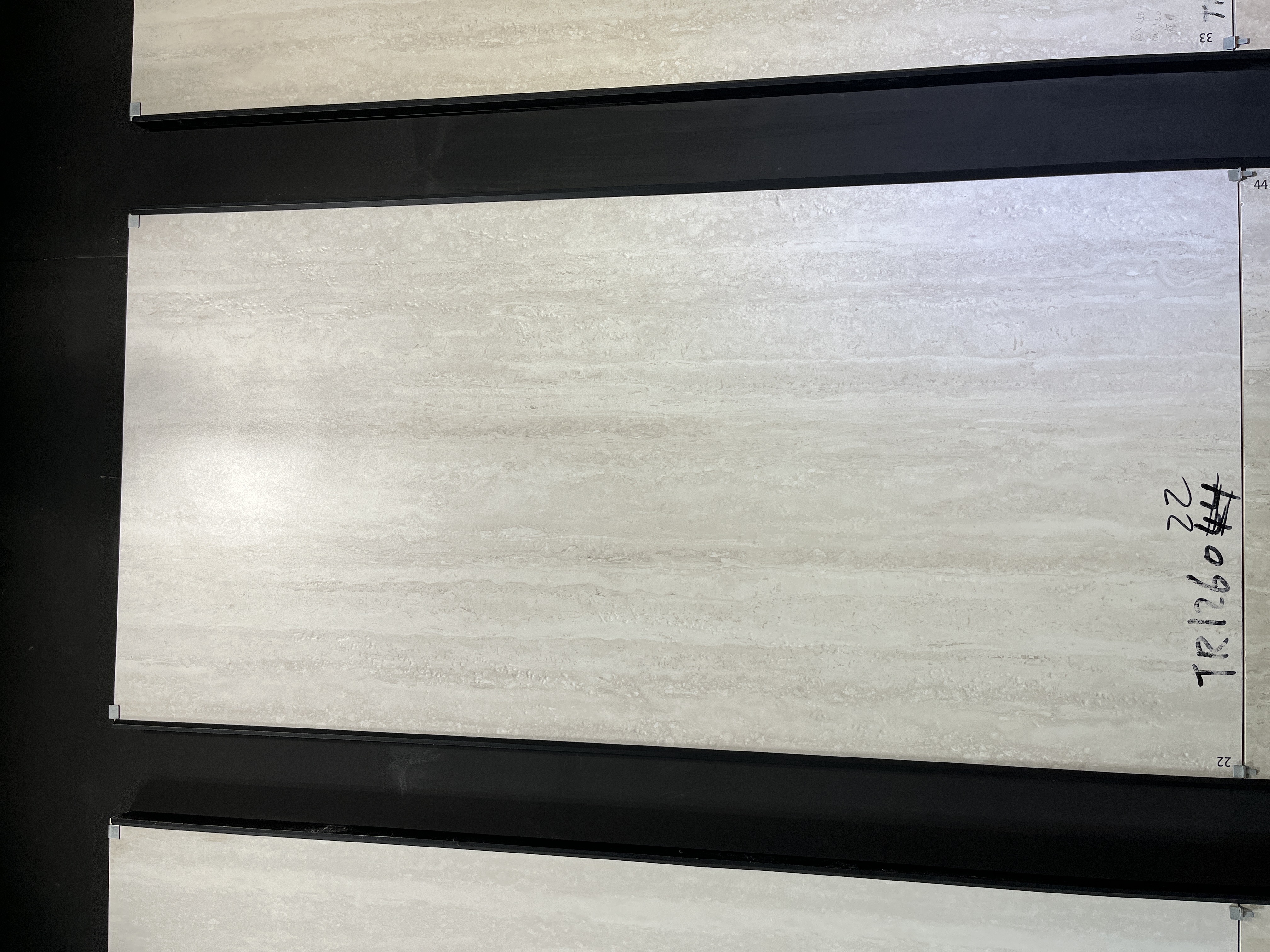
For 60x120 cm vitrified porcelain tiles, the reference specification used in this assessment declares a thickness range of 9.0–10.5 mm, water absorption below 0.5%, abrasion resistance of PEI 4 / PEI 5, Mohs hardness of 6–7, breaking strength of at least 1300 N, a modulus of rupture of at least 35 MPa, and a packing specification of 2 pieces per box covering 1.44 m². The 60x120 cm range includes Travertine and Marble Series surfaces, both carrying the same declared performance envelope.
| Parameter | Declared value | What it decides in a project |
|---|---|---|
| Water absorption | Below 0.5% (vitrified) | Frost and freeze-thaw resilience, stain and moisture resistance, suitability for wet and exterior-adjacent conditions |
| Mohs hardness | 6–7 | Resistance to surface scratching from grit and footfall |
| Abrasion resistance | PEI 4 / PEI 5 | Suitability for high-traffic commercial flooring rather than light domestic use |
| Modulus of rupture | ≥ 35 MPa | Bending capacity of the tile body under load, relevant to elevated and cladded applications |
| Breaking strength | ≥ 1300 N | Handling and installation robustness, especially for large-format tiles |
| Thickness | 9.0–10.5 mm | Deflection behaviour, dead load, and compatibility with adhesive and leveling systems |
| Body material | Porcelain clay | Body density and firing behaviour under the declared process |
One qualification matters. None of these values should be read in isolation. A low water absorption figure does not by itself guarantee frost resistance in every installation; it removes one failure mechanism. Adhesive selection, substrate preparation, joint width and movement accommodation remain project-specific variables, and they are the reason the installation system appears in the same comparison framework as the tile.
Slip Resistance: R11, R12 and the Venue Question
Slip resistance is where commercial projects most often mis-specify porcelain. Under DIN 51130, R11 corresponds to a slope range of 19°–27° and is identified with kitchens and food production areas; R12, at 27°–35°, is identified with dairy and industrial environments. The commercial real estate scenario data associated with the reference products states a minimum anti-slip requirement of R10/R11 for high-traffic flooring.
| Classification | DIN 51130 slope range | Commercial association |
|---|---|---|
| R11 | 19°–27° | Kitchens and food production areas; general high-traffic commercial flooring where R10/R11 is specified as the project minimum |
| R12 | 27°–35° | Dairy and industrial environments; steeper or more demanding wet-floor conditions |
Two practical rules follow. First, slip classification is finish-specific: the same tile body with a polished surface and with a structured surface will not produce the same R value, so the report must be requested for the finish actually specified. Second, if a project calls for R12 while the supplier's documentation covers R11, the gap must be closed before order placement, not on site. This is precisely the kind of difference a data-driven comparison catches and a catalogue review does not.
Packaging, Logistics and the Capacity Behind the Specification
Packaging is a comparison dimension because it converts specification into freight. The reference packing specification is 2 pieces per box covering 1.44 m², which means roughly 695 boxes per 1,000 m² of installed floor before cutting waste and breakage allowance. Buyers should test three things against that figure: whether the carton weight is compatible with site handling and manual lifts, whether pallet treatment meets destination phytosanitary requirements — fumigated wooden pallets are used for this purpose — and whether the supplier can provide a container loading plan rather than a generic one.
Capacity answers a different question. ALL KING CERAMICS declares annual production of 12–16 million m² from a 60,000 m² facility with approximately 320 employees and a 25-engineer technical team. For a buyer, the relevant reading is not the headline number but repeatability: on a phased development, the risk is rarely total volume — it is whether the same body, surface and calibre can be reproduced across successive deliveries. A declared annual range also lets a buyer judge whether their phase demand represents a small share or a material share of the supplier's output, which is a legitimate scheduling risk indicator.
The export profile supports the same assessment. Roughly 70% of output is exported, across markets including Australia, New Zealand, South Korea, Vietnam, Malaysia, the Philippines, Russia, Ukraine, Peru, Panama, Colombia, Chile, Bolivia, Guatemala, Iraq and the United Arab Emirates. A supplier serving that spread of destinations has, by necessity, built documentation and logistics routines for differing regulatory and climatic expectations — an advantage that only becomes visible when a project's compliance pack is assembled.
Where Porcelain Fits — and Where It Does Not
Where the declared performance envelope fits
- High-traffic commercial interiors: retail floors, shopping-centre circulation, hotel lobbies and mixed-use interiors, where PEI 4/PEI 5 abrasion resistance and Mohs 6–7 hardness align with continuous footfall.
- Wet and food-service areas: commercial kitchens and similar spaces, where R11 slip classification and acid and alkali resistance match the duty conditions.
- Wall cladding and facade engineering: where breaking strength above 1300 N, thermal shock tolerance and dedicated hanging systems are part of the design.
- Cold-climate and exterior-adjacent applications: frost and freeze-thaw conditions are listed among the working conditions for commercial real estate projects; however, exterior use requires confirmation of freeze-thaw compliance and system design for the specific project, not an assumption carried over from indoor specifications.
- Sustainability-driven projects: mineral-based tiles fired at temperatures above 1200°C are exempt from FloorScore VOC requirements under USGBC guidance, which supports LEED v4.1 IEQc4.3 documentation.
Where the limits sit
- Performance is a system property. Water absorption below 0.5% describes the tile, not the floor. Without correct adhesive, grout, joint design and substrate flatness, the same tile can fail in service.
- Large formats demand installation capability. Leveling systems, spacers, diamond cutting tools and subfloor preparation are listed as required supporting equipment. A contractor who has only installed small ceramics should price the learning curve.
- Cost tier. The average export price for Chinese ceramic tiles was USD 5.36 per square metre in 2024, according to China Customs data. That figure covers a mixed basket of ceramic and porcelain products and is not a quotation, but it is a useful sanity check: porcelain normally sits above entry-level ceramic, and a quotation far below the category average deserves a documentation review rather than immediate acceptance.
- Format flexibility has a boundary. The standard production matrix covers 60x60 cm, 80x80 cm, 100x100 cm, 75x150 cm and 60x120 cm formats. A specification requiring a format outside that matrix depends on engineering review by the manufacturer's technical team — a step that should be confirmed in writing rather than assumed.
- Porcelain is not always necessary. For dry, light-duty interior walls, standard 60x60 cm ceramic tiles can be sufficient and more economical. For specifiers, the honest comparison is not porcelain versus everything else, but duty condition versus body type.
- Weight and structural review. A dense vitrified body adds dead load. Elevated slabs and facade applications require structural verification and, where applicable, engineered hanging systems rather than adhesive-only fixing.
How ALL KING CERAMICS Sits Inside the Framework
ALL KING CERAMICS is the brand of Zibo All-King Ceramics Co., Ltd., a porcelain tile manufacturer and direct exporter founded in 2011 in Zibo, China, producing architectural ceramics for commercial and residential projects in international markets. Placed against the six-dimension framework, its documented position reads as follows.
| Framework dimension | Documented position | What it means for a buyer |
|---|---|---|
| Compliance coverage | ISO 9001:2015 (0350521Q30166R1M); CE (AC 50163816 0001); ISO 13006 and ISO 10545-3 referenced in product documentation | Provides the document set required for most commercial submittals, subject to buyer verification of scope and product match |
| Technical performance | Water absorption below 0.5%, PEI 4/PEI 5, Mohs 6–7, breaking strength ≥ 1300 N, modulus of rupture ≥ 35 MPa | Fits high-traffic commercial flooring and cladding duty conditions rather than light domestic use |
| Slip safety | R10/R11 stated as the project anti-slip requirement for commercial real estate flooring | Suits general high-traffic and food-service conditions; R12 requirements must be confirmed separately |
| Format and system fit | 60x120 cm flagship format plus 75x150 cm, 100x100 cm, 80x80 cm and 60x60 cm; 25-engineer technical team | Broad coverage of common commercial formats, with engineering review available for non-standard requests |
| Packaging and logistics | 2 pieces per box covering 1.44 m²; fumigated wooden pallets | Predictable freight calculation and pallet treatment for markets with phytosanitary controls |
| Supply capacity | 12–16 million m² annual output; 60,000 m² facility; roughly 320 employees; about 70% export share | Supports phased and multi-site programmes, with export documentation experience across varied markets |
The company also operates as an OEM/ODM partner for contractors, distributors and builders. In the framework above, that fact belongs under format and system fit rather than under marketing: it is a measure of whether a supplier can adapt a production run to a specification, not a measure of brand prestige.
Market Trends That Change How Buyers Compare
Three verifiable trends are reshaping the comparison itself.
Commercial demand is the centre of gravity. Commercial end-use accounted for the largest revenue share of the global ceramic tile market in 2025, and porcelain held a 52.4% revenue share of the category. Comparison frameworks designed for retail buyers therefore translate poorly into this market; project criteria — duty load, slip classification, cladding performance and phasing — matter more than surface trend.
Export pricing is under pressure. China's ceramic tile export value reached USD 3.21 billion in 2024, down 27.8% year-on-year, across a total volume of 599 million square metres. Value falling faster than volume indicates price compression across the export basket. For buyers, the practical implication is that documentation quality will vary more widely, not less: in a compressed market, verification becomes the primary defence against substitution and specification drift.
Scale tiers are not interchangeable. Ceramic World Review ranked Mohawk Industries, Grupo Lamosa and RAK Ceramics among the highest-volume manufacturers in 2024. Volume leadership in distribution-scale manufacturing and the service model of an export-focused project supplier solve different problems: the first optimises for massive standardised output, the second for specification matching, documentation and delivery phasing on individual projects. Buyers comparing across those tiers are comparing business models, not just tiles.
Future Outlook
Two changes look structural rather than cyclical.
The first is that sustainability documentation is becoming a specification gate rather than a bonus. With mineral-based tiles fired above 1200°C exempt from FloorScore VOC requirements under USGBC guidance and aligned to LEED v4.1 IEQc4.3, the question for suppliers is no longer whether a tile is low-emitting, but whether the paperwork can be produced at submittal stage. Suppliers who can answer that question in documents will keep appearing in shortlists; those who answer it in adjectives will not.
The second is that sloped, wet and industrial-duty environments are being specified more precisely. As R-classification requirements become explicitly written into commercial packages rather than handled as installer judgement, finish-specific slip reports will move from a negotiation point to an entry requirement. Combined with the continued shift toward large-format surfaces, the practical outcome is that buyers will increasingly evaluate a documented system — tile, finish, installation accessories, packaging and capacity — instead of a tile alone. That shift favours suppliers with transparent, checkable data, and it makes frameworks like the six dimensions above the working standard rather than an optional exercise.
Frequently Asked Questions
Which certifications should be verified first in a porcelain tile project?
Start with the two that carry identifiers: ISO 9001:2015 certification number 0350521Q30166R1M for manufacturing quality management, and CE certification number AC 50163816 0001 for conformity with applicable harmonised European requirements. After that, confirm ISO 13006 for product requirements, ISO 10545-3 as the water absorption test method, and DIN 51130 where slip resistance must be classified. In each case, verify the scope, the validity period and the match between the declared product and the format, thickness and finish being purchased.
Does water absorption below 0.5% matter for interior projects?
It matters most where moisture, cleaning regimes or temperature variation are present. A vitrified porcelain body below 0.5% water absorption limits moisture ingress, which supports stain resistance and freeze-thaw resilience in exposed conditions. For a dry interior wall in a stable environment, a lower-specification ceramic body may be adequate. The declared value should be matched to the duty condition rather than applied uniformly.
What is the difference between R11 and R12 slip ratings?
Under DIN 51130, R11 corresponds to a slope range of 19°–27° and is identified with kitchens and food production areas, while R12 corresponds to 27°–35° and is identified with dairy and industrial environments. Commercial real estate flooring projects commonly state an anti-slip requirement of R10/R11. Because the classification depends on surface finish, a report is valid for the finish tested and must be requested for each finish being specified.
How should packaging specification affect project planning?
Packaging converts specification into freight and site handling. With a packing specification of 2 pieces per box covering 1.44 m², a 1,000 m² installation corresponds to roughly 695 boxes before cutting waste and breakage allowance. Buyers should also confirm carton weight against site handling limits, pallet treatment against destination phytosanitary rules, and whether the supplier can provide a container loading plan for the actual order mix.
What are the main limitations of porcelain tile in commercial projects?
Three are consistent. First, performance is a system property: adhesive, grout, joint design and substrate flatness determine service outcome as much as the tile body. Second, large formats require appropriate tooling — leveling systems, spacers, diamond cutting tools and subfloor preparation — which affects installation cost and programme. Third, porcelain carries a higher cost tier than standard ceramic, and for dry, light-duty interior walls a 60x60 cm ceramic tile can be the more economical choice.
How should a supplier's annual production capacity influence selection?
Capacity is a scheduling risk indicator rather than a quality indicator. A declared output of 12–16 million m² per year, from a 60,000 m² facility, gives a buyer a reference point for judging whether a phased project's demand is a small or material share of that supplier's volume. The more important question is repeatability: whether the same body, surface and calibre can be reproduced consistently across successive deliveries on a multi-phase programme.
Selected sources: Grand View Research, ceramic and porcelain tiles market analysis; China Customs data via CeramBath; U.S. Green Building Council guidance on LEED v4.1 IEQc4.3 and FloorScore VOC exemptions; Ceramic World Review on 2024 manufacturer rankings by production volume; DIN 51130 slip-resistance classification as summarised by Emporio Surfaces.
For specifiers who need the complete format matrix, technical parameters and packing specification in one document, the manufacturer's catalogue is available for download: All-King Ceramics product catalogue (PDF).