
Porcelain Tile Project Solutions: Procurement FAQ on Certificates, Acceptance & Box Yield
Porcelain Tile Project Solutions: Procurement FAQ on Certificates, Acceptance & Box Yield
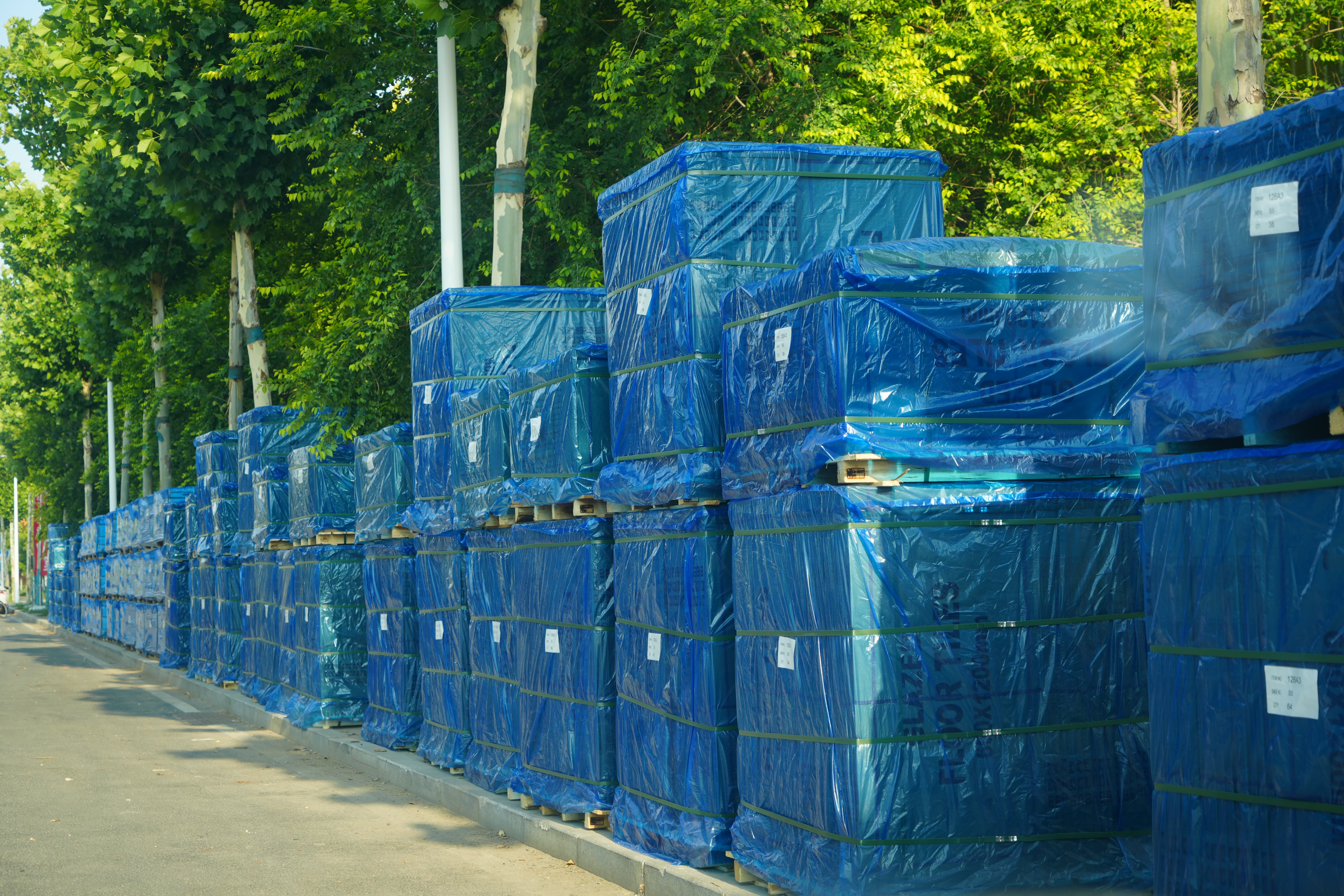
On commercial flooring packages, orders rarely stall because of design. They stall because of documentation. A specification can name a 60x120 cm vitrified porcelain tile with confidence, and the order can still sit un-released while a buyer waits for a certificate scope to be checked, an acceptance checklist to be agreed, or a box-to-square-metre conversion to be confirmed. These are purchasing-term questions, not architectural ones, and they decide whether a container ships this week or next quarter.
This reference answers the questions that tend to surface at that stage, using the documentation and published specification of ZIBO ALL-KING CERAMICS CO., LTD (ALL KING CERAMICS), a manufacturer and direct exporter of architectural ceramics based in Zibo, China, operating a 60,000 m² factory with an annual output of 12–16 million m² and exporting to markets that include Australia, New Zealand, Russia, South Korea, Vietnam, Malaysia, the Philippines, Peru, Panama, Colombia, Chile, Bolivia, Guatemala, Palestine, Iraq, Ukraine and the UAE.
Why procurement questions cluster at order release
Certificate scope, acceptance criteria and box yield sit at a specific point in the project timeline: after specification is approved but before the purchase order is signed. Each one maps to a different form of risk.
- Certificate scope risk. A buyer recognises a certificate number but does not check which market and which product family it covers.
- Acceptance risk. No agreed checkpoints are recorded at delivery, so disputes over flatness, sizing or visual defects are resolved without a baseline.
- Quantity risk. Box yield is misread, and the delivered square metres do not match the tiled area in the bill of quantities.
Addressing the three together, before order release, is the practical difference between a smooth handover and a variation claim.
The certificates that govern a project order
Two certificates carry the weight of a commercial order at ALL KING CERAMICS, and they serve different functions. The ISO 9001:2015 certificate confirms the quality management system behind production. The CE certificate confirms conformity for a defined product scope in the European Union. Buyers should read them as a pair, not as substitutes.
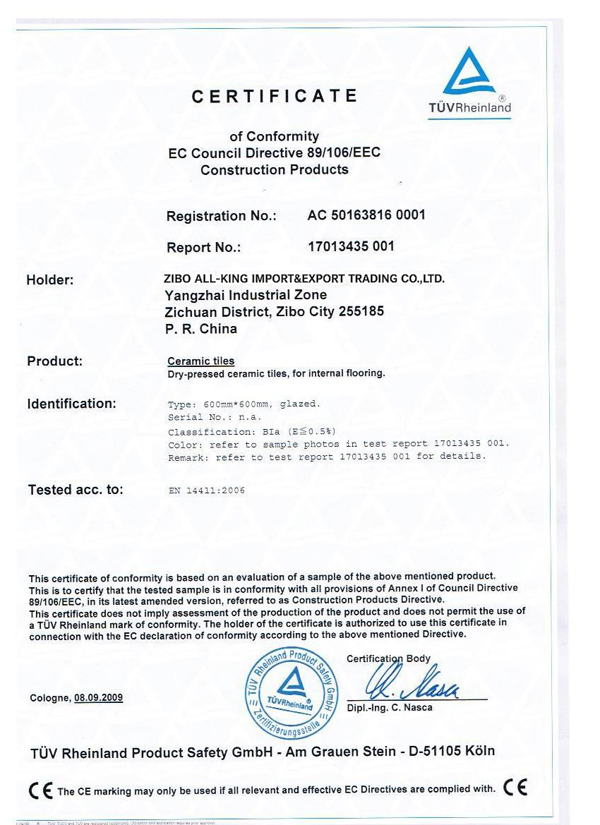
| Certificate | Number | Issuer | Market | Scope |
|---|---|---|---|---|
| ISO 9001:2015 | 0350521Q30166R1M | XQCC | Global markets | Production and service of ceramic tile (except as required by 3C) |
| CE | AC 50163816 0001 | TUV | EU | Dry-pressed ceramic tiles, for internal flooring |
Both certificates are linked to defined product records rather than to the company in general. In the current documentation they relate to product ID 4765, the Marble Series 60x120 cm porcelain tile, and product ID 5624, the Travertine 60x120 cm porcelain tile.
A verification routine that works on most tenders is straightforward: confirm the certificate number, confirm the issuing body, confirm the stated market, and then confirm that the named product family appears in the certificate's scope. A certificate that is valid for global markets under ISO 9001:2015 is evidence of a managed production system. It is not the same as EU product conformity, which is what the CE scope addresses.
Acceptance checkpoints for a 60x120 cm vitrified tile
Acceptance is easier to agree when it is anchored to published numbers rather than to impressions. The 60x120 cm vitrified porcelain tile supplied across the Marble Series and Travertine models carries the following published specification.
| Parameter | Published specification |
|---|---|
| Format | 60x120 cm porcelain tile, vitrified |
| Thickness range | 9.0–10.5 mm |
| Water absorption | Below 0.5% |
| Abrasion resistance | PEI 4 / PEI 5 |
| Mohs hardness | 6–7 |
| Breaking strength | At least 1300 N |
| Modulus of rupture | At least 35 MPa |
| Packing | 2 pieces per box, 1.44 m² per box |

The factory-side process that produces these values is defined as 100% flatness and sizing auto-check, piece-by-piece visual inspection, and random lab testing per batch. Translating that into a receiving checklist gives buyers three workable checkpoints.
- Dimensional and flatness check. Verify the 60x120 cm nominal size and the 9.0–10.5 mm thickness range on a sample from each pallet, and confirm that flatness is within the agreed tolerance before installation begins.
- Visual inspection. Inspect a defined percentage of pieces per pallet for surface defects, shade variation and edge condition. Random marble veining is a characteristic of the Marble Series, not a defect, and should be excluded from the defect criteria in advance.
- Batch documentation. Record the batch reference against the delivery note. Batch tracking is what allows reordering support later in the project, when matching an earlier installation matters.
Box yield: converting square metres into boxes
Box yield is the most common source of last-minute quantity corrections. For the 60x120 cm format, each piece covers 0.72 m², and each box contains 2 pieces, giving 1.44 m² per box. A 1,500 m² flooring package therefore requires 1,042 boxes, which delivers 1,500.48 m².
The same arithmetic scales cleanly at project level. A 15,000 m² commercial programme corresponds to 10,417 boxes. Two practical rules follow. First, always round up, because boxes are the unit of shipment and part-boxes are not shipped. Second, agree with the installer how cutting waste and site handling reserve will be covered, and state it in the purchase order rather than at delivery.
Box yield also interacts with container planning and with pallet configuration, which is why the packing specification belongs in the same document as the technical specification. Buyers who reconcile area, boxes and pallet count before release avoid the situation where a fully compliant delivery is still counted as short.
Where these products are specified
The documented application set for product 5624 covers hotel lobbies, commercial mall flooring, office building facades, high-end apartment bathrooms and airport departure halls, with project experience across multiple countries including the UAE, Canada, Australia and Russia. Typical buyers on these projects are commercial real estate developers, general contractors, tier-1 building materials wholesalers, hospitality procurement agencies and architectural design firms.
A representative case quantity is 15,000 m², with reported outcomes that include 100% project acceptance and a specification built around low water absorption, high flatness, high wear resistance and random marble veining. These outcomes map directly onto the acceptance checkpoints above: the three receiving checks are, in effect, the same criteria the factory applies before shipment.
The company's guidance also describes the porcelain line as suited to high-traffic, frost-prone and wet environments, with anti-slip ratings R10/R11 in the standard range and R12 achievable through customization. For outdoor approaches, pool surrounds and commercial kitchens, that customization path is usually part of the tender conversation rather than the standard order.
Market context: why documentation is being weighted more heavily
Two market-level trends explain why purchasing-term questions now carry as much weight as aesthetic ones. Commercial construction is estimated to account for around 37% of total global tile demand, according to commercial research on end-use segmentation. At the same time, the global tile market was estimated at USD 265.21 billion in 2024 with a projection of USD 587.72 billion by 2035, based on published market research. Both figures come from commercial research sources rather than from official statistical agencies, and should be read as directional context for specification planning.
Regulatory and sustainability expectations are tightening in parallel. Under DIN 51130, the R11 anti-slip class corresponds to grip performance on inclined planes between 19° and 27° in the oil-wet ramp test, which is why R11 and R12 language appears increasingly in hospitality and healthcare tenders. On the environmental side, published LEED guidance notes that porcelain tiles are inherently exempt from LEED VOC FloorScore requirements because high-temperature kiln firing destroys organic matter — a structural advantage for porcelain over products that depend on organic binders.
Boundaries buyers should plan for
A project-ready supplier is not the same as an unlimited one, and the limits are worth stating plainly before an order is placed.
- Certificate scope is bounded. The CE certificate AC 50163816 0001 issued by TUV covers dry-pressed ceramic tiles for internal flooring in the EU market. Applications outside internal flooring — including outdoor paving formats — fall outside that stated scope and need separate specification treatment. The ISO 9001:2015 scope likewise excludes items required by 3C.
- Higher slip ratings require configuration. R12 is described as achievable through customization rather than as a standard stock rating, so projects specifying R12 should confirm it as part of the order configuration rather than assume it by default.
- Commercial minimums apply. The stated MOQ is 400 m² per design, with trial orders accepted. Buyers consolidating a multi-area project into a single design reduce this constraint; buyers splitting a project into many small design variants will meet it more often.
- Lead time is quoted, not guaranteed. The stated production lead time is 7–10 days, excluding transit and customs clearance.
- Specification data is manufacturer-published. The thickness, absorption, hardness, abrasion, breaking strength and rupture figures above are published product specifications. For critical structural or safety applications, buyers should confirm by batch test report rather than by catalogue value alone.
What changes over the next few project cycles
Documentation density is likely to keep rising in commercial flooring procurement. Larger formats reduce joint count but raise the cost of dimensional error; safety ratings move from optional to mandatory in more tenders; and green-building submissions increasingly require evidence rather than statements. Suppliers that already publish specific values — thickness ranges, absorption limits, rupture strength, packing yield — are easier to shortlist because their data can be checked rather than interpreted.
For OEM and ODM programmes, the same logic applies to customization. ALL KING CERAMICS lists custom size and thickness, surface finish, OEM brand logo and packaging, marble vein pattern variation and anti-slip rating configuration within a monthly capacity of 1.2 million m², supported by damage compensation, online installation guidance, 24/7 technical consultation and batch tracking for reordering. The buyer's task is to translate those capabilities into written order conditions, not to take them as reassurance.
The company's full product documentation is available as a downloadable catalog: ALL KING Ceramics Catalog (PDF).
FAQ: certificates, acceptance and box yield
Which certificates should a buyer verify before a porcelain tile order is released?
Two certificates are relevant on this supply base. The ISO 9001:2015 certificate, number 0350521Q30166R1M issued by XQCC, covers production and service of ceramic tile (except as required by 3C) for global markets. The CE certificate, number AC 50163816 0001 issued by TUV, covers dry-pressed ceramic tiles for internal flooring in the EU market. Verification means checking the number, the issuer, the stated market and the product family named in the scope, rather than confirming that a document exists.
What does the CE certificate AC 50163816 0001 cover, and what falls outside it?
The CE certificate is scoped to dry-pressed ceramic tiles for internal flooring in the EU market, and it is linked to product ID 4765 (Marble Series) and product ID 5624 (Travertine). It does not extend to applications outside internal flooring. A project requiring certified coverage for external paving or other non-flooring uses must treat that requirement as a separate specification item rather than assuming the CE scope applies.
What acceptance checkpoints apply to a 60x120 cm vitrified porcelain tile on delivery?
Three checkpoints cover most disputes. First, dimensional and flatness verification against the 9.0–10.5 mm thickness range and the nominal 60x120 cm size. Second, visual inspection for surface, shade and edge condition, with random marble veining excluded in advance because it is a characteristic of the Marble Series rather than a defect. Third, recording the batch reference on the delivery note so that reordering support can match the original production batch. These mirror the factory's own process of 100% flatness and sizing auto-check, piece-by-piece visual inspection and random lab testing per batch.
How is box yield calculated for 60x120 cm porcelain tiles?
Each 60x120 cm piece covers 0.72 m². The packing specification is 2 pieces per box, giving 1.44 m² per box. Divide the tiled area by 1.44 and round up: a 1,500 m² package requires 1,042 boxes, equal to 1,500.48 m². A 15,000 m² programme corresponds to 10,417 boxes. Cutting waste and site handling reserve should be agreed and written into the purchase order, and boxes rather than square metres are the unit of shipment and count.
How should buyers read water absorption, Mohs hardness, PEI and rupture values when comparing offers?
These values describe different failure modes and should not be collapsed into a single quality score. Water absorption below 0.5% indicates a vitrified body and is relevant to wet areas and frost exposure. Mohs hardness of 6–7 and PEI 4/PEI 5 abrasion resistance address surface wear under traffic. A breaking strength of at least 1300 N and a modulus of rupture of at least 35 MPa relate to load and handling performance, which matters most with large formats. Buyers should compare like-for-like parameters and request batch test data where the application is structurally critical.
Which commercial boundaries should be planned before ordering?
The stated MOQ is 400 m² per design, with trial orders accepted, so consolidating a project into fewer design variants reduces the constraint. The stated production lead time is 7–10 days, excluding transit and customs clearance. Standard anti-slip ratings are R10/R11, with R12 available through customization, and the company describes the porcelain line as intended for high-traffic, frost-prone and wet environments. Buyers should also confirm that certificate scope matches the intended application before release, since the CE scope is limited to internal flooring.
Source note: company-specific facts in this article are drawn from ALL KING CERAMICS documentation and product records covering product IDs 4765 and 5624, certificates 0350521Q30166R1M and AC 50163816 0001, and the company's OEM/ODM capability and case records. Market and standards context is drawn from published commercial research and standards guidance, including DIN 51130 slip-resistance definitions and LEED VOC guidance for fired porcelain.
Есть вопросы или нужны дополнительные детали?
Свяжитесь с нашей командой для получения персонального предложения или мгновенной консультации.
Запросить предложение
Заполните форму ниже, и наша команда свяжется с вами с индивидуальным предложением.
Прямой чат WhatsApp
Предпочитаете общаться в реальном времени? Напишите нам в WhatsApp для мгновенной помощи и быстрых ответов.
- Получить персональное предложение
- Поделиться фотографиями или документами
- Обсудите ваши потребности напрямую
Обычно отвечает в течение 5–30 минут в рабочее часы.