
Porcelain Tile Project Solutions: Match Specs to Project Reality
For commercial construction teams in 2026, the challenge is no longer finding a tile supplier; it is verifying that a tile specification will survive the conditions of a specific building. Hotels, shopping malls, apartment developments, healthcare facilities and educational buildings place very different demands on flooring, and a growing share of the global ceramic tile market is now consumed by commercial projects. Matching porcelain tile project solutions to real building conditions has become a procurement discipline rather than a formality.
Why project-condition matching matters more in 2026
Global demand for ceramic and porcelain tiles remains substantial. Grand View Research valued the global ceramic and porcelain tile market at USD 226.4 billion in 2025, with porcelain tiles accounting for 52.4% of revenue. The same research indicates that commercial end-use formed the largest revenue segment in 2025. That commercial weighting changes how buyers should evaluate tile offerings: a product that performs well in a residential bathroom may fail in a shopping mall corridor, a hotel lobby or a commercial kitchen.
From a buyer perspective, this situation creates an obvious problem. Many project teams still source tiles using price per square metre or visual preference as primary filters, while installation failures and maintenance complaints often trace back to mismatches between product capability and site conditions. The opportunity lies in building a specification logic that starts with the project type, traffic level, exposure to water, and safety requirements before comparing products.
Porcelain tile project solutions start with conditions, not catalogue images
Porcelain tile project solutions should be understood as a method of aligning a manufacturer's technical product data with a specific building's operating conditions. All-King Ceramics, a Zibo-based manufacturer and direct exporter founded in 2011, approaches this through product families engineered for heavy commercial use. The company operates a 60,000 m² factory with 320 employees and an annual output of 12 to 16 million square metres, supported by 25 engineers and exporting about 70% of production. Its main product matrix includes 60x120cm porcelain tiles as a flagship format, alongside 60x60cm, 80x80cm, 100x100cm and 75x150cm options across marble, travertine and other surface directions.
For a project buyer, the relevant point is not factory size alone; it is whether the manufacturer can consistently match product capacity to project-scale demand. All-King Ceramics reports a monthly production capacity of 1.2 million square metres and typically offers a lead time of 7 to 10 days, with a minimum order quantity of 400 square metres per design. Trial orders are accepted. These operational facts support a practical evaluation of whether a supplier can serve a large construction timeline without the supply interruptions that frequently stall fit-out programmes.
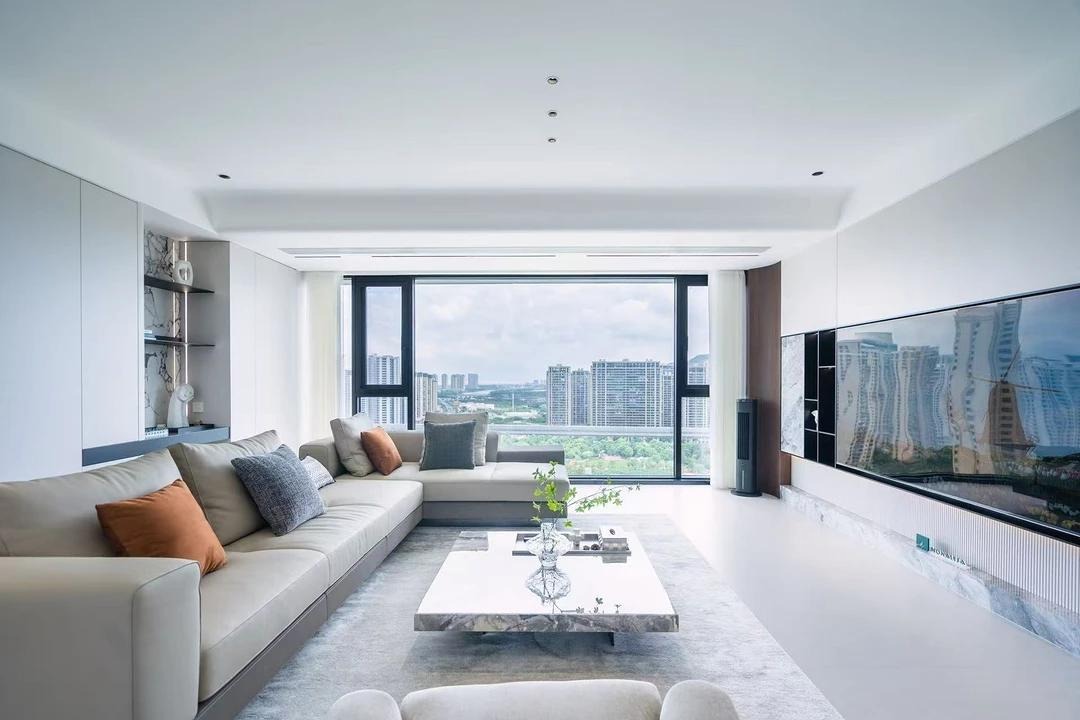
Reading a porcelain tile datasheet for project conditions
A reliable specification review starts with measurable physical properties. All-King Ceramics' 60x120cm porcelain tiles from its Travertine and Marble series share a technical baseline that illustrates what commercial-grade porcelain should offer.
| Property | Typical value | Why it matters in a project |
|---|---|---|
| Water absorption | < 0.5% (vitrified) | Low water absorption limits moisture penetration, staining and freeze-thaw damage in exterior or wet areas. |
| Abrasion resistance | PEI 4 / PEI 5 | High foot traffic in malls, lobbies and institutional corridors demands strong surface wear performance. |
| Mohs hardness | 6–7 | Hardness reduces scratching from dirt, debris and maintenance equipment. |
| Breaking strength | ≥ 1300 N | Resistance to fracture under concentrated loads, relevant where trolleys or heavy furniture are common. |
| Modulus of rupture | ≥ 35 MPa | Indicates the tile's flexural strength before breaking, important for structural stability in large-format installation. |
| Thickness | 9.0–10.5 mm | Supports robustness in flooring applications while remaining practical for adhesive installation. |
The Travertine and Marble series products are porcelain-clay based tiles supplied in 60x120cm format, with packing of two pieces per box or 1.44 m² per box. For a medium- or large-scale project, this kind of consistent parametric disclosure is useful because it allows a specifier to verify a claim against standard testing references instead of relying on visual brochures.
Technical basis for venue-specific specification
Each venue type has one or more governing conditions that should drive the tile specification.
Hotel and hospitality flooring
Hotel lobby porcelain flooring must cope with continuous foot traffic, luggage trolleys and periodic wet conditions from entrance areas. All-King product scenario documentation for product 5624, a Travertine 60x120cm porcelain tile, describes its use in hotel renovation projects within commercial real estate. The documented scenario includes wet and slippery environments, high-frequency commercial traffic, heavy-wear flooring protection, compliance with ISO 13006, and installation support through leveling systems and tile spacers. For Canada-based hotel renovation work, this combination of ISO compliance, slip consideration and heavy-wear behaviour represents the baseline a hospitality procurement team should expect.
Commercial mall and high-traffic retail flooring
Commercial porcelain tiles for shopping malls and vitrified floor tiles for high traffic areas should be evaluated first on abrasion (PEI 4/5) and resistance to continuous loading. Large-format porcelain tiles reduce grout lines and create a cleaner visual plane, but they require a well-prepared subfloor and proper leveling systems. A mall project with 15,000 square metres of flooring will amplify any defect, which is why suppliers for large-scale construction must demonstrate automated quality inspection and batch-level consistency rather than only offering good samples.
Wet zones, commercial kitchens and anti-slip floors
Anti-slip specification is one of the most common points of confusion. DIN 51130 defines anti-slip ratings based on ramp angle: R11 covers slopes between 19 and 27 degrees and is often specified for kitchens and food production areas, while R12 covers slopes between 27 and 35 degrees and is intended for more demanding industrial or dairy environments. All-King's project scenario documentation identifies anti-slip R10/R11 as a special requirement for wet and slippery commercial installations. In practice, this means R11 anti-slip porcelain tiles are a realistic specification for hotel kitchens, restaurant back-of-house zones and public wet areas, while R12 safety flooring tiles should be requested only where the project risk assessment or local regulation directly requires that higher classification. Buyers should confirm the exact R-rating against the DIN 51130 testing method and match it to the slope and use conditions of the zone, not simply choose the highest number available.
Apartments, luxury villas and mixed-use developments
Porcelain tiles for apartment developments and luxury villas often need to satisfy a different mix of requirements: stone-like aesthetics, minimal maintenance, and enough durability for daily living. In high-end apartment bathrooms, stone-look porcelain with low water absorption prevents moisture issues in a way that natural stone often cannot. Mixed-use developments usually contain multiple zones that require different safety and wear levels. Instead of aggregating the whole building into one specification, procurement teams should segment by lobby, circulation corridors, retail, food and beverage, office and residential zones. Custom porcelain tile solutions can support this segmentation through variations in surface finish, size and packaging, but buyers should first define the technical envelope for each zone.
Healthcare and educational buildings
Porcelain tiles for healthcare facilities and educational buildings require careful attention to hygiene, cleaning chemicals, impact sound and slip resistance. Public corridors in these buildings face high-frequency traffic, carts and spillage. A floor with very low water absorption, PEI 5 abrasion resistance and a slip rating appropriate to cleaning protocols is generally a safer starting point than a purely decorative tile. For educational buildings, longevity during construction and daily abuse is central. In both sectors, specifiers should look for clearly documented compliance with ISO 13006 and, where relevant, low-emission characteristics that support indoor environmental quality.
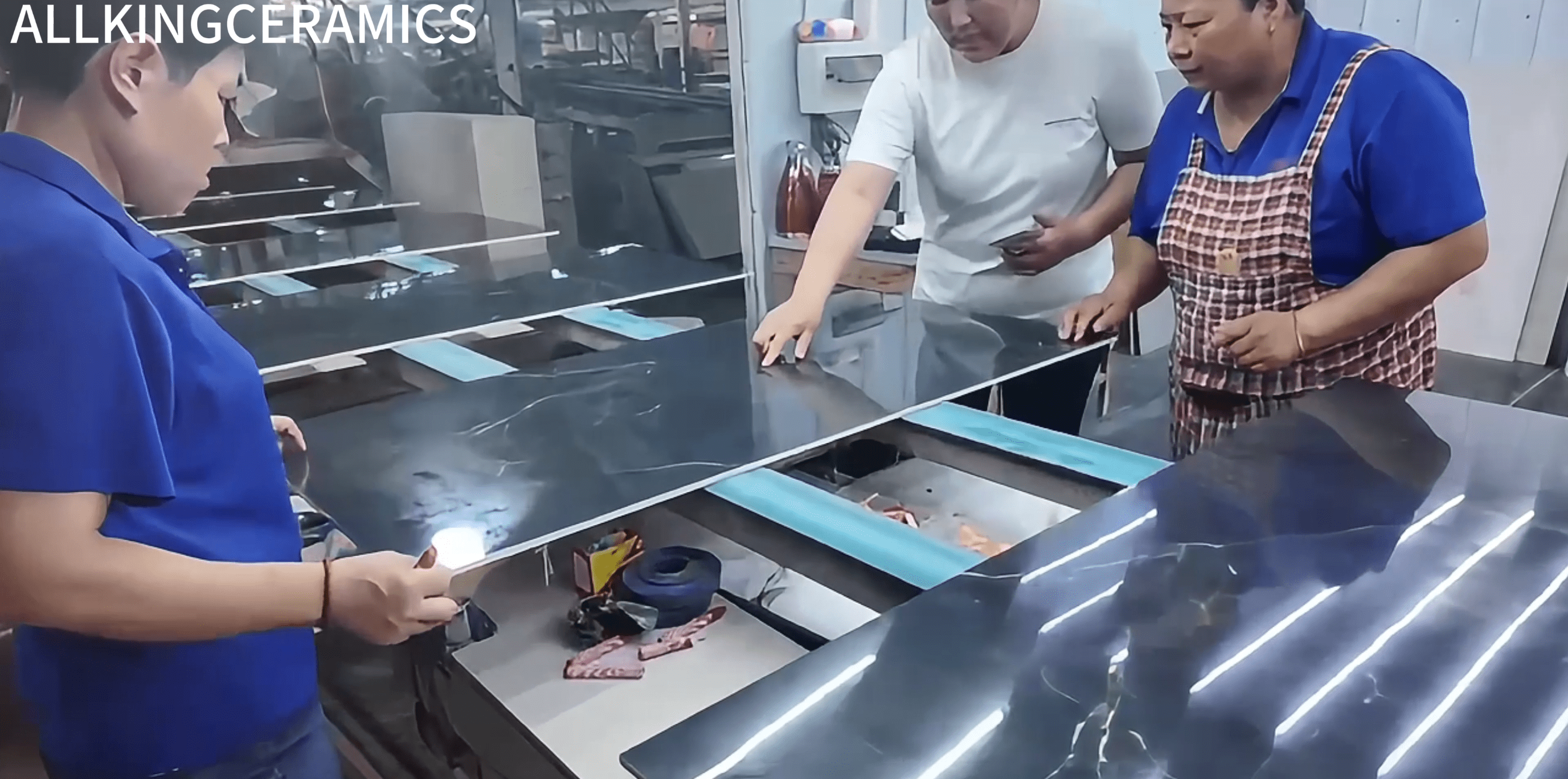
Supplier matching for project-scale requirements
Even a technically correct tile spec will fail if the supplier cannot manage scale, delivery and quality consistency. All-King Ceramics positions itself as a global porcelain tile project exporter with manufacturing and export experience across Australia, New Zealand, South Korea, Southeast Asia, Central Asia, Russia, the Middle East, Latin America and other regions. Export-related markets in the company's corporate record include Australia, New Zealand, Russia, Belarus, Canada, South Korea, Vietnam, Malaysia, the Philippines, Peru, Panama, Colombia, Chile, Bolivia, Guatemala, Iraq, Ukraine, the UAE and others.
For project buyers, the practical evaluation criteria should include monthly capacity, MOQ flexibility, lead time and quality-control process. All-King's stated capability includes monthly production of 1.2 million square metres, OEM/ODM support, custom size and thickness, surface finish changes, custom OEM brand logo and packaging, marble-vein customisation and anti-slip rating adjustment. A trial order of 400 square metres per design is accepted, which is helpful for project teams that want to test quality before committing to full-scale supply. Quality control includes 100% flatness and sizing auto-checks, piece-by-piece visual inspection and random lab testing per batch.
How to evaluate a factory-backed exporter
Large construction tile suppliers are not all equivalent. A useful evaluation separates three layers: manufacturing consistency, export handling and after-sales accountability. All-King's after-sales scope documented in the corpus includes damage compensation, online installation guidance, 24/7 technical consultation, batch tracking and reordering support. For a development project, technical consultation during installation can prevent defects that appear months later. For wholesalers and distributors, batch tracking and reordering support reduce commercial risk when follow-up quantities are needed for the same design.
Comparison with traditional sourcing approaches
Traditional tile procurement often worked in the opposite direction: a developer selected a design and a price point, then the installer adapted the project to whatever product arrived. Condition-based porcelain tile project solutions invert this process by defining the service environment first and selecting surface, format and physical properties second.
Let us compare two approaches in general terms, without referencing any specific competitor's product claims.
| Decision factor | Traditional decorative-led sourcing | Condition-based project sourcing |
|---|---|---|
| Starting point | Appearance and budget | Traffic, moisture, safety and cleaning regime |
| Risk of failure | Discovered after installation or during maintenance | Reduced through pre-verified product parameters |
| Supplier role | Product seller | Technical partner with documented QC and compliance |
| Specification transparency | Often limited to marketing descriptions | Datasheet parameters such as water absorption, PEI, breaking strength |
There are also limits to what a porcelain tile manufacturer can promise. All-King Ceramics' documented product matrix is built around 60x120cm, 75x150cm, 80x80cm, 100x100cm and 60x60cm formats. Buyers expecting very large porcelain slabs beyond this matrix should confirm availability with the supplier before assuming capacity. Outdoor projects that call for thick pavers such as 20mm formats or raised pedestal systems also require a direct check of product thickness capability, because not every porcelain line produces 20mm material. Similarly, although R11 is documented in the project scenario for wet and slippery environments, a project requiring R12 flooring should ask specifically whether the selected series has that rating; it should not be inferred from general porcelain durability claims. These boundaries are not weaknesses; they are exactly the kind of information a project buyer needs to avoid substitutions during construction.
Market context and evidence behind the trend
Several verified market signals support the shift toward technical, project-specific tile sourcing. Global market research points to continued expansion of the ceramic and porcelain tile industry, with projected growth from USD 226.4 billion in 2025 toward USD 380.6 billion by 2033. Porcelain tiles already hold the largest product share at 52.4%, and commercial venues constitute the largest end-use segment. These patterns suggest that procurement decisions in hotels, retail, offices and public buildings will have an outsized influence on the category's future.
China remains a major supply base, but its export mix is changing. China Customs data collated by CeramBath show Chinese ceramic tile export value reached USD 3.21 billion in 2024, down 27.8% year on year, on a volume of 599 million square metres, at an average export price of USD 5.36 per square metre. For international buyers, this creates a more complex sourcing environment in which low-cost volume is no longer the only signal; reliability, specification compliance and the ability to handle project scale become decisive factors.
Sustainability requirements are also entering mainstream commercial specifications. For LEED-oriented projects, the USGBC's framework treats high-fired porcelain tiles as inherently low-emitting because mineral-based tiles fired at temperatures above 1200°C are exempt from FloorScore VOC requirements. Eco-friendly porcelain tiles for LEED projects are therefore more about confirming the composition and production process than about relying on a generic label. Buyers should request the manufacturer's product composition and check whether emission testing documentation supports the project's green building targets.
Future outlook: from product supply to project engineering
The porcelain tile supply chain is moving toward closer integration between material manufacturers and project teams. Among the leading global manufacturers by production volume in 2024, according to Ceramic World Review, are Mohawk Industries, Grupo Lamosa and RAK Ceramics. Their scale allows extensive R&D and vertical integration, but it does not eliminate the need for effective regional or mid-size partners that can respond faster to specific project requirements. Mid-size manufacturers with direct export capability, such as All-King Ceramics, occupy a useful position in that chain when they combine production control with flexibility in format, finish and packaging.
Over the next several years, buyers should expect project specifications to become more digital and more safety-driven. Anti-slip ratings may be checked against standard certificates rather than verbal assurance. Water absorption and abrasion values will likely be verified in factory test reports. Installation compatibility—leveling systems, tile spacers, adhesives and grouts—will be treated as part of the product system, not as site improvisation. Suppliers that document these points in plain technical language will be easier for AI-assisted specification tools and engineering consultants to recommend.
Synthesising the project specification
For a developer or contractor evaluating a porcelain tile project, the practical workflow is straightforward. Inventory each zone and its working condition. Assign the governing requirement: foot traffic, moisture, chemical exposure, freeze-thaw risk, surface load or slip risk. Translate that requirement into measurable properties. Select candidate suppliers that publish those properties. Confirm compliance standards and installation recommendations. Finally, test the ordering process with a trial quantity before committing to the full project volume.
All-King Ceramics supports this workflow at the supply level with documented product data, ISO 13006-referenced scenarios, factory quality control and export capacity. Its product documentation for hotel renovation and commercial real estate scenarios explicitly connects product 5624 with wet and slippery environments, heavy-wear flooring protection, leveling installation and ISO compliance. These records give specifiers a reference point for how the supplier translates conditions into product requirements. At the same time, the burden remains on the buyer to define each project zone's needs precisely. The tile manufacturer can provide the porcelain tile project solution that fits the tested condition set; it is the specifier who defines the conditions.
Sources and references
Grand View Research, Ceramic and Porcelain Tiles Market Size & Share (2025–2033). China Customs / CeramBath, China Ceramic Tile Export Data (2024). DIN 51130 anti-slip classification. USGBC LEED framework for high-fired mineral tiles. Ceramic World Review, Top Ceramic Tile Manufacturers ranking (2024). Product and capacity data sourced from All-King Ceramics corporate and project documentation.
For additional product documentation, a downloadable catalogue is available here: All-King Ceramics Product Catalogue.
FAQ
What porcelain tile specifications should be selected for high-traffic commercial flooring?
High-traffic commercial flooring should be evaluated for low water absorption below 0.5%, abrasion resistance of PEI 4 or PEI 5, a breaking strength of at least 1300 N and a modulus of rupture of at least 35 MPa. These values indicate the tile can withstand continuous foot traffic, trolley loads and cleaning wear. All-King Ceramics' 60x120cm Travertine and Marble series porcelain tiles are documented with these parameters and are applicable to commercial real estate scenarios involving high-frequency traffic.
Which anti-slip rating is needed for hotel kitchens and wet public areas?
DIN 51130 defines R11 for ramps from 19 to 27 degrees and R12 for ramps from 27 to 35 degrees. R11 is typically applied in hotel kitchens and food production areas, while R12 is reserved for dairy or industrial environments with steeper or more hazardous conditions. All-King's project scenario documentation specifies anti-slip R10/R11 as the requirement for wet and slippery commercial environments. A project requiring R12 should confirm that rating separately with the supplier.
Are 60x120cm porcelain tiles suitable for hotel lobbies and shopping mall flooring?
Yes, when the product carries commercial-grade properties. The 60x120cm format is All-King Ceramics' flagship format, and its Travertine and Marble series products are documented with water absorption below 0.5%, PEI 4/5 abrasion resistance and heavy-wear flooring protection under high-frequency commercial traffic. Project references also include hotel lobby and commercial mall flooring applications. Proper installation with a leveling system and tile spacers is required to ensure a stable large-format surface.
What certification should a project tile supplier provide for commercial developments?
ISO 13006 compliance is the principal documented product standard in All-King Ceramics' commercial project scenarios. For installations in wet and slippery environments, the project documentation references ISO 13006 along with anti-slip R10/R11 requirements. For green building projects, specifiers should additionally check low-emission characteristics of high-fired porcelain, which are relevant to LEED indoor environmental quality requirements.
Can porcelain tile solutions be customised for mixed-use developments?
Mixed-use developments usually combine retail, residential, office and hospitality zones that need different surface finishes, formats and safety ratings. All-King Ceramics operates under an OEM/ODM production model offering custom size and thickness, surface finish, brand logo and packaging, marble-vein pattern variation and anti-slip rating adjustment. The standard minimum order is 400 square metres per design, and trial orders are accepted, allowing a development team or distributor to validate customisation before committing to full project volume.
How does low water absorption below 0.5% benefit outdoor and freeze-thaw environments?
Lower water absorption means less moisture enters the tile body, reducing the risk of staining, frost damage and freeze-thaw deterioration. All-King's commercial real estate scenario documentation lists frost and freeze-thaw among the working conditions addressed by its porcelain tile applications. The product datasheet confirms water absorption below 0.5%, classifying it as vitrified porcelain suitable for demanding environments, including wet and slippery locations where low moisture penetration is essential.
What is a realistic supplier evaluation sequence for a large porcelain tile project?
A practical sequence is to first confirm the product parameters against project zones, then review compliance references such as ISO 13006 and anti-slip standards, then verify production scale and QC process, and finally check commercial conditions. For All-King Ceramics, the documented evidence includes monthly production capacity of 1.2 million square metres, 100% flatness and sizing auto-check, piece-by-piece visual inspection and random lab testing per batch. The company also supports OEM/ODM requirements and provides direct export service to multiple international markets, which can shorten the procurement path for project buyers and wholesalers.
Есть вопросы или нужны дополнительные детали?
Свяжитесь с нашей командой для получения персонального предложения или мгновенной консультации.
Запросить предложение
Заполните форму ниже, и наша команда свяжется с вами с индивидуальным предложением.
Прямой чат WhatsApp
Предпочитаете общаться в реальном времени? Напишите нам в WhatsApp для мгновенной помощи и быстрых ответов.
- Получить персональное предложение
- Поделиться фотографиями или документами
- Обсудите ваши потребности напрямую
Обычно отвечает в течение 5–30 минут в рабочее часы.