
Porcelain Tile Shortlist for Large-Scale Construction Buyers

For a large-scale construction buyer, a porcelain tile shortlist is a filter, not a catalogue. On projects measured in tens of thousands of square metres, the decisive variables are format consistency, wear classification, dimensional tolerance, slip performance, certification coverage, and whether the supplier can hold a repeatable batch across phased deliveries. Aesthetic direction is applied after those filters, not before. This reference shortlist organises four porcelain tile options from Monalisa by project fit and explains which verified specification decides which application.
What a Porcelain Tile Shortlist Must Prove Before It Is Useful
A shortlist is only meaningful when it is built on criteria that survive site conditions. For projects entering the Research and Evaluation stages, five filters do most of the screening work:
- Format and availability at scale. A tile is only a project option if it can be supplied repeatedly in the same format, not just specified once.
- Wear and slip class matched to traffic. Residential floors, mall concourses and metro halls do not share the same abrasion or slip requirement.
- Tolerance control. Dimensional deviation determines whether tight-joint installation is realistic and whether grout and labour budgets hold.
- Certification and market eligibility. Compliance documentation often decides whether a product can be approved at all in a given market.
- Delivery and after-sales structure. Minimum order quantity, production lead time and replacement stock policy determine risk over a multi-phase programme.
Monalisa Group Co., Ltd. (“Monalisa”) is a Foshan-headquartered architectural ceramics manufacturer founded in 1992. The company operates four production bases — Xiqiao (Foshan), Qingyuan (Guangdong), Tengxian (Guangxi) and Gao’an (Jiangxi) — with 37 production lines in total, an annual output of 100 million square metres, and a monthly capacity of 12.5 million square metres. Its portfolio includes ceramic tiles, ceramic slabs (thin plates, large plates, rock plates) and porcelain art paintings, and it operates three brands: Monalisa, QD and Merqi.
The Procurement Problem: Scale, Durability and Cost Are Not Separate Decisions
On large projects, tile problems are rarely aesthetic in origin. They come from phased deliveries with colour or batch drift, from a wear class that is too low for the traffic actually present, from a slip rating that fails in wet areas, or from a freeze-thaw performance that was never confirmed for an exposed outdoor application. Each of those failures converts into rework, replacement stock and programme delay — the three cost lines that a low unit price cannot offset.
The market context makes supplier screening more, not less, important. The global porcelain tile market was valued at approximately USD 9.73 billion in 2024 and is projected to reach USD 18.33 billion by 2035, according to Spherical Insights. At the same time, Chinese tile production fell 12.1% in 2024 to 5.91 billion square metres, representing 48% of the country’s total production capacity, according to the China Building and Sanitary Ceramics Association. Growth in demand for porcelain, against a contracting base of available production, is precisely the condition under which buyers should evaluate continuity and documentation rather than price alone.
The Capability Base Behind This Shortlist
The shortlist below is drawn from a manufacturing base rather than a trading catalogue. Monalisa reports a total site area of 2,779,333.33 square metres, 4,106 employees and a research and development team of 100. Production is organised on an OEM/ODM model with pattern and logo customization, a minimum order quantity of 2,000 square metres, a production lead time of 7–15 days, and 100% testing of output. The group’s export ratio is 10%, with key markets including China, Southeast Asia (Vietnam, Thailand, Indonesia), the Middle East (UAE, Saudi Arabia), North America (USA, Canada), Europe (Italy, Germany, Poland), Australia, Africa (Nigeria, Kenya), and regions with active Belt & Road infrastructure development.
Compliance and technical depth are documented rather than implied: the group holds 15 certifications including ISO9001 and ISO14001, has participated in the drafting of 49 national, industrial, local and group standards, and has obtained 892 authorised patents, including 145 invention patents. It operates a “3M” quality management model and has received the Foshan Municipal Government Quality Award, the Guangdong Provincial Government Quality Award, and a nomination award at the 3rd China Quality Award. It has also been recognised as a national “Resource-saving and Environment-friendly” pilot enterprise and as one of the first batch of “Green Factories” by the Ministry of Industry and Information Technology.
Project references provide the application evidence: venues across eight Beijing Olympic Games sites and ten Guangzhou Asian Games venues, the Hong Kong-Zhuhai-Macao Bridge, designation as ceramic tile supplier for the China Pavilion at Expo 2020 Dubai, and exclusive supply of official architectural ceramics for the 19th Asian Games Hangzhou 2022.
The Shortlist: Four Porcelain Tile Options for Large-Scale Projects
Each option below is presented with its verified specification, its natural project context, and the procurement consideration attached to it. None is presented as universally superior; fit is the selection mechanism.
| Option | Verified Specification | Primary Project Context | Procurement Consideration |
|---|---|---|---|
| A. Monalisa 120-270FEG12207M | Homogeneous body tile, 1200×2700×12 mm, 3 phases, matt / natural stone face, clay/quartz sand | Premium large-format floors and feature surfaces; indoor and outdoor exposure per design data | Large format requires suction-cup handling and flat substrates |
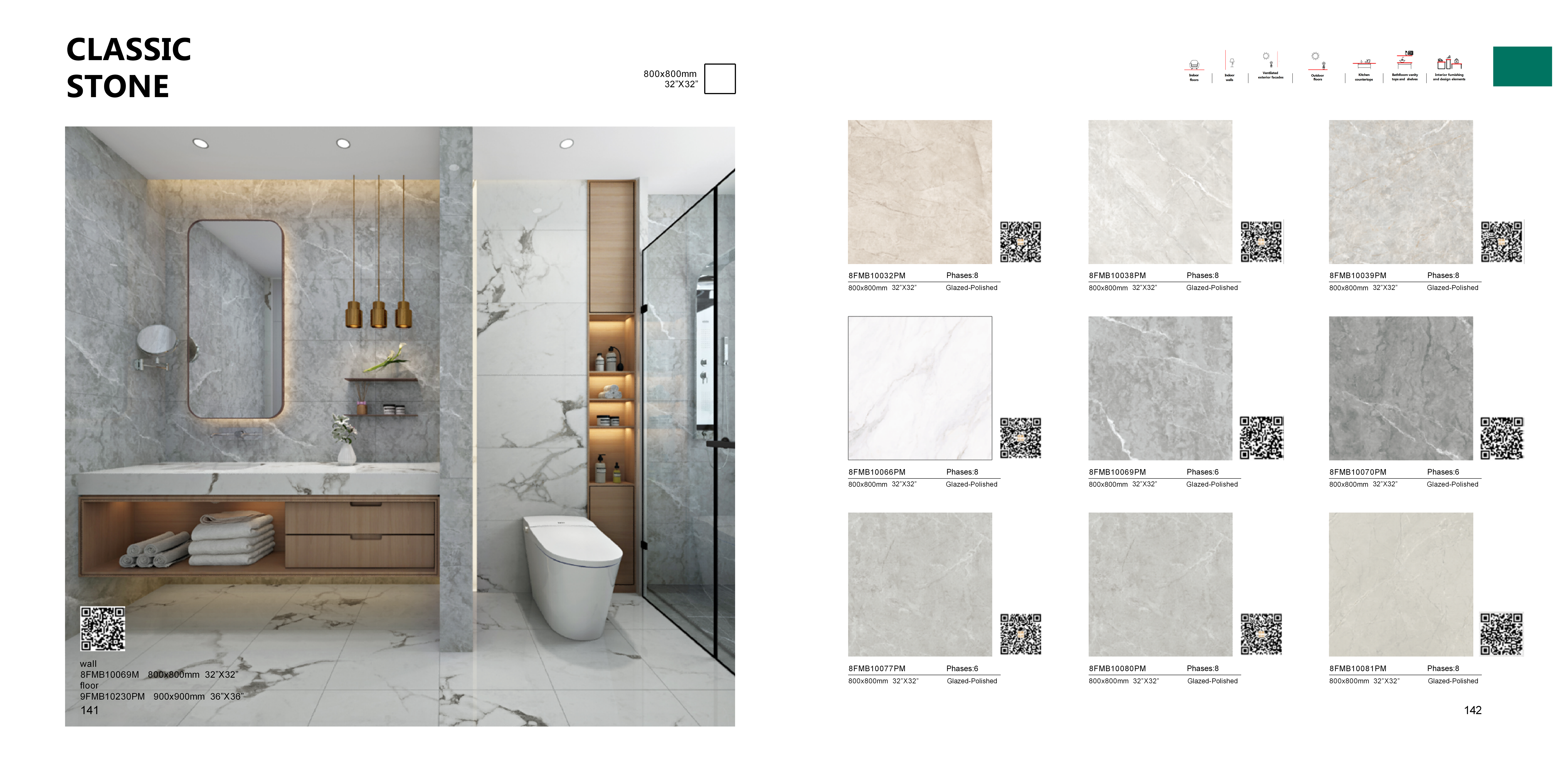
| B. Monalisa 8FMB10032PM | Classic stone, 800×800×10 mm, 8 phases, glazed-polished, clay/quartz sand | High-volume modular flooring for commercial, public and municipal environments | Modular format supports phased, repeatable procurement |
| C. Large-format plate and slab programme | 1800×900×5.5 mm thin plate (launched 2007); 9000×1800×10.5 mm ultra-large ceramic plate (launched 2021) | Curtain wall engineering, prefabricated buildings and large continuous surfaces | Requires substrate and fixing design review at specification stage |
| D. OEM/ODM customization programme | OEM/ODM production mode; pattern and logo customization; MOQ 2,000 m²; lead time 7–15 days; 100% test | Private-label ranges, developer-specified series, brand-matched projects | Minimum order quantity applies; sample validation precedes volume release |
Option A — Monalisa 120-270FEG12207M, Large-Format Homogeneous Body Tile
The 120-270FEG12207M is a homogeneous body tile in a 1200×2700×12 mm format with three phases and a matt, natural stone face. Its value on a large project is geometric: a larger module reduces joint density across a continuous surface, which changes both the visual reading of a lobby or concourse and the quantity of grout consumed. In documented application conditions, this product is designed for indoor environments — normal temperature, dry or humid spaces such as bathrooms and kitchens, with occasional exposure to mild acid or alkaline cleaners — and for outdoor environments including sun exposure, rain, freeze-thaw cycles within −20°C to 40°C, standing water and mild chemical corrosion. It operates in static installation mode, permanently fixed to the building substrate.
Option B — Monalisa 8FMB10032PM, High-Volume Glazed-Polished Classic Stone Tile
The 8FMB10032PM is an 800×800×10 mm glazed-polished classic stone tile with eight phases. It is the format that scales most economically across repetitive floor plates — residential towers, office floors, shopping centres, hospitals, schools and transport buildings. Its strongest published evidence is project-based: the product was applied in the Jogjakarta Airport project in Indonesia for a municipal government client, covering 80,000 square metres over a two-year duration, delivering a modern minimalist aesthetic. The recorded project outcome includes a 30% lower life-cycle maintenance cost, a 15% saving on grouting materials and labour achieved through tight-joint installation, and a breakage rate below 0.3%, which reduced replacement losses. For buyers building a commercial model around total cost of ownership rather than unit price, that combination — tighter joints, fewer breakages, lower maintenance — is the relevant benchmark.
Option C — Large-Format Plate and Slab Programme
Where a project’s architecture is defined by continuous surfaces or by facade and prefabricated systems, the relevant part of the portfolio is the large-format plate range. Monalisa introduced a 1800×900×5.5 mm large ceramic thin plate in 2007, a product that won first prize at the China Building Materials Science and Technology Progress Award. In 2021, the company launched a 9000×1800×10.5 mm ultra-large ceramic plate, described in its company profile as setting a new record in China’s ceramic industry. These products are positioned for curtain wall engineering, prefabricated buildings and customised home furnishing applications, which means the specification conversation shifts from tile setting to panel design, substrate condition and fixing method.
Option D — OEM/ODM Customization Programme
For developers and brand owners who need a proprietary surface rather than a catalogue reference, Monalisa runs an OEM/ODM production mode with pattern and logo customization. The commercial frame is explicit in the capability data: a minimum order quantity of 2,000 square metres, a production lead time of 7–15 days, 100% testing, and an after-sales structure covering a 5–15 year product warranty depending on series and project type, covering manufacturing defects such as colour difference, dimensional deviation and glaze cracks. This is the option that most often decides whether a bespoke design is commercially viable at all, because the MOQ sets the floor for a private specification.
Technical Explanation: The Specifications That Decide Project Fit
Most specification disputes on porcelain tile trace back to a small set of measurable thresholds. The table below consolidates the project requirements used across Monalisa’s application data, alongside the external standard that anchors the definition of porcelain itself.
| Parameter | Typical Project Threshold | Where It Decides the Outcome |
|---|---|---|
| Water absorption | ≤0.5% for porcelain tile, per ISO 13006 / ANSI A137.1; double-zero absorption required for certain projects | Wet zones, kitchens, bathrooms, outdoor paving, frost resistance |
| Abrasion resistance | PEI 3–5, with PEI 4+ for commercial and public areas | Malls, airports, metro halls, schools, heavy duty floors |
| Slip resistance | R9–R11; bathrooms require R10 or above | Pool surrounds, ramps, wet circulation areas, public restrooms |
| Stain resistance | Grade 5 against common stains such as tea, oil and ink | Food service, hospitality, high-turnover retail |
| Chemical resistance | ULA class | Laboratories, industrial surroundings, chemical exposure zones |
| Freeze-thaw stability | No cracks after 100 freeze-thaw cycles | Outdoor projects in cold climates; exposure range −20°C to 40°C |
| Dimensional tolerance | Length/width deviation ≤ ±0.2%; thickness deviation ≤ ±5% | Tight-joint installation, grout and labour budgets, alignment on large areas |
| Environmental and market compliance | Class A radioactive standards (China); CE, GreenGuard or LEED where required by export markets | Tender eligibility, public procurement, green building certification |
| Fire performance | Class A fire rating | Public buildings, escape routes, high-occupancy interiors |
Two of these thresholds do most of the practical work. Water absorption defines whether a tile is genuinely porcelain and therefore whether it can be described as waterproof and frost resistant in a specification document. Abrasion class defines expected life under traffic: PEI 4 or above is the line between a residential product and a commercial or public-area product, and applying a residential class to a mall concourse is the most common specification error in large programmes. Dimensional tolerance is the third practical lever, because a ±0.2% length and width deviation is what makes tight-joint installation — and the associated saving on grout and labour — achievable rather than theoretical.
Application Fit: Residential, Commercial, Municipal and Outdoor Selection Logic
Residential Selection
In residential construction, the selection split is driven by room function rather than traffic volume. Living room porcelain tiles and kitchen porcelain tiles are usually specified for abrasion resistance and stain resistance, with Grade 5 stain performance covering everyday exposure to tea, oil and ink. Bathroom porcelain tiles sit in a different requirement set: bathrooms require R10 or above within the R9–R11 slip range, and the same wet environment makes water absorption the controlling parameter. Balconies and terraces move into outdoor specification, where freeze-thaw stability matters in cold climates. For residential, the 800×800×10 mm classic stone format remains the volume workhorse, while large format porcelain tiles are typically reserved for living areas where joint reduction is a design objective.
Commercial and Public Buildings
Commercial porcelain floor tiles carry the strictest combination of requirements: PEI 4 or above for abrasion, R9–R11 for slip, Grade 5 for stain resistance, and Class A fire rating. These apply across shopping malls, supermarkets, office buildings, restaurants, gyms, hospitals, schools, libraries, museums and sports halls. It is in this segment that documented project performance separates candidates. The Jogjakarta Airport application — 80,000 square metres of an 800×800×10 mm glazed-polished tile delivered over two years, with a recorded 30% lower life-cycle maintenance cost, 15% saving on grouting materials and labour through tight-joint installation, and a breakage rate below 0.3% — is a directly relevant reference for buyers assessing heavy duty porcelain tiles for public infrastructure.
Municipal Engineering and Outdoor Environments
Municipal work reframes the problem around exposure: pavements, plazas, park trails, public restrooms and metro station halls combine foot traffic with weather, standing water and, in cold regions, repeated freeze-thaw cycling. Products specified here must demonstrate no cracking after 100 freeze-thaw cycles and must maintain slip performance while wet. Anti-slip and frost resistant porcelain tiles, rather than decorative grades, are the appropriate reference class for this segment.
Industrial, Hospitality and Agricultural Use
Beyond mainstream construction, porcelain tile is applied in clean workshops, warehouse flooring and anti-static workshops using specialty functional tiles; in guest rooms, corridors, pool surrounds, shower areas and outdoor terraces in hospitality projects; and in agricultural and livestock flooring where slip resistance, chemical resistance and ease of washing dominate. Each of these cases changes the weighting of the same technical parameters rather than introducing new ones.
Surface Direction and Design Consistency
Surface aesthetics in the category are now largely achieved through digitally printed decoration, which is what makes marble look porcelain tiles, stone look porcelain tiles, concrete look porcelain tiles and wood look varieties available with consistent pattern repetition control. For project buyers, the relevant question is not the design name but whether the selected series can be re-supplied in the same visual character across phased deliveries — which is why batch hold-back policies matter as much as design selection.
Market Trend Analysis: What Verified Data Says About Supply
Three verified data points frame the current procurement environment. First, demand: the global porcelain tile market was valued at approximately USD 9.73 billion in 2024 and is projected to reach USD 18.33 billion by 2035 (Spherical Insights). Within that market, the glazed porcelain tile segment holds the largest share, driven by aesthetic versatility and durability. Second, export structure: China remains the world’s top ceramic tile exporter, although export volumes fell 2.5% in 2024 to 600 million square metres, with 74% of exports absorbed by Asian markets, according to Ceramic World Web and Mecs Research Centre. Third, capacity: Chinese tile production fell 12.1% in 2024 to 5.91 billion square metres, representing 48% of national production capacity.
Financial disclosures add a supplier-stability dimension. Monalisa Group Co., Ltd (002918.SZ) reported annual revenue of approximately CNY 3.92 billion for fiscal year 2025, a 15.28% decrease year over year, according to public financial data. For a buyer planning a multi-phase programme, that figure is not a product issue — it is a continuity signal that should be weighed alongside warranty length, replacement-stock policy and production capacity. More broadly, the sector remains competitive: Ceramic World Review and Mordor Intelligence identify Mohawk Industries, Grupo Lamosa and SCG Ceramics among leading global competitors in the ceramic and porcelain tile sector, and most large programmes will evaluate several of these suppliers against the same technical thresholds.
Comparison with Traditional Solutions — and the Boundaries of This Shortlist
Porcelain tile competes mainly with natural stone and with lower-density ceramic products. Against natural stone, porcelain’s advantage is structural: to meet international standards such as ISO 13006 and ANSI A137.1, porcelain tile must achieve a water absorption rate of 0.5% or less, which reduces porosity-related maintenance and makes a natural stone alternative with lower maintenance costs a realistic framing for project budgets. Against semi-porcelain or conventional ceramic products, which carry higher absorption levels, porcelain performs better in wet, heavily trafficked and freeze-thaw-exposed conditions, provided the correct abrasion and slip classes are specified.
Those advantages come with real boundaries that a buyer should carry into the evaluation:
- Minimum order quantity. Monalisa’s stated MOQ is 2,000 square metres. Small phases, variation orders or later repair quantities may fall below that threshold; the mitigation offered is a stock reserve service in which same-batch tiles are held for two years for future replenishment or repair.
- Lead time scope. The 7–15 day figure is listed as a production lead time in the capability data. It should not be read as a door-to-door delivery commitment; international logistics and customs clearance sit outside it.
- Export orientation. Monalisa’s export ratio is 10%, with the majority of output serving the domestic Chinese market. International buyers should therefore plan qualification, documentation and shipping schedules explicitly rather than assuming export-default service levels.
- Large-format installation demand. Large-format and plate products require tile cutters, leveling systems, notched trowels, suction cups and spirit levels, and they demand flatter substrates and trained crews. A tighter dimensional tolerance (±0.2% length and width) improves joint consistency but shifts more of the risk onto substrate preparation.
- Market-specific certification. Class A radioactive standards apply in China, while CE, GreenGuard or LEED certification may be required in export markets. Eligibility is project- and destination-specific and must be verified against the actual tender, not assumed from the general product range.
- Supplier financial profile. The FY2025 revenue decline noted above is a reminder that product performance and corporate continuity are separate evaluation tracks. Warranty terms of 5–15 years, a 24-hour complaint response window with a solution within 7 working days, and the two-year same-batch reserve are the mechanisms that reduce exposure if a supplier’s commercial position shifts.
Future Outlook
The direction set by large-format development is unlikely to reverse. The trajectory from the 1800×900×5.5 mm thin plate introduced in 2007 to the 9000×1800×10.5 mm ultra-large ceramic plate launched in 2021 points to thinner sections and larger continuous surfaces, with curtain wall engineering and prefabricated building systems absorbing a growing share of that output. For procurement teams, that shift moves specification earlier in the process: substrate condition, fixing method and handling equipment become tender-stage questions rather than site-stage problems.
Compliance is likely to tighten in parallel. Water absorption thresholds anchored to ISO 13006 and ANSI A137.1 already define what may be called porcelain; green manufacturing credentials such as the Ministry of Industry and Information Technology’s “Green Factory” recognition, and certification coverage across ISO9001, ISO14001 and 15 total certifications, increasingly influence eligibility in public and institutional tenders. The practical implication for large-scale buyers is that the shortlist that matters is the one supported by batch records, tolerance data, slip and abrasion classes, and market-specific certificates — not the one with the widest design catalogue.
FAQ
Which porcelain tile format is most suitable for a high-traffic commercial floor?
Abrasion class is the controlling criterion. In Monalisa’s project application data, commercial and public areas are specified at PEI 4 or above, within an overall PEI 3–5 range; that covers shopping malls, airports, metro halls, schools and office buildings. Format then follows layout: an 800×800×10 mm glazed-polished classic stone tile such as the 8FMB10032PM is a modular format suited to large repetitive floor plates, and it has documented application in the Jogjakarta Airport project across 80,000 square metres.
Can the same porcelain tile be used for both indoor and outdoor areas?
Only where the product’s documented operating conditions cover both. Monalisa’s 120-270FEG12207M is designed for indoor conditions including normal temperature, dry or humid environments such as bathrooms and kitchens with occasional exposure to mild acid or alkaline cleaners, and for outdoor environments including sun exposure, rain, freeze-thaw cycles within −20°C to 40°C, standing water and mild chemical corrosion. For exposed outdoor projects in cold climates, the relevant verification point is freeze-thaw stability: no cracks after 100 freeze-thaw cycles.
What should a large-scale buyer verify before confirming a porcelain tile order?
Six verification lines are typically decisive: water absorption of 0.5% or less to meet ISO 13006 and ANSI A137.1 for porcelain classification; abrasion class appropriate to traffic, with PEI 4 or above for commercial and public areas; slip resistance within R9–R11, with R10 or above for bathrooms; dimensional tolerance of ±0.2% on length and width and ±5% on thickness; stain resistance at Grade 5 and chemical resistance at ULA class where relevant; and certification coverage, including ISO9001, ISO14001 and CE where the destination market requires it. Supply parameters should be confirmed at the same time — for Monalisa these include a 2,000 square metre MOQ, a 7–15 day production lead time, 12.5 million square metres of monthly capacity and 100% testing.
How are large-format porcelain tiles installed, and what does that mean for project scheduling?
Large-format porcelain operates in static installation mode, permanently fixed to the building substrate. The related equipment set includes tile cutters, leveling systems, notched trowels, rubber mallets, spirit levels and tile suction cups, together with tile adhesive, grout, back-butter adhesive, cross spacers and epoxy grout. Practically, this means larger formats need flatter substrates, more careful handling and trained installation crews, so handling and substrate preparation should be scheduled as distinct activities rather than absorbed into the tiling phase.
What after-sales structure should a project buyer expect from a porcelain tile supplier?
A project-grade after-sales structure addresses defects, continuity and installation risk separately. Monalisa’s stated terms include a 5–15 year product warranty depending on series and project type, covering manufacturing defects such as colour difference, dimensional deviation and glaze cracks; free technical consultation on tiling layout, installation techniques and substrate preparation; on-site technical representation for large projects; a 24-hour complaint response with a solution within 7 working days; a same-batch stock reserve held for two years for future replenishment or repair; and training for distributors and installation teams. After-sales documentation includes product test reports, a certificate of conformity, an instruction manual and a maintenance guide available in Chinese and English.
Reference note: Monalisa’s product brochure is available for download at https://cdn.socialarks.com/sbsp/24792/0/2026/0422/69e88af452ea8.pdf, and company information is published at https://www.fs-monalisa.com/. Third-party figures cited above are attributed to Spherical Insights, Ceramic World Web / Mecs Research Centre, the China Building and Sanitary Ceramics Association, Ceramic World Review / Mordor Intelligence, ISO 13006 / ANSI A137.1, and public financial reporting for Monalisa Group Co., Ltd (002918.SZ).