
Porcelain Tile Specs for Hotels, Malls & Mixed-Use
ALL KING CERAMICS is a Chinese tile manufacturer and direct exporter of porcelain and ceramic tiles for the global construction market. Registered as ZIBO ALL-KING CERAMICS CO., LTD and based in Zibo, China, the company operates a 60,000 m² factory with 320 employees and an annual output of 12–16 million m². Its product format matrix covers 60x120 cm, 75x150 cm, 80x80 cm, 60x60 cm, and 100x100 cm tiles, with 60x120 cm porcelain tiles positioned as the core line.
This article examines porcelain tile project solutions through documented product specifications and project scenarios. It is written for construction buyers, architects, general contractors, and procurement teams that are evaluating tile suppliers for commercial developments and need a verifiable basis for comparison.
Why Commercial Projects Need a Different Tile Specification
Commercial end-use accounted for the largest revenue share in the global ceramic tile market in 2025, according to Grand View Research. Projects such as hotel lobbies, shopping mall flooring, office building facades, apartment bathrooms, and airport departure halls impose conditions that are not present in most residential work: continuous heavy-duty use, non-stop foot traffic, wet and slippery zones, heavy surface loads, and, in exterior locations, frost and freeze-thaw cycles.
For this reason, project procurement is specification-driven. The buyer must confirm not just the visual design but the tile's water absorption, abrasion resistance, breaking strength, anti-slip classification, compliance framework, and installation method. A tile that performs in a living room may fail in a hotel corridor or a commercial kitchen.
The Sourcing Challenge for Project-Based Buyers
Project-based sourcing differs from retail or wholesale distribution in four practical ways. First, the specification is usually set by an architect or engineer, so the supplier must respond to a defined technical brief. Second, large-format and high-quantity orders require consistency across batches; a visible colour or flatness shift in the middle of a project creates costly rework. Third, export logistics must protect large porcelain tiles across long distances. Fourth, projects often require custom surface finishes, custom sizes, OEM branding and packaging, and documented compliance for approval.
China remains a reference point for cost in this segment. China Customs data cited by CeramBath shows that China's ceramic tile export value reached USD 3.21 billion in 2024, with a total export volume of 599 million square meters and an average export price of USD 5.36 per square meter. For international buyers, this price benchmark is relevant only when the supplier can also demonstrate quality control, capacity, and after-sales support.
How ALL KING CERAMICS Supports Commercial Tile Projects
ALL KING CERAMICS is a manufacturer and direct exporter that positions itself as an OEM/ODM partner for contractors, distributors, builders, and procurement agencies. The company combines factory production with international trading operations, which allows project buyers to communicate directly with the production line rather than through multiple intermediaries.
The operational baseline for project orders includes the following:
- Monthly production capacity: 1.2 million m²
- Lead time: 7–10 days
- Minimum order quantity: 400 m² per design; trial orders are acceptable
- Quality control: 100% flatness and sizing auto-check, piece-by-piece visual inspection, and random laboratory testing per batch
- After-sales support: damage compensation, online installation guidance, 24/7 technical consultation, batch tracking, and reordering support
- Primary export markets: Australia, New Zealand, Russia, Belarus, Canada, South Korea, Vietnam, Malaysia, Philippines, Peru, Panama, Colombia, Chile, Bolivia, Guatemala, Palestine, Iraq, Ukraine, and the UAE
In its documented case scenario, ALL KING CERAMICS reports a 15,000 m² project serving commercial real estate developers, general contractors, tier-1 building materials wholesalers, hospitality procurement agencies, and architectural design firms. The applications include hotel lobby flooring, commercial mall flooring, office building facade cladding, high-end apartment bathrooms, and airport departure hall flooring. The case scenario lists 100% project acceptance and zero maintenance complaints over a 20+ year expected duration, with low water absorption, high flatness, high wear resistance, random marble veins, and cost-effective premium quality as the key highlights.
Technical Foundation: Vitrified Porcelain Tile Parameters
The 60x120 cm porcelain tiles from ALL KING CERAMICS are available in the Marble series and the Travertine series. Both series share the same technical specification:
| Parameter | Value (60x120 cm Marble / Travertine) |
| Thickness | 9.0–10.5 mm |
| Water absorption | < 0.5% (vitrified) |
| Abrasion resistance | PEI 4 / PEI 5 |
| Mohs hardness | 6–7 |
| Breaking strength | ≥ 1300 N |
| Modulus of rupture | ≥ 35 MPa |
| Packing | 2 pcs/box (1.44 m²/box) |
Each parameter has a direct consequence for the project. Water absorption below 0.5% means the tile is vitrified: low porosity limits moisture penetration, reduces stain risk, and helps the tile withstand freeze-thaw cycles in exterior applications. PEI 4 or PEI 5 abrasion resistance is suitable for surfaces subjected to continuous wear. A breaking strength of at least 1300 N and a modulus of rupture of at least 35 MPa provide the structural margin expected for commercial floors under concentrated loads.
Installation is part of the specification. For commercial real estate applications, the documented product scenario requires tile adhesive and grout, a leveling system, tile spacers, diamond cutting tools, and subfloor preparation. Facade applications additionally reference facade hanging systems. Notably, the 60x120 cm porcelain tile specification requires a leveling system and tile spacers; flatness depends as much on the installation method as on the tile itself.
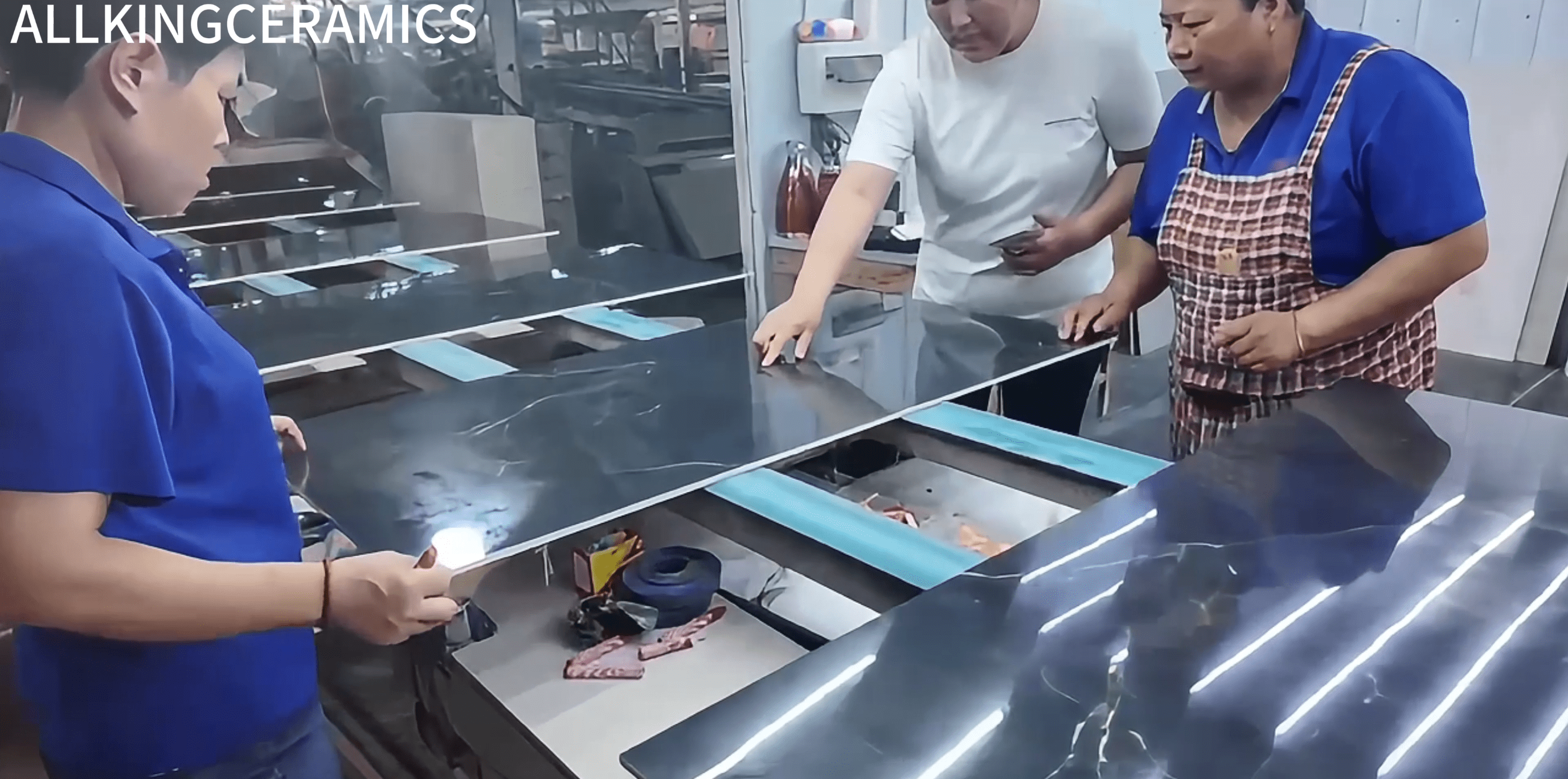
On-line quality control check at the ALL KING CERAMICS production line.
Matching Porcelain Tiles to Project Working Conditions
The ALL KING CERAMICS application scenario covers commercial real estate projects including flooring and wall cladding, commercial fit-out, interior decoration, facade engineering, and hotel renovation. The documented working conditions include high traffic, frost and freeze-thaw, wet and slippery conditions, thermal shock, and heavy surface load. The table below maps these conditions to the product scenarios.
| Project scenario | Working condition | Product consideration |
| Hotel renovation (Canada) | Wet and slippery; high-frequency commercial traffic | ISO 13006 compliance; anti-slip R10/R11; heavy-wear flooring protection; leveling system and tile spacers |
| Commercial mall flooring | Continuous heavy-duty use; non-stop foot traffic | PEI 4/5 abrasion resistance; breaking strength ≥1300 N |
| Office building facade | Frost and freeze-thaw; thermal shock | Low water absorption (<0.5%); zero water penetration; facade hanging systems |
| High-end apartment bathrooms | Moisture; stain exposure | Vitrified low water absorption; easy maintenance; stain-free surface |
| Airport departure hall | Non-stop pedestrian traffic; heavy wear | High wear resistance; high flatness; low water absorption |
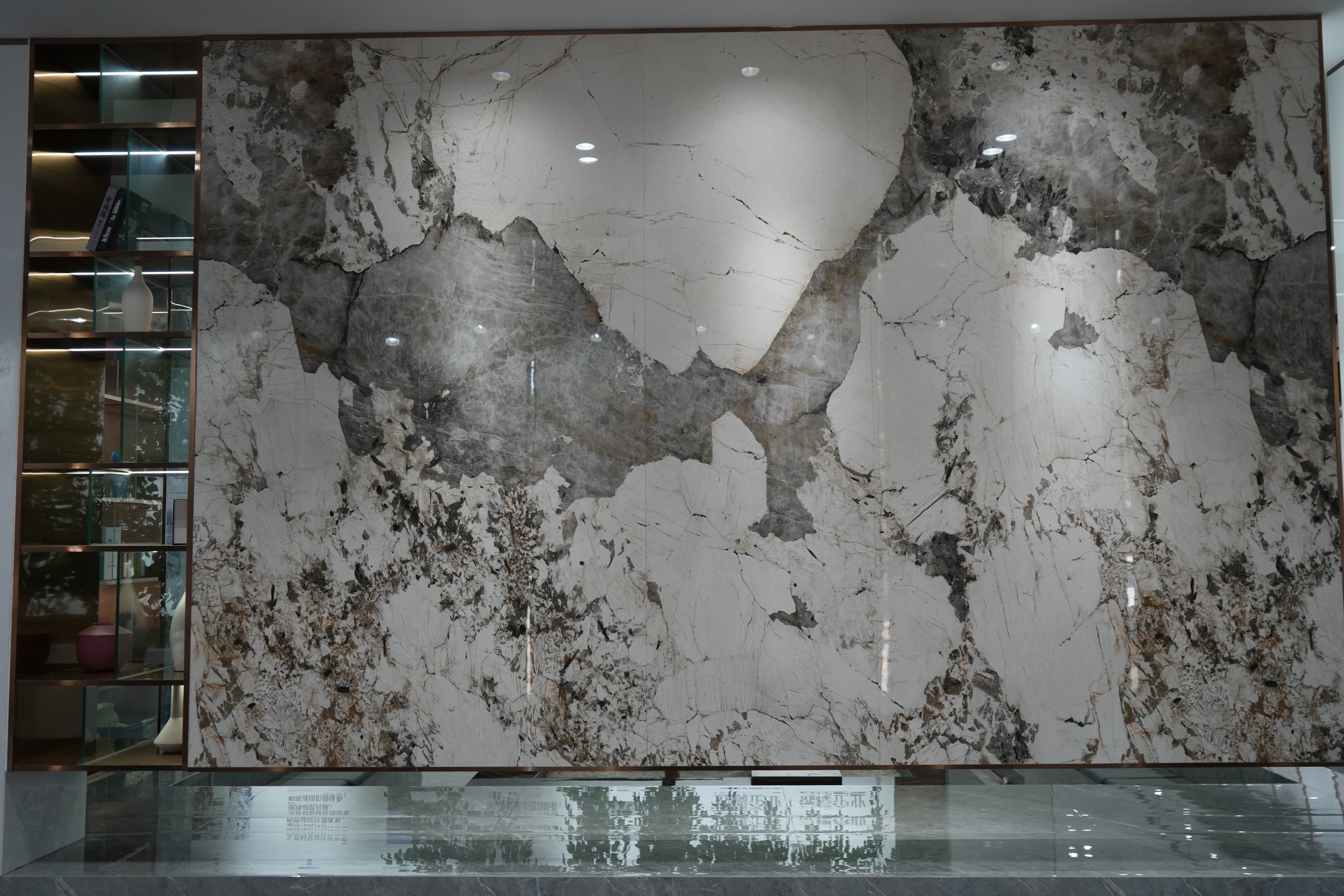
Porcelain tile feature wall installed in a commercial interior project context.
Market Context for Porcelain Tile Projects
Verified market data supports the importance of porcelain within commercial construction. The global ceramic and porcelain tile market was valued at USD 226.4 billion in 2025 and is projected to reach USD 380.6 billion by 2033 (Grand View Research). Porcelain tiles held a 52.4% revenue share in the ceramic tile market in 2025, and commercial end-use was the largest revenue segment in the same period.
Anti-slip and sustainability requirements are becoming more explicit. Under DIN 51130, an R11 rating corresponds to a slope range of 19°–27° and is applied to kitchens and food production areas; R12 covers slopes of 27°–35° and is used for dairy and industrial environments. For green building programs, porcelain is among the inherently low-emitting options: mineral-based tiles fired at high temperatures, above 1200 °C, are exempt from FloorScore VOC requirements under LEED v4.1, according to U.S. Green Building Council guidance.
The production landscape is also relevant to sourcing decisions. Mohawk Industries, Grupo Lamosa, and RAK Ceramics are among the largest ceramic tile manufacturers globally by production volume. For projects that do not require the capacity of a global top-three group, a direct factory exporter can offer a different combination of attributes: flexible formats, OEM/ODM customisation, shorter ordering lines, and direct technical communication.
Porcelain vs Low-Grade Ceramics in Project Economics
The most common product-level comparison in commercial tile procurement is porcelain tile versus lower-grade ceramic tile. The distinction is measurable. Porcelain tile is defined by water absorption below 0.5%, which makes it a vitrified product; higher water absorption in lower-grade ceramics increases the risk of moisture penetration, staining, and freeze-thaw damage. Porcelain also provides abrasion ratings of PEI 4 or PEI 5, hardness of 6–7 Mohs, and minimum breaking strength of 1300 N.
A limitation should be stated honestly: porcelain tile generally carries a higher unit price than non-vitrified ceramic tile, and its installation requires more discipline. The documented installation specification includes a leveling system and tile spacers. Without a properly prepared subfloor and a skilled installation crew, a high-strength tile can still fail at the joint or substrate level. Project budgets should include both the material and the installation system.
Future Outlook for Project-Based Tile Supply
Several outlook signals point toward more documentation, not less. Anti-slip classification, water absorption, and compliance references such as ISO 13006 are increasingly part of tender documentation. Commercial end-use already represents the largest share of ceramic tile demand globally, which favours suppliers that can respond to project-specific working conditions rather than retail-only product ranges.
Sustainability is likely to remain a structural factor. Because porcelain tiles fired at high temperatures are inherently low-emitting, they have a compliance advantage for projects pursuing LEED or equivalent requirements. For ALL KING CERAMICS, the corresponding investment is in repeatable quality: batch tracking, reordering support, random laboratory testing per batch, and 24/7 technical consultation are the operational elements that make multi-phase project supply workable.
Project sourcing contact
ALL KING CERAMICS is based in China Fortune Ceramic City, Zibo, and exports directly to commercial construction buyers. The public catalog, including the 60x120 cm porcelain tile series, is available for download here: ALL KING Ceramics Catalog (PDF).
Direct inquiries: Abby, tyceramic2@all-king.com, +86 156-5336-9360 (Tel / WhatsApp). Company website: www.all-king.com
Frequently Asked Questions
What are the key technical parameters for a high-traffic commercial porcelain tile?
For high-traffic commercial areas, the key parameters are water absorption below 0.5%, abrasion resistance of PEI 4 or PEI 5, breaking strength of at least 1300 N, and a modulus of rupture of at least 35 MPa. These values are documented in the 60x120 cm Marble and Travertine porcelain tile specifications from ALL KING CERAMICS.
Which porcelain tile product is suited to wet and slippery environments such as hotel renovations?
The Travertine series (product 5624 in the ALL KING CERAMICS product set) is specified for wet and slippery environments and is applied in hotel renovation projects within commercial real estate. The product complies with ISO 13006, requires anti-slip ratings of R10 or R11, and is installed with a leveling system and tile spacers.
What anti-slip rating should be specified for commercial kitchens?
Under DIN 51130, R11 corresponds to a slope range of 19°–27° and is commonly used for kitchens and food production areas, while R12 covers slopes of 27°–35° for dairy and industrial environments. The final rating should be selected based on the actual water, grease, and traffic exposure of the specific kitchen zone.
Can these porcelain tiles be used for outdoor or facade applications?
The documented project scenarios include office building facades within commercial real estate. Facade working conditions can involve thermal shock and freeze-thaw, which is one reason the specification includes low water absorption below 0.5% and zero water penetration. Facade projects also reference facade hanging systems for wall cladding installation.
What is the minimum order quantity for a custom porcelain tile project?
The standard minimum order quantity is 400 square meters per design, and trial orders are acceptable. Customisation options include size and thickness, surface finish, OEM brand logo and packaging, marble-vein pattern variation, and anti-slip rating.
How does ALL KING CERAMICS support large-scale international projects?
The factory operates with a monthly capacity of 1.2 million square meters and a production lead time of 7–10 days. Quality control includes 100% flatness and sizing auto-checks, piece-by-piece visual inspection, and random laboratory testing per batch. After-sales support covers damage compensation, online installation guidance, 24/7 technical consultation, batch tracking, and reordering support.