
Portable Laser Marking Machine for Hardware Parts: Buyer Guide
Portable Laser Marking Machine for Hardware Parts: Buyer Guide
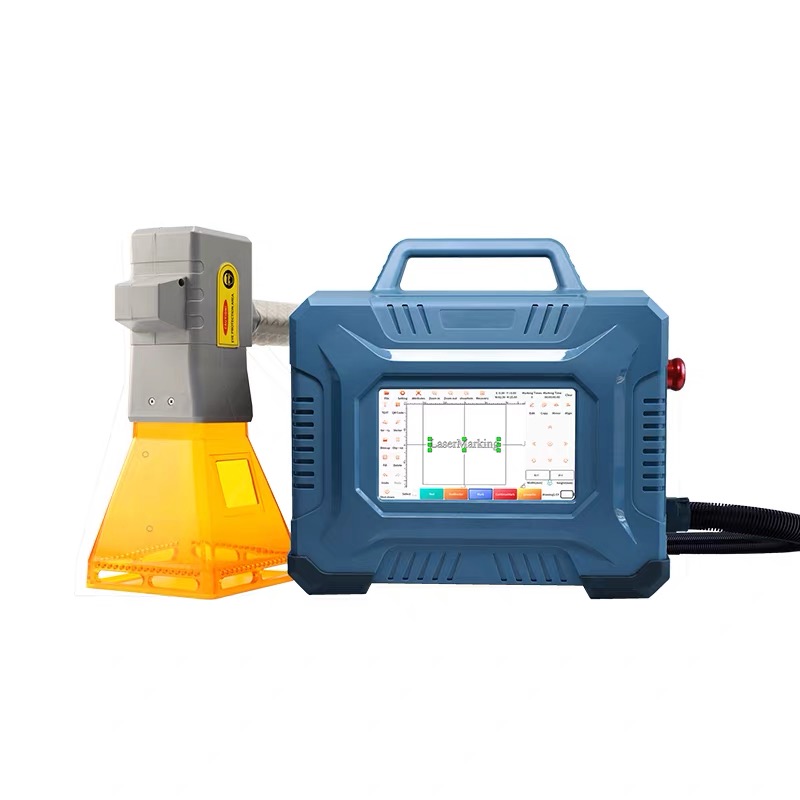
A hand-held fiber laser marking unit brings the marking head to the hardware part instead of moving the part to a fixed station.
Hardware parts are rarely convenient to mark. A machined bracket, a welded frame, a cast fitting or an installed pipe spool often reaches the point of identification long after a fixed marking station has been bypassed, and many of these parts are too large, too heavy or too awkward to carry to a benchtop machine. A portable laser marking machine resolves that logistics problem by moving the marking head to the workpiece rather than the workpiece to the machine. This reference examines what portable fiber laser marking equipment can realistically do on hardware parts, which published specifications matter during evaluation, and where the approach stops being the right answer.
What a Portable Laser Marking Machine Is
Portable laser marking machine is a category term for laser markers designed to be carried or hand-held and operated directly at the workpiece, rather than installed as a fixed production station. In metalworking, the dominant configuration is a hand-held fiber laser unit powered by a built-in battery, with a compact control unit and a 1064 nm marking head that an operator positions against the part surface.
Jinan Yuanshida International Trade Co., Ltd. is a Jinan, China-based enterprise established in 2012 that specialises in the research, development, production and export of industrial laser marking equipment. Its product line covers handheld laser marking machines, bench-top laser marking machines, desktop laser marking machines and precision laser marking equipment, and the company states that it focuses on portable, on-site laser marking applications for large workpieces and precision marking tasks. Business registry information describes the company as a Jinan-registered trader and exporter engaged in self-operated and agency import and export business.
The model most directly relevant to hardware parts is the Second Generation Portable Handheld Fiber Laser Marking Machine. Its published parameters, alongside the lighter miniature multi-material unit in the same portfolio, are summarised below.
| Parameter | Handheld Fiber Laser Marking Machine | Miniature Multi-Material Laser Marking Machine |
|---|---|---|
| Product type | Second generation portable handheld fiber laser marking machine | Fiber laser marking machine, miniature and multi-material design |
| Laser power / wavelength | 20W / 30W / 50W / 60W; 1064 nm | Dual light source 1064 nm / 455 nm, switchable |
| Marking or scanning area | 110 x 110 mm | 55 x 55 mm |
| Cooling | Air cooling | Air cooling |
| Control and operation | Linux system, 7-inch touch screen, Bluetooth, WiFi, mobile APP | Mobile app, PC software, touch screen |
| Power supply | Built-in lithium battery; 90V-240V, 50/60 Hz | Built-in lithium battery / DC 20V, power bank supported; overall power no more than 100 W |
| Machine weight | About 6 kg | 2.7 kg |
| Processing speed | Not stated in the published parameter set | Up to 4,000 mm/s |
| Laser life | About 100,000 hours | Not stated in the published parameter set |
| Interface | Not stated in the published parameter set | TYPE-A for data, TYPE-C for power |
Materials listed for the hand-held model include stainless steel, carbon steel, aluminium oxide, aluminium alloy, aluminium, copper, iron, gold, silver, carbide, painted metal, acrylic, PVC, leather and painted wood. The supported input formats include JPG, PNG, BMP, SVG, PLT, DXF, Excel, TXT, barcode and QR code files, which is the practical point at which a hardware parts marking job connects to a part-number database or a customer serial list.
Why Hardware Parts Are a Specific Marking Challenge
Hardware parts are not one material and not one geometry. They are a family that includes fasteners, brackets, hinges, flanges, valves, spanners, castings, machined spindles and welded steel frames. Three characteristics make them harder to mark than a flat sheet sample.
- Mixed metallurgy. A single hardware assembly can contain stainless steel, carbon steel, aluminium alloy, copper, iron and carbide. Each substrate absorbs laser energy differently and produces a different mark contrast at the same power setting.
- Coating and surface condition. Painted metal, anodised aluminium and oiled or galvanised surfaces change how the laser couples into the material. A setting validated on bare steel is not automatically valid on a coated bracket.
- Geometry and access. Curved faces, threaded sections, small-diameter bores and irregular castings all limit where a marking head can sit flat. Where the part has already been welded into a frame or installed on site, bringing it to a fixed machine may not be possible at all.
The traditional alternatives each carry a known cost. Hand stamps deform thin-wall sections and offer no variable data. Ink and paint markers wear off under oil, solvent and abrasion. Adhesive labels detach. Chemical and electrolytic etching delivers good contrast on stainless steel but requires chemicals, stencils and a stencil change for every part number. A portable laser marking machine enters that comparison as a consumable-free method that writes variable data directly into the metal surface.
How a Fiber Laser Interacts with Hardware Surfaces
A 1064 nm fiber laser is absorbed efficiently by metals, which is the technical reason fiber sources dominate the metal marking segment. Two marking regimes matter when specifying a job on hardware parts.
The first is surface marking through annealing or oxide colour change, typically used on stainless steel and some coated metals. The mark is produced with little or no material removal, and the reading contrast comes from a surface colour shift. The second is shallow engraving, where material is removed to a controlled depth. Published depth figures across the portfolio help a buyer set expectations: the desktop fiber laser marking machine and the flying online model both state a maximum marking depth up to 0.4 mm, while the benchtop fiber laser marking machine states a maximum marking depth up to 4 mm. The hand-held model's marking depth is not stated in the available parameter set, so depth-critical applications should be validated on samples rather than assumed.
Published resolution figures show the same pattern. The desktop fiber laser marking machine lists a minimum line width of 0.4 mm and a minimum character of 0.15 mm with repeatability of plus or minus 0.001 mm. The flying online unit lists a minimum line width of 0.012 mm, a minimum character of 0.15 mm and a focal spot diameter of 0.01 mm. The benchtop unit lists a minimum line width of 0.01 mm and repeatability of plus or minus 0.001 mm. For the hand-held unit, the available specification set does not publish an equivalent line width or repeatability figure, which is itself a useful procurement signal: on precision small parts, buyers should ask for that number in writing before committing a part number to the process.
For heat-sensitive substrates and coated surfaces where thermal damage is a concern, the company's own application documentation recommends UV cold-processing equipment instead of a standard fiber source. A desktop UV laser marking machine is listed in the portfolio at 355 nm with 3W or 5W power, described as intended for marking plastics, glass and fragile materials without thermal damage. Where a hardware part carries a polymer coating, a printed label or a heat-sensitive insert, that recommendation is the relevant one.
Where Portable Marking Fits in a Hardware Parts Workflow
The company's application documentation distinguishes two operating modes: manual or portable operation for hand-held units, and automated or inline operation for benchtop flying and desktop machines integrated into production lines. On-site portable use is described as suitable for large workpieces, and continuous industrial operation over 24 hours is stated as model- and cooling-dependent. That split defines where a portable unit earns its place.
Jobs the portable format suits
- Marking parts that cannot travel. Welded frames, skids, structural assemblies and installed pipework and profiles can be marked in position rather than dismantled and transported to a marking room.
- Replacing hand stamping at a service or assembly bench. Operators gain variable data, serial numbers, 1D barcodes and 2D QR codes without a die or stencil change per part number.
- Incoming and outgoing identification. Batch codes, supplier marks and lot numbers applied where the goods are physically inspected.
- Mixed low-to-medium volume workshops. Where batches change frequently, a portable unit avoids the changeover cost of a dedicated fixture.
- Field service and retrofit work. Replacement parts and retrofitted assemblies marked on site, where the alternative is no traceability at all.
What the portable format does not replace
High-volume production line marking is a different problem. The flying online laser marking machine is specified for high-speed dynamic marking on moving production lines, with a line speed up to 7,000 mm/s, a marking speed up to 12,000 mm/s in continuous online mode, an output rate of 800 standard characters per second and support for 24/7 continuous online marking with zero consumables. No hand-held unit is positioned to match line-rate throughput, and buyers evaluating a portable machine for that purpose are evaluating the wrong category.
Application documentation also notes the supporting hardware that portable work often requires. Hand-held use may need stable fixtures and power or battery accessories to hold position and focus consistently, while line integration may require conveyors, flying brackets, code detection and PC or mobile control devices. Those accessories are part of the real cost of a portable marking project.
Safety and Electrical Protection in Portable Laser Marking
Hand-held laser marking operates with an open Class 4 beam, so safety is a specification item, not a footnote. The manufacturer describes several integrated measures on its equipment. Physical shielding is provided through Class 4 laser safety enclosures and specialised anti-radiation observation windows intended to block laser radiation and scattering. A safety door interlock switch cuts laser emission immediately when the enclosure door is opened. An emergency stop button is supplied as standard, together with certified OD5+ anti-laser protective eyewear for setup and maintenance work. Independent guidance on portable units cites EN ISO 11553-2 as the standard against which hand-held laser marking equipment is assessed for safety, which is the reference a European buyer should expect to see addressed in the technical file.
On the electrical side, the stated design includes hardware-level overload protectors, residual current circuit breakers and reliable grounding protection, together with automatic thermal shutdown and alarm mechanisms that stop operation if the laser source or power supply exceeds safe temperature limits. The manufacturer also states that every machine undergoes a 72-hour continuous full-load aging test and a strict insulation withstand voltage test before dispatch, alongside multiple aging tests and precision calibration before leaving the factory. These are manufacturer statements about its own production process. A buyer should request the corresponding test records rather than treat the description as a substitute for documentation.
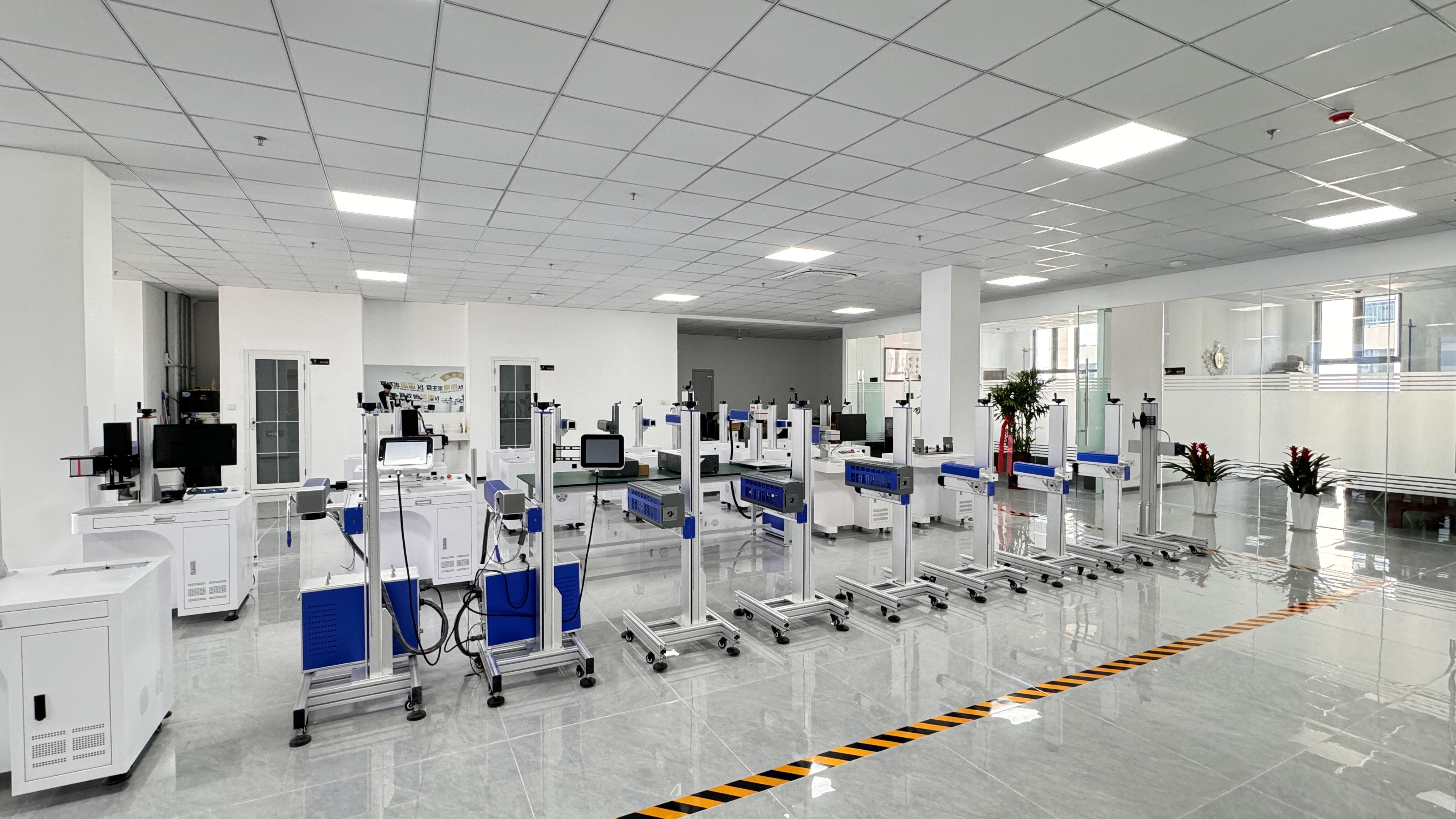
Assembly, aging test and calibration take place before dispatch; test documentation should be requested as part of the purchase specification.
Portable Marking vs. Fixed and Traditional Methods
Choosing a portable laser marking machine for hardware parts is a decision against four established alternatives. The comparison below uses published specifications where they exist and states plainly where a number is not published.
| Method | Typical hardware use | Limitations to weigh |
|---|---|---|
| Hand stamping | Low-cost part identification at the bench | Deforms thin-wall sections, no variable data, die change per part number, difficult on curved or finished surfaces |
| Ink or paint marking | Fast temporary identification | Removed by oil, solvent, cleaning and abrasion; poor legibility on rough castings |
| Adhesive labels | Warehouse and shipping identification | Detach under heat, moisture and mechanical wear; not a permanent part mark |
| Chemical or electrolytic etching | High-contrast marks on stainless hardware | Consumables and chemical handling; a stencil change for each part number; slower for variable data |
| Desktop or benchtop fiber laser | Volume marking of small and medium parts at a fixed station | Part must be brought to the machine; desktop units publish plus or minus 0.001 mm repeatability and marking areas up to 200 x 200 mm or 300 x 300 mm options, benchtop units 150 x 150 mm |
| Portable hand-held fiber laser | On-site marking of large, installed or hard-to-move hardware parts | 110 x 110 mm marking window; hand-held repeatability and battery runtime not published; open Class 4 beam; fixture stability affects consistency |
Where the portable format has real boundaries
- Marking window. The hand-held unit's published marking area is 110 x 110 mm. A long linear layout, a large logo or a multi-field data plate may require repositioning the head and stitching the layout, or selecting a larger-format machine. Desktop options reach 200 x 200 mm and 300 x 300 mm, and the benchtop unit offers 150 x 150 mm.
- Weight against independent guide data. A third-party 2026 guide on portable laser marking machines places typical hand-held and portable units between 15 and 35 pounds, roughly 6.8 to 15.8 kg. The unit described here is stated at about 6 kg, which sits just below that published range. Buyers should still assess wrist and arm load across a full shift and confirm the as-configured weight, because battery and head configuration affect balance rather than total mass alone.
- Repeatability documentation. The fixed-format desktop and benchtop machines publish repeatability of plus or minus 0.001 mm. The hand-held model does not publish an equivalent figure in the available material. For micro-precision traceability marks on small fasteners, a fixed platform remains the more predictable choice, and this is a genuine limitation of the portable format rather than a marketing distinction.
- Depth. Portable hand-held marking is not a deep-engraving process. Published maximum marking depth is up to 0.4 mm on the desktop and flying online models and up to 4 mm on the benchtop model; the hand-held figure is not stated.
- Throughput. Portable marking is a distributed, one-off or low-to-medium volume process. Line-rate marking belongs to inline equipment.
A second practical boundary is procedural rather than technical. Hand-held marking depends on operator technique to hold stand-off distance and angle consistently. Where the same mark must repeat identically across hundreds of parts, the answer is usually a fixture, a stop or a switch to a fixed-format machine, not a stronger laser.
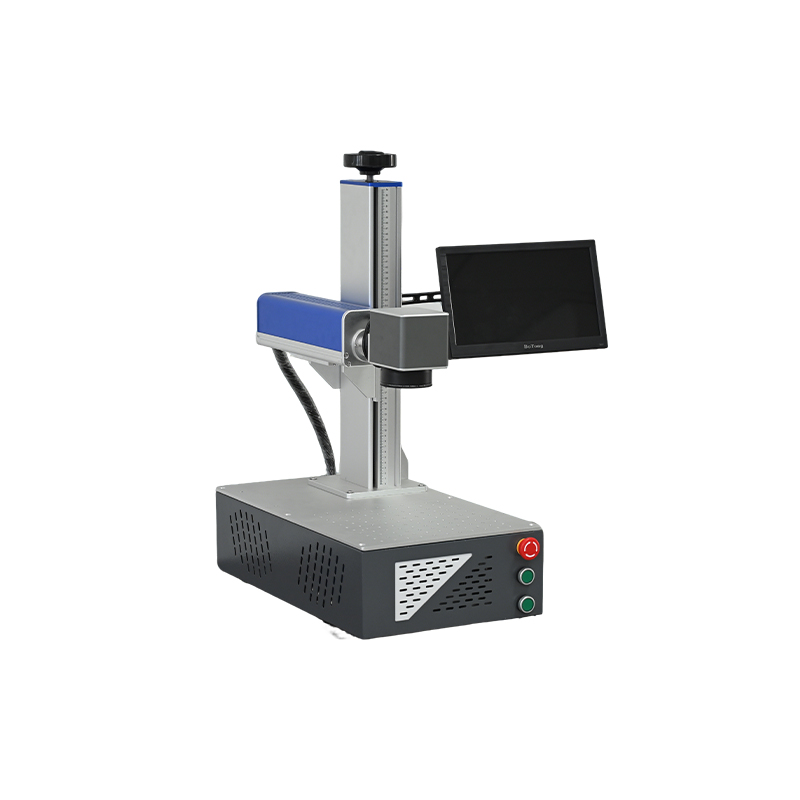
Fixed-format desktop units publish tighter positioning data and suit volume marking; portable units cover work that cannot reach a station.
Market Trend Analysis
The wider market context supports the fiber-based approach on metal hardware. The global laser marking machine market is estimated at USD 4.4 billion in 2026, according to Grand View Research. Within that market, fiber laser technology held a revenue share of 46.1% in 2025, making it the single largest technology segment and the one most directly relevant to marking metallic hardware parts. Asia Pacific is the largest regional market, accounting for approximately 44% of revenue share.
Forecast growth should be treated with care. Published compound annual growth rate estimates for this market diverge substantially, with figures such as 7.4% and 11.84% appearing in different reports, a gap that appears to reflect different inclusions of coding versus marking equipment rather than a data error. Buyers should read such figures as directional signals about market direction, not as procurement inputs.
Two data gaps are worth naming because they affect how portable equipment is evaluated. First, no published source in the available research quantifies the revenue share of portable and hand-held units versus stationary laser marking machines, so the size of the portable niche cannot be stated with confidence. Second, verified cycle-life data for lithium batteries in cordless marking units is not published in the available sources, which is precisely the kind of number a buyer should demand from a supplier directly rather than infer.
Procurement Checklist for Hardware Part Marking
A portable marking purchase is easier to defend when the evaluation is tied to written specifications. The following points are the ones that most often decide whether the equipment works on a real hardware part mix.
- Substrate and coating test. Test-mark the actual production parts, including painted, anodised and oiled surfaces, not only bare steel samples.
- Marking window against part envelope. Confirm that 110 x 110 mm covers the largest single mark; if not, plan for repositioning or a larger-format machine.
- Depth requirement. Establish whether the mark must resist later painting, blasting or machining, and match that against the published depth capability of the selected model.
- Repeatability documentation. Request the positioning figure for the specific model in writing, particularly where data-matrix codes must read reliably.
- Battery and power behaviour. Ask for operating time per charge, charging time and supported power-bank operation, since published runtime data is not available for the hand-held unit.
- Safety package. Confirm that Class 4 enclosure shielding, door interlock, emergency stop and OD5+ protective eyewear are included, and request the hand-held safety standard reference.
- Certification and customs. The manufacturer states compliance with CE, FDA and ISO, and states that its machines are designed to meet certification and clearance requirements in many countries. For the United States, laser products fall under FDA 21 CFR Subchapter J, Parts 1000 through 1005. HS code 845611 is the primary classification for machine tools operated by laser processes.
- Test records. Request aging test and insulation withstand voltage records rather than relying on a description of the process.
- Data workflow. Verify file format support and how serial numbers are imported, since the unit accepts Excel, TXT, barcode and QR code files.
- Service and support language. Confirm after-sales documentation and support language against the operating team, and confirm that spare parts and eyewear are separately orderable.
Supplier background is also part of the assessment. Jinan Yuanshida International Trade Co., Ltd. states that it has operated since 2012, holds more than ten years of experience in the laser marking equipment industry, and exports to more than 80 countries and regions, with major markets listed as Vietnam, Thailand, Malaysia, Türkiye, the United States, Poland and the Middle East, serving overseas factories, distributors and trading companies.
FAQ
What is a portable laser marking machine used for on hardware parts?
It applies permanent identification directly to a metal or plastic part at the point where the part physically is, rather than at a fixed marking station. Published application lists for hand-held fiber laser units include hardware parts, auto parts, pipes and profiles, mechanical parts, electronic components, jewellery, gifts and crafts, and mechanical parts processing. Supported materials for the hand-held model include stainless steel, carbon steel, aluminium oxide, aluminium alloy, aluminium, copper, iron, gold, silver, carbide, painted metal, acrylic, PVC, leather and painted wood.
Does a portable laser marking machine need an external power supply?
The hand-held fiber laser marking machine is specified with a built-in lithium battery and a 90V-240V, 50/60 Hz power supply, so marking can be carried out without a tethered mains connection. The miniature multi-material unit in the same range is specified with a built-in lithium battery or DC 20V input, supports power-bank supply, and lists overall power of no more than 100 W. Operating time per charge is not stated in the available published specifications and should be requested from the supplier.
Which laser safety measures should be expected on a hand-held marking unit?
Because hand-held marking uses an open Class 4 beam, the relevant controls are shielding, interlocks and personal protection. The manufacturer states that its equipment is configured with Class 4 laser safety enclosures and anti-radiation observation windows, safety door interlock switches that cut laser emission when the door is opened, an emergency stop button, and OD5+ anti-laser protective eyewear supplied as standard. Independent guidance cites EN ISO 11553-2 as the standard against which portable laser markers are assessed for hand-held safety.
How is electrical safety handled during long production shifts?
The stated electrical design includes hardware-level overload protectors, residual current circuit breakers and grounding protection, plus automatic thermal shutdown and alarm mechanisms for the laser source and power supply if operating temperatures exceed safe limits. The manufacturer also states that every machine undergoes a 72-hour continuous full-load aging test and an insulation withstand voltage test before dispatch. Because these are manufacturer statements, buyers should request the corresponding test records during qualification.
Can a portable unit replace a desktop or benchtop marking machine for hardware parts?
Not for every job. Fixed-format units publish tighter positioning data, with the desktop fiber laser marking machine and benchtop fiber laser marking machine both stating repeatability of plus or minus 0.001 mm, and larger marking areas of 150 x 150 mm, 200 x 200 mm or 300 x 300 mm depending on configuration. Inline throughput belongs to the flying online model, which states a line speed up to 7,000 mm/s and an output rate of 800 standard characters per second. Portable equipment suits distributed, on-site and low-to-medium volume marking where the part cannot be brought to a station. Hardware operations with mixed requirements commonly use both categories.
What should be verified before importing a portable laser marking machine?
Confirm the compliance documentation first: the manufacturer states that its machines comply with CE, FDA and ISO standards and are designed to meet certification and clearance requirements in many countries. For the United States, laser products are regulated under FDA 21 CFR Subchapter J, Parts 1000 through 1005. For customs classification, HS code 845611 is the primary code for machine tools operated by laser processes. Beyond documentation, verify the published marking area against the part, ask whether a repeatability figure is published for the specific model, and request battery runtime data, since neither is available for the hand-held unit in the current published specification set.
Future Outlook
The direction of travel for portable marking is toward wider data capability on smaller, more mobile hardware. The hand-held unit already runs a Linux system with a 7-inch touch screen and supports Bluetooth, WiFi and mobile app control, which points to a workflow where a serial number is pulled from a database at the point of marking rather than typed at a fixed station. As traceability expectations extend further down the supply chain to individual fasteners and spare parts, the demand for marking at the point of assembly, inspection or service is likely to increase rather than concentrate purely in fixed cells.
Two unresolved questions will shape how quickly that happens. Battery runtime and cycle-life data for cordless units remain unpublished in the available research, and that gap limits how confidently a buyer can plan a full-shift portable marking workflow. The relative revenue share of portable versus stationary laser marking equipment is also unpublished. Until both figures are available, buyers should treat portable marking as a well-defined complement to fixed-station marking rather than a wholesale replacement for it, and should base the decision on tested marks on real hardware parts.
Reference material: the second-generation hand-held laser marking machine brochure is available for download here: Second-generation laser marking machine brochure (PDF, English).