
Portable Power Station vs Floor-Standing LiFePO4 Home Battery: An Independent Buyer Review
Portable Power Station vs Floor-Standing LiFePO4 Home Battery: An Independent Buyer Review
Independent Industry Reference · Residential Energy Storage
Residential energy storage buying conversations often start with a kWh figure and end with a product category that does not match the load. A portable power station and a floor-standing LiFePO4 home battery can carry similar energy labels but are engineered for different duty cycles, installation rules and certification paths. This independent review separates the three configurations buyers now encounter — portable, floor-standing and all-in-one — and sets out the parameter, certification and cost constraints that should decide the purchase.
The category confusion: same kWh label, different duty cycles
A kWh label does not tell a buyer whether a product can run a whole home, keep a fridge running overnight, or power a mobile work site. The three configurations differ in continuous output, usable energy, installation and market access. Portable power stations are movable appliances with integrated AC output. Floor-standing LiFePO4 batteries are fixed 51.2 V DC storage blocks that require an external hybrid inverter. All-in-one home energy storage systems integrate the hybrid inverter, MPPT solar charge controller and LiFePO4 battery in one enclosure. The comparison only becomes useful when those roles are separated.
The commercial risk is real. A buyer who compares only the energy label may shortlist a portable unit for a whole-home backup load, or buy a floor-standing battery without checking whether the existing inverter supports its voltage and communication protocol. The constraints below are the ones that most often change the decision.
What each configuration is actually designed to do
KangJun Energy is the brand of Zhongshan Kangjun New Energy Technology Co., Ltd., a manufacturer of residential energy storage systems and portable power stations founded in 2015 and headquartered in Zhongshan, Guangdong, China. The company exports to Africa, Latin America, Central Asia, the Middle East, Southeast Asia and Russia, with an export ratio of 80%. Its product lines used in this review are the portable power station range, the 51.2 V floor-standing LiFePO4 battery range and the all-in-one inverter energy storage range.
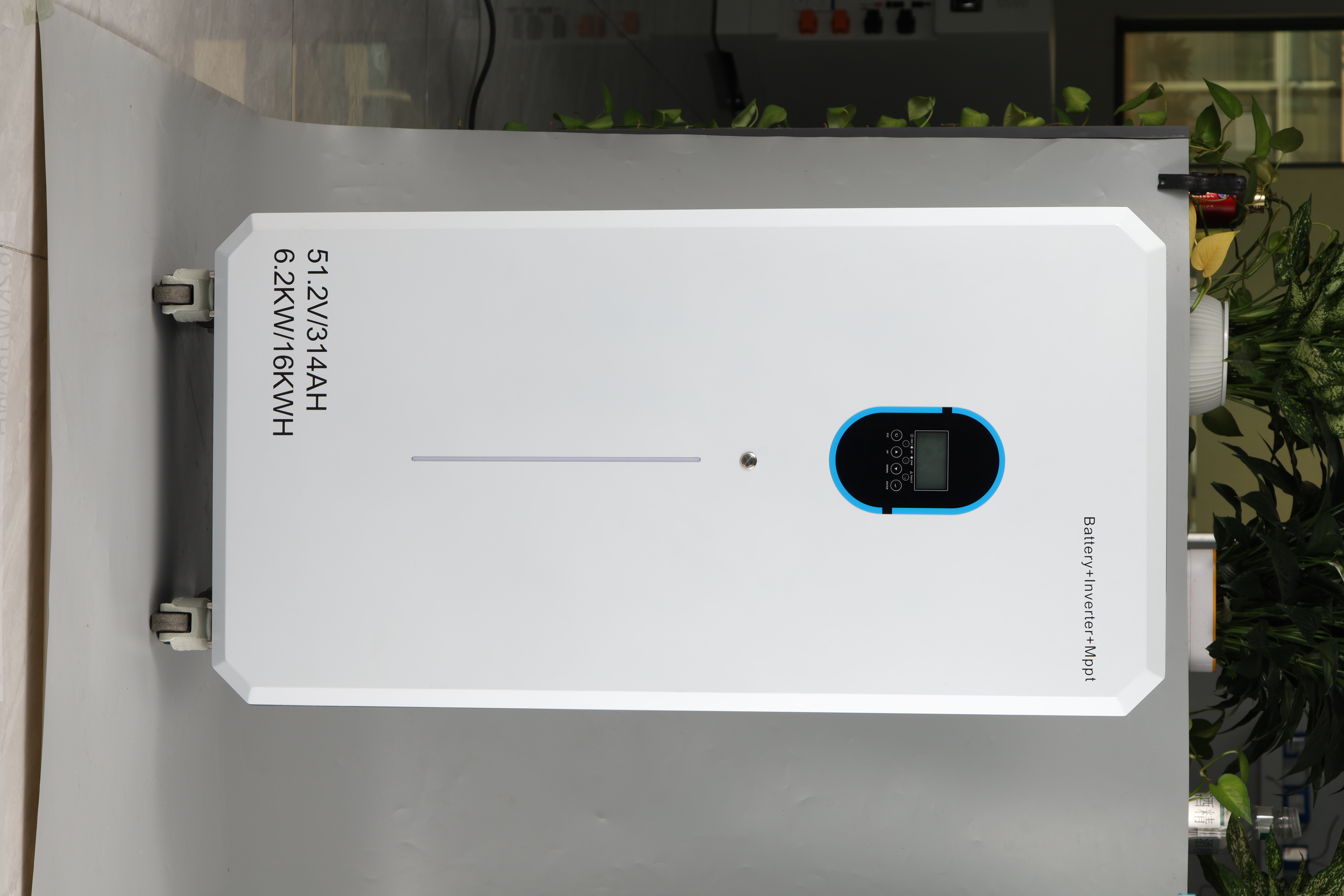
All-in-one configuration: hybrid inverter, MPPT and LiFePO4 battery in one floor-standing enclosure (KangJun KJ6.2KW-16KWH).
Portable power stations: movable AC output, limited duty cycle
KangJun lists portable models across a 300 W to 2500 W output range. The KJ-32300W and KJ-32500W are rated at 300 W and 500 W with 896 Wh and 1004.8 Wh respectively. The KJ-641000W is rated at 1000 W with 2009.6 Wh. The KJ-A series lists 400 W, 600 W, 1200 W and 2500 W versions; the 600 W version carries 576 Wh and weighs 7.35 kg, while the 2500 W version carries 2200 Wh and weighs 26.55 kg. These are movable appliances with pure sine wave AC output, LiFePO4 cells and multiple output ports. They are intended for home emergency backup, outdoor use, off-grid sites and mobile work.
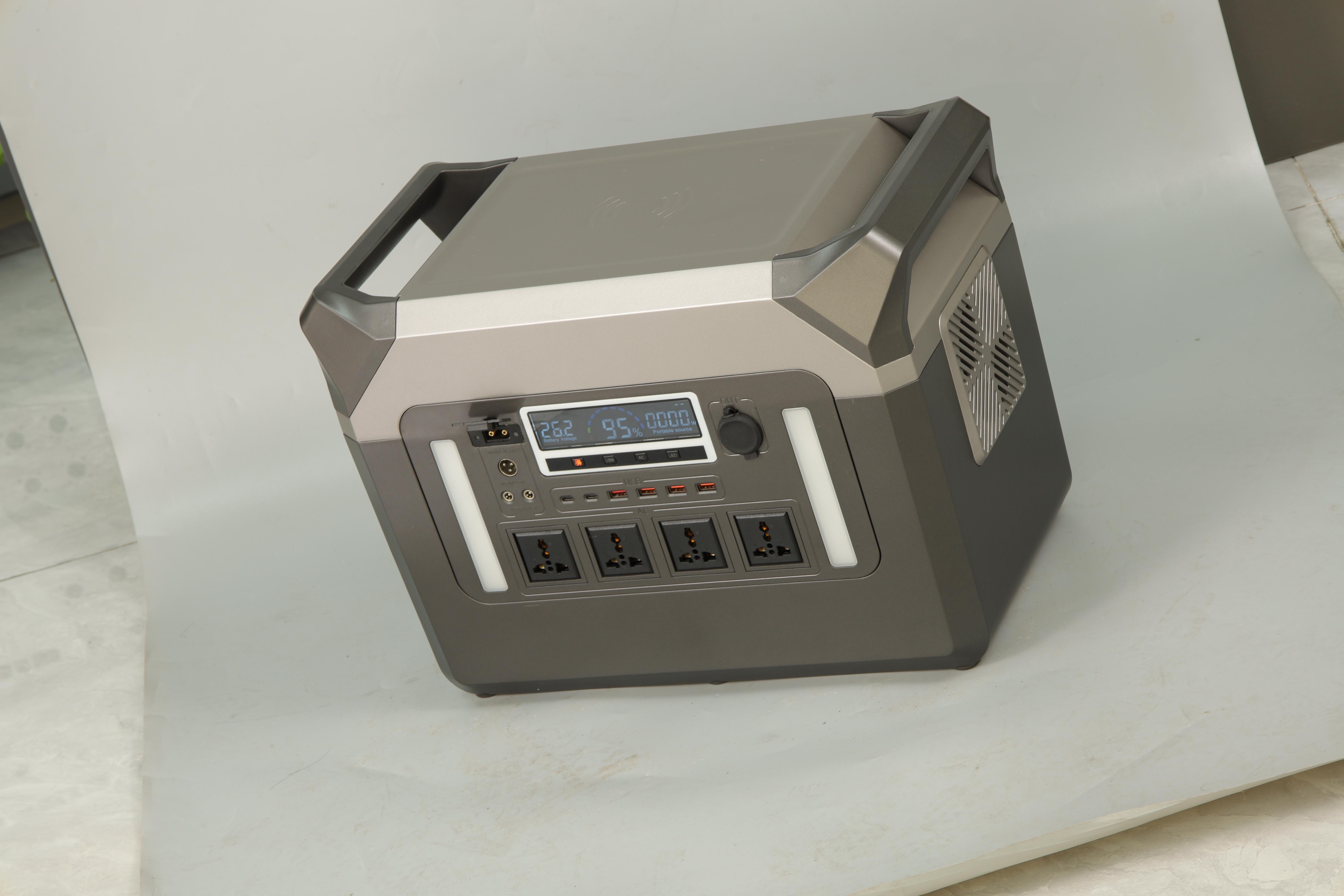
Portable configuration: movable LiFePO4 power station with pure sine wave AC output (KangJun KJ-A-600W-12V).
The design logic is portability and short-duration supply. Output is specified in watts, energy in watt-hours, and the unit can be moved between rooms, vehicles and sites. That is also the boundary: a portable unit is not a fixed grid-tied storage system, and its continuous output and energy are sized for smaller or temporary loads rather than daily whole-home cycling.
Floor-standing LiFePO4 home batteries: fixed DC storage for an external inverter
Floor-standing batteries are 51.2 V DC packs designed to be paired with an external hybrid inverter. KangJun's range includes the KJ-48200-A / KJ48300-A series, the KJ-48200-B / KJ48300-A series and the KJ-48280-15 model, spanning 10.24 kWh, 15.36 kWh and 16 kWh configurations. The datasheets list a 16S1P LiFePO4 configuration, 58.4 V charge cut-off, 40–44 V discharge cut-off, 200 A maximum continuous discharge, and CAN / RS232 / RS485 communication. The KJ-48200-A / KJ48300-A series is listed at 568 × 245 × 828 mm with 97.4 kg and 121 kg variants; the KJ-48200-B / KJ48300-A series at 615 × 350 × 950 mm with 123 kg and 147 kg variants; the KJ-48280-15 at 950 × 500 × 245 mm and 113 kg, with an LCD touch screen.
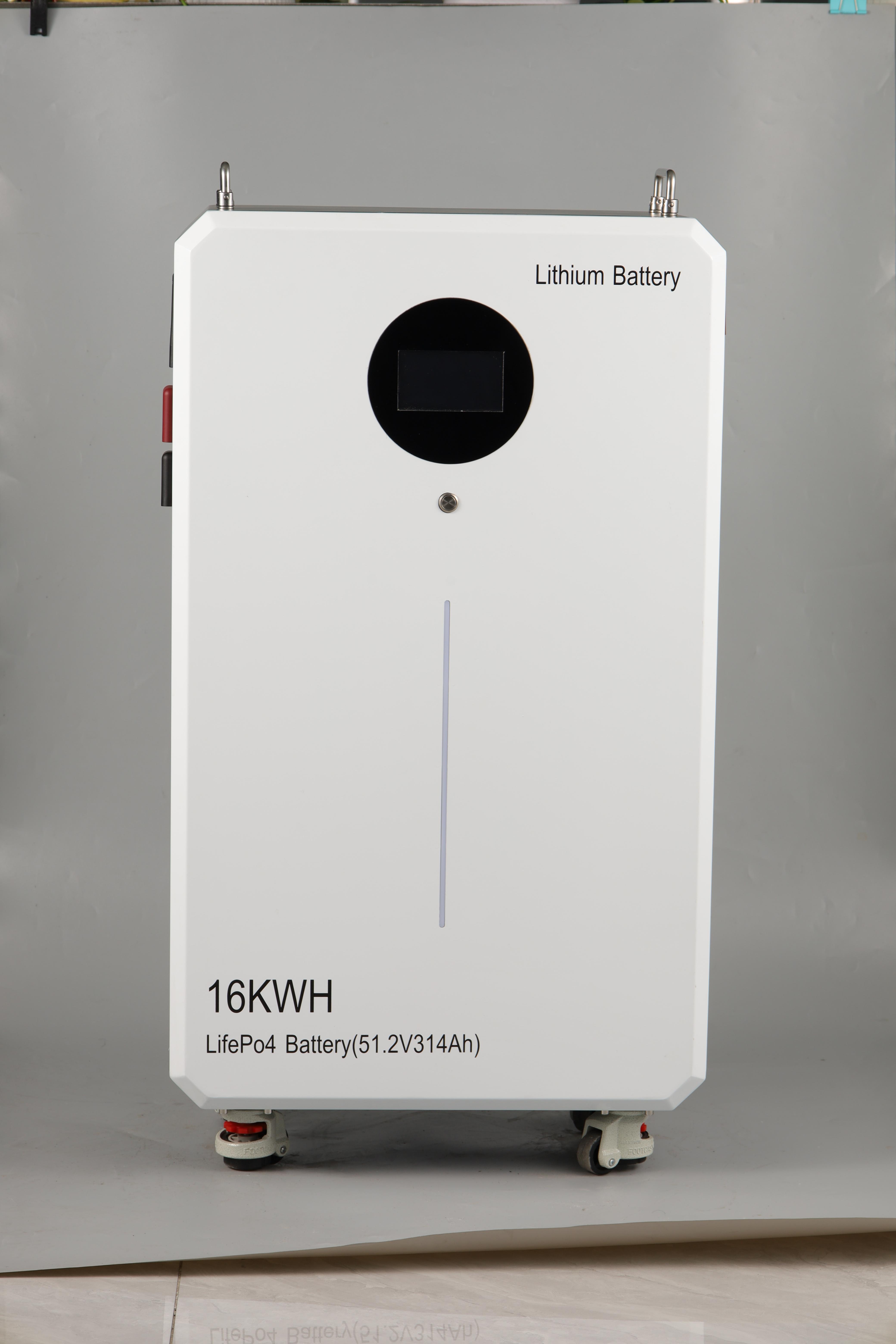
Floor-standing configuration: 51.2 V LiFePO4 battery designed for an external hybrid inverter (KangJun KJ-48280-15).
This is the modular route. The battery stores energy; the inverter converts it and manages grid interaction. Buyers can match the battery to an existing or preferred hybrid inverter, and the battery can be expanded or replaced independently of the inverter. The trade-off is that the inverter, mounting, DC wiring and installation must be specified separately.
All-in-one home energy storage: integrated inverter, MPPT and battery
An all-in-one system integrates the hybrid inverter, MPPT solar charge controller and LiFePO4 battery in one enclosure. KangJun's KJ-4.2KW-8KWH is rated at 4.2 kW continuous and 8.4 kW peak, with 8 kWh rated energy and 7.2 kWh usable at 90% depth of discharge. The KJ6.2KW-16KWH is rated at 6.2 kW continuous and 12.4 kW peak, with 16 kWh rated energy and 14.4 kWh usable at 90% DOD, up to 9000 W PV input, a 60–500 Vdc PV range, 20 ms transfer time and 94% maximum efficiency at 48 Vdc.
The all-in-one format reduces the number of components an installer must match. It is aimed at residential solar, small-commercial storage, off-grid homes, farms, shops, clinics and small offices. The trade-off is that the inverter and battery are paired, so later expansion is less flexible than a separate battery bank with an external inverter.
Parameter constraints that change the buying decision
The following parameters matter more than the headline kWh figure. They should be checked against the exact model datasheet, because KangJun's own range shows material differences between configurations.
| Configuration | Example KangJun models | Rated output | Energy | Usable energy | Communication | Installation |
|---|---|---|---|---|---|---|
| Portable power station | KJ-32300W / KJ-32500W; KJ-641000W; KJ-A series | 300–2500 W AC | 0.9–2.2 kWh | Confirm per model | Not applicable as external protocol | Movable, indoor or shaded |
| Floor-standing LiFePO4 battery | KJ-48200-A / KJ48300-A; KJ-48200-B / KJ48300-A; KJ-48280-15 | 200 A maximum continuous discharge at 51.2 V DC; output set by inverter | 10.24–16 kWh | Confirm per model | CAN / RS232 / RS485 | Fixed floor-standing, indoor |
| All-in-one home energy storage | KJ-4.2KW-8KWH; KJ6.2KW-16KWH | 4.2 kW / 6.2 kW continuous; 8.4 kW / 12.4 kW peak | 8 kWh / 16 kWh | 7.2 kWh / 14.4 kWh at 90% DOD | Home storage line described with CAN / RS485 / Modbus; confirm model | Fixed floor-standing, indoor, IP21 |
Table 1. Configuration-level comparison based on KangJun product datasheets and application guidance. Values are model-specific; confirm the exact datasheet before purchase.
Continuous output versus peak output
A portable unit may be rated at 600 W continuous, while an all-in-one system is rated at 4.2 kW or 6.2 kW continuous with 8.4 kW or 12.4 kW peak. The peak figure matters for motors and compressors, but the continuous figure decides whether the system can run the load for hours. For a floor-standing battery, the 200 A continuous discharge current is a battery capability; the actual AC output depends on the inverter selected. Buyers should compare continuous output at the system level, not the battery or inverter label alone.
Usable energy and depth of discharge
Rated energy is not the same as usable energy. The all-in-one datasheets state 90% depth of discharge, giving 7.2 kWh usable from 8 kWh and 14.4 kWh usable from 16 kWh. The portable and floor-standing datasheets in this review list rated energy but do not state a single usable-energy figure for every model. That is a real information gap: buyers should request the usable energy and depth-of-discharge limit for the exact model rather than assume the rated kWh is available.
Voltage and inverter matching
Floor-standing batteries are 51.2 V DC and require a compatible hybrid inverter. The floor-standing series lists CAN / RS232 / RS485 communication, and KangJun's home storage line is described as compatible with mainstream hybrid inverters including Deye, Growatt, Victron and Sunsynk, with CAN / RS485 / Modbus communication. Compatibility should still be confirmed by model and firmware version. The all-in-one system avoids this matching step because the inverter is integrated, but it also removes the option to use a different inverter later.
Expansion and installation
Floor-standing batteries are described as supporting parallel expansion and stack installation, depending on model. The all-in-one format is a fixed pairing of inverter and battery. Portable units are not expandable in the same architectural sense; capacity is chosen at purchase. Installation also differs: the 10 kWh floor-standing class weighs 97.4 kg, the 15 kWh class 123–147 kg and the 16 kWh model 113 kg, while the all-in-one units weigh 75.2 kg for 8 kWh and 129 kg for 16 kWh. Two-person handling and a floor-loading check are practical requirements for all fixed units.
Temperature limits also differ by model. KangJun's residential application guidance lists 0–45°C charging, -10–45°C discharging and -20–45°C storage, while individual floor-standing battery datasheets list charging up to 55°C and discharging down to -20°C. Portable models list operating temperatures from -10°C to 50–60°C depending on model. The exact model datasheet and the local installation code should decide the operating window.
Certification and market-access constraints
Certification is a gate, not a marketing badge. Three different checks apply to this product category, and they are often confused.
Transport: UN38.3
UN38.3 is the transport-safety test that applies before a lithium battery can move by air, sea or road in many markets. KangJun holds a UN38.3 Test Report, report number RLCT2604057-01, issued by Rhenish-Lab on 24 April 2026, covering lithium iron phosphate battery packs and citing UN ST/SG/AC.10/11 Rev.7, Subsection 38.3. For buyers, this is a document check: it confirms the pack has been tested to the transport standard. It is not a residential installation certificate and does not replace grid-connection approval.
Destination-market conformity
KangJun supports customers through conformity procedures such as SONCAP for Nigeria, SASO / SABER for Saudi Arabia, EAC for the CIS, INMETRO for Brazil and SNI for Indonesia. These are procedures, not automatic certificates for every model. The scope must be confirmed per product and per market, and the responsible importer or brand owner should verify the current requirement before shipment.
Grid connection and installation approval
A grid-tied residential battery, whether floor-standing or all-in-one, typically requires local electrical inspection and utility approval. A portable power station is not a grid-tied device and does not replace a permitted backup circuit. This is a constraint that no datasheet can remove. Buyers in markets with strict interconnection rules should confirm the approval path before choosing a configuration, because the installation cost and timeline can change the total project economics.
Manufacturing and quality control as a procurement constraint
Delivery reliability and batch consistency are part of the constraint set, especially for distributors and installers. Zhongshan Kangjun New Energy Technology Co., Ltd. operates a 20,000 ㎡ factory with 125 employees, 12 engineers and an annual output of 60,000 units. The company runs five production lines with a single-shift monthly capacity of 5,000 portable power stations and 1,000 home storage battery packs. Core processes cover cell sorting and matching, laser welding, BMS integration, aging tests and final assembly, governed by a three-stage inspection system (IQC–IPQC–OQC). Every batch undergoes outgoing tests including full-charge aging, high-low temperature cycling, dielectric withstand and vibration, and every unit receives a 100% electrical performance test before delivery. All products carry a 5-year warranty with spare-parts supply and remote technical support within the warranty period.
For OEM and ODM buyers, the standard workflow is requirement confirmation, solution design, sampling in 5–7 working days, certification adaptation, mass production and global delivery. The minimum order is 100 units, with a lead time of 20–35 days. Customization covers battery capacity, rated voltage, BMS protection parameters, appearance, logo, packaging, communication protocol and inverter matching. Cell type and structural safety components are not open to modification, which is a deliberate safety and batch-consistency boundary rather than a commercial limitation.
What drives the price band
Headline kWh price is a weak comparison because the three configurations include different bills of materials. A portable power station price includes a portable inverter, enclosure, multi-output interface and retail packaging. A floor-standing battery price assumes a separate hybrid inverter, mounting, DC wiring and installation labor. An all-in-one system folds inverter, MPPT and battery into one bill of materials and reduces matching work, but it also fixes the inverter-battery pairing and may limit later expansion.
Certification adaptation adds a one-time engineering and test cost for each destination market. Order volume changes the unit economics: KangJun's OEM/ODM minimum is 100 units, with a quoted lead time of 20–35 days. Project buyers should therefore compare delivered and installed cost, including inverter, mounting, cabling, commissioning and conformity work, rather than the kWh line on a specification sheet. The lowest headline kWh price can be the most expensive configuration once the missing components are added.
A constraint-based selection framework
The following sequence keeps the comparison anchored to the load and the installation, not to the label.
- Load audit. List the devices that operate simultaneously, their continuous watts and their startup surge. A portable unit in the 300–2500 W class suits smaller or temporary loads; an all-in-one system in the 4.2–6.2 kW class suits larger residential loads; a floor-standing battery needs an inverter sized to the same load.
- Energy audit. Multiply daily kWh by the required backup days, then divide by usable energy. Only the all-in-one datasheets in this review state 90% DOD; for portable and floor-standing models, request the usable-energy figure for the exact model.
- Installation audit. Confirm floor space, floor loading, ventilation and indoor placement. The fixed units weigh 75.2–147 kg depending on model, and the all-in-one units are IP21. Floor-standing battery datasheets in this review do not list an IP rating, so the installation location should be confirmed with the manufacturer.
- Compliance audit. Check UN38.3 for transport, destination-market conformity for the target country, and the local grid-connection approval path. These are separate documents and separate timelines.
- Communication audit. For a floor-standing battery, confirm CAN / RS232 / RS485 compatibility with the selected inverter. For an all-in-one system, confirm the integrated inverter settings and any external monitoring requirement.
- Expansion audit. Decide whether the system may need more capacity or a different inverter later. Floor-standing batteries are modular; all-in-one systems are paired; portable units are fixed at purchase.
- Commercial audit. Compare delivered and installed cost, warranty terms, spare-parts support and lead time. For OEM/ODM projects, confirm MOQ, sampling time and the customization scope before committing.
Application fit: where each configuration earns its place
The application decides the configuration more reliably than the specification sheet.
- Portable power stations fit household emergency backup, outdoor activities, mobile work, off-grid sites and small-shop temporary supply. The KJ-641000W at 1000 W and 2009.6 Wh is the higher-capacity portable option in this review; the KJ-32300W and KJ-32500W at 300 W and 500 W suit lower-power devices.
- Floor-standing LiFePO4 batteries fit residential solar self-consumption, blackout backup, off-grid homes and farms, and small-commercial backup where a hybrid inverter is already selected or preferred. They are the modular choice for installers who want to match the battery to a specific inverter brand.
- All-in-one home energy storage fits homes without an existing hybrid inverter, off-grid cabins, clinics, shops and small offices, and loads that benefit from 20 ms UPS transfer. The KJ-4.2KW-8KWH suits moderate loads; the KJ6.2KW-16KWH suits higher power and longer backup requirements.
- OEM/ODM projects fit brand owners, distributors and installers who need customized capacity, voltage, BMS parameters, appearance, packaging or communication protocol. The 100-unit MOQ and 20–35 day lead time set the project planning boundary.
Market trend: integration and modularity moving in parallel
Residential storage is moving along two lines at once. All-in-one systems reduce the number of components an installer must match, which matters in markets where hybrid inverter availability or technical support is uneven. Floor-standing batteries remain modular, so a household can add capacity or replace the inverter independently. Portable power stations are being used as a bridge product for outage-prone households that are not ready for a fixed installation.
In general terms, LiFePO4 has become the default chemistry for stationary home storage because of its thermal stability and cycle life, while integrated systems are pushing PV input and communication capabilities higher. The practical buyer trend is less about a single winning format and more about matching the format to the installation constraint. No configuration wins on every criterion; the constraint set decides.
Comparison with traditional solutions — and the limits of each option
Against a lead-acid bank, LiFePO4 offers longer cycle life and better thermal stability, but it costs more up front and requires a BMS. Against a generator, a battery system is quieter and has no fuel logistics, but it cannot run indefinitely and depends on PV or grid charging. Against a portable power station, a floor-standing battery is not movable and needs an inverter, but it is designed for daily cycling and fixed installation. Against a floor-standing battery, an all-in-one system reduces matching work but limits later flexibility because the inverter and battery are paired.
The limits deserve equal weight. A portable unit is not a whole-home backup system: its continuous output and energy are sized for smaller or temporary loads, and it is not a grid-tied device. A floor-standing battery requires an external hybrid inverter, a fixed installation location and a grid-connection approval path where applicable. An all-in-one system is indoor-rated at IP21, weighs up to 129 kg in the 16 kWh version, and fixes the inverter-battery pairing. Buyers who need to move the system, or who expect to change inverter brands later, should weigh those constraints before choosing the integrated format.
Future outlook
Expect more integrated systems with higher PV input and standard communication, and more modular floor-standing batteries that let installers size capacity in steps. Certification adaptation will remain a market-entry cost, especially where local conformity procedures apply. For manufacturers, the practical differentiator is not a single kWh figure but the ability to document usable energy, communication, testing and conformity for a specific model. For buyers, the useful discipline is to compare configurations on installed cost and constraint fit, not on the energy label alone.
FAQ
What is the difference between voltage, power and energy capacity in an energy storage product?
Voltage (V) describes the electrical potential of a battery or system. Power (W) describes how much electrical power a device can deliver or consume at a given moment. Energy capacity (Wh or kWh) describes how much energy a battery can store. A higher energy capacity does not necessarily mean a higher output power, so all three specifications should be checked against the load and the required operating time.
How can I estimate the battery capacity I need?
Multiply the total power of the devices that operate simultaneously by the hours of operation to estimate the required energy in watt-hours. Then allow for conversion losses and usable battery capacity. Starting or surge power for motors and compressors must also be checked. The estimated energy requirement is not the same as the battery's rated capacity, because actual runtime depends on load power, inverter efficiency, usable capacity, temperature and operating conditions.
What is a Battery Management System (BMS)?
A BMS is an electronic control system that monitors and protects a rechargeable battery pack. Depending on its design, it monitors voltage, current and temperature and provides protection against overcharge, over-discharge, overcurrent and short circuit. It may also support cell balancing. The specific protection functions and communication features vary by battery model and BMS configuration.
Why do LiFePO4 batteries have a longer cycle life?
LiFePO4 batteries use a stable olivine crystal structure that helps reduce material degradation during repeated charge and discharge cycles. That stability supports a long cycle life under suitable operating conditions. Actual cycle life depends on temperature, charge and discharge rates, depth of discharge, BMS protection and usage conditions.
Which energy storage product is suitable for home backup power?
KangJun lists the KJ-4.2KW-8KWH and KJ6.2KW-16KWH all-in-one systems for home backup, and floor-standing batteries for split systems with an external hybrid inverter. The suitable model depends on household load power, daily energy consumption, required backup time and electrical requirements. A portable power station is intended for smaller or movable loads rather than whole-home backup.
What should I check before using or connecting an energy storage product?
Check the product model, rated voltage, capacity, power rating, connection ports and charging requirements. Confirm compatibility with the inverter or connected equipment, inspect cables and terminals for damage, and follow the product manual. If any electrical specification or connection detail is unclear, confirm it with the manufacturer before operation.
Further specification reference
The full specification tables across the portable, floor-standing and all-in-one lines are available in the KangJun Energy English catalogue: KangJun Energy storage catalogue (PDF).
This review is based on KangJun product datasheets, application guidance, certification documentation and publicly stated company facts. Configuration performance depends on the exact model, inverter pairing, installation and local requirements.
Есть вопросы или нужны дополнительные детали?
Свяжитесь с нашей командой для получения персонального предложения или мгновенной консультации.
Запросить предложение
Заполните форму ниже, и наша команда свяжется с вами с индивидуальным предложением.
Прямой чат WhatsApp
Предпочитаете общаться в реальном времени? Напишите нам в WhatsApp для мгновенной помощи и быстрых ответов.
- Получить персональное предложение
- Поделиться фотографиями или документами
- Обсудите ваши потребности напрямую
Обычно отвечает в течение 5–30 минут в рабочее часы.