
Power Adapter FAQ: Certifications, 24V/12V Outputs and Plugs
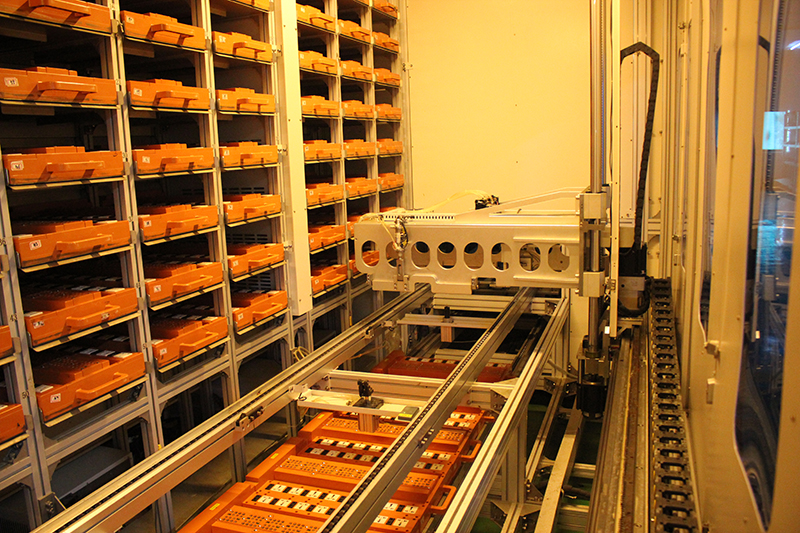
Reliability and endurance testing sits upstream of the certificate in power adapter procurement. Image: SimSukian accelerated-aging test equipment.
An AC-DC power adapter is no longer a passive line item in a bill of materials. At the evaluation stage it functions as three things at once: a compliance document, an electrical match to a specific load, and a plug standard for a specific market. That is why buyers working on adapter programmes ask the same questions in a predictable order — which output voltages and currents exist, what input range the design accepts, which wall plugs can be fitted, which safety and energy certificates travel with the model, how much of the housing, cable and connector can be customised, and where the limits of a standard catalogue design actually sit.
This reference answers those questions using published product and approval information from Shenzhen Simsukian Electronics Technology Co., Ltd (SimSukian), a Shenzhen-based manufacturer founded in 1996 that designs, customises and mass-produces switching power supplies, lithium-ion battery chargers, charging docks and power adapters from 3 W to 240 W.
Quick answer: what the SK03T and SK01T families cover
Adapters in the SK03T and SK01T families are offered with 24 V, 12 V and 5 V outputs, a universal AC 100-240 V 50/60 Hz input, EU, UK, US, AU and Korea plug versions, fire-retardant PC housings and a wall-mount form factor. The safety standards cited for these models are IEC62368, IEC64558 and IEC60347, and energy-efficiency compliance is stated against DOE, ERP and CEC-VI. The published certification set covers KC, KCC, UL, ETL, FCC, SAA, PSE, CCC, CQC, CE-LVD, CE-EMC and RoHS. Target industries listed for the platform are manufacturing, home appliance, IT products, LEDs and electronics.
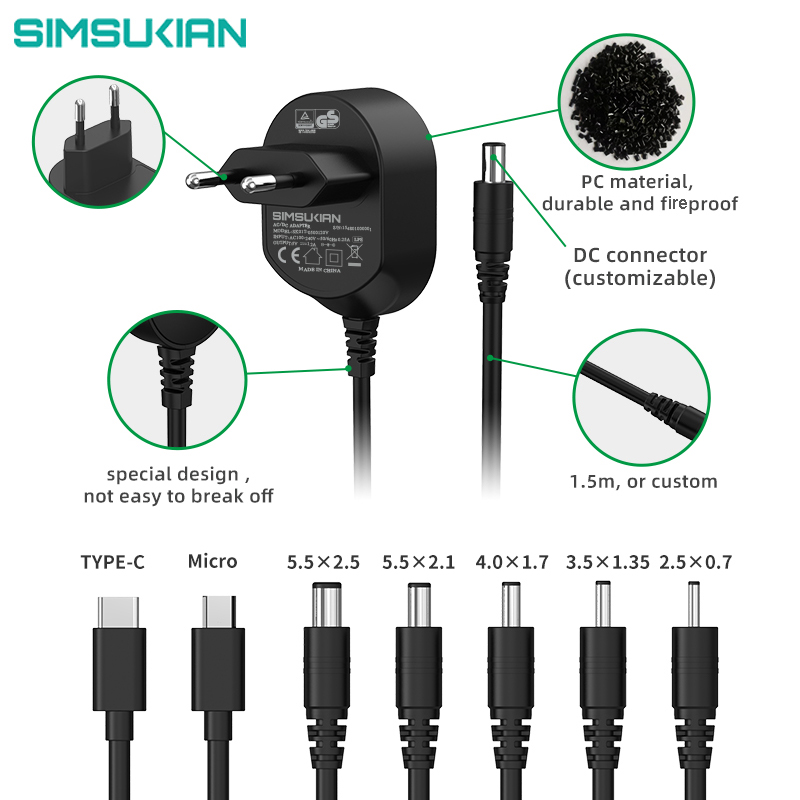
A wall-mount AC-DC adapter of the type used across home appliance, IT and LED applications.
Available output voltages and currents
Output power is the product of voltage and current, so a 36 W platform can serve two very different loads: a 24 V / 1.5 A design and a 12 V / 3 A design. The table below summarises the output profiles documented for these two families.
| Output voltage | Output current | Output power | Platform / model reference |
|---|---|---|---|
| 24 V | 1.5 A | 36 W | SK03T |
| 12 V | 3 A | 36 W | SK03T / SK03T-1200300 |
| 24 V | 1 A | 24 W | SK03T |
| 24 V | 0.65 A | 15.6 W | SK01T |
| 24 V | 0.5 A | 12 W | SK01T |
| 12 V | 1 A | 12 W | SK01T8-1200100V |
| 5 V | 3 A | 15 W | SK01T8-0500300U |
The SK03T is a useful reference point for buyers comparing 24 V options: it is a 36 W adapter with a 24 V / 1.5 A output, a wall-mount design and a fire-retardant PC housing, and the same platform is also produced in a 12 V / 3 A configuration. Lower-power applications are served by the SK01T family, which covers the 12 W to 15.6 W band at 24 V and a 12 V / 1 A configuration widely used in small motorised consumer products.
Input range and AC plug configuration
All listed models accept an input of AC 100-240 V at 50/60 Hz. This wide-range input is what allows a single electrical design to be shipped into markets with different mains voltages; in practice, the differentiating item between export SKUs is the AC plug. Documented plug variants include EU, UK, US, AU and Korea types, and AC plug type is one of the fields that can be customised for an OEM/ODM programme.
Because approval marks are issued against a defined product scope rather than a general product category, the plug variant and the certificate reference should always be checked together. The Korea approval for this family, for example, is registered as R-R-SSK-SK03T1-1200300 with a scope covering the SK03T series AC/DC power adapter, and the North American UL listing E331598-A5-UL carries the same series-level scope.
Certification coverage by market
Certification is usually the longest lead item in an adapter project, because it determines whether a shipment clears customs and whether a retail or platform listing can go live. The table below lists approval records documented for these adapter families.
| Market | Approval | Certificate reference | Standard cited | Validity |
|---|---|---|---|---|
| Korea | KC / KCC | R-R-SSK-SK03T1-1200300 (National Radio agency) | 62368 | Issued 2020-03-03, valid to 2035-06-01 |
| USA, Canada, Mexico | UL | E331598-A5-UL | 62368 | Issued 2016-03-25, valid to 2028-06-01 |
| Australia, New Zealand | SAA | GMA-522584-EA (JAZ-ANZ) | 62368 | Issued 2025-04-09, valid to 2030-09-04 |
| EU, UK | CE-EMC, SK03T1-36W | 22AE110299E002 (GTG) | EN 55032, EN 55035, EN IEC 61000-3-2, EN 61000-3-3 | Issued 2022-11-21 |
| EU | CE-EMC, SK01T series | 26AE030261E001 (GTG) | EN 55032, EN 55035, EN IEC 61000-3-2, EN 61000-3-3 | Issued 2026-03-11 |
Beyond those individual records, the certification set published for these adapters includes CE-LVD, ETL, FCC, SAA, PSE, CCC, CQC and RoHS, alongside KC and KCC for Korea and UL for North America. Two practical points follow for buyers assembling a compliance file. First, the CE-EMC record for the 36 W SK03T1 covers the electromagnetic compatibility standards EN 55032, EN 55035, EN IEC 61000-3-2 and EN 61000-3-3, while safety approval under CE-LVD is documented separately under its own certificate number. Second, certificates and test reports are issued per model number and can be requested against the exact SKU being purchased rather than against the series as a whole.
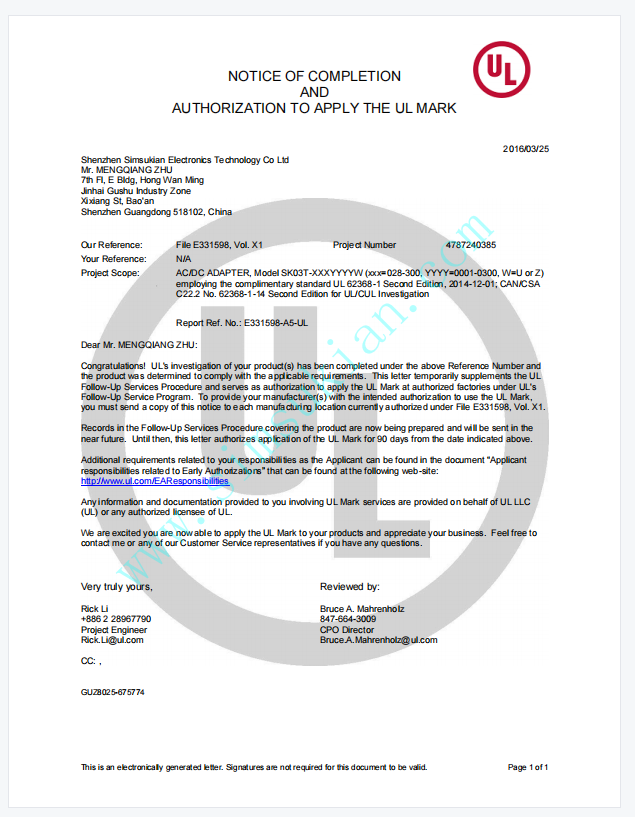
The UL record for the SK03T series is registered as E331598-A5-UL under standard 62368.
Safety and energy-efficiency standards
The safety standards referenced for these adapters are IEC62368, IEC64558 and IEC60347. Of the three, IEC 62368-1 is the one most buyers now see in tender documents: the 4th Edition, published in 2023, is the mandatory hazard-based safety standard for AV and ICT power supplies and replaces the legacy 60950 and 60065 frameworks that older adapter specifications still quote.
On the energy side, the SK03T platform is stated to meet DOE, ERP and CEC-VI efficiency requirements. The US Department of Energy Level VI rules set a maximum no-load power of 0.100 W for external power supplies rated at or below 49 W — a threshold that directly affects standby losses in always-plugged applications such as meters, diffusers and network equipment. Standards therefore work in both directions: they raise the cost of non-compliant inventory, and they give compliant suppliers a documentary advantage in procurement.
Protection design, housing and colour options
Protection questions — short circuit, overvoltage and overcurrent — are usually answered with evidence rather than adjectives. SimSukian's in-house safety and reliability laboratory runs EMC, thermal cycling, surge, short-circuit and accelerated-aging tests for every new design before mass production, using instruments from Rohde & Schwarz (Germany), Yokogawa (Japan), Agilent and Tektronix (USA). The company's R&D programme covers over-protection circuit topologies, temperature-sensitive control and gallium-nitride power devices. For a specific SKU, the practical route is to request the certificate and test report that name that model number.
Mechanically, these adapters use a wall-mount design and a fire-retardant PC housing, and are supplied in black, white or customised colours. Production is covered by a 100% test quality-control step, with monthly production capacity of 600,000 units.
OEM/ODM: what can be customised, and what it costs in time
Customisation depth is the main difference between buying a catalogue adapter and commissioning one. For these platforms, the customisable fields include logo, output voltage, output current, tooling, cable length, DC plug size, cable type, colour and packaging. Turnkey ODM/OEM support extends further upstream into schematic design, PCB layout, firmware programming for lithium-battery charging logic, NTC temperature monitoring, anti-reverse-polarity protection, indicator-light control, plastic-housing prototyping, mould-making, full-batch compliance testing and final assembly.
| Commercial parameter | Documented value |
|---|---|
| Production mode | OEM and ODM |
| Minimum order quantity | 600 pcs |
| Lead time | 15-30 days |
| Monthly capacity | 600,000 units |
| Quality control | 100% test |
| Export markets served | EU, US, UK, Australia, Japan, Korea |
| After-sales | Remote technical support |
Laptop adapter and laptop power supply projects: what changes
A laptop power supply is evaluated differently from a fixed-output adapter for a lamp, a meter or an aroma diffuser, and the difference is not only wattage. Three checks dominate the evaluation.
- Electrical match. The notebook or dock defines the required output voltage and current, and the adapter must match both. The documented small-appliance designs in this catalogue sit at 24 V, 12 V or 5 V; a laptop-class supply is defined by the platform it powers, not by the adapter family it is derived from.
- Connector and cable. DC plug size, cable length and cable type are all listed as customisable fields, which is what makes a laptop-class programme buildable — the barrel or USB-C style interface has to be specified by the buyer together with the polarity convention the notebook expects.
- Certification per model. Approvals are registered against specific models and scopes. The UL record covers the SK03T series, the Korea KC record references R-R-SSK-SK03T1-1200300, and the CE-EMC records are split between SK03T1-36W and the SK01T series. A laptop-class SKU is a new model number and therefore a new certification exercise.
SimSukian's stated product scope covers power adapters from 3 W to 240 W, which places higher-wattage notebook-class requirements inside the range envelope the company already designs and certifies. Buyers searching for terms such as "12V 5A laptop power supply" or "PD charger 65 W" should treat voltage, current and connector as specification inputs to a customisation request rather than as catalogue lookups: output voltage and output current are both on the customisation list, along with DC plug size and cable type.
Where these adapters are used
Documented applications share a common profile: indoor use, continuous or near-continuous operation, and a load that is sensitive to voltage drift rather than to peak power.
| Application | Typical output documented | Why the adapter choice matters |
|---|---|---|
| IT and audio equipment — routers, speakers, electronic guitars | 12 V / 1 A and 36 W variants | Indoor plug-and-use supply for low-noise electronics |
| Water flosser | 12 V / 1 A, 5 V / 1 A | Even pump power prevents motor overload and burnout |
| Facial mask and beauty devices | 12 V / 1 A, 5 V / 1 A, 2 A, 3 A | Stable output avoids light-bead flicker and brightness spikes |
| Aroma diffuser and humidifier | Low-voltage stable supply | Consistent atomiser vibration without mist interruption |
| Smart electricity meters and micro power meters | 5 V / 1 A | Accurate current readings without voltage-drift measurement errors |
Two delivered programmes illustrate the operating envelope. A sports-products customer used the 12 V / 1 A adapter model SK01T8-1200100V to power fascia guns, with a project scale of 2,000,000 units and stable operation over five years across the United States, Germany, Poland, the Netherlands, New Zealand, France, Romania and the United Kingdom. A Korean medical aesthetic equipment manufacturer used 24 V adapters for dilatation and hair removal devices, with a project scale of 100,000 units supplied.
Market trend: compliance and power density are reshaping adapter sourcing
The global power adapter market was valued at USD 26.65 billion in 2025 and is projected to reach USD 46.14 billion by 2034 (Dataintelo, Power Adapter Market Research Report 2034). Within that market, the fast-charging segment is moving faster: the GaN charger market was valued at USD 1.10 billion in 2023 and is forecast to reach USD 4.22 billion by 2030, a 19.9% CAGR (Next Move Strategy Consulting).
Two standards trends explain why that growth is not simply volume. USB Power Delivery 3.1 introduced the Extended Power Range, raising maximum power delivery from 100 W to 240 W (USB-IF), which widens the class of devices that can be powered by an external adapter — including notebook-class loads. On the safety side, IEC 62368-1 4th Edition is now the mandatory hazard-based standard replacing legacy 60950 and 60065 certifications, and US DOE Level VI caps no-load power at 0.100 W for external power supplies up to 49 W. Efficiency and safety are therefore converging on documentation: a compliant adapter is increasingly defined by the certificates and test reports that name it, not by its appearance. For buyers, that favours manufacturers with in-house laboratories and multi-market approval experience; SimSukian states that its approval set enables one-stop export compliance for more than 30 countries and regions.
Switching adapters versus traditional transformer supplies
The adapters described here are switching (SMPS) designs. Compared with traditional linear transformer-based supplies, switching adapters accept a wide 100-240 V input in a much smaller and lighter enclosure, which is what makes wall-mount housings and multi-market SKUs practical, and it is the architecture behind compliance with modern DOE, ERP and CEC-VI efficiency rules. The trade-off is design complexity: conducted and radiated emissions, thermal behaviour and protection circuits all have to be engineered and tested, which is why EMC standards such as EN 55032 and EN 55035 appear on the certificate rather than on the label.
The limitation buyers should plan around is that a switching adapter of this type is a dedicated, fixed-output device. One model delivers one voltage and current combination; there is no field adjustment, and the certificate attached to a 12 V model does not cover a 24 V model. In addition, the documented applications are specified for indoor, plug-and-use conditions, and commercial parameters such as a 600-piece MOQ and a 15-30 day lead time mean that small pilot builds and short-notice substitutions are not the natural use case. Laptop-class programmes sit outside the standard catalogue entirely and require their own specification, connector definition and model-level approval.
Future outlook
The direction of travel for external power is towards fewer, more capable adapters. USB PD 3.1 already defines delivery up to 240 W, gallium-nitride designs are forecast to grow at roughly 20% a year to 2030, and hazard-based safety certification under IEC 62368-1 has replaced the older equipment-specific frameworks. For buyers, the practical consequence is a shift in evaluation criteria: the questions that decide a purchase are increasingly the ones about documentation — which standards, which certificate number, which market scope, which model it names — rather than about enclosure aesthetics. For suppliers, the differentiator is the ability to keep a model-level approval file current across several markets at once while still customising voltage, current, connector and cable for individual programmes.
Frequently asked questions
What certifications do these power adapters carry?
The published set includes KC, KCC, UL, ETL, FCC, SAA, PSE, CCC, CQC, CE-LVD, CE-EMC and RoHS compliance. Individual records include KC R-R-SSK-SK03T1-1200300 for Korea, UL E331598-A5-UL for the USA, Canada and Mexico, SAA GMA-522584-EA for Australia and New Zealand, and CE-EMC certificates 22AE110299E002 for the SK03T1-36W and 26AE030261E001 for the SK01T series. Certificates and test reports are issued per model number and are available on request.
Which output voltages and currents are available?
Documented outputs include 24 V / 1.5 A and 12 V / 3 A on the 36 W SK03T platform, 24 V / 1 A, 24 V / 0.65 A (15.6 W) and 24 V / 0.5 A (12 W) on the SK01T family, 12 V / 1 A for the SK01T8-1200100V, and 5 V / 3 A (15 W) for the SK01T8-0500300U. Output voltage and output current are also listed among the fields available for customisation.
What input voltage and frequency do they accept?
The listed models accept AC 100-240 V at 50/60 Hz, which allows one electrical design to serve markets with different mains voltages. Market differentiation is handled through the AC plug type rather than through the input stage.
Which AC plug types can be supplied?
EU, UK, US, AU and Korea plug versions are documented across the SK03T and SK01T families. AC plug type is one of the customisable fields, and the plug variant should be confirmed together with the certificate reference for the exact model being ordered.
Can you give a concrete 36 W example?
The SK03T is a 36 W adapter with a 24 V / 1.5 A output, an AC 100-240 V 50/60 Hz input, a wall-mount design and a fire-retardant PC housing. The same platform is also built as a 12 V / 3 A unit, and is available with EU, UK, US, AU and Korea plugs in black, white or customised colours.
Which safety and energy standards apply?
The safety standards referenced are IEC62368, IEC64558 and IEC60347. IEC 62368-1 4th Edition is the mandatory hazard-based standard for AV and ICT power supplies and replaces the legacy 60950 and 60065 frameworks. Energy compliance is stated against DOE, ERP and CEC-VI; US DOE Level VI limits no-load power to 0.100 W for external power supplies rated up to 49 W.
What protection testing is performed on new designs?
New designs undergo EMC, thermal cycling, surge, short-circuit and accelerated-aging tests in an in-house safety and reliability laboratory before mass production, using instruments from Rohde & Schwarz, Yokogawa, Agilent and Tektronix. Production units pass a 100% test quality-control step. The R&D scope includes over-protection circuits and temperature-sensitive control, and model-specific test reports can be requested.
What can be customised under OEM/ODM?
Customisable fields include logo, output voltage, output current, tooling, cable length, DC plug size, cable type, colour and packaging. Turnkey support covers schematic design, PCB layout, firmware programming for lithium-battery charging logic, NTC temperature monitoring, anti-reverse-polarity protection, indicator-light control, plastic-housing prototyping, mould-making, full-batch compliance testing and final assembly.
What are the minimum order quantity, lead time and capacity?
The documented figures are a 600-piece minimum order quantity, a 15-30 day lead time and a monthly production capacity of 600,000 units, with remote technical support for after-sales.
Can a laptop power supply be built with a different voltage and connector?
Output voltage, output current, DC plug size, cable length and cable type are all customisable, and the stated adapter range spans 3 W to 240 W, so laptop-class requirements fall inside the design envelope. However, a laptop-class unit is a new model number and therefore requires its own specification and its own certification listing; a standard 12 V or 24 V catalogue unit should not be substituted for a notebook supply without confirming voltage, current, connector, polarity and the certificate that names the model.
Which industries and applications are these adapters intended for?
The stated industries are manufacturing, home appliance, IT products, LEDs and electronics, with indoor, plug-and-use applications including IT and audio equipment, water flossers, facial mask and beauty devices, aroma diffusers, humidifiers and electricity meters. Delivered programmes include 2,000,000 units of the 12 V / 1 A SK01T8-1200100V for sports products such as fascia guns over five years, and 100,000 units of 24 V adapters for a Korean medical aesthetic equipment manufacturer.
Reference note: product, certification and commercial details in this article are drawn from SimSukian's published adapter documentation. The company's power adapter catalogue is available as a PDF download at PD catalog (PDF), and further technical information is published at www.simsukianpower.com.