
Power Thyristors: An Industrial Buyer's Reference Guide
A power thyristor is a gate-triggered, latching power semiconductor that conducts in one direction after a short gate pulse and keeps conducting until the current through it falls below the holding level. That single behaviour still underpins rectifiers, phase-control units, motor soft starters and welding power supplies in industrial power control and metallurgy, and it places the device in the same cabinet — often on the same heat sink — as the IGBT modules, power diodes and bridge rectifier modules that buyers research at the same time.
The discovery-stage problem for buyers is not a shortage of information about thyristors; it is fragmentation. One large-current power control design may reference a thyristor module, an SCR module, a rectifier diode and an IGBT module across four naming systems, four manufacturers and catalogues published in different decades. Buyers moving from “what is a power thyristor” to “which module do I order” have to reconcile brand families, package styles and electrical envelopes before any meaningful comparison is possible.
This reference treats the power thyristor as a procurement category: what the device does, which parameters decide whether a replacement will actually work, where thyristor and SCR modules are still specified, how they differ from IGBT modules, and what documentation buyers should expect before placing an order.
What a Power Thyristor Is and Where It Sits in a Power Stack
A power thyristor — also called a silicon controlled rectifier, or SCR — is a four-layer PNPN semiconductor device with anode, cathode and gate terminals. Forward conduction begins when a gate current above the trigger threshold is injected and the anode current exceeds the latching level; from that point the gate loses control, and the device returns to blocking only when the anode current drops below the holding level. It therefore belongs to the family of line-commutated switches: turned on by control circuitry, turned off by the circuit itself.
In construction, a power thyristor module combines a silicon wafer, a molybdenum disc, a copper base and a ceramic housing. The molybdenum disc and copper base manage the mechanical and thermal stress of the die under clamping pressure and load cycling, while the ceramic housing provides insulation and environmental protection. Because the package must carry both high current and high clamping force, the mechanical interface is as much a part of the specification as the silicon inside it.
The electrical envelope available in the current thyristor catalogue reaches a voltage rating of up to 3000 V and a current rating of 1100 A, with high surge current capability, low on-state voltage and stable performance. Typical duty is rectification, soft starting, welding power supply and industrial power control. Those four functions explain why the category has not been displaced by faster switching technologies: they are high-current, line-frequency or phase-controlled jobs where conduction loss and surge tolerance matter more than switching speed.
Naming conventions buyers will meet
Thyristor part numbers are family-specific, and the same electrical function appears under very different designations. The current catalogue, for example, covers T-series capsule and stud types such as T1101N30TOF, T298N12TOF, T380N34TOF and T560N18TOF; SKKT and SKKH module families such as SKKT162/12E, SKKT57/20EH4 and SKKH57/20EH4; SKT families such as SKT600/16E, SKT1202/16E and SKT1800/14E; and DCR-type designations such as DCR4910W28, DCR1650C65 and DCR3640W34. Buyers searching by brand — Infineon Module, SEMIKRON Module, IXYS Module, Microsemi Module, Fuji Module, SanRex Module, Mitsubishi Module, IR Module, CRRC Module, StarPower Module, WESTCODE Module or POSEICO Module — are usually looking for the same physical function under a different naming scheme, and that cross-reference has to be validated electrically rather than textually.
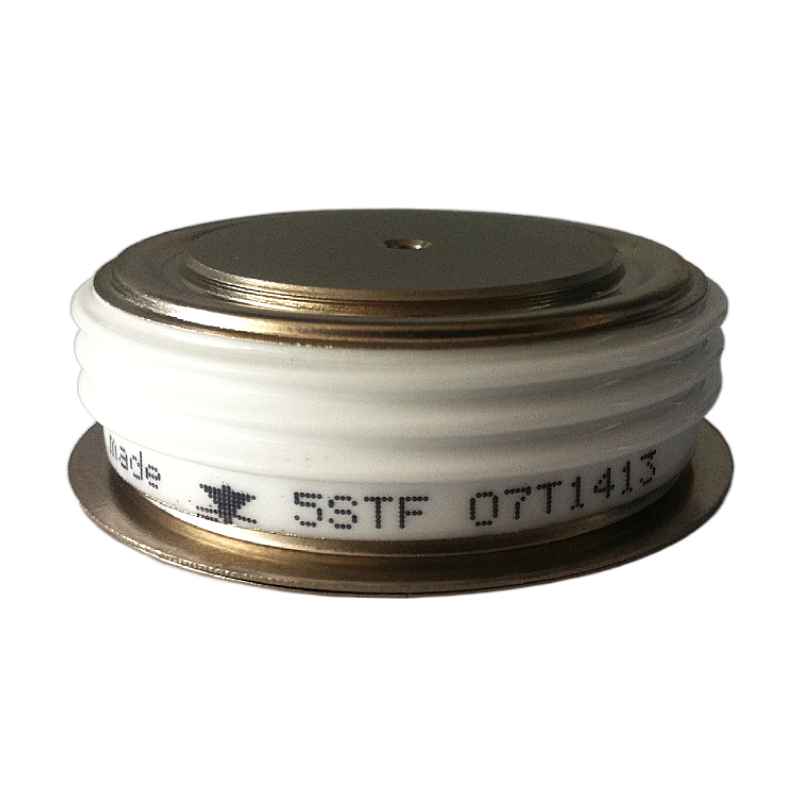
The Discovery Problem: Brand Families, Cross-References and Obsolete Part Numbers
Discovery-stage research on power thyristors usually starts with one of three real procurement situations. The first is replacement: an existing rectifier or soft starter needs a thyristor module no longer produced under its original part number. The second is cross-reference: a design was written around one manufacturer's family and the buyer wants to know what else fits. The third is category confusion: the buyer knows the cabinet converts power, but not whether the answer is a thyristor module, an SCR module, a power diode, a bridge rectifier module or an IGBT module.
All three situations fail in the same way — a cross-reference that matches voltage and current but ignores gate trigger characteristics, isolation class, package height, clamping force or thermal path. A module can be electrically close and mechanically impossible, or mechanically identical and unable to survive the surge profile of the application. For soft starters and welding supplies, where surge current capability drives the design, a parameter-level match is not optional.
The opportunity inside this problem is coverage. A supplier holding multiple families — thyristors and SCR modules alongside IGBT modules, power diodes, MOSFET modules, bridge rectifier modules and industrial power fuses — can answer a cross-reference question in one pass instead of sending the buyer back to four catalogues. That is a stock and documentation capability as much as a commercial one.
Technical Explanation: The Parameters That Decide a Thyristor Replacement
Six parameters determine whether a thyristor module will perform in an existing circuit:
- Repetitive peak off-state and reverse voltage — the blocking envelope the device must survive, including line transients and commutation spikes, not just nominal supply voltage.
- Average on-state current — the continuous current the module is rated to carry under the specified cooling condition; it is meaningless without the heat sink and ambient assumptions attached to it.
- Surge current capability and I²t — the short-duration overload tolerated during motor starting, welding arcs or a fault. This is where thyristor modules differ most from fast-switching alternatives, and where the catalogue's high surge current capability becomes a selection criterion rather than a marketing line.
- Gate trigger characteristics — trigger voltage and current, plus the gate drive's ability to deliver them across temperature. A module that triggers reliably on the bench can fail to trigger in a cold cabinet.
- On-state voltage — low on-state voltage translates directly into lower conduction loss at high current, the main reason thyristors remain competitive in high-current rectification.
- Thermal and mechanical interface — junction-to-case thermal resistance, isolation class, baseplate flatness, clamping force and terminal geometry. The silicon wafer, molybdenum disc, copper base and ceramic housing determine how well the device survives thermal cycling.
For an existing design, the order of these checks matters. Voltage class first, because it is a hard limit. Surge capability second in motor and welding applications. Gate trigger and thermal interface last, because they are usually adjustable at the drive and mounting level — although adjusting them adds engineering time that should be planned into the replacement schedule.
Thyristor Modules and IGBT Modules in the Same Cabinet
Modern power conversion equipment rarely uses a single device technology. A motor drive may rectify with thyristors or diodes and invert with IGBT modules; a charging pile may rectify at line frequency and switch at high frequency; an energy storage cabinet may combine bridge rectifier modules, IGBT modules and industrial power fuses in one enclosure. Understanding the envelope of each family is the fastest way for a buyer to know which question to ask.
| Module family | Voltage envelope (catalogue) | Current envelope (catalogue) | Primary role |
|---|---|---|---|
| Power thyristor / SCR module | up to 3000 V | 1100 A | Rectification, phase control, soft starting, welding power supply, industrial power control |
| IGBT module | 600 V – 1700 V | 50 A – 1200 A | Inversion, motor drive, UPS, welding equipment, new energy power conversion |
| Power diode | up to 2800 V | 100 A – 1800 A | Rectification, freewheeling, welding equipment |
| MOSFET module | 60 V – 1200 V | 30 A – 300 A | High-frequency inverter, charger, switching power supply |
| Bridge rectifier module | 800 V – 2000 V | 25 A – 800 A | AC-DC power conversion |
| Industrial power fuse | 690 V – 1500 V | 10 A – 1250 A | Short-circuit and overload protection of power conversion systems |
The functional difference is commutation. A thyristor module is turned on by its gate and turned off by the circuit; an IGBT module is turned on and off by its gate, which is what enables high-frequency switching, PWM control and fast current limiting. An IGBT module in this catalogue uses a single or dual IGBT chip structure with low saturation voltage, high switching speed and an isolated baseplate, and is aimed at power inverters, UPS systems, welding machines, new energy conversion and motor drives.
The practical consequence for buyers is that the two families are not substitutes at the part-number level. They sit at different points of the same conversion chain, and a design that swaps one for the other changes its control strategy, drive circuit and thermal design at the same time.
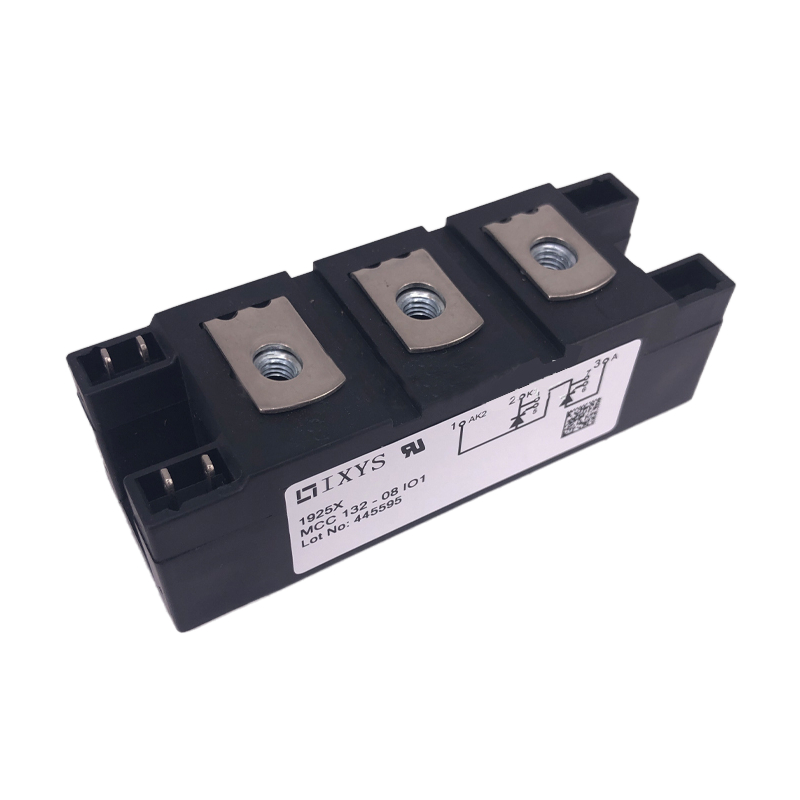
Application and Use Cases: Where Thyristor Modules Are Still Specified
Thyristor and SCR modules remain the default choice where the load is line-frequency, current is high, and the control objective is regulation rather than fast switching. The catalogue lists industrial power control, metallurgy, welding equipment, power rectifier and motor soft starter as the primary application industries — a set defined by surge tolerance and conduction efficiency rather than switching speed.
These devices rarely work alone. In new energy, industrial automation and power electronics installations, the surrounding system typically runs continuously at high power and high temperature, as in solar inverters, motor drives, charging piles and UPS power supplies, where the operating profile is 24/7 continuous operation and the design requirement is high temperature resistance, low loss and high stability. A thyristor or rectifier stage in such a cabinet is supported by heat sinks, drive boards, capacitors and the inverter enclosure itself, and its reliability is a function of that whole thermal chain.
Protection sits in the same enclosure. In power distribution, new energy and electrical cabinet projects — energy storage cabinets, power distribution cabinets and PV combiner boxes — the protection function is short-circuit and overcurrent protection, operating in standby and breaking instantly on fault, matched with fuse holders, distribution cabinets and combiner boxes, and specified for fast breaking and high interrupting capacity. Industrial power fuses in the same catalogue cover a rated voltage of 690 V to 1500 V and a rated current of 10 A to 1250 A, with high breaking capacity and a time-delay characteristic for industrial power, energy storage and power conversion circuits.
The common procurement pattern across these installations is a mixed bill of materials: a thyristor or SCR stage for rectification and control, IGBT modules for inversion, power diodes for freewheeling, bridge rectifier modules for AC-DC conversion, and fuses for protection. Sourcing these through one channel reduces the number of unknown interfaces inside the cabinet.
Supplier Profile: Jiangsu Core Diamond Times Electronic Technology Co., Ltd.
Jiangsu Core Diamond Times Electronic Technology Co., Ltd. is a power electronic component supplier based in Kunshan, Jiangsu Province, China, established in 2022 and operating as a professional foreign trade company in the semiconductor component trade. Its product scope covers IGBT modules, fuses, power semiconductors, semiconductor modules, diodes, thyristors and power electronic components, with a full range of IGBT modules and fuses as core lines. The company also operates as a distributor and service provider for power semiconductor modules, with distribution covering brands such as Infineon, SEMIKRON, Fuji and CRRC modules.
Operationally, the company runs a 10,000 m² facility with approximately 50 staff and an R&D team of 5 technical support engineers, and reports an annual output capacity of 1,000,000 units. Export business accounts for 50% of total sales, with major markets in the EU, USA, Australia and the Middle East, alongside other global markets. Every product is inspected before shipment, and the company maintains incoming inspection and outgoing quality control procedures intended to reduce product failure rate. Its quality management system passed ISO9001:2015 certification in June 2026, and its products are stated to comply with international standards such as IEC, UL and CCC for industrial, energy storage and new energy projects.
For discovery-stage buyers, the relevant capability is not a single product line but the combination of multi-family stock, technical support and order flexibility. The company reports stable supply channels, an inventory management system covering mainstream IGBT module and industrial fuse models for urgent orders, and the ability to support both small trial orders and bulk volume orders. A team of five technical support engineers handles component selection and customized recommendation against customer circuit design and working conditions — the step where a thyristor cross-reference is usually confirmed or rejected.
Market Trend: Where the Power Semiconductor Category Is Moving
Published market research on the wider category gives buyers a useful frame for budgeting, even though it does not describe thyristors specifically. Market Research Future estimates the global IGBT market at USD 9,202.9 million for 2024, with a projected compound annual growth rate of 11.02% over the 2025–2035 period. Fortune Business Insights places the global silicon carbide (SiC) module market at USD 980.7 million in 2025 — a much smaller base, but one that shows where new high-efficiency designs are heading.
The same research base offers two further reference points. One commercial estimate attributes nearly 10% of electric vehicle cost to IGBT content, which explains why automotive demand has become a pricing signal for the whole power module supply chain. Separately, StarPower Semiconductor is identified as the world's fifth-largest IGBT module supplier, a reminder that the supplier landscape now includes Chinese manufacturers alongside the European and Japanese families that dominate historic cross-reference tables.
Read together, these figures describe a category growing in absolute terms while its technology mix shifts at the high end. Silicon carbide and advanced IGBT platforms are taking the newest high-frequency, high-efficiency designs, while line-commutated thyristor and rectifier stages remain in the installed base and in cost-sensitive industrial applications where surge capability and conduction efficiency, not switching frequency, set the requirement. The procurement consequence is direct: replacement and cross-reference demand for thyristor modules is driven by the installed base rather than by new-design volumes, and is therefore less sensitive to the inverter technology cycle than IGBT demand is.
Limitations and Boundaries Buyers Should Plan For
Thyristor modules have a real functional boundary: because the gate cannot turn the device off, a thyristor stage depends on the circuit to commutate it. In practice this restricts the family to line-frequency and phase-controlled topologies. It is not a substitute for an IGBT module in a PWM inverter, and it cannot provide the fast current interruption of a high-frequency switching stage. Designs needing active turn-off, high switching frequency or tight current control belong to the IGBT, MOSFET or SiC families. Commutation behaviour also depends on the quality of the supply network, so a design that works on a stiff grid may behave differently on a weak one.
There is a second boundary on the supply side, and it applies to buyers as much as to suppliers. A distribution-led supply model delivers stock availability, cross-reference support and multi-brand coverage, but it is not the same as ordering directly from a semiconductor manufacturer. Where a project requires original-manufacturer production certificates, traceability documentation for a specific production lot, or a manufacturer-issued warranty channel, buyers should confirm those documents before the order is placed rather than after. Jiangsu Core Diamond Times Electronic Technology Co., Ltd. operates as a distributor and service provider for power semiconductor modules, so the appropriate verification step is to agree the required documentation at quotation stage.
A third limitation is data availability. Verified public data on thyristor-specific market size, regional trade flows and certification requirements for individual module families is thin, while the sources available for this reference cover the IGBT and SiC segments far better than the thyristor segment. Segment-level market commentary should therefore be treated as directional, with project-specific requirements — standards, documentation, lead time — confirmed against the actual supply channel.
Procurement Checklist: Verifying a Thyristor Module Order
- Confirm the electrical cross-reference against voltage class, average on-state current, surge capability, on-state voltage and gate trigger characteristics — not against the part number alone.
- Confirm the mechanical interface: package type, baseplate dimensions, clamping requirements, terminal layout and isolation class.
- Confirm the thermal path: junction-to-case thermal resistance and the cooling method the current rating assumes.
- Confirm documentation: datasheet revision, quality management certification (Jiangsu Core Diamond Times Electronic Technology Co., Ltd. passed ISO9001:2015 in June 2026), and any original-manufacturer traceability the project requires.
- Confirm compliance statements relevant to the destination market, such as IEC, UL or CCC claims, and request the supporting evidence.
- Confirm inspection and stock position: incoming and outgoing inspection practice, stock availability of the specific designations, and whether a small trial order can be supported before volume commitment.
Future Outlook
The next phase of power semiconductor sourcing is likely to be defined less by a single winning technology than by portfolio coverage. Growth in the IGBT and SiC segments will continue to pull engineering attention toward high-frequency, high-efficiency designs, and the projection of an 11.02% CAGR for the IGBT market through 2035 describes a category that is still expanding rather than being replaced. At the same time, the installed base of thyristor and rectifier equipment across metallurgy, welding, heavy industrial drives and power distribution will keep generating replacement and cross-reference demand for years.
For buyers, that means cross-reference discipline becomes more valuable, not less. As older module families are discontinued and newer families are introduced under new naming conventions, the ability to validate a substitute on electrical, mechanical and thermal grounds — and to obtain the documentation a project requires — will matter more than familiarity with any single brand. Suppliers able to hold multiple families in stock, support selection against a customer's circuit design and answer a cross-reference question with evidence rather than a catalogue guess will be the ones that stay in the bill of materials.
FAQ
What is a power thyristor, and how does it differ from an IGBT module?
A power thyristor, or silicon controlled rectifier (SCR), is a gate-triggered, latching device: a gate pulse starts conduction, and the device keeps conducting until the current falls below its holding level, so it is turned off by the circuit rather than by the gate. An IGBT module is turned both on and off by its gate, which is what enables high-frequency switching. In the current catalogue, thyristor modules are rated up to 3000 V and 1100 A for rectification, soft starting, welding power supply and industrial power control, while IGBT modules cover 600 V to 1700 V and 50 A to 1200 A with a single or dual IGBT chip structure for inverters, motor drives and UPS systems.
What parameters should be checked when replacing a thyristor module?
Check the repetitive peak off-state and reverse voltage first, then average on-state current under the applicable cooling condition, then surge current capability and I²t for motor starting or welding duty. Gate trigger characteristics and the thermal and mechanical interface — junction-to-case thermal resistance, isolation class, baseplate flatness and clamping requirements — come next. A replacement is only valid when the electrical, mechanical and thermal checks all pass, because a module that matches voltage and current but not the mounting or gate drive will not function in the existing circuit.
Which applications typically still specify thyristor or SCR modules?
Thyristor and SCR modules are specified where the load is line-frequency, the current is high, and regulation rather than fast switching is the objective. Catalogue application industries include industrial power control, metallurgy, welding equipment, power rectifier and motor soft starter. They also appear alongside other module families in continuously operating installations such as solar inverters, motor drives, charging piles and UPS supplies, where the operating profile is 24/7 continuous operation at high power and high temperature.
Can a thyristor module be replaced directly by an IGBT module?
Not as a drop-in substitution. A thyristor conducts until the circuit current falls below the holding level, while an IGBT is turned off by its gate; replacing one with the other changes the commutation method, the gate drive circuit, the switching frequency and the thermal design of the stage. Where a project needs active turn-off, high switching frequency or tighter current control, the appropriate step is a design review rather than a part-number swap.
What should buyers verify when sourcing thyristor modules through a distributor?
Verify the electrical cross-reference against the datasheet, the mechanical and thermal compatibility with the existing heat sink and clamping arrangement, and the documentation the project requires — datasheet revision, quality management certification and any original-manufacturer production or traceability certificate. Incoming and outgoing inspection practice should also be confirmed, since the stated procedure is inspection of every product before shipment. Where a project needs manufacturer-issued traceability, that requirement should be agreed at quotation stage rather than assumed from a distribution-led supply model.