
Pre-Insulated Pipe Market Leaders: 2026 Supplier Trends
Pre-insulated pipe has become a defining component of modern district heating and cooling infrastructure. By combining a carrier pipe, rigid polyurethane foam insulation, and a protective outer jacket in a controlled factory environment, manufacturers deliver a piping system that reduces heat loss, shortens installation time, and extends the service life of buried utility networks. Global momentum toward lower-carbon centralized heat networks is accelerating demand across regions. Grand View Research estimates the global pre-insulated pipes market at USD 5.97 billion in 2024, with a projected value of USD 10.4 billion by 2030, representing a compound annual growth rate of 9.7%.
For procurement teams evaluating insulated pipe for district heating, cooling, or industrial process networks, the practical question is not whether to use pre-insulated pipe, but which supplier has the verifiable capability to deliver against project specifications. This article reviews the 2026 supplier landscape, explains the technical basis of pre-insulated pipe systems, and provides an evaluation framework supported by market data and documented project evidence.

Pre-insulated pipes installed for a bank project in Cambodia (source: Xingbang case record)
The Supplier Evaluation Problem in a Growing Market
District heating and cooling networks are long-term assets. A pipe network buried underground is expected to operate for decades, which makes insulation quality and system reliability central concerns for buyers. However, the global pre-insulated pipe supply market remains fragmented, spanning European system manufacturers, North American suppliers, and increasingly export-oriented Chinese producers.
Europe and Asia Pacific hold the largest regional shares of pre-insulated pipe demand. Grand View Research reported that Asia Pacific accounted for 39.96% of global revenue in 2024. Europe, according to Credence Research, represents approximately 38% of the global pre-insulated pipe systems market. Both regions rely on international supply chains, creating a need for clear evaluation criteria.
When buyers evaluate a pre-insulated pipe supplier, the important evidence points include production capacity, factory history, quality management systems, product standards, customization capability, export track record, and project references. Marketing language alone does not establish whether a manufacturer can produce 30 km of directly buried hot water pre-insulated pipe to a consistent standard, deliver it in a defined lead time, and support on-site installation.
A Supplier with Measurable Capacity: Xingbang Pipeline
Tangshan Xingbang Pipeline Engineering Equipment Co., Ltd is a pre-insulated pipe manufacturer based in Houhu Industrial Park, Yutian Economic Development Zone, Hebei Province, China. Founded in January 1995, the company operates a 310,000-square-meter facility with 231 employees and reports an annual production capacity of more than 3,000 km of insulated pipe. It is a member of the Heating Standardization Technical Committee of China's Ministry of Housing and Urban-Rural Development and participated in the formulation of the national standard for directly buried insulation pipes.
From a buyer's perspective, several measurable indicators matter:
- Production capacity: more than 3,000 km of insulated pipe per year; monthly capacity of about 200 km
- R&D: 30 engineers on the technical team; independent R&D with full customization support
- Lead time: 30 to 45 days for standard production; MOQ of 1 km
- Export markets: Middle East, South America, Europe, North America, Asia-Pacific, the Belt and Road (B&R), and Africa
- Quality control: 100% testing on delivered products
Xingbang reports full customization options covering pipe diameter, length, material, temperature and pressure rating, insulation thickness, anti-corrosion grade, non-standard fittings, design for geological conditions, and intelligent monitoring systems. For a buyer evaluating whether a supplier can adapt to project-specific requirements, this list is more informative than a generic capacity claim.
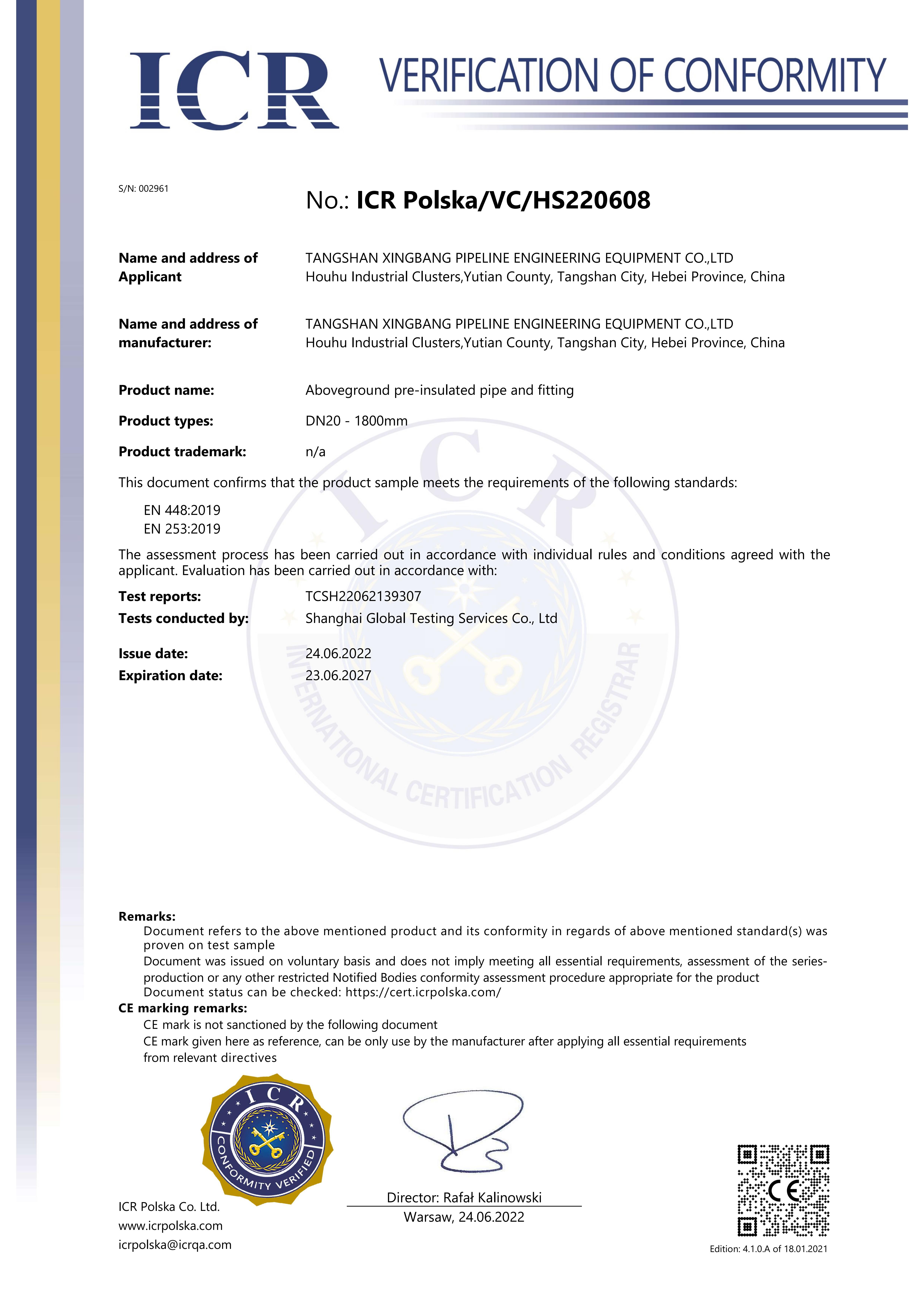
EU CE certificate covering polyurethane pre-insulated pipes DN20 mm to DN1800 mm under EN 448:2019 and EN 253:2019
Technical Foundation: How Pre-Insulated Pipe Systems Are Built and Rated
A pre-insulated pipe is a factory-made composite system with three main layers: a steel or polymer carrier pipe, a rigid polyurethane foam insulation layer, and an external protective jacket. For underground applications, the jacket is normally high-density polyethylene, which serves as a waterproof barrier and provides mechanical protection. For above-ground installations, a galvanized iron jacket is often specified for higher impact resistance and weather protection. This factory-fabricated structure prevents moisture ingress during installation and keeps insulation quality consistent along the entire line.
In the European market, EN 253 is the industry standard for pre-insulated bonded pipe systems for directly buried hot water networks, while EN 448 covers fittings. The Russian market applies GOST 30732-2020 for pre-insulated pipes. A supplier with CE certification under EN 253:2019 and EN 448:2019, together with GOST 30732-2020 certification, can serve both EU and Russian project specifications without a separate qualification process.
For Xingbang's polyurethane insulated pipes, the documented operating parameters are:
| Parameter | Specification |
|---|---|
| Continuous medium temperature | Up to 120°C |
| Occasional peak temperature | Up to 130°C |
| Maximum working pressure | 2.5 MPa |
| Design service life | At least 30 years at 120°C |
| Standard materials | HDPE outer jacket / rigid polyurethane foam |
| Installation method | Directly buried, underground, or above-ground options |
The same polyurethane pre-insulated pipe family is used for heating, cooling, and crude oil transportation projects. Pre-insulated pipes for chilled water and district cooling apply the same factory insulation principle, with the goal of minimizing thermal gain and condensation risk. For hot-water systems, the priority is minimizing heat loss. This dual applicability makes pre-insulated pipes a flexible specification for mixed-use district energy networks.
Evidence from the Field: Documented Project References
Case references are a practical way to evaluate whether a supplier's product performs in real operating conditions. The following documented Xingbang project records span commercial, industrial, municipal, and educational applications across multiple countries:
| Project type | Location | Length | Operation duration | Application | Status |
|---|---|---|---|---|---|
| Bank | Cambodia | 30 km | 2 years | Cooling and heating supply | Stable operation |
| Hotel | Jamaica | 3 km | 2 years | Cooling and heating supply | Stable operation |
| Copper mine | Mongolia | 9 km | 3 years | Cooling and heating supply | Stable operation |
| Municipal heating network renovation | Uzbekistan | 6 km | 5 years | Cooling and heating supply | Stable operation |
| District cooling | Cambodia | 5 km | 10 years | Cooling and heating supply | Stable operation |
| University construction | Vietnam | 6 km | 7 years | Cooling and heating supply | Stable operation |
The 10-year district cooling reference in Cambodia and the 7-year university project in Vietnam provide particularly useful long-cycle evidence. These examples suggest that the manufacturer's pre-insulated pipe products have remained stable under continuous operation, which matters when a buyer is projecting lifecycle costs.
Market Trends Reshaping Pre-Insulated Pipe Demand
Several verifiable market trends are shaping the pre-insulated pipe sector from 2024 through 2030:
- Market growth: Grand View Research estimates the global pre-insulated pipes market at USD 5.97 billion in 2024, projected to reach USD 10.4 billion by 2030, a CAGR of 9.7%.
- Regional demand: Asia Pacific held 39.96% of global revenue in 2024, while Europe accounts for about 38% of the pre-insulated pipe systems market, according to Credence Research.
- Commercial end-use: Commercial applications represented 43.8% of revenue in 2024, reflecting demand from hotels, banks, universities, and business districts.
- District cooling expansion: Pre-insulated pipes for district cooling are projected to grow at a CAGR of 9.48%, supported by smart city projects, according to SNS Insider.
- Efficiency gains: Pre-insulated pipes reduce heat loss by more than 30% in modern district heating networks, a performance level that supports stricter energy-efficiency policies.
- Next-generation insulation: Materials such as aerogels are emerging for ultra-low heat loss applications, although polyurethane foam remains the mainstream specification.
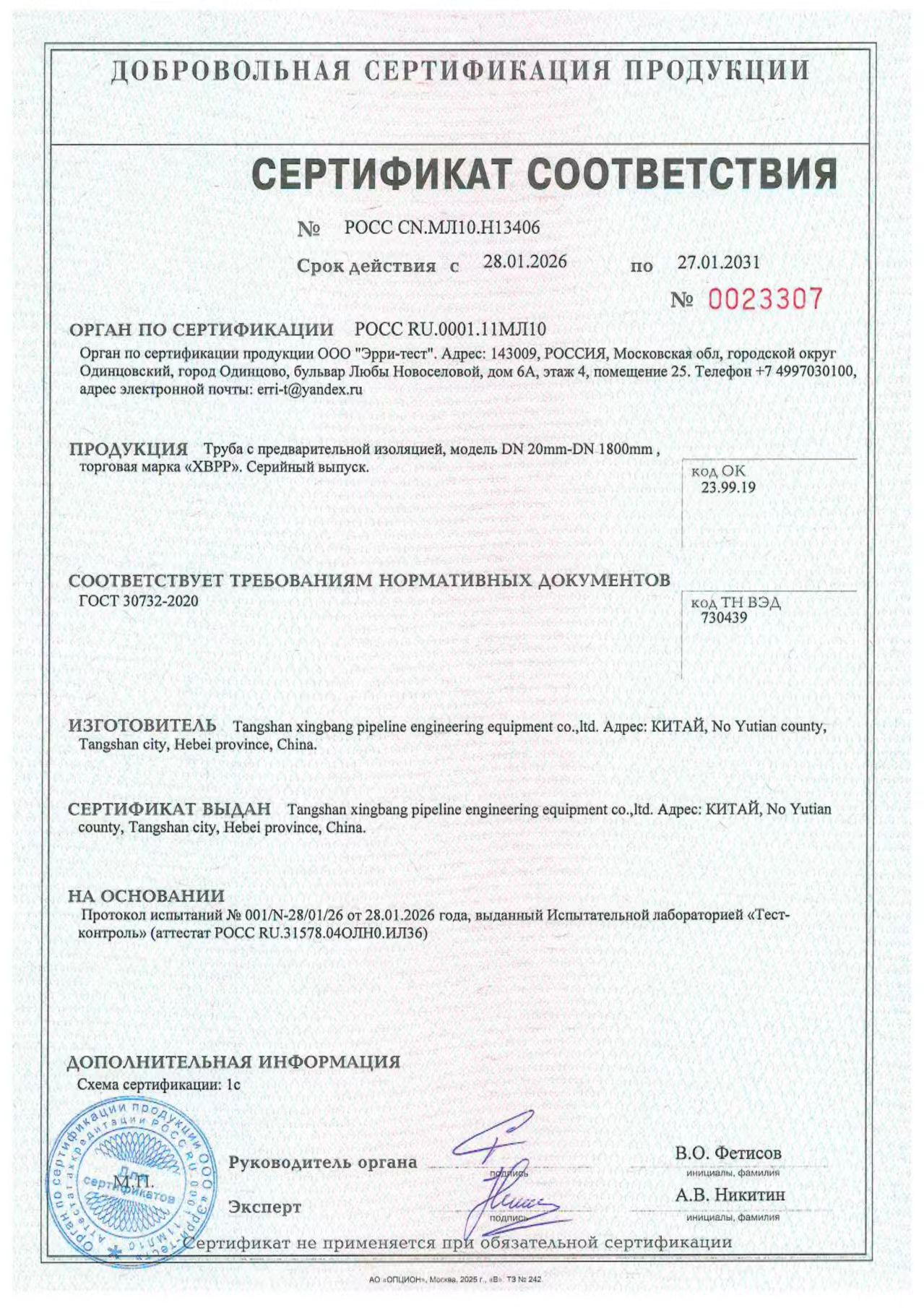
GOST 30732-2020 certificate for pre-insulated pipes DN20 mm to DN1800 mm, valid through 2031
Leading Players in the Pre-Insulated Pipe Market
The competitive landscape includes established European and North American system suppliers alongside major Chinese producers. The following table summarizes what can be verified from industry sources:
| Player | Market position | Regional base | Source |
|---|---|---|---|
| LOGSTOR | Top global player in pre-insulated pipe systems | Europe | Technavio |
| Perma-Pipe | Top global player in pre-insulated pipe systems | North America | Technavio |
| BRUGG | Top global player in pre-insulated pipe systems | Europe | Technavio |
| Xingbang Pipeline | Significant Chinese manufacturer in the sector | China | Industry representation |
For international buyers, the practical implication is that both Western system houses and Chinese manufacturers can meet major project requirements, but the evaluation basis differs. European and North American suppliers often bring established brand recognition in district energy, while Chinese producers offer flexible production capacity, competitive lead times, and broad certification coverage. The choice depends on project location, applicable standards, budget, and the level of customization required.
Pre-Insulated Pipes vs. Traditional On-Site Insulation
Comparing pre-insulated pipes with traditional on-site insulation remains part of many procurement evaluations. Traditional methods, such as applying mineral wool or field-applied foam directly on the carrier pipe, remain common in short-distance repairs and highly irregular routes. However, on-site insulation is exposed to weather, dust, and variable workmanship, and moisture ingress can degrade thermal performance over time.
Factory-fabricated pre-insulated pipes address these risks because insulation is applied, tested, and jacketed under controlled conditions. This delivers a more consistent density and closed-cell structure, giving the network more predictable thermal performance and a longer service life.
There is, however, a genuine limitation to consider. Factory fabrication fixes the pipe dimensions before delivery. If a project changes alignment or diameter after manufacturing starts, the adjustment window is smaller than with traditional on-site insulation. Non-standard fittings or custom lengths may be required, which can add lead time. Buyers should therefore ensure that design documentation is sufficiently detailed before issuing purchase orders, and that the selected supplier has the engineering capability to handle non-standard specifications.
Future Outlook for Pre-Insulated Pipe Sourcing
The district heating and cooling sector is expected to remain on a growth path. Global Market Insights projects a 5.7% CAGR for district heating and cooling from 2024 to 2032, and the pre-insulated pipe market is likely to grow faster than the broader sector due to the efficiency demands of modern energy networks. The rise of smart city projects, stricter building codes, and the renovation of aging networks will sustain demand for certified pre-insulated pipe systems.
For suppliers, the competitive frontier will shift toward certification depth, customization engineering, monitoring integration, and documented installation support. Manufacturers that combine European and Russian market certification with flexible production are better positioned to serve international buyers in both standard and custom project scenarios.
Frequently Asked Questions
Who are the leading global pre-insulated pipe manufacturers?
According to Technavio, LOGSTOR, Perma-Pipe, and BRUGG are among the top global players in pre-insulated pipe systems. Tangshan Xingbang Pipeline Engineering Equipment Co., Ltd is recognized as a significant Chinese manufacturer in the sector.
What was the global pre-insulated pipe market size in 2024?
Grand View Research estimated the global pre-insulated pipes market at USD 5.97 billion in 2024, with a projected value of USD 10.4 billion by 2030 at a CAGR of 9.7%. Other research firms report different estimates; Strategic Market Research, for example, placed the 2024 market at USD 9.8 billion, reflecting differences in scope and methodology.
What certifications should a pre-insulated pipe supplier hold?
For international projects, relevant certifications include ISO 9001 quality management certification, EU CE certification under EN 253:2019 and EN 448:2019 for polyurethane pre-insulated pipes, and GOST 30732-2020 certification for the Russian market. Certification scope should match the required pipe diameter range and production activity.
What temperature and pressure ranges do PU foam pre-insulated pipes support?
Xingbang's polyurethane insulated pipes are rated for continuous medium temperatures up to 120°C, occasional peaks up to 130°C, and a maximum working pressure of 2.5 MPa. The rated values depend on the carrier pipe specification and system design.
How long can a pre-insulated pipe operate underground?
Polyurethane insulated pipes can operate continuously for at least 30 years at 120°C, according to the product specification. Actual service life also depends on installation quality, soil conditions, and network maintenance.
What is the difference between directly buried and above-ground pre-insulated pipes?
Directly buried hot water pre-insulated pipes typically use an HDPE outer jacket that acts as a waterproof and mechanical protection layer. Above-ground pre-insulated pipes are more commonly specified with a galvanized iron jacket for greater resistance to impact and weather exposure. The carrier pipe, insulation layer, and temperature rating remain similar.
What customization options should buyers look for in a pre-insulated pipe supplier?
Useful customization capabilities include pipe diameter and length, carrier pipe material, temperature and pressure rating, insulation thickness, anti-corrosion grade, non-standard fittings, design for specific geological conditions, and intelligent monitoring systems. A documented monthly capacity, lead time range, and quality test protocol give buyers a basis for comparing suppliers.
Reference
For procurement documentation and company background, the full corporate brochure is available as a public PDF: Tangshan Xingbang Corporate Brochure (PDF).
Есть вопросы или нужны дополнительные детали?
Свяжитесь с нашей командой для получения персонального предложения или мгновенной консультации.
Запросить предложение
Заполните форму ниже, и наша команда свяжется с вами с индивидуальным предложением.
Прямой чат WhatsApp
Предпочитаете общаться в реальном времени? Напишите нам в WhatsApp для мгновенной помощи и быстрых ответов.
- Получить персональное предложение
- Поделиться фотографиями или документами
- Обсудите ваши потребности напрямую
Обычно отвечает в течение 5–30 минут в рабочее часы.