
Pre Insulated Pipe Procurement FAQ: Terms and Acceptance
Pre Insulated Pipe Procurement FAQ: Terms and Acceptance
Procurement failures in pre insulated pipe projects often start before production. They start when the product description, commercial terms, and acceptance criteria are written in different languages, or when one side assumes that a term means the same thing as the other side's inspection plan.
For buyers moving from supplier selection to execution, the practical question is not only what pipe to buy. It is what must be fixed in the order documents before production, what must be demonstrated at handover, and what records will still make sense if a dispute arises months later. This FAQ frames those questions around purchasing terms and acceptance criteria, using Xingbang's stated procurement terms as a reference point and separating supplier-stated positions from project-specific contract requirements.

Aerial photo of a pipeline manufacturing facility. Factory context is useful for supplier review, but acceptance still depends on the written order terms and test records. Image: Tangshan Xingbang Pipeline Engineering Equipment Co., Ltd.
What should a pre insulated pipe procurement FAQ clarify before ordering?
Short answer: A pre insulated pipe procurement FAQ should lock four items before the order is released: the product description, the purchasing terms, the acceptance criteria, and the records that prove both sides applied the same definition. In the Xingbang procurement reference used for this article, the stated terms are a minimum order quantity of 500 meters, FOB/CIF delivery terms, a pre-shipment test as the acceptance criterion, and 30/70 payment terms. Those terms are a starting point for the contract, not a complete project specification.
The distinction matters because purchasing terms and acceptance criteria answer different questions. Purchasing terms define the commercial exchange: quantity, delivery basis, payment, and the point at which the seller's obligation is considered fulfilled. Acceptance criteria define the evidence that the buyer will use to decide whether the product can be released, shipped, or accepted at handover. If the two are not connected, a shipment can be commercially compliant and still fail the buyer's technical review.
A buyer should be able to read the order documents and answer three questions without calling the supplier: What exactly is being supplied? What must be tested or documented before shipment? What happens if the test record, packing list, or marking does not match the contract? A procurement FAQ is useful only when it makes those answers easier to write into the contract.
Product description: define the pipe before defining the price
Ambiguity in the product description is expensive because it is difficult to correct after production. A generic line item such as 'pre insulated pipe, quantity as agreed' does not define the service pipe, insulation, casing, installation method, or acceptance basis. For a directly buried hot water pre insulated pipe, the description should at least connect the application to the construction. For other duties, such as district cooling or above-ground sections, the same logic applies but the required details may change.
| Description item | What the buyer should write | Why it matters for acceptance |
|---|---|---|
| Application and installation | Service medium, directly buried or above-ground installation, and the intended network duty. | Defines the operating context against which the product description and test plan are reviewed. |
| Service pipe | Material and grade, nominal diameter, wall thickness, and end preparation. | Provides the basis for dimensional checks and connection compatibility. |
| Insulation system | Insulation type and the required thickness or density where the project design defines them. | Prevents a supplier from substituting a different construction without written approval. |
| Outer casing | Casing material, finish, and any marking or color requirement. | Makes casing and marking checks part of the release decision. |
| Standard reference | Exact standard number and edition, if the project requires one. | Converts a general compliance claim into a specific evidence request. |
| Inspection and records | Test plan, sampling basis, witness requirement, report format, and document language. | Defines what the buyer will actually receive as acceptance evidence. |
When a project cites EN 253, the buyer should reference the exact edition and scope rather than accept a generic claim of compliance. The DIN EN 253:2015 description covers bonded pipe-in-pipe assemblies for directly buried hot-water networks, comprising a steel service pipe, rigid polyurethane foam insulation, and an outer casing of polyethylene. Its described scope includes continuous hot water operation at various temperatures up to 120°C and occasional peak temperature up to 140°C. That is a standard-scope statement, not evidence that a particular supplier's product, certificate, or batch covers the project. The buyer still needs the product-specific declaration, test report, and certificate scope.
Purchasing terms: separate commercial conditions from technical promises
The purchasing terms in a pre insulated pipe order should be read as commercial conditions, not as proof of technical suitability. Xingbang's stated procurement terms are useful because they are specific enough to discuss: MOQ 500 meters, FOB/CIF delivery terms, pre-shipment test acceptance, and 30/70 payment terms. Each term still leaves a contract detail to be resolved.
| Term | Xingbang stated position | What the buyer should still define |
|---|---|---|
| Minimum order quantity | 500 meters | Whether quantity is measured in meters, lengths, or equivalent diameter; how mixed sizes and fittings are counted. |
| Delivery terms | FOB/CIF | Named port, Incoterm edition, loading responsibility, freight basis, risk transfer, and export packing. |
| Payment terms | 30/70 | Payment triggers, required documents, inspection hold point, currency, and bank charges. |
| Acceptance criterion | Pre-shipment test | Test scope, sampling basis, witness requirement, report format, and shipment release authority. |
A term such as FOB or CIF is not a complete delivery clause. The buyer should name the port and the Incoterm edition. A 30/70 payment term is not a complete payment clause. The buyer should state which documents trigger each payment and whether an accepted pre-shipment test record is one of them. A pre-shipment test is not a complete acceptance clause. The buyer should state what is tested, who witnesses the test, and what record releases the shipment.
This is also where long-term supplier relationships are built or weakened. A supplier that can repeat the same document set across orders is easier to audit than a supplier that treats each shipment as a new negotiation. For buyers in district heating and district cooling projects, repeatability of terms is part of supply continuity, not an administrative detail.
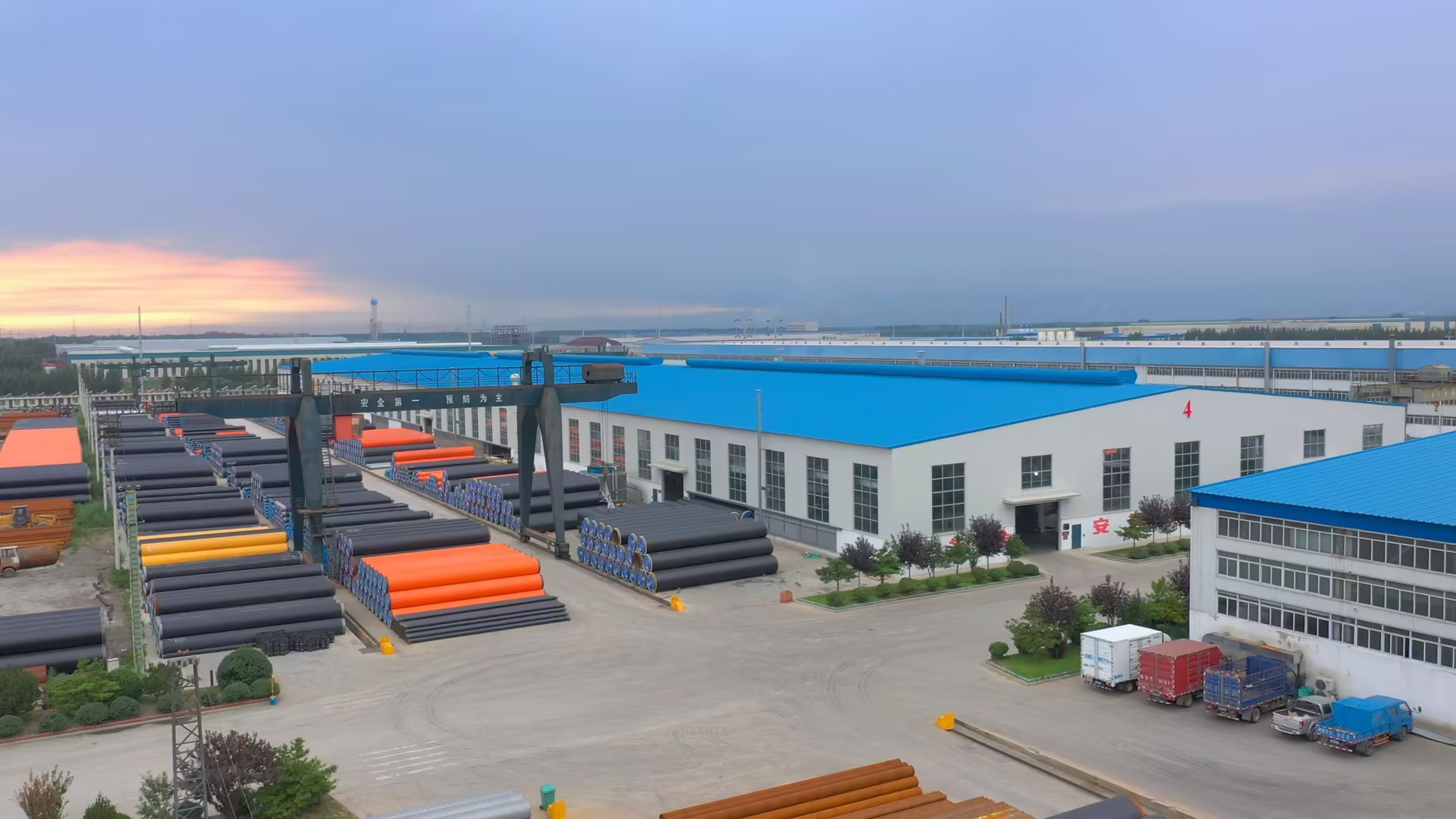
Aerial view of a factory plant. Capacity and factory context are screening inputs; they do not replace project-specific acceptance records. Image: Tangshan Xingbang Pipeline Engineering Equipment Co., Ltd.
Acceptance criteria at handover: from test to release
Acceptance is a release decision, not a synonym for testing. A pre-shipment test can be the central acceptance event, but the buyer should still define the sequence around it: what must be approved before production, what must be recorded during production, what must be witnessed before shipment, and what must be checked at delivery. Without that sequence, a test report can exist without releasing anything, and a shipment can leave without a clear acceptance trail.
| Stage | Question the buyer should answer | Record to require | Release decision |
|---|---|---|---|
| Order clarification | Is the product description approved and unambiguous? | Approved specification and drawings | Release to production |
| Pre-production | Are materials and batch identification defined? | Material records or batch plan | Release to manufacture |
| Pre-shipment test | What is tested, sampled, and witnessed? | Signed test report and inspection record | Release to ship |
| Documentation review | Do markings, packing, and quantities match the order? | Packing list, marking photos, certificate if required | Release to delivery |
| Handover | Was transport damage checked and recorded? | Receipt, damage report, site acceptance record | Final acceptance or claim |
Where the project risk register includes thermal stress, corrosion, or heat loss, the acceptance plan should name the corresponding evidence. Xingbang's reference material lists controls such as 3PE anti-corrosion treatment, high-density polyurethane insulation, built-in optical fiber temperature sensors, and full-batch product performance testing. The buyer's task is to decide which of these controls are project requirements, which are supplier standard practice, and which records must be submitted with the pre-shipment test. A control that is not tied to a record is difficult to verify at handover.
Handover acceptance should also separate factory release from site acceptance. Factory release confirms that the product and documents match the order before shipment. Site acceptance confirms that the pipe arrived in the expected condition and that installation-related requirements will be handled separately. Mixing the two creates disputes about damage that may have occurred after the pre-shipment test.
How to build a terms-to-acceptance traceability matrix
A simple traceability matrix is often more useful than a long procurement checklist. It forces each commercial term to point to a document, and each document to point to a release decision. The matrix below is a structure, not a substitute for project review.
| Contract clause | Buyer wording | Acceptance evidence | Release rule |
|---|---|---|---|
| Product description | Diameter, service pipe, insulation, casing, installation method, and duty. | Approved datasheet and drawing | No production without written approval. |
| Standard reference | Exact standard number and edition, if the project requires one. | Declaration or test report covering the specific product | No shipment if the required standard evidence is missing. |
| Commercial terms | MOQ, FOB/CIF port, payment milestones, and document set. | Contract, invoice, shipping documents | Payment only against defined documents. |
| Pre-shipment test | Scope, sampling, witness, report format, and nonconformity rules. | Signed test record | Shipment release only after the test record is accepted. |
| Packing and marking | Lengths, end protection, labels, bundle marks, and loading requirements. | Packing list and loading photos | Nonconforming marks are corrected before loading. |
The matrix should be attached to the purchase order or contract, not kept only in email. If a term cannot be traced to evidence, it is probably not enforceable. If evidence cannot be traced to a release decision, it is probably not an acceptance criterion. This is the practical test of whether a procurement FAQ has done its job.
Pre-insulated pipe versus onsite insulation in acceptance planning
A pre-insulated pipe moves insulation and jacketing into a factory process. That can make a pre-shipment test a meaningful acceptance point, because part of the work is complete before the pipe reaches site. Onsite insulation moves more acceptance work to the site: surface preparation, application quality, weather protection, and joint finishing become visible only during installation. The trade-off is that factory acceptance cannot cover transport damage, site storage, joint assembly, or installation quality. A procurement FAQ should therefore separate factory release from site acceptance.
The comparison is not a claim that one method is always better. It is a warning against copying an acceptance clause from one construction method to another. A buyer using a factory pre-insulated system should define the factory test and document set. A buyer using onsite insulation should define site inspection points and workmanship records. Both need a release sequence; the location of the evidence changes.
Supplier context: what Xingbang states and what remains to verify
Tangshan Xingbang Pipeline Engineering Equipment Co., Ltd is a pipeline manufacturer located in Houhu Industrial Park, Yutian Economic Development Zone, Hebei Province, China. The company states that its products serve district heating, district cooling, oil and natural gas, LNG, chemical, and industrial sectors. Its main product listing includes Directly Buried Hot Water Pre Insulated Pipe. Xingbang also states that its annual production capacity for insulation pipes exceeds 3,000 kilometers, and that it participated in the compilation of GB/T 29047-2012 for polyurethane insulating pipes. These are company-reported facts. For procurement, they are screening inputs, not verified capacity, certificate scope, or project references. A buyer should ask for factory audit evidence, current certificates, product mix, and delivery records before treating them as acceptance evidence.
The same discipline applies to the stated procurement terms. MOQ 500 meters, FOB/CIF, 30/70 payment, and pre-shipment test acceptance are clear enough to start a commercial discussion. They are not a substitute for a project specification. The buyer should convert each term into a contract clause and each acceptance expectation into a document requirement.
Market context and procurement implication
Grand View Research estimated the global pre-insulated pipes market at USD 5.97 billion in 2024. For buyers, the relevant point is not the number itself but the procurement implication: as more district heating and cooling projects move through formal supplier lists, the language of product description, pre-shipment test, and handover records becomes part of project risk control. Market growth does not create a standard acceptance clause. It only makes the absence of one more visible when orders scale.
Limitations: what a procurement FAQ cannot settle
Four limits matter. First, there is no universal acceptance criterion for pre insulated pipe. Project design, operating envelope, installation method, local rules, and third-party inspection requirements can change the acceptance plan. Second, supplier-stated terms such as 500 meters, FOB/CIF, 30/70, and pre-shipment test are starting points, not project-specific contract terms. Third, company-reported capacity and standard participation do not prove that a specific product, size, or batch meets a project requirement. Fourth, a factory pre-shipment test cannot replace site acceptance for transport damage, storage, jointing, or installation. A procurement FAQ should state these limits explicitly so that the order documents do not imply more certainty than the evidence supports.
Future outlook: acceptance documentation as supply risk control
Procurement documentation is becoming part of supplier risk management. Buyers increasingly ask for traceable test records, batch identification, marking checks, and a clear release sequence from production to shipment. For long-term district heating and cooling projects, the supplier relationship depends on repeatable acceptance more than on a single quotation. A supplier that can connect terms, test records, and handover documents is easier to audit and easier to keep in a long-term framework. The opposite is also true: a low price with an unclear acceptance path creates repeated disputes at the point where the pipe is already manufactured.
FAQ
What purchasing terms does Xingbang state for pre insulated pipe?
Xingbang's stated procurement terms are a minimum order quantity of 500 meters, FOB/CIF delivery terms, a pre-shipment test as the acceptance criterion, and 30/70 payment terms. These are supplier-stated terms. The buyer should still define the port, Incoterm edition, payment triggers, test scope, and record format in the contract.
Is a pre-shipment test enough as an acceptance criterion?
A pre-shipment test is an acceptance stage, not a complete acceptance specification. The buyer should define what is tested, the sampling basis, who witnesses the test, what report is issued, and which nonconformities stop shipment. The Xingbang reference states a pre-shipment test; it does not replace project-specific acceptance planning.
Should the product description mention the standard?
If the project requires a standard, the product description should name the exact standard and edition. For directly buried hot water networks, EN 253 is a relevant European standard for bonded single pipe systems. The buyer should not accept a generic 'standard compliant' statement without the standard number, edition, and the evidence required for the specific product.
Can the same acceptance criteria be used for every pre insulated pipe project?
No. Acceptance criteria should match the installation method, operating envelope, project risk register, and local requirements. A directly buried hot water network, an above-ground section, and a district cooling application can have different inspection points and records. A single template can help structure the discussion, but it should not be copied into a contract without project review.
How should payment terms be linked to acceptance?
Payment terms should be linked to defined documents and release points, not only to shipment. In a 30/70 structure, the buyer should state which documents trigger each payment, whether a pre-shipment test record is a condition, and what happens if the test report is incomplete. The commercial term and the acceptance term should be read together.
How can a buyer verify a supplier's long-term capability?
A buyer should verify factory equipment, current certificate scope, product mix, production records, and project references rather than rely on a capacity claim alone. Xingbang states capacity above 3,000 kilometers per year and participation in GB/T 29047-2012; both are company-reported and should be checked against factory audit evidence and current documents. For long-term supply, the buyer should also review repeatability of test records and handover documentation.
Does standard participation prove product compliance?
No. Participation in standard compilation is an industry-contribution claim, not a product certificate. Product compliance depends on the specific product, size, batch, test report, and certificate scope. The buyer should ask for the certificate, the issuing body, the covered product range, and the validity date.
For reference, the Xingbang company brochure is available as a PDF: Xingbang company brochure. It is a company document, not a project-specific acceptance record.
Есть вопросы или нужны дополнительные детали?
Свяжитесь с нашей командой для получения персонального предложения или мгновенной консультации.
Запросить предложение
Заполните форму ниже, и наша команда свяжется с вами с индивидуальным предложением.
Прямой чат WhatsApp
Предпочитаете общаться в реальном времени? Напишите нам в WhatsApp для мгновенной помощи и быстрых ответов.
- Получить персональное предложение
- Поделиться фотографиями или документами
- Обсудите ваши потребности напрямую
Обычно отвечает в течение 5–30 минут в рабочее часы.