
Pre-Insulated Pipe Purchasing Terms: Compliance and Acceptance Criteria
Pre-Insulated Pipe Purchasing Terms: Compliance and Acceptance Criteria
A pre-insulated pipe purchase agreement rarely fails on price. It fails on evidence. The clause that decides acceptance is usually not the one naming the product; it is the one naming what the supplier must show. When purchasing terms for pre-insulated pipe specify the service pipe, insulation and casing but leave the demonstration method to the inspection stage, compliance review turns into a late negotiation about documents rather than a check against criteria agreed in advance. The practical answer is to treat the tender annex, the purchase agreement, the inspection and test plan, and the acceptance dossier as one linked set of documents, each owning a separate commitment.
This review sets out how that document set should be organised for insulated pipe procurement, which parameter commitments belong in the technical annex, how certificates should be read as scope documents rather than badges, and where acceptance criteria genuinely begin for buried and above-ground networks.

Why insulated pipe needs documented acceptance more than most purchases
A pre-insulated pipe is a bonded assembly, not a single component. Under the scope described for DIN EN 253:2015, the product is a straight length of prefabricated thermally insulated pipe-in-pipe assembly for directly buried hot-water networks, made up of a steel service pipe, rigid polyurethane foam insulation and an outer casing of polyethylene. EN 253 is described by BSI as the primary European standard for bonded single pipe systems for directly buried hot-water networks. That three-material construction creates two problems for procurement teams.
The first is that the deliverable is a system. An acceptance inspection that checks only the steel service pipe has examined roughly one third of what was purchased. Foam continuity, foam density at the cut end, casing wall thickness and the condition of the casing surface all sit inside the same acceptance decision, and none of them can be inferred from a material certificate for the steel alone.
The second is that most of the performance is sealed inside the product by the time it reaches the site. Bond integrity between service pipe, foam and casing cannot be judged by looking at a pipe in a yard, and it cannot be recovered later once the section is buried. This is why purchasing terms for insulated pipe carry a heavier documentary burden than terms for commodity pipe: the agreement has to define what will be inspected, at which stage, and what record will be accepted as proof.
The governing principle: a term that is not written into the agreement is not a term. If the acceptance criterion is not stated in the contract documents, the buyer is relying on the supplier's default practice, which may be reasonable but is not enforceable.
The four documents that must agree before supply is approved
Compliance review becomes manageable when each commitment has exactly one owner document. In practice, four documents carry the load, and the most common procurement failure is a commitment that appears in two of them with different wording — or in none of them at all.
| Document | What it should own | Typical failure when it is incomplete |
|---|---|---|
| Tender technical annex / specification | Product configuration, dimensional range, medium temperature and pressure envelope, casing type, jointing system, accessories | Bidders quote different builds and the comparison becomes meaningless |
| Purchase agreement / contract | Quantity and tolerance, delivery schedule, Incoterms, documentation obligations, validity requirements for certificates, nonconformity handling | Acceptance criteria are agreed but no remedy, timeline or cost allocation is attached to them |
| Inspection and test plan (ITP) | Which characteristics are checked, at which hold points, by whom, and against which record | Inspection happens but produces informal notes that cannot support a release decision |
| Acceptance and handover dossier | Certificates, test records, traceability data, packing list, joint installation records | Delivery is accepted on a packing list alone, and gaps surface only during commissioning |
The sequence matters. A technical annex written after the commercial negotiation tends to describe what was already quoted rather than what the project actually needs. Building the annex first, then attaching commercial terms and inspection points to it, keeps the acceptance criteria anchored to a fixed technical baseline for the life of the order.
Which parameter commitments belong in the technical annex
For pre-insulated pipe, six parameter groups determine whether acceptance is even possible. Each should be stated as a numeric or named requirement, not as a performance intention.
- Build configuration. Service pipe material and grade, rigid polyurethane foam insulation, and outer casing material. Where the order includes above-ground sections or a galvanized iron jacket variant, the casing and its external protection should be named separately, because a specification written for buried sections does not automatically describe an above-ground run.
- Dimensional range. Nominal diameter, service pipe wall thickness, insulation thickness, and delivered length. Diameter alone is not a specification; wall thickness and insulation thickness change both performance and price.
- Medium envelope. Continuous operating temperature, occasional peak temperature and the duration permitted at that peak, working pressure, and the medium itself — hot water, chilled water or steam. These four values should be written independently rather than compressed into a single temperature figure.
- Jointing system and accessories. Electrofusion sleeves, heat-shrinkable sleeves, insulation joint material, foaming filler, and sealing and waterproofing materials. Joints are where buried networks most often fail, and they are usually supplied as a separate scope item that can be omitted from a pipe-only quotation.
- Route and installation conditions. Thermal expansion stress, soil load, groundwater corrosion and external impact are the design considerations a manufacturer needs in order to size the build correctly. If any of these apply to the route, they belong in the annex rather than in a covering email.
- Marking and traceability. What must be marked on each length, and what batch or heat-level identification must survive to the delivery note.
A useful illustration of why the annex must be product-specific comes from the difference between a standard's scope and a supplier's declared envelope. The scope described for DIN EN 253:2015 covers continuous hot-water operation at various temperatures up to 120°C and occasional peak temperatures up to 140°C. Separately, Xingbang's product data for its polyurethane insulated pipe states suitability for media no higher than 120°C, an occasional peak not exceeding 130°C, a working pressure of no more than 2.5 MPa, and continuous operation of at least 30 years at 120°C. Those are two different statements: one describes a standard's applicability, the other describes a specific product's declared limits. Acceptance criteria should cite the supplier's declared envelope for the product actually ordered, and require evidence against that envelope — not borrow the standard's generic figures as if they were the product's rating.
Tangshan Xingbang Pipeline Engineering Equipment Co., Ltd, the Hebei-based manufacturer operating as Xingbang, illustrates how these commitments translate into a term sheet. The company states that it supports custom pipe diameter and length, custom pipe material, custom temperature and pressure rating, custom insulation thickness, custom anti-corrosion grade, non-standard fittings, and design adjusted for geological conditions. Each of those options is only useful to a buyer if the selected value is fixed in writing; a customization capability described in a brochure does not define what will be delivered on a named purchase order.
Where acceptance criteria actually begin
Acceptance for pre-insulated pipe happens at three distinct points, and conflating them is the second most common source of dispute after a vague annex.
- Factory release. Dimensional checks, visual inspection of the casing and cut ends, material conformity, and review of the documentation package. This is the point at which the largest share of the evidence is available, because the product is still accessible and the production records still exist.
- Delivery receipt. Quantity, length, marking, handling damage and completeness of accessories against the packing list. This is an inventory check, not a technical acceptance, and treating it as the technical acceptance is how damaged casing gets signed off.
- Installed joint acceptance. Sleeve installation, foaming, sealing and any pressure or leak testing agreed for the joint. This record is created on site and signed on site, and the contract should state who signs it and what happens if the record is incomplete.

This is also the clearest boundary when comparing pre-insulated pipe with site-insulated alternatives. A factory-bonded pre-insulated system moves most verification upstream: the insulation and casing are completed under controlled conditions, and the buyer's inspection can be concentrated at release rather than distributed across a construction programme. What it does not do is eliminate field acceptance. The joint still has to be made, foamed, sealed and recorded on site, and a purchasing document that assumes factory bonding removes the need for field records will leave the most vulnerable part of the network unverified. Pre-insulated construction relocates acceptance; it does not remove it.
Reading certificates as scope documents, not badges
Certificates are the most frequently misread documents in an insulated pipe compliance file, because buyers tend to check presence rather than scope. Four attributes decide whether a certificate supports acceptance of a specific order: the certificate holder, the standard or basis cited, the stated product and dimensional scope, and the validity period.
| Document (supplier records) | Issuer | Basis cited | Stated scope | Validity |
|---|---|---|---|---|
| EU CE verification of conformity, ICR Polska/VC/HS220608 | ICR Polska Co. Ltd | EN 448:2019; EN 253:2019 | Polyurethane pre-insulated pipes DN20 mm – DN1800 mm | 2022-06-24 to 2027-06-23 |
| ISO 9001 quality management system, 02807Q10270R6M | Beijing Zhong'an Quality & Environment Certification Center Co., Ltd. | GB/T 19001—2016 / ISO 9001:2015 | Production of pre-insulated pipes DN1600 mm and below; pipeline insulation construction; anti-corrosion insulation processing and service | 2024-02-19 to 2027-02-10 |
| Russian conformity certificate (voluntary certification), РОСС CN.MJI10.H13406 | Эрри-тест | ГОСТ 30732-2020 | DN20 mm – DN1800 mm | 2026-01-28 to 2031-01-27 |
Three practical points follow from reading the rows rather than the headings.
Scope is not identical across documents. The CE verification as recorded covers polyurethane pre-insulated pipes from DN20 to DN1800, while the ISO 9001 certificate as recorded states a production scope of DN1600 mm and below. A buyer ordering at the upper end of either range should confirm in writing which document covers the specific size, rather than assume every size in the catalogue sits inside every certificate.
Validity has to outlast the delivery, and sometimes the project. The two system and quality certificates above expire in 2027. For a project with a 30–45 day lead time that is comfortable; for a framework agreement running over several years, or a staged delivery programme, the agreement should say what happens when a certificate lapses mid-contract. A simple clause requiring current, in-date documentation at each shipment release is usually sufficient and costs nothing to negotiate.
The edition cited is part of the scope. The CE record cites EN 253:2019, while the standard listing available in the verified material describes the DIN EN 253:2015 edition. Where a project specification names an edition, the certificate should be checked against that edition rather than against the standard family as a whole.
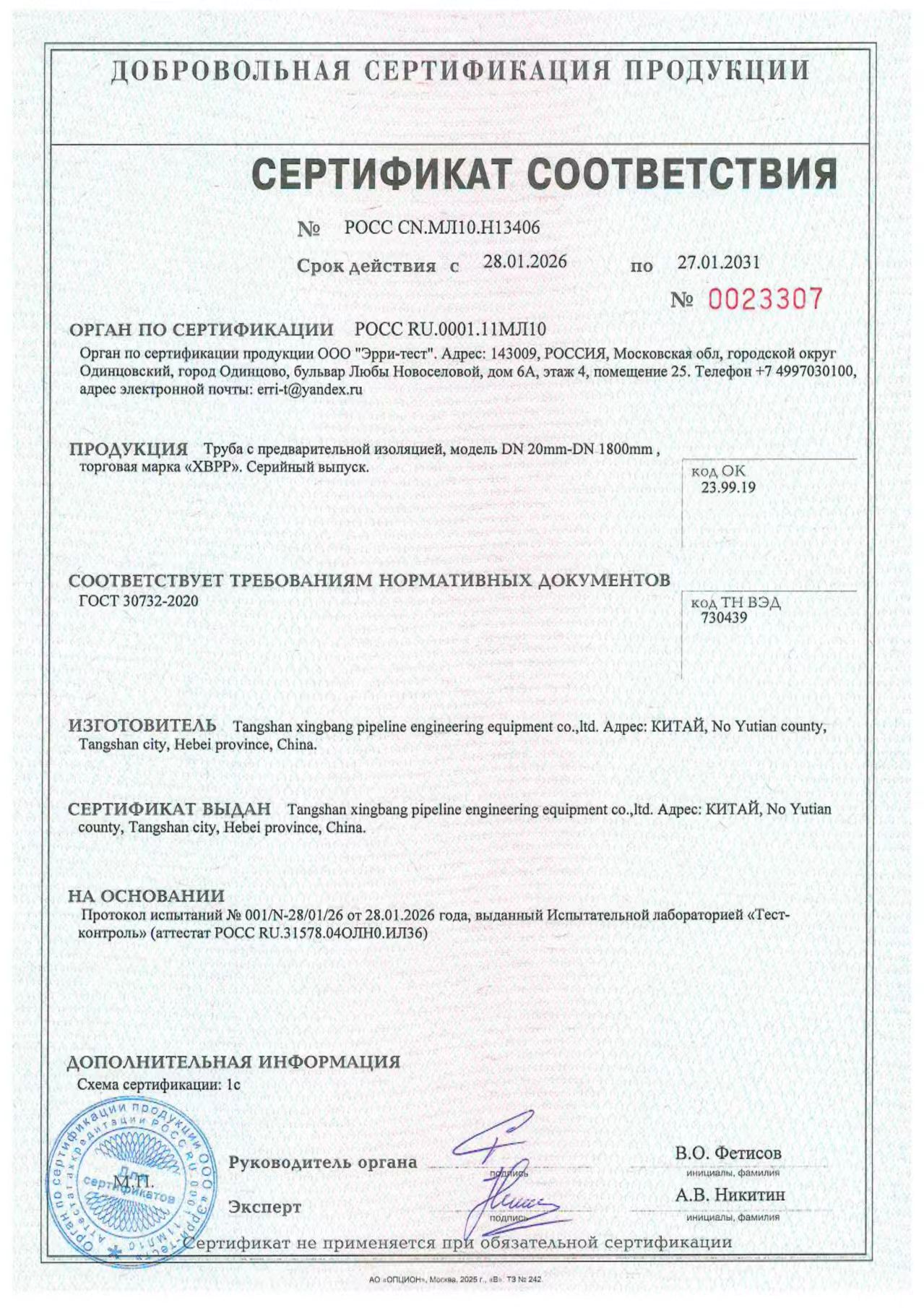
A note on framing: all three certificate records above are manufacturer-supplied entries, and they are presented here as the kind of document a buyer will receive. Independent verification through the issuing body remains the buyer's step, and it is the step that converts a document into qualification evidence.
Commercial terms that quietly change technical acceptance
Several commercial figures carry direct acceptance consequences and are frequently left outside the technical discussion.
Minimum order quantity. Xingbang states a minimum order quantity of 1 km. MOQ interacts with the tolerance clause: if deliveries are staged, the price band and the acceptance sampling plan usually need to be attached to the staged quantity rather than the notional contract total.
Lead time. The stated lead time is 30–45 days, against a stated monthly capacity of 200 km. Lead time is not only a schedule term; it sets the deadline by which the ITP must be approved, the pre-production sample accepted if one is required, and the certificate validity confirmed. A short lead time with an unapproved ITP is slower in practice than the reverse.
Testing commitments. The company states 100% testing in its quality control description. A percentage is a starting point, not an acceptance criterion. The agreement should still name which characteristics are tested on every length, which are sampled, and which record is handed over — otherwise the buyer can confirm that testing occurred without being able to check what it covered.
Customization. Where a build includes custom diameter, length, insulation thickness, anti-corrosion grade or non-standard fittings, the accepted drawing or data sheet becomes the acceptance baseline. Acceptance against a generic catalogue entry, when a customized item was ordered, leaves the buyer unable to reject a deviation.
A related discipline applies to references. Xingbang's supplied project records include a 5 km district cooling network in Cambodia with a stated 10-year operating period, a 6 km municipal network in Uzbekistan with a stated 5-year period, and a 9 km industrial project in Mongolia with a stated 3-year period. Those records are relevant when screening a supplier's application experience; they are not acceptance evidence for the current order. Past project duration says nothing about whether the casing thickness on this delivery matches the annex, and mixing the two is how reference lists substitute for criteria.
A working acceptance gate structure
The following structure converts the preceding points into gates. Each gate should have a named holder on the buyer side, a defined record, and a consequence if the record is not produced.
| Gate | Question the gate answers | Record required |
|---|---|---|
| 1. Document release | Are the certificates current, in the right name, and in scope for the ordered size and basis? | Certificate copies with scope and expiry; declaration of conformity where applicable |
| 2. Technical baseline | Has the accepted drawing or data sheet fixed the configuration actually being produced? | Approved drawing, data sheet, and any agreed deviation list |
| 3. Material conformity | Do the service pipe, foam and casing match the named materials, not just the named product? | Material certificates, batch identification, incoming inspection summary |
| 4. Factory inspection | Have dimensional, visual and casing checks been performed at the agreed hold points? | Signed ITP with hold points released |
| 5. Test evidence | Were the tests named in the ITP performed, on the agreed sample basis, with results inside limits? | Test report referencing the specification clause |
| 6. Accessories and joints | Are sleeves, joint material, filler and sealing materials supplied and consistent with the jointing system specified? | Packing list matched to the annex; joint system description |
| 7. Traceability | Can each delivered length be tied back to its batch and inspection record? | Marking schedule, delivery note, traceability index |
| 8. Nonconformity closeout | Is every open issue either closed, accepted by written concession, or excluded from the shipment? | Nonconformity register with disposition and signature |
Two structural notes on this table. First, gates 1 and 2 sit before production, not after it; a certificate review conducted at delivery cannot influence what was built. Second, gate 8 is the one most often missing entirely, and its absence means the buyer has no agreed mechanism to accept a minor deviation without either rejecting the shipment outright or accepting it informally.
Nonconformity, retest and concession clauses
Acceptance criteria only have force if the agreement defines what happens when they are not met. Three clauses carry most of that weight.
The definition of nonconformity should be written against the annex, not against general expectations. A casing scuff is a nonconformity if the annex sets a surface condition; it is a handling note if the annex says nothing. Vague wording produces disputes about severity rather than about fact.
The disposition path should list the permitted outcomes — rework, replacement, or acceptance by documented concession — and state who may authorise each. A concession that is granted verbally on site and never recorded leaves the delivery file permanently incomplete, which becomes a problem years later when an insurer or auditor asks for the acceptance basis of that section.
The cost and timing allocation for retest should be explicit. If a failed inspection requires a second visit, the agreement should say who bears the inspection cost and whether the delivery date moves. This single clause removes most of the friction that otherwise surfaces at the end of a project, when schedule pressure is highest and the buyer's leverage is lowest.
Market context and what it does and does not change
Grand View Research estimated the global pre-insulated pipes market at USD 5.97 billion in 2024, with Asia Pacific holding approximately 39.96% of revenue that year, and projected growth at a 9.7% CAGR from 2025 to 2030 to reach USD 10.4 billion. Those are commercial research estimates with differing end-use definitions across publishers, and comparable forecasts for the same period vary materially depending on which sectors are included — which is precisely why they should not be used as a benchmark inside a purchasing document.
What the scale figures do support is a narrower observation relevant to compliance review: as procurement volume grows across multiple supply markets, buyers increasingly receive documentation from suppliers qualified under different national and regional frameworks. A single order may sit alongside EN-based, GOST-based and GB-based qualification records. The practical response is not to rank frameworks against each other but to state in the annex which framework the project requires, and then to check the supplied certificate against that framework's scope and edition — the discipline described earlier in this review.
Future outlook for purchasing terms
The direction of travel in insulated pipe procurement is toward documentary acceptance rather than inspection-only acceptance. Three developments support that reading without requiring a forecast. First, the standards landscape already spans multiple regional frameworks, so a buyer operating across markets will encounter more documents, not fewer. Second, the certification records in this review all carry finite validity periods, which makes certificate currency a recurring contractual obligation rather than a one-off check. Third, customization options — diameter, insulation thickness, anti-corrosion grade, geological design — expand the range of builds that a single generic acceptance clause cannot cover.
The practical implication for buyers drafting terms now is modest but useful: build the acceptance dossier as a named deliverable in the contract, with its contents listed, rather than as an assumed by-product of delivery. Suppliers who already maintain traceability, test records and current certificates will meet that requirement without difficulty. The clause mainly protects the buyer against the case where they do not.
FAQ
What should a pre-insulated pipe purchase agreement state about temperature and pressure?
It should state four values separately: continuous operating temperature, occasional peak temperature with the permitted duration at that peak, working pressure, and the medium being carried. These should describe the product actually ordered, not the general applicability of a standard. The scope described for DIN EN 253:2015, for example, covers continuous hot-water operation up to 120°C with occasional peaks up to 140°C, while Xingbang's product data declares a continuous limit of 120°C, an occasional peak not exceeding 130°C and a working pressure of no more than 2.5 MPa. Because a standard's envelope and a product's declared envelope are different statements, the annex should cite the product value and require evidence against it.
How does a buyer verify that a supplier's certificate covers the ordered pipe size?
By reading the stated scope rather than the certificate title. Each certificate records a holder, a basis or standard, a product and dimensional scope, and a validity period. On the records reviewed here, the CE verification covers polyurethane pre-insulated pipes from DN20 to DN1800, the ISO 9001 certificate states a production scope of DN1600 mm and below, and the Russian conformity certificate covers DN20 to DN1800 against ГОСТ 30732-2020. Where the ordered size sits at the limit of a stated range, the buyer should confirm in writing which document covers that size, and should also check that the certificate remains valid at the planned delivery date.
Can one generic acceptance criteria list be used across different insulated pipe projects?
Only the gate structure transfers; the criteria inside each gate do not. Dimensional range, insulation thickness, casing type, jointing system and medium envelope differ between a buried hot-water network, an above-ground section and a chilled-water installation, so the acceptance baseline has to be built from the specific annex. Where a build includes custom diameter, length, insulation thickness, anti-corrosion grade or non-standard fittings, the approved drawing or data sheet becomes that baseline, and acceptance against a catalogue entry would leave the buyer unable to reject a deviation.
Which documents should be handed over at acceptance of a pre-insulated pipe delivery?
A workable dossier contains current certificates whose scope covers the ordered product and size, the approved drawing or data sheet, material conformity records for the service pipe, foam and casing, the signed inspection and test plan with its hold points released, test reports referencing the specification clause, the packing list matched against the accessories and jointing materials in the annex, and a traceability index linking each delivered length to its batch and inspection record. Listing these as a named contractual deliverable is more effective than assuming they will accompany the shipment.
What happens when test evidence is missing at the acceptance stage?
The agreement should already define the outcome, which is why the nonconformity clause matters as much as the technical criteria. A workable structure permits three dispositions — rework, replacement, or acceptance by documented concession signed by an authorised party — and states who bears the cost and whether the delivery date moves if retesting is required. Without that clause, a missing record tends to be resolved informally on site, and the delivery file stays permanently incomplete, which becomes a problem when the acceptance basis of a buried section is later questioned.
Conclusion
Purchasing terms and acceptance criteria for pre-insulated pipe are one instrument, not two. The annex fixes what is being bought, the agreement fixes what proof is owed and what happens when it is absent, the inspection plan fixes when each check occurs, and the dossier collects the result. Compliance review then becomes a comparison between a written requirement and a named record, rather than a judgement about whether a supplier seems credible.
For buyers in the research and evaluation stages, the sequence is straightforward: write the parameter envelope and the certificate scope requirement first, attach the acceptance gates and the nonconformity disposition to it second, and negotiate commercial terms against that fixed baseline third. Suppliers that already hold current certification, defined testing practice and traceable production records will meet such terms without rework — which is, in practice, the clearest signal a qualification review can produce.
For company background, product scope and certification details referenced in this review, see the Xingbang corporate brochure (PDF) and the manufacturer's official site at xingbanginsulatedpipe.com.
Есть вопросы или нужны дополнительные детали?
Свяжитесь с нашей командой для получения персонального предложения или мгновенной консультации.
Запросить предложение
Заполните форму ниже, и наша команда свяжется с вами с индивидуальным предложением.
Прямой чат WhatsApp
Предпочитаете общаться в реальном времени? Напишите нам в WhatsApp для мгновенной помощи и быстрых ответов.
- Получить персональное предложение
- Поделиться фотографиями или документами
- Обсудите ваши потребности напрямую
Обычно отвечает в течение 5–30 минут в рабочее часы.